
 Worksheets
Quantum Physics
Total questions: 105
Worksheet time: 2hrs 36mins
Units of light emitted by a blackbody were originally called _____.
resonators
amperes
bolts
quanta
Which is the true statements regarding absorption spectra?
The wavelengths (and also the frequencies) of the spectrum are characteristic of the element emitting the light.
The wavelength of the spectrum are the same for all elements.
Absorption spectra form bright lines, representing small segments of the spectrum.

Light is shining on a metal, but no photoelectrons are released, which of the following should you do to get electrons?
Use a higher intensity light, but do not adjust the wavelength.
Use a lower intensity light, but do not adjust the wavelength.
Use light of a longer wavelength (lower frequency)
Use light of a shorter wavelength (higher frequency)
Light has a dual nature, therefore it behaves like ____.
A particle
A wave
Both a particle and a wave
Light is shining on a metal, but you want to increase the number of electrons you are producing. Which of the following should you do?
Use a higher intensity light, but do not adjust the wavelength.
Use a lower intensity light, but do not adjust the wavelength.
Use light of a longer wavelength (lower frequency)
Use light of a shorter wavelength (higher frequency)
A photon with a higher frequency also has a higher ______.
intensity
energy
amplitude
period
When high enough frequency of light strikes the surface of a metal, this occurs.
blackbody radiation
energy is created
refraction of light
the photoelectric effect
Which of the following best describes the energy states available to electrons?
Electron's energy states are quantized, meaning they can only be in certain specific amounts.
Electron's energy states are continuous, meaning they can be in any amount they would like.
Electron's energy states are undefinable, meaning we cannot determine their energy.
When photons have the same energy, which other things are the same? Mark 2 correct answers.
The photon's energy.
The photon's wavelength.
The photon's frequency.
The photon's momentum
A beam of electrons has a dual nature, therefore it behaves like ____.
A particle
A wave
Both a particle and a wave
A blackbody emitting __________ light is hottest.
red
yellow
blue
A blackbody emitting __________ light is coolest.
red
yellow
blue
Energy levels available to electrons are ____.
whole number integers - 1, 2, 3, and so on.
half - integer values - 1.5, 2.5, 3.5, and so on.
continuous, they can be any integer value.
Solar cells are examples of the application of which of the following?
blackbody radiation curves.
photoelectric effect.
gyroscopic precession
thermal equilibrium
High intensity light has ______________ photons, while low intensity light has _________ photons.
less / more
more / less
faster / slower
slower / faster
two of the above are correct.
A discreet bundle of electromagnetic energy that is carried in quantized amounts is a(n) _____________.
photon
amplifier
radiator
latent particle
The photoelectrons emitted from the photoelectric effect will have higher velocity if you increase the ____________ of the incoming light.
frequency
intensity
More electrons will be emitted from a metal with the photoelectric effect if the light has a higher __________.
frequency
intensity
How will you prepare for this exam?
Play or study the printed Quizizz
Practice with the Quizlet.
Re-read my worksheets and notes.
Ignore all study materials and sleep with a physics textbook under your pillow.
Watch the discovery channel.
Wave -particle duality is supported by...
electrons behaving as particles with ordinary matter
electrons behaving as waves when travelling through space
the photo electric effect
all of the above
Planck's constant can be found ...
energy of a particle x speed of light / wavelength
energy of a particle x speed of light / frequency of light
energy of a particle x wavelength / speed of light
slope of the cut-off voltage vs frequency graph
10 MeV is equilavent to
1.6 x 10^-19 J
1.6 x 10^-14 J
1.6 x 10^-13 J
1.6 x 10^-12 J
Einsteins' Photoelectric equation can be expressed as
hf = Ek + B where
hf = the energy of the electron
B = the energy of the electron
Ek = work function
none of the above
the minimum frequency for which the photoelectric effect can occur is called the
absolute frequency
cut off frequency
Lyman frequency
threshold frequency
De Broglie equation
relates the momentum of a mass to its wavelength
relates the energy of a mass to its wavelength
relates the frequency of a mass to its wavelength
relates the work function of a mass to its wavelength
All electromagnetic waves...
travel at the speed of light
can be reflected
can exhibit interference
all of the above
When an electron losses energy it ...
transitions from a lower energy level to a higher energy and emits a photon of light
transitions from a higher energy level to a lower energy and emits a photon of light
transitions from a higher energy level to a lower energy and absorbs a photon of light
transitions from a lower energy level to a higher energy and absorbs a photon of light
The energy of an emitted photon can be calculated from ...
Plancks constant x frequency of the photon
h x c / wavelength of the light emitted
the difference in the energy levels
all of the above
Who is responsible for the quantization of energy?
Planck
Einstein
Compton
de Broglie
Heisenberg
Who is responsible for the photoelectric effect?
Planck
Einstein
Compton
de Broglie
Heisenberg
Who is responsible for the wave nature of matter?
Planck
Einstein
Compton
de Broglie
Heisenberg
Who is responsible for the Compton effect?
Planck
Einstein
Compton
de Broglie
Heisenberg
Who is responsible for the uncertainty principle?
Planck
Einstein
Compton
de Broglie
Heisenberg
Who is known as the Father of Quantum Mechanics?
Planck
Einstein
Compton
de Broglie
Heisenberg
Which scientist is from America?
Planck
Einstein
Compton
de Broglie
Heisenberg
The amount of energy an object is allowed to have is...
continuous at the macro level and quantized at the micro level
continuous at both the macro and micro levels
quantized at both the macro and micro levels
quantized at the macro level and continuous at the micro level
Energy at the atomic level (microscopic) can only exist in specific amounts. This is the idea behind...
Quantization of Energy
Photoelectric Effect
Compton Effect
deBroglie Waves
Uncertainty Principle

Which quantum principle describes how solar cells work?
Quantization of Energy
Photoelectric Effect
Compton Effect
deBroglie Waves
Uncertainty Principle
What did Einstein win his Nobel Prize for?
E = mc2
Special Relativity
General Relativity
Photoelectric Effect

Why do we see colors when we look at neon signs?
Electrons are jumping from an excited state to a normal state and giving off energy
Electrons are jumping from a normal state to an excited state and absorbing energy
Electrons are jumping from an excited state to a normal state and absorbing energy
Electrons are jumping from a normal state to an excited state and giving off energy
In a wave, the distance between two crests is called
amplitude
wavelength
frequency
The wave's height from the origin to the crest is called ____.
amplitude
wavelength
frequency
The number of wave cycles to pass a given point per unit of time is called the __________.
amplitude
wavelength
frequency
The SI unit of frequency is the __________.
meter
second
hertz
meter per second
In the speed of light equation, c stands for
frequency
wavelength
the speed of light
Carbon
The Heisenberg Uncertainty Principle said that one cannot know
the speed of light in a vacuum.
the number of energy levels in a very large atom.
both the wavelength and frequency of a photon at the same time.
both the velocity and the position of a particle at the same time.
Dalton's law of multiple proportions
Quantum physics describes:
Nature at the smallest scales of energy levels of atoms and macroatomic particles.
Nature at the biggest scales of energy levels of atoms and subatomic particles.
Nature at the smallest scales of saiyajin levels of atoms and subatomic particles.
Nature at the smallest scales of energy levels of atoms and subatomic particles.

Qubits can:
Store more memory than bits
Store less memory than bits
Which equation is used to calculate the wavelength associated with matter?
c = λν
λ = c/ν
λ = h / mv
λ = ch / E
What do the different parts of the de Broglie equation (λ = h / mv) equal?
h = Planck's constant, m = meters, v = frequency
h = Planck's constant, m = meters, v = velocity
h = Planck's constant, m = mass, v = frequency
h = Planck's constant, m = mass, v = velocity
How did the Heisenberg Uncertainty Principle affect the quantum mechanical model?
You can't know the speed and position of the electron at the same time.
You can know the speed and position of the electron at the same time.
You can't know the mass and charge of an electron at the same time.
You can't know the frequency and wavelength at the same time.
What is the purpose of the Schrödinger's finding?
We can never know exactly where an electron exists.
He defined areas around the nucleus called orbitals where the electron is likely to be found.
We can measure the speed of an electron using different energies of light.
What does it mean to be "quantized"?
The electron's mass is very small.
The electron is actually a wave.
The position & speed of the electron cannot be known at the same time.
The electron is limited to certain positions in the atom because of specific, fixed energy levels.


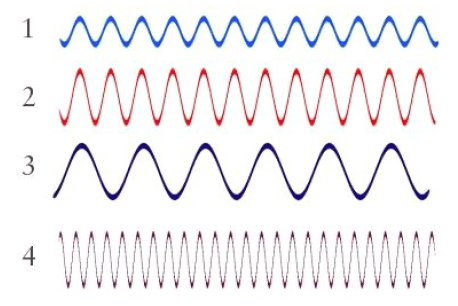


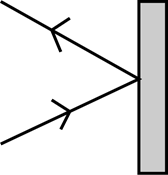
In the illustration, the light ray striking the object is-


How does light energy move?
Longitudinal Waves
Wavelengths
Transverse Waves
Ocean Waves
A wave with a large wavelength will have a ______ frequency and _____ energy
high, low
high, high
low, high
low, low
What is the speed of light?
3.0x10⁸ ms
3.0x10⁸ m/s
6.626x10⁻³⁴ Js
6.626x10⁻³⁴ J/s
The frequency of violet light is 7.5x10¹⁴ Hz. What is its wavelength?
4.0x10⁻⁷ m
4.0x10⁷ m
2.25x10²³m
2.25x10²³ Hz

If short wavelength has more ENERGY than long wavelength, which color Lightsaber is the most dangerous, or powerful?
Red
Orange
Blue
Green

Who coined the term Quanta (plural of quantum)
Albert Einstein
Thomas Young
Max Planck
Robert Millikan
The wave function of the particle lies in which region?
x > 0
x < 0
0 < X < L
x > L
The Energy of the particle is proportional to __________
n
n-1
n2
n-2
Heisenberg’s uncertainty principle is
ΔE⋅Δx≥4πh
ΔE⋅Δp≥4πh
Δp⋅Δx≥4πh
Δp⋅Δt≥4πh
Schrodinger Wave equation can be derived from Principles of Quantum Mechanics.
True
False
Which subatomic particle is negatively charged?
proton
neutron
electron
quark
Photoelectrons will be ejected from a material surface if?
The threshold frequency is greater than the photon frequency
The work function is less than the photon energy
The intensity of light is high enough
The wavelength of photon is maximum
A monochromatic light beam with a quantum energy of 9.0 eV is incident upon a photocell. The work function of the photocell is 4.1 eV. What is the maximum kinetic energy of the electron.
4.2 eV
4.4 eV
4.7 eV
4.9 eV
It is the science that studies matter and its motion.
Physics
Chemistry
Biology
Psychology
It is a branch of physics that includes various areas of study based on quantum theory which deals with matter and electromagnetic radiation, and the interactions between them.
Optics
Nuclear Physics
Thermodynamics
Quantum Physics

He is the one who created the principle of gravity.
Isaac Newton (1643-1727)
Galileo Galilei (1564-1642)
Albert Einstein (1879-1955)
James Clerk Maxwell (1831-1871)

He is the one who invented the telescope.
Isaac Newton (1643-1727)
Galileo Galilei (1564-1642)
Albert Einstein (1879-1955)
James Clerk Maxwell (1831-1871)

He is a famous revolutionary scientist who discovered relativity, quantum mechanics and gravitation.
Isaac Newton (1643-1727)
Galileo Galilei (1564-1642)
Albert Einstein (1879-1955)
James Clerk Maxwell (1831-1871)

He is the one who discovered the theory of electromagnetism.
Isaac Newton (1643-1727)
Galileo Galilei (1564-1642)
Albert Einstein (1879-1955)
James Clerk Maxwell (1831-1871)

She is the first ever female scientist to win a Nobel Prize for discovering radioactivity.
Paul Dirac (1902-1984)
Richard Feynman (1918-1988)
Marie Curie (1867-1934)
Michael Faraday (1791-1867)

He discovered the electromagnetic induction and the laws of electrolysis.
Paul Dirac (1902-1984)
Richard Feynman (1918-1988)
Marie Curie (1867-1934)
Michael Faraday (1791-1867)
It is a branch of physics that deals with the behavior of objects and systems in response to various forces.
Classical Physics
Mechanics
Thermodynamics
Physics
Relativity

