wayground logo

Free Printable Worksheets

Font size

S
M
L
XL
Worksheets

Magnetic Materials

Total questions: 85

Worksheet time: 1hrs 1mins

Name
Class
Date
1.

The area around a magnet is called the .....

a)

attraction zone

b)

work area

c)

magnetic field

d)

hot zone

2.

What would happen is a north pole of a magnet came close to a north pole of another magnet?

a)

they would be attracted to each other

b)

they would be repelled from each other

3.

Where is the the pushing or pulling force of a magnet strongest?

a)

In the middle of the magnet

b)

At the ends of the magnet

c)

Same all the way through the magnet

d)

none of them

4.

What happens if you hold the south pole of one magnet close to the north pole of another magnet?

a)

They will attract each other

b)

They will repel each other

c)

They will grow very hot

d)

Nothing will happen

5.
What subatomic particle causes magnetism in an atom? 
a)
protons
b)
neutrons
c)
electrons
d)
nucleus
6.

How is Earth's magnetic field similar to that of a magnet?

a)

It's shaped like a horseshoe.

b)

It has north and south poles.

c)

It is made plastic.

d)

It is hundreds of miles long.

7.
This is a picture of a simple electromagnet. How can the electromagnet be made stronger?
a)
Add more coils of wire to the nail.
b)
Use a smaller battery.
c)
Reverse the poles of the magnet.
d)
Remove all the coils and the nail.
8.

Why does a compass needle point north?

a)

Because it is being attracted to the Magnetic South Pole

b)

Because north is up

c)

Because it is being attracted to the Magnetic North Pole

d)

Because north is down

9.
A magnet cannot not move which of the following objects?
a)
a paper clip
b)
a nail
c)
a toothpick
d)
a staple
10.
Magnetic force between two magnets gets weaker the more ________________ between them.
a)
distance
b)
attraction
c)
metal
d)
lightsabers
11.

A group of atoms that has all like poles pointing in the same direction are called

a)

magnetic forces

b)

magnetic fields

c)

magnetic domains

d)

magnetic poles

12.

The place on a magnet where the force it exerts is the strongest is called

a)

a magnetic pole

b)

a magnetic field line

c)

a domain

13.

What is the magnetic attraction or repulsion of a magnet called?

a)

the magnetic domain

b)

the magnetic field

c)

the magnetic pole

d)

the magnetic force

14.

Which type of magnet loses magnetism outside of a magnetic field?

a)

a strong magnet

b)

a temporary magnet

c)

a permanent magnet

d)

an electromagnet

15.

Which type of magnet does not lose it's magnetic properties easily.

a)

a permanent magnet

b)

an electromagnet

c)

a temporary magnet

d)

a nail rubbed across the north pole of a magnet

16.

Paper clips and staples are attracted to magnets because paper clips and staples are

a)

permanent magnets

b)

temporary magnets

c)

magnetic materials

d)

magnetic domains

17.

What are the two magnetic forces?

a)

attraction

b)

equilibrium

c)

magnetic acceleration

d)

repulsion

18.
Magnetic field lines are closet together at the __________.
a)
poles
b)
lines
19.
Earth's magnetic poles are in the same place as the geographic poles.
a)
True
b)
False
20.

The entire region surrounding a magnet is known as the:

a)

Magnetic Domain

b)

Lodestone

c)

A Compass

d)

Magnetic Field

21.

Which metal can be attracted to magnets?

a)

Copper

b)

Aluminum

c)

Iron

d)

Gold

22.
What will happen when these magnets are brought close together?
a)
They will attract each other.
b)
They will repel each other.
c)
Both magnets will turn to the left
d)
Both magnets will turn to the right
23.
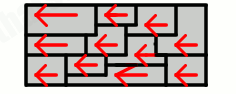
You know this substance is magnetized because
a)
all the domains have right angles
b)
the arrows are drawn in red
c)
the domains are aligned
d)
the domains are random
24.

All metals are attracted to magnets

a)

True

b)

False

25.
How is Earth's magnetic field similar to that of a magnet?
a)
It is hundreds of miles long
b)
It has north and south poles
c)
It is made in Earth's core
d)
It is shaped like a horseshoe
26.
If two magnets come together what is it called?
a)
Repel
b)
Force
c)
Attract
d)
None of the Above
27.
This substance is
a)
magnetizecd
b)
unmagnetized
c)
positively charged
d)
negatively charged
28.
A child puts two magnetic toy trains next to each other on a track. What will happen next, and why?
a)
The trains will not move.
b)
The trains will move away from each other.
c)
The trains will move closer to each other.
d)
Not enough information.
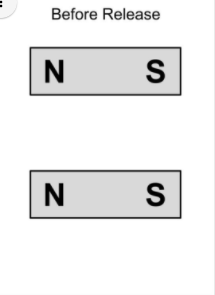
29.
Which way will the magnets move after they are released?
a)
Towards each other
b)
Away from each other
c)
Not enough information
30.
A(n) __________ is a device that has a magnetized needle that can spin freely.
a)
Compass
b)
Magnetic Field
31.

Are the magnetic field lines in the picture correct?

a)

Yes, because they point from north to south.

b)

No, because they point from north to south (they're supposed to go the other way).

c)

Yes, because the North pole is on the left in all pictures.

d)

No, because the North pole is on the left in all pictures (it's supposed to be on the right).

32.

Looking at the field lines in this picture, these two magnets are ________

a)

Attracting

b)

Repelling

c)

Attracting and Repelling

d)

Doing nothing

33.

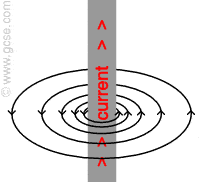
What is the shape of a magnetic field around a wire?
a)
b)
c)
d)
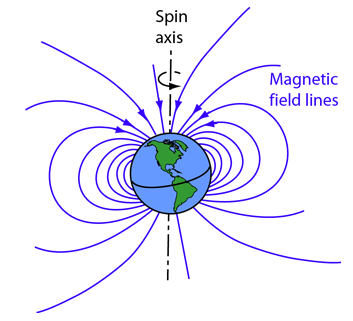
34.

What is the shape of a magnetic field around the Earth?

a)
b)
c)
d)
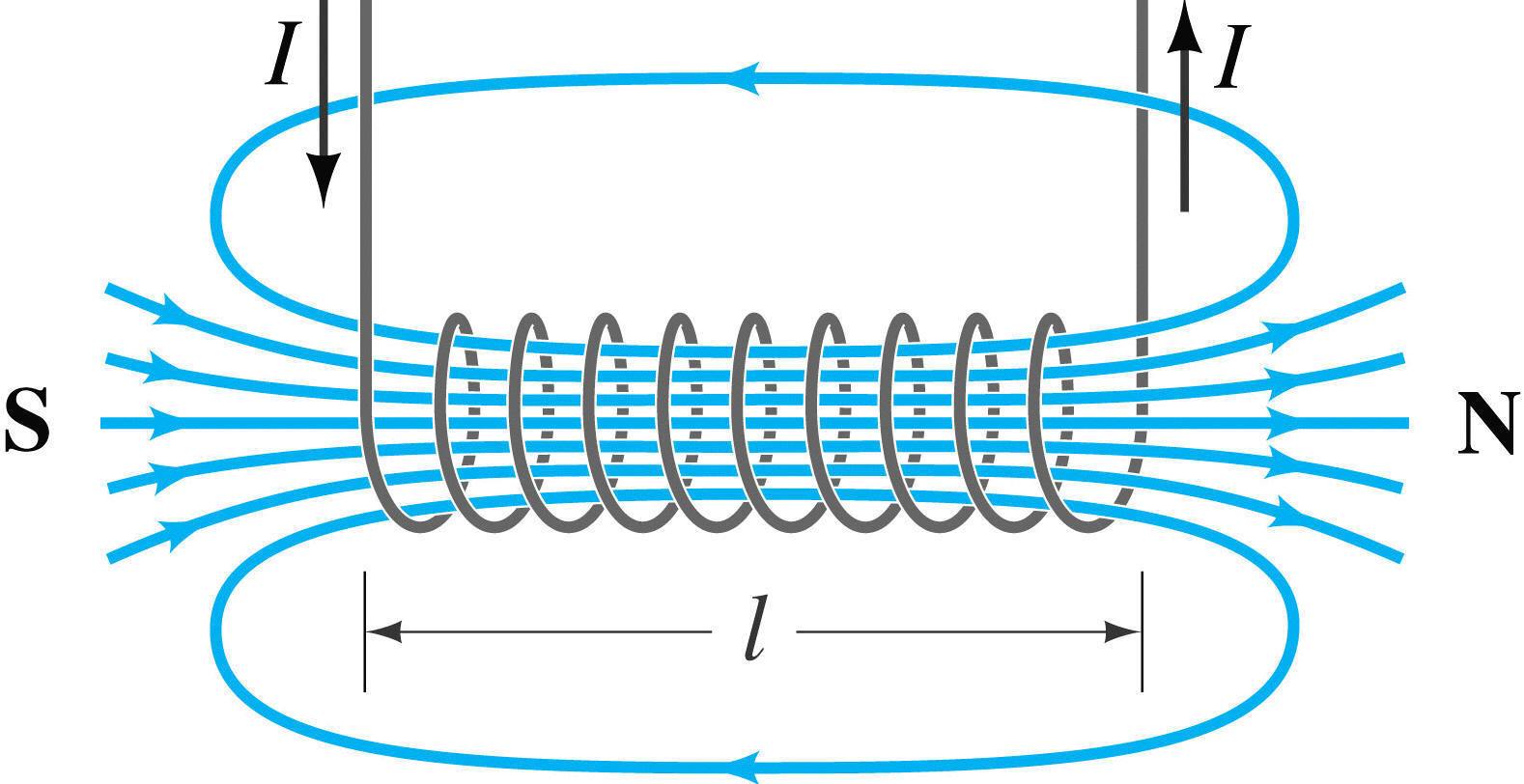
35.

What is the shape of a magnetic field around a solenoid?

a)
b)
c)
d)
36.

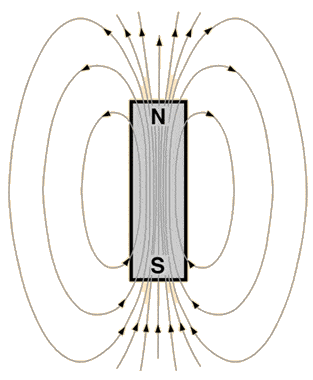
What is the shape of a magnetic field around a bar magnet?

a)
b)
c)
d)
37.
How are electromagnets different from magnets?
a)
magnets can be turned on/off
b)
you can turn an electromagnet on/off
c)
magnets are more powerful
d)
magnets have a North and South pole
38.
______________is a measure of the amount of flux in a magnetic field.
a)
Magnetic flux density
b)
Magnetic flux 
c)
ferromagnetic metal
d)
Field strength
39.
The magnetic field is made up of lines of called ______________
a)
Magnetic flux density
b)
Magnetic flux
c)
ferromagnetic metal
d)
Field strength
40.
As field intensity increases, magnetic flux density:
a)
decreases
b)
is stable
c)
is not related
d)
increases
41.
Tesla is a unit of
a)
field strength
b)
inductance
c)
flux density
d)
flux
42.
Ferrites are materials.
a)
paramagnetic
b)
diamagnetic
c)
ferromagnetic
d)
none of the above
43.
A material which is slightly repelled by a magnetic field is known as
a)
ferromagnetic material
b)
diamagnetic material
c)
paramagnetic material
d)
conducting material
44.
When an iron piece is placed in a magnetic field
a)
the magnetic lines of force will bend away from their usual paths in order to go away from the piece
b)
the magnetic lines of force will bend away from their usual paths in order to pass through the piece
c)
the magnetic field will not be affected
d)
the iron piece will break
45.
Fleming’s left hand rule is used to find
a)
direction of magnetic field due to current carrying conductor
b)
direction of flux in a solenoid
c)
direction of force on a current carrying conductor in a magnetic field
d)
polarity of a magnetic pole
46.
The ratio of intensity of magnetisation to the magnetization force is known as
a)
flux density
b)
susceptibility
c)
relative permeability
d)
none of the above
47.
The left hand rule correlates to
a)
current, induced e.m.f. and direction of force on a conductor
b)
magnetic field, electric field and direction of force on a conductor
c)
self induction, mutual induction and direction of force on a conductor
d)
current, magnetic field and direction of force on a conductor
48.
Magnetising steel is normals difficult because
a)
it corrodes easily
b)
it has high permeability
c)
it has high specific gravity
d)
it has low permeability
49.
The unit of relative permeability is
a)
henry/metre
b)
henry
c)
henry/sq. m
d)
it is dimensionless
50.
The force between two long parallel conductors is inversely proportional to
a)
radius of conductors
b)
current in one conductor
c)
product of current in two conductors
d)
distance between the conductors
51.
Materials subjected to rapid reversal of magnetism should have
a)
large area of B-H loop
b)
high permeability and low hysteresis loss
c)
high coercivity and high retentivity
d)
high coercivity and low density
52.
The use of permanent magnets is not made in
a)
magnetoes
b)
energy meters
c)
transformers
d)
loud-speakers
53.
Paramagnetic materials have relative permeability
a)
slightly less than unity
b)
equal to unity
c)
slightly more than unity
d)
equal to that ferromagnetic materials
54.
Substances which have permeability less than the permeability of free space are known as
a)
ferromagnetic
b)
paramagnetic
c)
diamagnetic
d)
bipolar
55.
In the left hand rule, forefinger always represents
a)
voltage
b)
current
c)
magnetic field
d)
direction of force on the conductor
56.
Which of the following is a ferromagnetic material?
a)
Tungsten
b)
Aluminium
c)
Copper
d)
Nickel
57.
Reciprocal of permeability is
a)
reluctivity
b)
susceptibility
c)
permittivity
d)
conductance
58.
The relative permeability is less than unity is case of
a)
ferromagnetic materials
b)
ferrites
c)
non-ferrous materials
d)
diamagnetic materials
59.
Which of the following is the unit of magnetic flux density?
a)
weber
b)
lumens
c)
tesla
d)
none of the above
60.
The magnetism left in the iron after exciting field has been removed is known as
a)
permeance
b)
residual magnetism
c)
susceptance
d)
reluctance
61.
One telsa is equal to
a)
1 Wb/mm2
b)
1 Wb/m
c)
1 Wb/m2
d)
1 mWb/m2
62.
Susceptibility is positive for
a)
non-magnetic substances
b)
diamagnetic substances
c)
ferromagnetic substances
d)
none of the above
63.
The unit of flux is the same as that of
a)
reluctance
b)
resistance
c)
permeance
d)
pole strength
64.
The retentivity (a property) of material is useful for the construction of
a)
permanent magnets
b)
transformers
c)
non-magnetic substances
d)
electromagnets
65.
The relative permeability of materials is not constant.
a)
diamagnetic
b)
paramagnetic
c)
ferromagnetic
d)
insulating
66.
Which of the following are ferromagnetic materials?
a)
iron
b)
cobalt
c)
nickel
d)
ALL OF THESE
67.
Magnetite is a natural permanent magnet.
a)
True
b)
False
68.
This is an example of...
a)
a permanent magnet
b)
a temporary magnet
69.
ALUMINUM
Magnetic or
Non-Magnetic?
a)
magnetic
b)
non-magnetic
70.
GLASS
Magnetic or Non-Magnetic?
a)
magnetic
b)
non-magnetic
71.
NICKEL
Magnetic or
Non-Magnetic?
a)
magnetic
b)
non-magnetic
72.

To pull toward each other

a)

Attract

b)

Repel

c)

Pole

d)

Magnet

73.

Compass

a)

An instrument that uses a free-rotating magnetic needle to show direction

b)

An instrument that measures the force upon and object

c)

An instrument that determines the amount of mass an object has.

d)

An instrument that measures the speed of an object.

74.

An attractive force between objects, like between Earth and objects on Earth

a)

Magnetic Force

b)

Gravitational Force

c)

Electrical Force

d)

Planetary Force

75.

Induced magnetism

a)

An object that responds to magnetic force

b)

An area of magnetic influence around a magnet

c)

The influence of a magnetic field on iron, which makes the iron a temporary magnet

d)

A property of certain kinds of materials that causes them to attract iron or steel

76.

An object that responds to magnetic force

a)

Magnetic field

b)

Magnet

c)

Compass

d)

Gravitational force

77.

An object that sticks to iron

a)

Attract

b)

Repel

c)

Magnet

d)

Repel

78.

Magnetic field

a)

A piece of iron that behaves like a magnet only when it is under the influence of an external magnetic field

b)

A property of certain kinds of materials that causes them to attract iron or steel

c)

Energy that matter has because of its position

d)

An area of magnetic influence around a magnet

79.

The end of a magnet

a)

Pole

b)

Permanent magnet

c)

Repel

d)

Compass

80.

Potential energy

a)

A property of certain kinds of materials that causes them to attract iron or steel

b)

The energy of movement

c)

Energy that matter has because of its position

d)

An area of magnetic influence around a magnet

81.

To push away from each other

a)

Repel

b)

Attract

c)

Pole

d)

Magnetic field

82.

group of atoms in a magnetic material in which the magnetic poles of the atoms are aligned in the same direction

a)

magnetic domain

b)

magnetic field

c)

magnetic pole

d)

electromagnetic induction

83.
If you cut a magnet in half, what happens to the poles?
a)
One half gets the North Pole, the other half gets the South Pole
b)
Both halves get only a North Pole
c)
Both halves get only a South Pole
d)
Both halves get a North pole and a South Pole
84.
A refrigerator magnet is an example of a:
a)
magnetic material
b)
permanent magnet
c)
horseshoe magnet
d)
temporary magnet
85.
In un-magnetized materials the domains are __________ aligned.
a)

super

b)
slightly
c)
randomly
d)
always