
 Worksheets
Properties of Materials Quiz
Total questions: 90
Worksheet time: 45mins
Which property of a body allows it to regain its original size and shape when the applied force is removed?
Elasticity
Plasticity
Rigidity
Flexibility
What is the deformation called when a body regains its original shape after the force is removed?
Elastic deformation
Plastic deformation
Permanent deformation
Temporary deformation
If a lump of putty or mud does not regain its previous shape after force is applied, what property does it exhibit?
Plasticity
Elasticity
Rigidity
Flexibility
Suppose you are designing a bridge. Which property of the materials would be most important to consider for its ability to regain shape after being loaded?
Elasticity
Plasticity
Density
Transparency
When a helical spring is stretched and then released, what happens to its length?
It regains its original length
It becomes permanently longer
It breaks
It melts
Which of the following substances are close to ideal plastics?
Putty and mud
Steel and iron
Glass and brass
Rubber and wood
Why might an engineer choose a particular shape for a railway track?
To optimize strength and durability
To make it look attractive
To reduce the cost of construction
To make it lighter
What is the main focus of Chapter Eight in the provided material?
Mechanical properties of solids
Chemical properties of liquids
Thermal properties of gases
Electrical properties of metals
What is the SI unit of stress?
Newton (N)
Joule (J)
Pascal (Pa)
Watt (W)
Which formula represents the magnitude of stress?
F + A
F/A
F × A
F - A
When equal and opposite deforming forces are applied parallel to the cross-sectional area of a cylinder, what type of stress is developed?
Tensile stress
Hydraulic stress
Shearing stress
Volumetric stress
If a cylinder is compressed under the action of applied forces, what is the restoring force per unit area called?
Tensile stress
Compressive stress
Shearing stress
Hydraulic stress
A solid sphere placed in a fluid under high pressure experiences which type of stress?
Tensile stress
Shearing stress
Hydraulic stress
Longitudinal stress
Shearing strain is defined as:
ΔL/L
ΔV/V
Δx/L
F/A
Which of the following best describes the change in length of a body under tensile stress?
The body shortens
The body elongates by ΔL
The body rotates
The body compresses uniformly
How is volume strain defined in terms of change in volume and original volume?
Volume strain = ΔV / V
Volume strain = V / ΔV
Volume strain = ΔL / L
Volume strain = L / ΔL
According to Hooke's Law, how are stress and strain related for small deformations?
Stress is proportional to strain
Stress is inversely proportional to strain
Stress is equal to strain squared
Stress is unrelated to strain
What is the proportionality constant in Hooke's Law known as?
Modulus of elasticity
Yield strength
Ultimate tensile strength
Fracture point
What is the yield point in a stress-strain curve?
The point where the material begins to deform permanently
The point where the material fractures
The point where stress and strain are not proportional
The point where the material returns to its original shape
What is meant by plastic deformation in the context of a stress-strain curve?
The material does not regain its original dimension after the load is removed
The material returns to its original shape after the load is removed
The material fractures immediately after being loaded
The material remains elastic under all conditions
What does the ultimate tensile strength (σₜ) of a material represent?
The maximum stress a material can withstand before fracture
The stress at which the material begins to deform elastically
The stress at which the material returns to its original shape
The stress at which the material becomes brittle
How can you distinguish between brittle and ductile materials using a stress-strain curve?
Brittle materials have fracture points close to ultimate strength; ductile materials have them far apart
Brittle materials have a large permanent set; ductile materials have none
Brittle materials obey Hooke's law throughout; ductile materials do not
Brittle materials have a higher modulus of elasticity than ductile materials
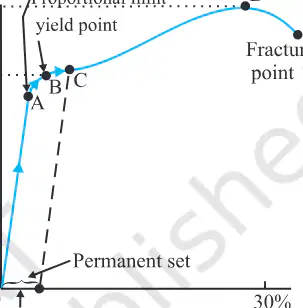
Which point on the stress-strain curve represents the ultimate tensile strength of the material?
Point D
Point B
Point C
Point E
Which term is used to describe substances like tissue of aorta and rubber that can be stretched to cause large strains?
Elastomers
Polymers
Metals
Ceramics
What is the symbol used to denote Young’s modulus?
Y
E
σ
ε
Which of the following materials has the highest Young’s modulus according to Table 8.1?
Steel
Aluminium
Copper
Polystyrene
What is the unit of Young’s modulus?
N m⁻² or Pascal (Pa)
kg m⁻³
N m
Joule (J)
According to the text, what is the proportional region within the elastic limit of the stress-strain curve called?
Modulus of elasticity
Yield strength
Ultimate strength
Plastic region
Which statement best describes the stress-strain behavior of the elastic tissue of aorta as shown in the diagram?
The material can undergo large strains without a well-defined plastic region.
The material follows Hooke’s law throughout the entire region.
The material cannot be stretched beyond its original length.
The material has a very low elastic limit.
If a material has a Young’s modulus of 200 × 10⁹ N m⁻² and an ultimate strength of 400 × 10⁶ N m⁻², which material is it most likely to be from Table 8.1?
Steel
Copper
Aluminium
Glass
Which equation correctly represents Young’s modulus in terms of stress and strain?
Y = σ / ε
Y = F / A
Y = ε / σ
Y = F × L / A × ΔL
Which material listed in Table 8.1 has the lowest Young’s modulus?
Polystyrene
Bone
Wood
Concrete
What is the Young's modulus of structural steel as mentioned in the text?
2.0 x 10¹¹ N m⁻²
1.1 x 10¹¹ N m⁻²
9.0 x 10¹⁰ N m⁻²
1.5 x 10¹¹ N m⁻²
Which material is described as being more elastic than copper, brass, and aluminium?
Steel
Wood
Concrete
Glass
If a steel rod has a radius of 10 mm and a length of 1.0 m, and a 100 kN force stretches it, what is the stress produced in the rod?
3.18 x 10⁸ N m⁻²
1.59 x 10⁻³ N m⁻²
2.0 x 10¹¹ N m⁻²
1.1 x 10¹¹ N m⁻²
Given a copper wire of length 2.2 m and a steel wire of length 1.6 m, both of diameter 3.0 mm, connected end to end, and stretched by a load resulting in a net elongation of 0.70 mm, what is the load applied?
1.8 x 10² N
2.5 x 10² N
1.1 x 10² N
2.0 x 10² N
A human pyramid in a circus has a performer lying at the bottom with a mass of 60 kg. If the combined mass of all persons and equipment is 280 kg, and each thighbone has a length of 50 cm and an effective radius of 2.0 cm, what concept is being tested when determining the amount by which each thighbone gets compressed under the extra load?
Application of stress and strain in biological systems
Calculation of Young's modulus for metals
Determining the density of bones
Measuring the elasticity of circus equipment
A human pyramid in a circus has a performer lying at the bottom with a mass of 60 kg. If the combined mass of all persons and equipment is 280 kg, and each thighbone has a length of 50 cm and an effective radius of 2.0 cm, what concept is being tested when determining the amount by which each thighbone gets compressed under the extra load?
Stress and strain in materials
Conservation of momentum
Thermal expansion
Simple harmonic motion
What is the SI unit of shear modulus?
Nm² or Pa
kg/m³
N/m
J/kg
Which material listed in Table 8.2 has the highest shear modulus?
Steel
Tungsten
Nickel
Copper
What is the formula for shear modulus (G) in terms of shearing stress and shearing strain?
G = (F/A)/(Δx/L)
G = (F × L)/(A × Δx)
G = (F/A)/θ
G = (F × Δx)/(A × L)
If the Young’s modulus for bone is 9.4 × 10⁹ Nm⁻², what is the approximate compression in each thighbone (ΔL) when a force of 1078 N is applied, given the length is 0.5 m and the cross-sectional area is 1.26 × 10⁻³ m²?
4.55 × 10⁻⁵ m
1.26 × 10⁻³ m
9.4 × 10⁹ m
2.0 × 10⁻² m
Which statement best describes the modulus of rigidity?
It is the ratio of shearing stress to shearing strain.
It is the ratio of tensile stress to tensile strain.
It is the ratio of compressive stress to compressive strain.
It is the ratio of force to area.
A square lead slab of side 50 cm and thickness 10 cm is subject to a shearing force of 9.0 × 10⁴ N. If the lower edge is riveted to the floor, how much will the upper edge be displaced?
0.16 mm
1.6 mm
16 mm
0.016 mm
Given the formula for shearing strain is (Δx/L) = Stress/G, what is the displacement Δx if Stress = 1.8 × 10⁶ N m⁻², L = 0.5 m, and G = 5.6 × 10⁹ N m⁻²?
1.6 × 10⁻⁴ m
5.6 × 10⁹ m
0.5 m
1.8 × 10⁶ m
For most materials, how is the shear modulus (G) related to Young’s modulus (Y)?
G ≈ Y/3
G ≈ Y/2
G ≈ 2Y
G ≈ 3Y
What does the diagram illustrate?
Shearing of a slab due to applied force
Compression of a rod
Expansion of a gas
Rotation of a wheel
Which of the following best defines bulk modulus?
The ratio of tensile stress to longitudinal strain
The ratio of hydraulic stress to hydraulic strain
The ratio of shear stress to shear strain
The ratio of force to area
What is the SI unit of bulk modulus?
Pascal (Pa) or N/m²
Joule (J)
Meter (m)
Watt (W)
Which material listed in Table 8.3 has the highest bulk modulus?
Aluminium
Nickel
Copper
Steel
According to Table 8.3, which of the following has the lowest bulk modulus?
Water
Air (at STP)
Mercury
Glass
What does a negative sign in the bulk modulus equation indicate?
An increase in pressure causes an increase in volume
An increase in pressure causes a decrease in volume
A decrease in pressure causes a decrease in volume
Pressure and volume are unrelated
What is the reciprocal of bulk modulus called?
Young's modulus
Shear modulus
Compressibility
Rigidity
Which type of stress results in a volume change but not a shape change, as shown in Table 8.4?
Tensile stress
Shearing stress
Hydraulic stress
Compressive stress
Based on Table 8.4, which elastic modulus is associated with pure shear strain?
Young's modulus
Bulk modulus
Shear modulus
Compressibility
Why are bulk moduli for solids much larger than for liquids and gases?
Solids have higher density
Solids resist volume change more than liquids and gases
Solids have lower compressibility
Solids have higher temperature
Which state of matter can exhibit bulk modulus according to Table 8.4?
Only solids
Only liquids
Only gases
Solids, liquids, and gases
Which state of matter is the least compressible?
Solid
Liquid
Gas
Plasma
What is the bulk modulus of water given in the example?
2.2×10⁹Nm−2
3.0×10⁷Nm−2
1.36 × 10^{-2} N m^{-2}
10 × 109 N m^{-2}
Poisson’s ratio is defined as the ratio of which two strains?
Longitudinal strain to lateral strain
Lateral strain to longitudinal strain
Stress to strain
Volume strain to pressure strain
For steels, the value of Poisson’s ratio is typically between:
0.10 and 0.20
0.28 and 0.30
0.33 and 0.40
0.50 and 0.60
Which formula represents the elastic potential energy per unit volume of a stretched wire?
u = 1/2 × stress × strain
u = stress / strain
u = strain / stress
u = 2 × stress × strain
A wire of original length L and cross-section A is subjected to a deforming force F along the length of the wire. If the wire is elongated by l, which equation gives the work done in stretching the wire?
W=LYA×l2
W = YA/L × l
W=LYA×l3
W = YA/L×l4
If the original diameter of a wire is d and the contraction under stress is Δd, what is the lateral strain?
Δd/d
d/Δd
ΔL/L
L/ΔL
What is the fractional compression ΔV/V of water at the bottom of the Indian Ocean, given the pressure exerted is 3×10⁷Nm−2 and the bulk modulus is 2.2×10⁹Nm−2 ?
1.36 × 10^-2 or 1.36%
2.2 × 10^-2 or 2.2%
3×10⁻² or 3%
10 × 10^{-2} or 10%
What is the minimum area of cross-section (A) required for a steel rope to lift a load without permanent deformation, given the yield strength (σ) and the load (Mg)?
A = W/σy = Mg/σy
A = W × σy
A = σy/Mg
A = Mg × W
If a steel rope has a yield strength of 300 × 10⁶ N m⁻² and is used to lift a load of 10 tonnes, what is the approximate radius of the rope required?
1 cm
10 cm
0.1 cm
5 cm
Why is a thicker rope of radius about 3 cm recommended for lifting heavy loads?
To increase the flexibility of the rope
To ensure safety by providing a factor of ten in the load
To reduce the cost of the rope
To make the rope lighter
What is the formula for the sag (δ) of a beam loaded at the centre and supported near its ends?
δ = Wl³/(4bd³Y)
δ = Wl/(4bd³Y)
δ = Wl³/(4bdY)
δ = Wl³/(4b³dY)
Which variable in the sag formula δ = Wl³/(4bd³Y) should be minimized to reduce bending for a given load?
l (length)
b (breadth)
d (depth)
W (load)
Why is a cross-sectional shape with a large bearing surface and enough depth preferred for beams in bridges?
It increases the weight of the beam
It reduces the cost and prevents bending
It makes the beam more flexible
It decreases the strength of the beam
Why must the design of a bridge or building take into account the conditions under which it will function?
To ensure the structure is aesthetically pleasing
To ensure reliability, cost-effectiveness, and long-term usability
To reduce the amount of material used
To make the construction process faster
Which of the following is NOT a type of stress mentioned in the summary?
Tensile stress
Compressive stress
Shearing stress
Magnetic stress
What is the restoring force per unit area called?
Strain
Stress
Pressure
Modulus
According to Hooke's law, what is the relationship between force and extension for a material under tension or compression?
F/A = YΔL/L
F/A = G × ΔL/L
p = B (ΔV/V)
F = ma
Which modulus is used to describe the elastic behavior of objects as they respond to deforming forces?
Young's modulus
Shear modulus
Bulk modulus
All of the above
A class of solids called elastomers does not obey which law?
Newton's law
Hooke's law
Boyle's law
Ohm's law
What type of stress is associated with the horizontal displacement of the upper face of a solid relative to the lower face?
Tensile stress
Compressive stress
Shearing stress
Hydraulic stress
When an object undergoes hydraulic compression due to a stress exerted by a surrounding fluid, which law is used to describe the relationship?
Hooke's law for tension
Hooke's law for shear
Hooke's law for hydraulic compression
Newton's law
What is the formula for pressure in the context of hydraulic stress?
p = B (ΔV/V)
F/A = YΔL/L
F/A = G × ΔL/L
p = ρgh
Why is the maximum height of a mountain on Earth about 10 km?
Due to atmospheric pressure
Due to the elastic properties of rocks
Due to the density of air
Due to the temperature of the Earth
What is the shearing stress at the bottom of a mountain of height h?
ρgh
F/A
B (ΔV/V)
YΔL/L
In the case of a wire suspended from the ceiling and stretched under the action of a weight, what is the tensile stress at any cross-section A of the wire if the tension is F?
F/A
2F/A
F/2A
A/F
Which law is valid only in the linear part of the stress-strain curve?
Newton's law
Hooke's law
Boyle's law
Ohm's law
The Young's modulus and shear modulus are relevant only for which type of materials?
Liquids
Gases
Solids
Plasmas
What does the bulk modulus refer to?
Change in length
Change in volume
Change in temperature
Change in mass
What is the term for the elastic constant that describes the change in lateral dimensions of a wire under longitudinal strain?
Young's modulus
Bulk modulus
Poisson ratio
Shear modulus
How is force different from stress?
Force is a vector, stress is a scalar
Stress is a vector, force is a scalar
Both are vectors
Both are scalars
A steel wire of length 4.7 m and cross-sectional area 3.0 × 10⁻⁵ m² stretches by the same amount as a copper wire of length 3.5 m and cross-sectional area of 4.0 × 10⁻⁵ m² under a given load. What is the ratio of the Young's modulus of steel to that of copper?
2:1
1:2
4:3
3:4
Figure 8.9 shows the strain-stress curve for a given material. What are (a) Young's modulus and (b) approximate yield strength for this material?
(a) 75,000 N/m², (b) 250 N/m²
(a) 100,000 N/m², (b) 300 N/m²
(a) 60,000 N/m², (b) 200 N/m²
(a) 50,000 N/m², (b) 150 N/m²

