wayground logo

Free Printable Worksheets

Font size

S
M
L
XL
Worksheets

Ch 8 Motion

Total questions: 83

Worksheet time: 2hrs 22mins
Name
Class
Date
1.
 Jermaine runs exactly 2 laps around a 400 meter track. What is the displacement?
a)
800
b)
400
c)
0
d)
200
2.

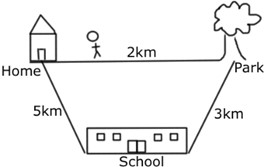
Jerry walked from home to school, then from the school to the park. What is his total distance?

a)

2 km

b)

5 km

c)

8 km

d)

10 km

3.

Jerry walked from home to school, then from the school to the park. What is his total displacement?

a)

2 km

b)

5 km

c)

8 km

d)

10 km

4.
A car drives 84 meters forward.  It's displacement and distance would be the same.
a)
True
b)
False
5.

A place or object (like a stop sign or mailbox) used for comparison to determine if another object is in motion is called a

a)

comparison point

b)

frame of reference

c)

point of view

d)

motion detector

6.

After completing one trip on a roller coaster, the roller coaster's ________ is zero.

a)

displacement

b)

reference point

c)

length

d)

distance

7.
The scientific (SI) unit for measuring distance is the ________ .
a)
mile
b)
foot
c)
kilometer
d)
meter
8.
There are _____ centimeters in a meter.
a)
10
b)
100
c)
1,000
d)
10,000
9.

What describes a vector best?

a)

Magnitude

b)

Magnitude and unit

c)

Magnitude, unit, and direction

d)

Direction

10.
Displacement is distance combined with
a)
direction
b)
speed
c)
velocity
d)
magnitude
11.
Because displacement has a magnitude and direction it is called a ______. 
a)
distance
b)
vector
c)
arrow
d)
length
12.
What is the total distance of the object represented in this motion graph?
a)
0 meters
b)
300 meters
c)
450 meters
d)
600 meters
13.
Which of the following describes distance and displacement correctly?
a)
The blue arrow shows distance and the orange arrows show displacement
b)
The blue arrow shows displacement and the orange arrows show distance
c)
Both arrows show distance only
d)
Both arrows show distance and displacement
14.
A ping-pong ball rolls forward 6 meters, and bounces backward 3 meters. It traveled a total distance of:
a)
9 meters
b)
6 meters
c)
3 meters
d)
0 meters
15.

What is the creature's final displacement?

a)

23 m

b)

9 m

c)

-9 m

d)

-23 m

16.

What distance did the creature travel?

a)

23 m

b)

9 m

c)

-9 m

d)

-23 m

17.

At what position did the creature change direction?

a)

-7 m

b)

9 m

c)

2 m

d)

16 m

18.

Negative displacement means the object is

a)

moving to the right.

b)

moving to the left.

c)

slowing down.

d)

negative displacement is not possible.

19.

If you check the odometer (it counts the miles) on your car to see how far you've gone, you just found the _____ you travelled.

a)

Distance

b)

Displacement

c)

Position

d)

Time

20.

Position

a)

Total length of the path travelled

b)

How far an object is from its starting point

c)

Location of an object relative to a defined zero point

21.
The word ________ is defined as the change in position of an object. It also implies that an object has moved.
a)
Velocity
b)
Displacement
c)
Speed
d)
Magnitude
22.
Match the definition with the term: starting point describing the location of an object
a)
positive direction
b)
reference point
c)
negative direction
d)
position
23.
1.  Amy runs 2 miles south, then turns around and runs 3 miles north. What is displacement?
a)
5 miles
b)
1 miles
c)
2 miles
d)
3 miles
24.

motion

a)

a change in the position of an object compared to another object (related term: move, movement)

b)

a pull or push that is applied to an object

c)

the change in position of an object

d)

the amount of space between one point and another

25.
Are people on a plane moving?
a)
Yes, planes are designed to transport people.
b)
No, you sit still on plane.
c)
It depends on what you compare it to.
d)
Flight is a myth.  The Earth is flat.
26.
To someone riding on a speeding train, others on the train don't seem to be moving.
a)
True
b)
False
27.

_______can be positive or negative depending on the reference point.

a)

Distance

b)

Displacement

c)

Force

d)

Energy

28.
What is the formula to calculate speed?
a)
S = t/d
b)
S = d/t
c)
S = d x t
d)
S = t x d
29.
What is speed?
a)
how far you go
b)
how much distance is covered over a period of time
c)
how fast you accelerate
d)
the change in the location of a object
30.
A runner races in the 100 meter dash.  It takes her 10 seconds to finish.  What is her average speed?
a)
10 m/s
b)
1000 m/s
c)
100 seconds
d)
10 seconds
31.
Total distance divided by total time is
a)
average speed
b)
constant speed
c)
instantaneous speed
d)
acceleration
32.
Velocity is both ____ and _____. 
a)
speed , direction 
b)
direction, mass
c)
volume, density 
d)
direction, magnitude 
33.
What is velocity?
a)
the quickness of an object
b)
the location of an object
c)
acceleration
d)
speed in a specific direction
34.
What is the SI unit for speed and velocity?
a)
Km
b)
s
c)
m/s
d)
m/s2
35.
A change in velocity over time is known as:
a)
acceleration
b)
constant speed
c)
average speed
d)
displacement
36.

vf and vi in the acceleration equation mean:

a)

change in time

b)

circular motion

c)

resting velocity and constant velocity

d)

final velocity and initial velocity

37.
Acceleration: is the rate of change in ___________.
a)
speed
b)
distance
c)
velocity 
d)
displacement 
38.
The SI unit for acceleration is
a)
mph
b)
ft/sec2
c)
m/s2
39.
Acceleration only takes place when things speed up. 
a)
True
b)
False
40.
How far will a person go if they jog for 2 hours at a speed of 12 km/hr?
a)
6 km
b)
0.5 km
c)
10 km
d)
24 km
41.
65mi/hr South is an example of...
a)
Speed
b)
Velocity
c)
Acceleration
d)
Direction
42.
Acceleration of an object happens when things ________
a)
slow down
b)
go faster
c)
change direction (turn)
d)
All of the above
43.
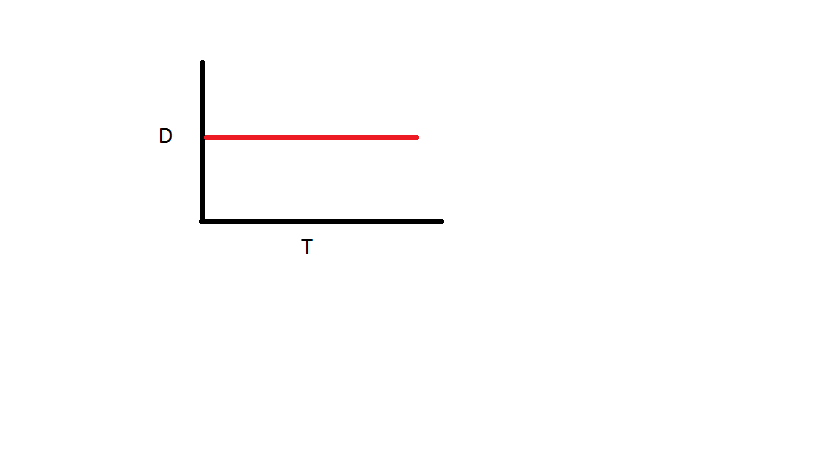
In the distance vs. time graph, what type of motion does the line represent?
a)
No motion
b)
Constant velocity
c)
Acceleration
d)
Deceleration
44.
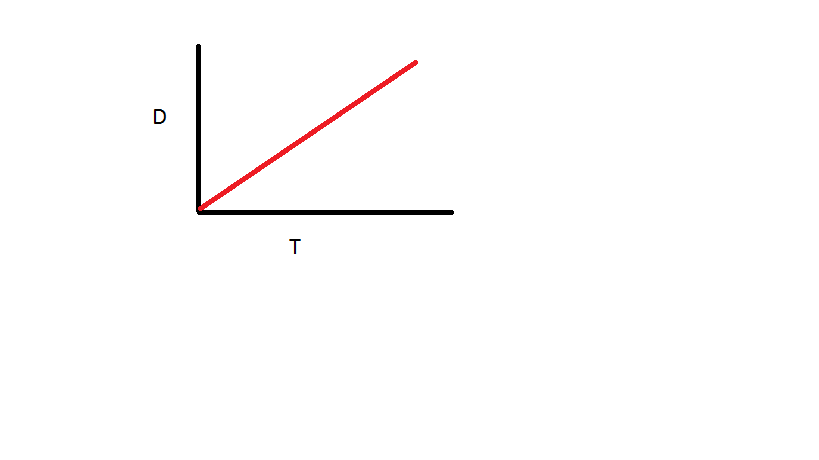
In the distance vs. time graph, what type of motion does the line represent?
a)
Acceleration
b)
No motion
c)
Deceleration
d)
Constant Velocity
45.
Describe the speed of the object from 4-6 seconds using the distance vs. time graph.
a)
Increasing speed
b)
Decreasing speed
c)
Not moving
d)
Constant speed
46.
What is the object doing from 10-12.5 seconds?
a)
Slowing down 
b)
Returning to the starting position
c)
Speeding up
d)
Not moving
47.
Which graph is would represent a decrease in speed?
a)
Graph A
b)
Graph B
c)
Graph C
d)
The object is not decreasing in speed in any of these graphs
48.

Acceleration describes how an object’s velocity is changing. Which of the following scenarios provides the best example of an accelerating object?

a)

A car driving at a constant speed

b)

A book sitting on top of a high shelf

c)

A toy train traveling in a circle

d)

A toy boat floating in a bathtub

49.

Aiden turned around when he saw a teacher needed help opening the door.

a)

Speed

b)

Velocity

c)

Acceleration

50.
Describe the speed of the rocket in the speed vs. time graph.
a)
Constant speed
b)
Decreasing speed
c)
Increasing speed
d)
Not moving
51.
Which runner won the race?
a)
A
b)
B
c)
C
52.

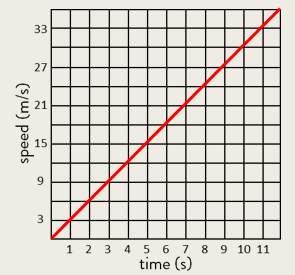
What is this graph showing?

a)

At rest

b)

Acceleration

c)

Constant speed of 1 m/s

d)

Gradually speeding up

53.
a)

Accelerating gradually

b)

Stopping

c)

Slowing down constantly

d)

Speeding up constantly

54.

What is this graph showing?

a)

Constant speed

b)

Gradually speeding up

c)

Gradually slowing down

d)

At rest

55.

What is this graph showing?

a)

Two objects speeding up constantly

b)

Two objects slowing down constantly

c)

Two objects accelerating

d)

Two objects at rest

56.

What is this graph showing?

a)

Constantly slowing down

b)

Constantly speeding up

c)

Acceleration

d)

Returning to starting point

57.

What is the graph showing?

a)

Slowing down moving toward start

b)

Speeding up moving toward start

c)

Slowing down moving away from start

d)

Speed up moving away from start

58.

What is the graph showing?

a)

Speeding up moving away from start

b)

Speeding up moving towards start

c)

Slowing down moving towards start

d)

Slowing down moving away from start

59.
a)

Slows down toward start

b)

Slows down away from start

c)

Speeds up while toward start

d)

Speeds up away from start

60.

What is the graph showing?

a)

Slows down toward start

b)

Speeds up toward start

c)

Slows down away from start

d)

Speeds up away from start

61.

What is the graph showing?

a)

Constant speed away from start

b)

Constant speed toward start

c)

Accelerating away from start

d)

Stopped toward start

62.

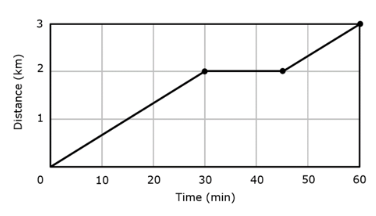
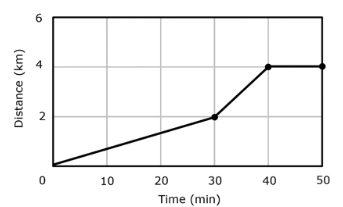
A student travels 2 km in 30 minutes. The student then travels another 2 km in only 10 minutes. After that, the student rests.
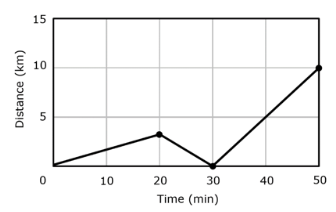
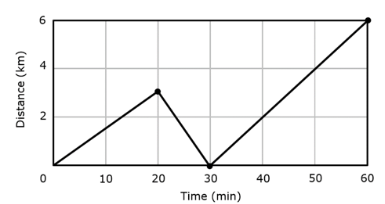
a)
b)
c)
d)
63.
How long did it take this object to travel 10 m?
a)
0 s
b)
10 s
c)
15 s
d)
20 s
64.
How many times does this object STOP moving?
a)
None
b)
Once
c)
Twice
d)
Three times
65.
What is this graph showing?
a)
Constant Speed
b)
Acceleration (speeding up)
c)
Deceleration (slowing down)
d)
No motion
66.

Dave runs a 400 m race with a speed of 4 m/s. How long will it take him to finish the race?

a)

1600 s

b)

100 min

c)

100 s

d)

0.025 s

67.
A dog runs with an initial speed of 7.5 m/s on a waxed floor.  It slides to a stop in 15 seconds.  What is the acceleration?
a)
-7.5 m/s
b)
-7.5 m/s2
c)
-0.5 m/s2
d)
7.5 mi//hr
68.

Kinematic equations (aka Equations of uniform motion) can only be used when you have a constant ....

a)

Position

b)

Velocity

c)

Acceleration

d)

Time

69.
A golf ball starts with a speed of 2 m/s and slows at a constant rate of 0.5 m/s2, what is its velocity after 2 s?
a)
0 m/s
b)
0.5 m/s
c)
1 m/s
d)
1.5 m/s
70.
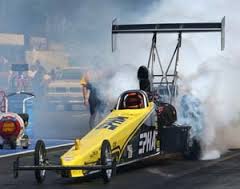
A drag racer accelerated from 0 m/s to 200 m/s in 5 s.  What was the acceleration?
a)
0 m/s
b)
40 m/s2
c)
-40 m/s2
d)
40 m/s
71.
A car accelerates at a rate of 3.0 m/s2. If its original speed is 8.0 m/s, how many seconds will it take the car to reach a final speed of 25.0 m/s?
a)
7.5 s
b)
5.7 s
c)
6.0 s
d)
3.2 s
72.
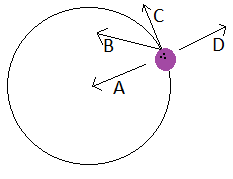
What is the direction of the acceleration at point A, if the ball is revolving clockwise?
a)
up
b)
right
c)
down
d)
left
73.
The velocity is always _____ to the line of a circle. 
a)
outwards
b)
towards the center
c)
tangent
d)
faster
74.
Which statement is true about an object that is traveling in uniform circular motion?
a)
The speed of the object varies.
b)
The net force on the object is directed toward the center of the circular path.
c)
The direction of the object's velocity is constant.
d)
The net force on the object is directed away from the center of the circular path.
75.

A race car completes three laps of a circular track with a radius of 35 m in 9.0 seconds. Determine the speed of the car.

a)

3.9 m/s

b)

73.3 m/s

c)

24.4 m/s

d)

1.0 m/s

76.

Why does an object experiencing uniform circular motion have an acceleration?

a)

because it ir changing speed

b)

because it is changing direction

c)

because it is moving n a straight line

d)

because it has mass

77.

When dealing with an object in circular motion, the distance the object covers in one revolution is called the:

a)

circumference.

b)

radius.

c)

tangent.

d)

distance.

78.

In uniform circular motion, which two variables point toward the center of the circle?

a)

the centripetal force and the acceleration

b)

the velocity and the mass

c)

the period and the mass

d)

the time and the radius

79.
Which represents the acceleration of the ball?
a)
A
b)
B
c)
C
d)
D
80.
Which of the following is the unit for centripetal force?
a)
J
b)
m/s2
c)
kg⋅m/s
d)
N
81.

How can you find the distance around a circle?

a)

2πr

b)

d/t

c)

v2

d)

T

82.

What is the equation for velocity?

a)

v = 2πr/T

b)

a = v2/r

c)

F = mv2/r

d)

F = ma

83.

What happens if you let go of the string when you spin the stopper around your head?

a)

the stopper continues moving in a circle

b)

the stopper moves in a straight line