
NEW
Font size
 Worksheets
Chem II Kinetics Review
Total questions: 43
Worksheet time: 48mins
How are the exponents n and m determined?
What would be the overall order of this rate law?
Rate=[A]2[B]1
0 Order
1st Order
2nd Order
3rd Order
step 2: O3 + O → 2 O2
The oxygen atom (O) is considered to be a(n)...
A reaction is found to be second order with respect to carbon monoxide. If the concentration of carbon monoxide is doubled, the rate of reaction __________.
doubles
remains unchanged
increases by a factor of 4
is reduced by a factor of 2
What does [ ] denote?
concentration, M
concentration, m
concentration, mass %
squared

Which is the rate determining step?
step 1
step 2
step 3
If there is only single substance (atom, molecule, or ion) involved in the rate-determining step, that reaction is said to be
unimolecular
bimolecular
polimolecular
trimolecular
If there are two substances (atoms, molecules, or ions) involved in the rate-determining step, the reaction is said to be
unimolecular
bimolecular
trimolecular
polimolecular
Reaction :
2A + B → C + D
is proposed to have reaction mechanism shown below :
A + B → AB + D (slow)
A + AB → C (fast)
the consistent rate law for the reaction mechanism above is ____
rate = k [A]2 [B]
rate = k [A]2 [B]2
rate = k [A] [B]
rate = k [A] [B]2
The decomposition of nitrous oxide :
2N2O(g) → 2N2(g) + O2(g)
is believed to occur by two-step mechanism
N2O(g) → N2(g) + O(g) (slow)
N2O(g) + O(g) → N2(g) + O2(g) (fast)
the consistent rate equation based for the mechanism above is ____
rate = k [N2O]2
rate = k [N2O]
rate = k [N2O]2 [N2]
rate = k
A possible mechanism for reaction :
A + 2B → C + D
is shown below :
2B → E (slow)
A + E → C + D (fast)
which of the following diagrams represents the reaction pathway diagram for this mechanism?


A possible mechanism for reaction :
2A + B → C + D + E
is shown below :
2A → E + F (fast)
B + F → C + D (slow)
which of the following diagram represents a reaction pathway diagram for this mechanism?


A possible mechanism for reaction :
2A + B → C + D
is shown below :
A + B→ E (slow)
A + E → C + D (fast)
which species is an intermediate in this reaction?
A
B
C
D
E

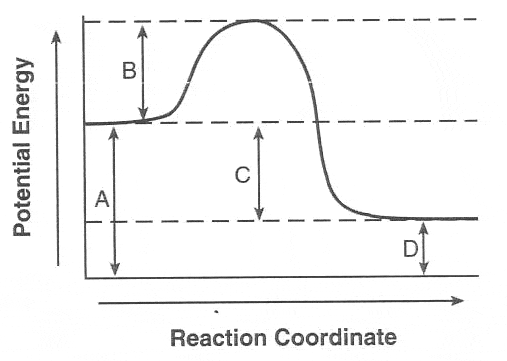
Which reaction mechanism is likely to have a reaction pathway diagram shown above?
A + B → C (slow)
C + A → F (fast)
A + B → C (fast)
C + B → D + E (slow)
E → F (fast)
A + B → C (fast)
C + A → F (slow)
A + B → C (fast)
C + B → D + E (fast)
E → F (slow)
When H2O2 (aq) molecules decompose in the, the following reaction mechanism is proposed to occur.
H2O2 → 2 HO- (slow)
H2O2 + HO- → H2O + HOO- (fast)
HOO- + HO- → H2O + O2 (fast)
2 H2O2(aq) → 2 H2O(l) + O2(g)
Which of the following rate laws for the overall reaction corresponds to the proposed mechanism?
Rate = k [H2O2]2
Rate = k [H2O2] [HO-]2
Rate = k [H2O2]
Rate = k [H2O] [HOO-]
Cl2 (g) + CHCl3 ↔ HCl + CCl4
The rate law for the overall reaction above is
Rate = k[Cl2]2 [CHCl3] .
Could the overall reaction be considered elementary? why or why not?
No; the orders in the rate law do not match the coefficients in the balanced reaction
No; rate laws are based on products, not reactants
Yes; both species in the rate law are seen in the reaction
Yes; any reaction can be considered elementary
2 NOBr (g) ↔ 2 NO (g) + Br2 (g)
The equation above represents an elementary step in a chemical reaction. Which of the following is the correct expression for the rate law of the elementary step?
Rate = k [NOBr]1/2
Rate = k [NOBr]
Rate = k [NOBr]2
Rate = k [NO]2 [Br2]

What order is the reactant in the graphs?
first order
second order
zero order
third order

What order is this graph?
Zero
First
Second
Third
If you quadruple the concentration and the rate quadruples, what order is this reaction?
zero
first
second
___________ are produced in one step and used up in a later step and __________________ are present and unchanged in the reactants and the products
intermediates, catalysts
catalysts, intermediates
What is the rate law for the reaction with this slow elementary step? A + A --> B + B
rate = k[A]2
rate = k[B]2
rate = k[A][B]
rate = k[A]
What is the rate law for the reaction with this slow elementary step? A --> B + C
rate = k[A]2
rate = k[B]2
rate = k[A][B]
rate = k[A]
What is the rate law for the reaction with this slow elementary step? A + 2B --> D + C
rate = k[A]2
rate = k[A][B]2
rate = k[A][B]
rate = k[A]
Which of the following plots will show a linear relationship for a second order reaction?
[A] vs time
1/[A] vs time
ln[A] vs time
[A]2 vs time
rate = k[A]
The rate constant in the rate law above is 0.5 L/mol·s. If the initial concentration of A is 0.1 M, how long will it take for [A] to drop to 0.025 M?
0.7 s
1.4 s
2.8 s
There is not enough information given.

Which species is the catalyst in this reaction mechanism?
R
W
X
There is no catalyst.

What is the rate law for this mechanism?
rate = k[A][B]2
rate = [B][X]
rate = [A]0.5[B]1.5
rate = [W][Y][Z]
Chemicals A and B can be reacted to produce chemical C with a reaction rate dictated by the law rate = k[A][B]2. If the reaction occurs in one elementary step, which of the following represents the elementary step?
A + 2 B --> C
A + B -- > C
2 A + B --> C
2 A + 2 B --> C
A + 2 B <--> D fast equilibrum
A + D --> E slow
Based on the reaction mechanism shown above, what is the rate law of this reaction?
rate = k[A]2[B]2
rate = k[A][D]
rate = k[A][B]2
rate = k[D][A][B]2
Which is the rate determining step?
step 1
step 2
step 3
When H2O2 (aq) molecules decompose in the, the following reaction mechanism is proposed to occur.
H2O2 → 2 HO- (slow)
H2O2 + HO- → H2O + HOO- (fast)
HOO- + HO- → H2O + O2 (fast)
2 H2O2(aq) → 2 H2O(l) + O2(g)
Which of the following rate laws for the overall reaction corresponds to the proposed mechanism?
Rate = k [H2O2]2
Rate = k [H2O2] [HO-]2
Rate = k [H2O2]
Rate = k [H2O] [HOO-]

What order is this graph?
Zero
First
Second
Third

