
 Worksheets
Kinetics and equilibrium test another retake
Total questions: 53
Worksheet time: 59mins
What is equal in equilibrium reactions?
The concentrations of products and reactants
the products equals the heat of reaction
the rate of the forward and reverse reaction
the heat of reaction equals the activation energy
SO2 + 1/2 O2 = SO3
Once equilibrium is reached, the concentration of SO2 is increased, which way does the reaction shift?
SO2 + 1/2 O2 = SO3
As soon as SO3 is created, it dissolves in water and is washed away. Which way does this shift the equilibrium?
CaCO3 --> CaO + CO2
If pressure is increased, which way does the reaction shift?
Identify the incorrect statement about achieving equilibrium.
achieved when product and reactant concentrations are equal
achieved when forward and reverse reaction rates are same
achieved when concentration of reactants is stable/constant
achieved when concentration ratio of reactants to products becomes stable, thus fixing the equilibrium constant (equilibrium position)


N2 + O2 <=> 2NO
If O2 is removed, the concentration of N2 will _______.
SO2 + O2 <=> SO3
If the equilibrium position shifts to the right, the concentration of O2 will ___________.
H2 (g) + Cl2 (g) <=> 2HCl (g) + heat
If the pressure in the system is increased, the equilibrium position will _______.
Given the reaction:
CH4(g) + 2O2(g) --> 2H2O(g) + CO2(g)
What is the overall result when CH4(g) burns according to this reaction?
Energy is released and the ΔH is positive
Energy is released and the ΔH is negative
Energy is absorbed and the ΔH is positive
Energy is absorbed and the ΔH is negative
Which statement correctly describes an endothermic chemical reaction?
The products have lower potential energy than the reactants, and the ΔH is positive
The products have lower potential energy than the reactants, and the ΔH is negative
The products have higher potential energy than the reactants, and the ΔH is positive
The products have higher potential energy than the reactants, and the ΔH is negative
Which balanced equation represents an endothermic reaction?
N2(g) + 3H2(g) --> 2NH3(g)
N2(g) + O2(g) --> 2NO(g)
CH4(g) + 2O2(g) --> CO2(g) + 2H2O(l)
C(s) + O2(g) --> CO2(g)

Given the reaction
S(s) + O2(g) --> SO2(g) + energy
Which diagram best represents the potential energy changes for this reaction?
a
b
c
d

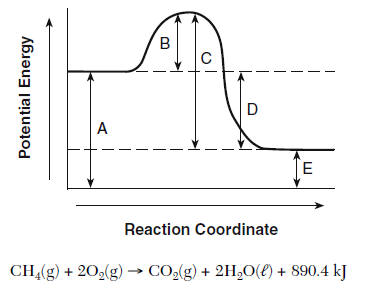
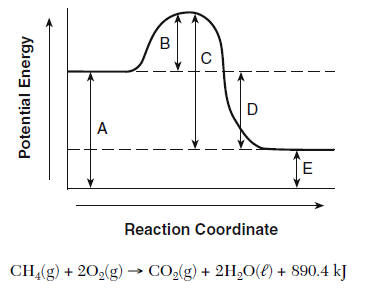
The potential energy diagram below represents a reaction.
Which arrow represents the activation energy of the forward reaction
A
B
C
D

Given the potential energy diagram for the chemical reaction:
Which statement correctly describes the energy changes that occur in the forward reaction
The activation energy is 50kJ and the reaction is exothermic
The activation energy is 50kJ and the reaction is endothermic
The activation energy is 10kJ and the reaction is exothermic
The activation energy is 10kJ and the reaction is endothermic
Increasing the temperature increases the rate of a reaction by
lowering the activation energy
increasing the frequency of effective collisions between reacting molecules
lowering the frequency of effective collisions between reacting molecules
increasing the activation energy

The beakers shown below, a 2.0 centimeter strip of magnesium ribbon reacts with 100 milliliters of HCl(aq) under the conditions shown
In which beaker will the reaction occur at the fastest rate?
A
B
C
D
At STP, which 4.0-gram zinc sample will react fastest with dilute hydrochloric acid?
sheet metal
powdered
bar
granules
Which statement best explains the role of a catalyst in a chemical reaction?
A catalyst changes the kinds of products produced
A catalyst provides an alternate reaction pathway that requires less activation energy
A catalyst limits the amount of reactants used
A catalyst is added as an additional reactant and is consumed but not regenerated
which phase change represents a decrease in entropy?
solid to gas
liquid to gas
solid to liquid
gas to liquid
Which sample has the lowest entropy?
1 mole of KNO3(l)
1 mole of KNO3(s)
1 mole of KNO3(aq)
1 mole of KNO3(g)
Which process is accompanied by a decrease in entropy?
boiling of water
melting of ice
condensation of water
subliming of iodine

Given the balanced equation
Which statement best describes this proces
It is endothermic and entropy decreases
It is endothermic and entropy increases
It is exothermic and entropy decreases
It is exothermic and entropy increases
Systems in nature tend to undergo changes toward
lower energy and lower entropy
lower energy and higher entropy
higher energy and lower entropy
higher energy and higher entropy

Temperature is a measure of average ________ energy of individual atoms.
heat
potential
mechanical
kinetic
N2(g) + 3H2(g) ↔ 2NH3(g)
Increasing the concentration of N2(g) will increase the foward reaction rate due to
N2(g) + O2(g) ↔ 2NO(g)
As the concentration of N2(g) increases, the concentration of O2(g) will
N2O4 (g) <--> 2NO2 (g)
The measurable quantities of the gases at equilibrium must be
H2(g)+Cl2(g)⇌2HCl(g)
The forward reaction is exothermic. What will happen to the equilibrium if the temperature is increased?
equilibrium shifts right
equilibrium shifts left
You cannot predict the effect
no change
H2(g)+Cl2(g)⇌2HCl(g)
Increasing the pressure will
shift equilibrium right
shift equilibrium left
You cannot predict the effect
have no change
H2(g)+Cl2(g)⇌2HCl(g)
Removing Cl2(g) will
shift equilibrium right
shift equilibrium left
increase pressure
have no change

