
 Worksheets
Quiz 7 b 1 vertebra column
Total questions: 33
Worksheet time: 19mins
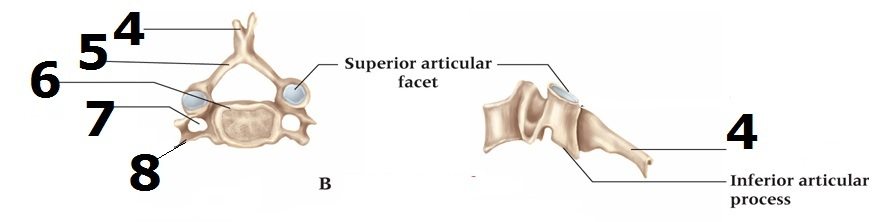
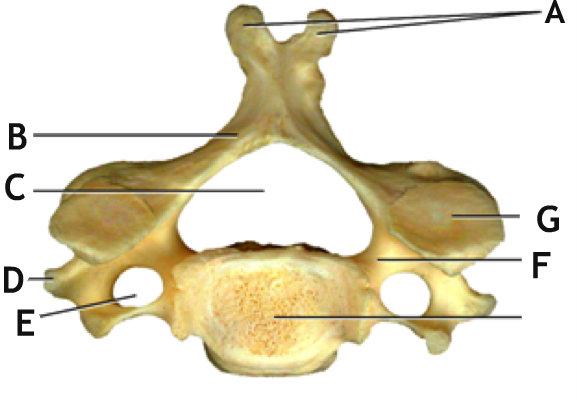
WHAT IS #5
SPINOUS PROCESS
BIFID SPINOUS PROCESS
TRANSVERSE PROCESS
LAMINA
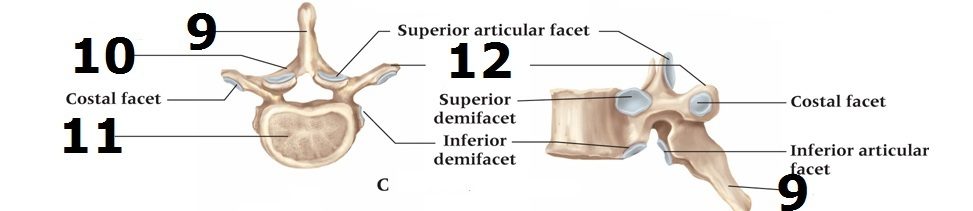
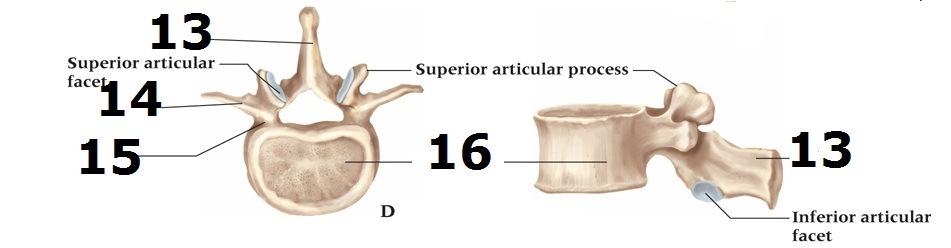
A hollow space that contains the spinal cord.
Vertebral foramen
Spinous process
Transverse process
Intervertebral disc
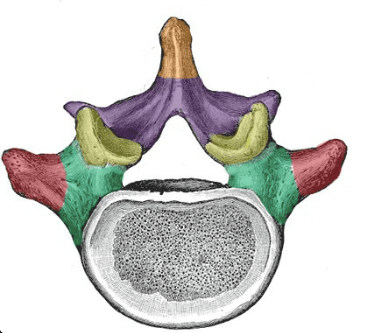

What is the vertebral arch?
Red Portion
Blue Portion
What is the vertebral body?
Red Portion
Blue Portion
What structure is not apart of the vertebral arch?
Pedicle
Transverse Process
Lamina
Intervertebral Disc
Spinous Process

What is number 1? Bony projection posteriorly.
Transverse Process
Spinous Process
Body
Pedicle
What is number 3? Bony projection laterally from the vertebra.
Demifacet
Superior Articular Facet
Transverse Process
Lamina
What is number 4? Portion that connects the vertebral body with the vertebral arch.
Pedicle
Superior Articular Facet
Transverse Process
Lamina
What is number 6? EASY!
Pedicle
Body
Transverse Process
Inferior Articular Facet
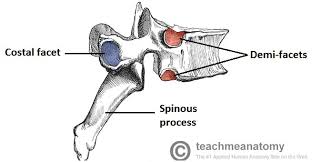
This vertebra is from what portion of the spine?
Cervical
Thoracic
Lumbar
None of these

The arrow is pointing to this, where the spinal cord traverses through.
Vertebral Foramen
Foramen
Intervertebral Foramen
Hole in vertebra

An abnormal spine curvature that is commonly called swayback is called
Lordosis
Kyphosis
Scoliosis
An abnormal spine curvature that is commonly called humpback is called
Lordosis
Kyphosis
Scoliosis
An abnormal spine curvature that bends laterally is called
Lordosis
Kyphosis
Scoliosis
Which of the following statements are NOT true about intervertebral discs?
They act as shock absorbers
They can flatten some during the day
They account for 25% of the height of the vertebral column
They protect the spinal cord by surrounding it and not letting it touch the bony parts of the vertebra
Which vertebrae receives the most weight and have the thickest intervertebral discs?
cervical
thoracic
lumbar
sacral
Which vertebrae are fused together?
cervical
thoracic
lumbar
sacral
Which vertebrae section includes your lower back?
cervical
thoracic
lumbar
sacral
The axial skeleton consists of
skull, vertebral column, and pelvis
arms, legs, hands, feet
skull, vertebral column, rib cage
vertebral column, pectoral and pelvic girdles
The tailbone is also called
coccyx
sacrum
lumbar
L5

