
 Worksheets
Nervous System and the Brain
Total questions: 91
Worksheet time: 1hrs 8mins


What does the cerebrum do?
controls thoughts, interprets information from senses
controls breathing and heart rate
controls balance
relays sensory information to the correct parts of the brain

Which part of the brain controls functions essential to life such as breathing and heart rate?
Thalamus
Frontal Lobe
Brain Stem
Cerebellum

What is the part highlighted in red?
Cerebrum
Cerebellum
Brain Stem
Hypothalamus

This part of the neuron receives chemical messages from the neurotransmitters of other neurons. It is labeled A in the diagram.
Dendrite
Axon
Axon Terminal
Cell Body

The long part of a neuron that sends information to receiving neurons. Labelled D in diagram.
Synapse
Axon
Myelin
Dendrite

Which part of the brain controls your blood pressure and heart rate?
brain stem
cerebrum
cerebellum
adrenal gland
What is the gap between two neurons called?
Impulse
Synapse
CNS
Inter neuron
In which direction does a signal travel inside a neuron?
From dendrite to axon
From axon to axon
From axon to dendrite
From cell body to dendrite
__________ carry messages between sensory neurons and motor neurons.
Active Neurons
Interneurons
Refraction Neurons
Flower Neurons
These cells are responsible for transmitting electrochemical signals to and from the brain
Neurons
Epithelial cells
Villi
Neurotransmitters

If you are having trouble with your BALANCE and COORDINATION, which part of your brain should be checked?
cerebrum
cerebellum
brain stem
spinal cord

Which color is the BRAIN STEM?
PINK
PURPLE
YELLOW

Which color is the CEREBELLUM?
PINK
PURPLE
YELLOW

Which color is the CEREBRUM?
PINK
PURPLE
YELLOW

What is the function of the nervous system?
provide nutrients for the body
send and receive messages, process information
circulate oxygen to cells
remove carbon dioxide from blood
A nerve cell is called a:
neutron
nerve
neuron
synapse

The brain stem/medulla is labeled as #...
1
2
3

The cerebellum is labeled as #...
1
2
3
Which part of the brain controls senses, thinking, and memory?
cerebrum
cerebellum
medulla
Which part of the brain controls balance and coordination?
cerebrum
cerebellum
medulla


This structure is involved in fear/panic response
Cerebellum
Hippocampus
Amygdala
Parietal Lobe

Who has a bigger frontal lobe?


The correct direction of the signal within one neuron.
Axon to Dendrite
Dendrite to Axon
Cell Body to Axon
Axon to Cell Body

The long part of a neuron that sends information to the next neuron
axon
dendrite
neurotransmitter
gene
The tiny gap between neurons where signals are sent from one neuron to another. It is where communication occurs between an axon and dendrite
synapse
axon terminal
impulse
myelin

Which is the following is represented by the letter B?
cell body
nucleus
dendrite
axon

Which of the following is represented by letter C?
Cell body
nucleus
axon
dendrite

Which is represented by the letter G?
axon
myelin sheath
schwan cell
terminal branches
Short, bushy parts of the neuron that take in signals
axon
dendrite
nucleus
myelin sheath
The long part of the neuron that carries signals away from the cell body:
axon
dendrite
myelin sheath
nucleus
The space between neurons:
neurotransmitter
synapse
axon
dendrite
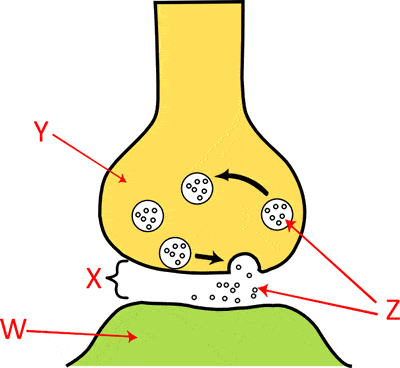
W
Axon
Neurotransmitters
Dendrite
Synapse
What are the chemicals that transmit a signal across a synapse from one neuron to another?
Neurotransmitters
Termini
Thresholds
Impulses
Z
Axon
Neurotransmitters
Dendrite
Synapse
X
Axon Terminal Button
Neurotransmitters
Dendrite
Synapse
The junction between the axon tip of the sending neuron and the dendrite or cell body of the receiving neuron.
axon
synapse
dendrite
vesicle
This neurotransmitter is linked to feelings of pleasure, euphoria, and reward.
dopamine
serotonin
substance p
glutamate
endorphins
The receiving part of a neuron.
Dendrite
Axon terminal
Axon
Axon terminal vesicles

The tiny gap between neurons where nerve impulses are sent from one neuron to another.
synapse
axon terminal
impulse
myelin
The proper name for brain chemicals
Hormones
Neurons
Neurotransmitters
Synapse
Type of neurotransmitters that increase the chance of the next neuron firing
Inhibitory
Excitatory
Synapse
Neuron
Type of neurotransmitters that decrease the chance of the next neuron firing
Inhibitory
Excitatory
Synapse
Neuron
Neurotransmitters that are ____________ cause a neuron to fire whereas ____________ neurotransmitters reduce the likelihood that a neuron will fire.
excitatory; inhibitory
synaptic; terminal
postsynaptic; presynaptic
dendritic; axon
In order for a neuron to send a signal, the neuron must receive more
excitatory neurotransmitters
inhibitory neurotransmitters
agnostic neurotransmitters
antagonistic neurotransmitters


Touch receptors are classified as
mechanoreceptors
nociceptors
chemoceptors
photoreceptors
The sense of the body's position
proprioception
kinesthesia
tactile sense
synesthesis
nociception
Receptors that detect light
photoreceptors
osmoreceptors
mechanoreceptors
chemoreceptors
Receptors that detect taste and smell
photoreceptors
osmoreceptors
mechanoreceptors
chemoreceptors
An example of a chemoreceptor is
hair cells
rods and cones
taste buds
Pacinian corpuscles
What kind of receptors enable the sense of smell?
Mechanoreceptors
Quasireceptors
Nocireceptors
Chemoreceptors

What is label B?
Cell wall
Axon
Axon terminal
Cell body
In synaptic transmission, what is released into the synaptic cleft between two neurons?
Beetlejuice
Receptors
Neurotransmitters
Synaptic fluid
Efferent molecules
sensory receptors that respond to physical touch, stretch, hearing, and pressure
Chemoreceptors
Thermoreceptors
Mechanoreceptors
Photoreceptors
The largest part of the brain -- controls the senses and conscious thought. Includes multiple lobes with different functions.
cerebrum
midbrain
thalamus
amygdala
anterior cingulate cortex
connects the amygdala to the frontal lobe; allows us to make better decisions when the amygdala is activated
connects the cerebellum to the amygdala; allows balance to influence anxiety
connects the occipital lobe to the frontal lobe; allows vision to influence thinking
connects the hippocampus to the amygdala; allows memories to make us angry
connects the amygdala to the frontal lobe; allows us to make better decisions when the amygdala is activated
anterior cingulate cortex
cerebellum
hippocampus
hypothalamus
responsible for controlling hunger, thirst, many emotions, body temperature, and circadian rhythms (sleeping and waking patterns)
anterior cingulate cortex
cerebellum
hippocampus
hypothalamus
The signals sent along a single neuron are
electrical
chemical
responsible for turning experiences into memories
anterior cingulate cortex
cerebellum
hippocampus
hypothalamus
responsible for empathy; small or damaged in psychopaths
frontal lobe of the cerebrum
parietal lobe of the cerebrum
occipital lobe of the cerebrum
temporal lobe of the cerebrum
The signals sent between neurons are
electrical
chemical
Part of the brain that allows you to control impulses from the amygdala; smaller in toddlers than in older children
anterior cingulate cortex
parietal lobe of the cerebrum
temporal lobe of the cerebrum
occipital lobe of the cerebrum

