wayground logo

Free Printable Worksheets

Font size

S
M
L
XL
Worksheets

Evolution Quizizz Challenge

Total questions: 86

Worksheet time: 1hrs 17mins

Name
Class
Date
1.

Which statement best describes the process of evolution?

a)

Populations can survive in different locations on earth

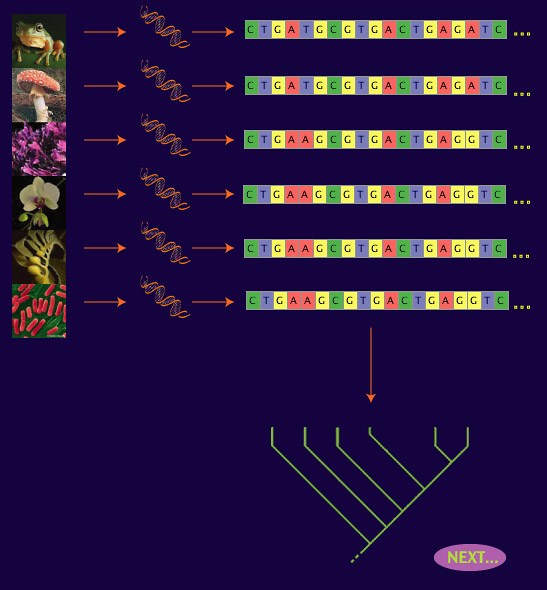
b)

Environmental conditions limit the number of species on Earth

c)

Populations grow when resources are abundant

d)

The traits of a species can change over time

2.

Organisms with the most beneficial/useful traits live long lives and reproduce. This is called ________ of the

a)

Survival of the Fittest

b)

Benefits of the Best

c)

Survival of the Living

d)

Genetic Drift

3.

All of the following are forms of evidence for evolution EXCEPT for:

a)

Similar developmental patterns (embryos)

b)

Homologous structures by divergence

c)

Similarities in DNA

d)

Analogous structures by convergence

4.

A whale uses its fin for a different function than a cat uses its paw. However,, the bone structure of the whale’s fin and the cat’s paw are the same because they both came from a recent common ancestor. This is an example of what kind of structures?

a)

Evolution Structures

b)

Homologous Structures

c)

Vestigial Structures

d)

Analogous Structures

5.

A monarch butterfly has wings and can fly and blue bird can also fly. The monarch butterfly and blue bird DO NOT have a recent common ancestor. What kind of evolution is that an example of?

a)

homologous structures created by divergent evolution

b)

Combined Evolution between the butterfly and bird

c)

analogous structures created by convergent evolution

d)

co-evolution between the butterfly and bird

6.

A species of ants that lives only on a particular plant. The ants provide protection for the plant by fighting off insects that try to eat it. The plant provides food and shelter for the ants. This mutually beneficial relationship has caused the ant and the plant to evolve together. What kind of evolution is this an example of?

a)

Coevolution

b)

Combined evolution

c)

Convergent Evolution

d)

Divergent Evolution

7.

Humans no longer have any use for their wisdom teeth. Even so, in our evolutionary history we once used our wisdom teeth for greater jaw strength. Wisdom teeth are an example of what kind of structure?

a)

Analogous Structure

b)

Homologous Structure

c)

Vestigial Structures

8.

Descent with modification, one of Charles Darwin’s two main ideas on evolution, states that all living species of organisms _________________?

a)

Came from spontaneous generation

b)

have evolved from species of the past.

c)

Have been the same since the beginning of time

d)

evolve due to genetic drift and natural selection
9.
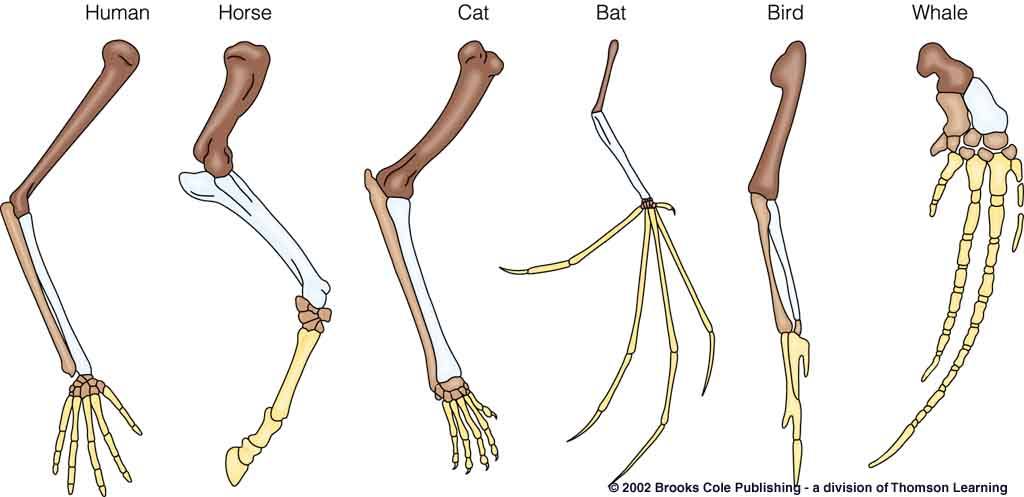
The structures shown are_________
a)
homologous
b)
heterologous
c)
analogous
d)
vestigial
10.

In stage one (top row) of these embryos, most of the embryos________

a)

look very similar (have similar phenotypes)

b)

have very different features. (have different phenotypes)

c)

show different stages of development.

d)

are showing genetic drift in appearance

11.

Which best explains why the birds evolved with differently shaped beaks?

a)

They interbred with each other.

b)

Some birds had defective gene pools.

c)

All of the birds ate the same type of food.

d)

They adapted to eating different types of food.

12.

Random changes in a DNA sequence, which may or may not impact the organism and be considered an adaptation, are called

a)

migrations

b)

mutations

c)

genetic drift

d)

natural selection

13.

Which of the following does NOT lead to genetic variation?

a)

mutations

b)

cloning

c)

sexual reproduction

d)

genetic recombination (crossing over and independent assortment)

14.

After a drought, a farmer discovers that some of his wheat crop has survived. What best explains this?

a)

They had larger leaves to do more photosynthesis

b)

They had smaller roots

c)

They had different genetic variations that caused them to be resistant to droughts

d)

They had taller stems to reach more of the sunlight

15.

Human arms, whale fins, and bat wings share the same number of bones in each place. Why?

a)

They all need to be able to do the same thing with their limbs.

b)

There is only one number of bones that all animals have in their limbs.

c)

They share a common ancestor and diverged over time.

d)

They lived in the same place and slowly developed the same number of bones.

16.

What does the Law of Superposition tell us?

a)

That the animal in the front will always have longer arms.

b)

That the fossils with better position will survive better.

c)

That the deeper fossil layers are older, unless something has disrupted them.

d)

That radiation decays over time.

17.
What characteristic did Darwin observe about the finches on the Galapagos Islands?
a)
Their feathers 
b)
Genotypes 
c)
Their beaks
d)
Their body sizes
18.
Two organisms that are closely related would have
a)
very similar DNA sequence
b)
exactly the same DNA sequences
c)
no proteins in common
d)
completely different DNA sequence
19.

A remnant or trace of an organism from the past is called a _______, these are usually found in _______.

a)

Ancestor, sedimentary rock

b)

Fossils, amber

c)

Fossils, sedimentary rock

d)

Imprints, amber

20.
The diagram shows fossils in different rock layers. Which of these statements about the age of these fossils is most likely correct?
a)
Fossil A and C are the same age
b)
Fossil B is older than fossil C
c)
Fossils A is older than fossil B
d)
Fossil D is older than fossil C
21.

Darwin referred to this as survival of the fittest. Over time, it results in changes in the inherited characteristics of a population because organisms with adaptations that make them fit for their environment will survive and reproduce better than those without favorable traits.

a)

Natural Selection

b)

Genetic Variation

c)

Survival of the Fittest

d)

Genetic Drift

22.
what did Charles Darwin observe in finch populations of the Galapagos Islands off the coast of South America?
a)
different species on different islands
b)
all species on one of the islands
c)
identical species on all the islands
d)
the same species as North America
23.
If an organism has a vestigial structure, that structure likely once had a function in a(n)
a)
close relative
b)
early ancestor
c)
unrelated organism
d)
embryological stage
24.
What is speciation?
a)
combining of tow species to form one with different traits
b)
isolation that affects mating behaviors
c)
timing of mating that prevents normal sexual selection
d)
divergence of two or more species from an existing one
25.

An earthquake causes an ocean channel to open and separate an island into two. the species on each section will experience ________ over time.

a)

allopratric speciation

b)

behavioral isolation

c)

disruptive selection

d)

sympatric speciation

26.
A population of pigs with small, medium, and long snouts lives on an island together with burrowing termites. Pigs that have the longest snouts tend to survive better. Over time, most of the pig population is made up of individuals that have very long snouts. This is an example of which type of selection?
a)
directional selection
b)
disruptive selection
c)
stabilizing selection
d)
sexual selection
27.

Finches with average sized beaks do well at cracking medium sized seeds so increase in a population. Finches with large beaks and small sized beaks are less energy efficient at cracking those seeds so decrease. Which pattern of natural selection has occurred?

a)

Directional selection

b)

Disruptive selection

c)

Stabilizing selection

d)

Sexual Selection

28.
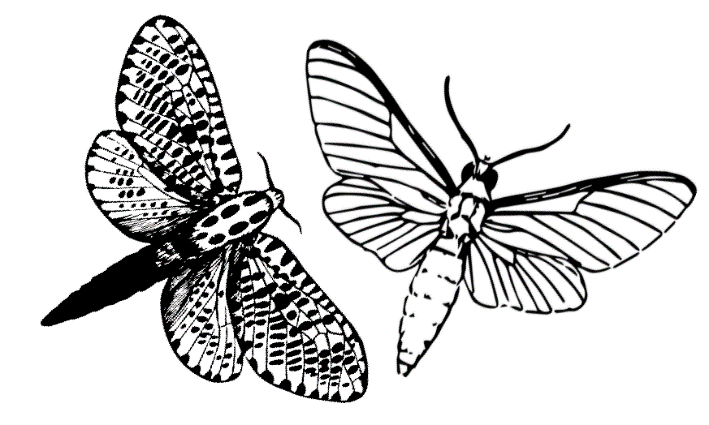
How would you describe these two features?
a)
Homologous structure
b)
Analogous structure
c)
Structural adaption
d)
Functional adaption
29.

Relative dating

a)

allows to us to see the sequence of events locked the rock record

b)

allows us to get a precise age of rocks

c)

tells us older fossils are found nearer the surface than newer ones

d)

use radioactive isotopes

30.

Genetic drift....

a)

causes gene pools shift due to random events and can actually cause inferior genetics to dominate a population for a short time

b)

causes gene pool shift due to natural selection

c)

causes the population to "drift" toward the most fit individuals in the population

d)

is a form of camouflage used in co-evolution

31.

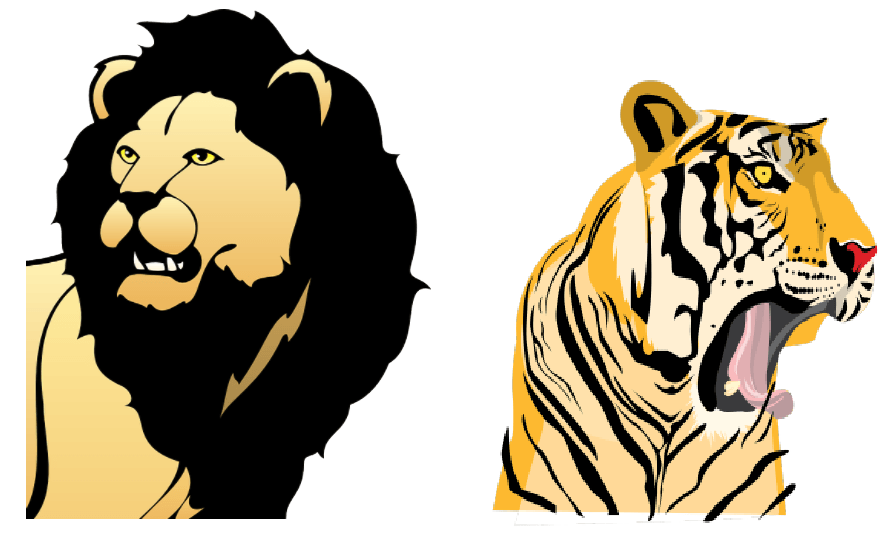
For speciation to occur there must be reproductive isolation between to developing species. When lions and tigers are forced to mate and liger is made. All male ligers are sterile and can make ligers. This is a form of ______ reproductive isolation.

a)

prezygotic

b)

postzygotic

c)

co-evolutary

d)

allopatric

32.

Which of the following is the FIRST thing that must occur for natural selection to be possible.

a)

variation within a population

b)

challenge in nature

c)

survival of the fittest

d)

gene pool frequency change

33.
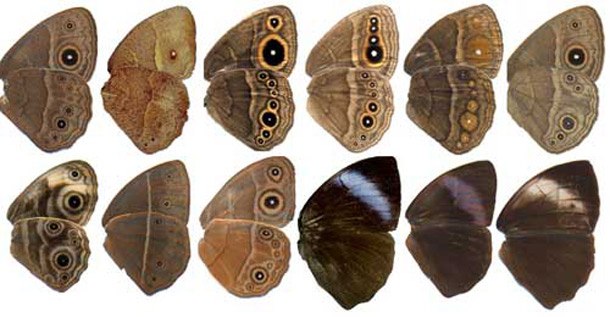
These moths are all the same species. The differences between their wings is an example of ________________
a)
Natural Selection
b)
Variation
c)
Homeostasis
d)
Extinction
34.

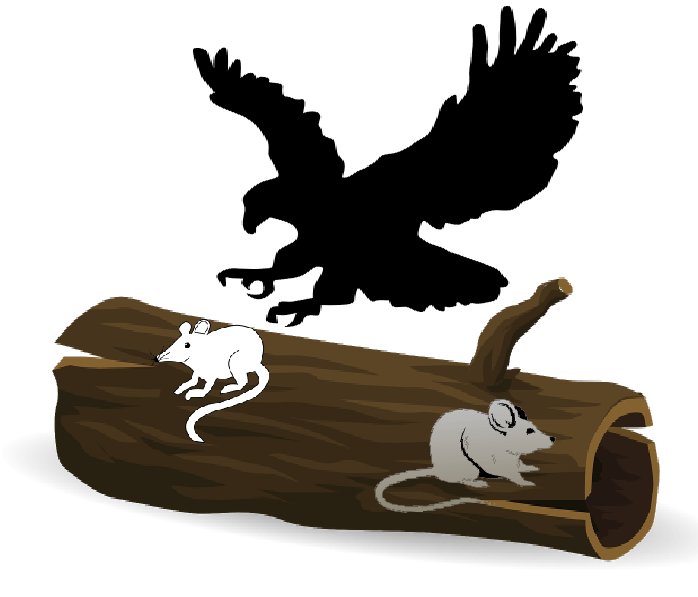
Over the years, white mice became extinct and darker mice survived. This is

a)

stabilizing selection

b)

directional selection

c)

disruptive selection

d)

due to exercise

35.

A physical trait favored by an environmental change can be called an_____ which leads to and organism's _____

a)

adaptation, fitness

b)

adaptation, extinction

c)

mutation, fitness

d)

fitness, adaptation

36.

The frequency that single genes (alleles) for a trait appear in a population.

a)

Genome

b)

Gene frequency

c)

Genetic Drift

d)

Population Frequency

37.

Organisms of the same species can no longer interbreed therefore creating two species.

a)

Gene Pool

b)

Genetic Drift

c)

Gene Frequency

d)

Speciation

38.

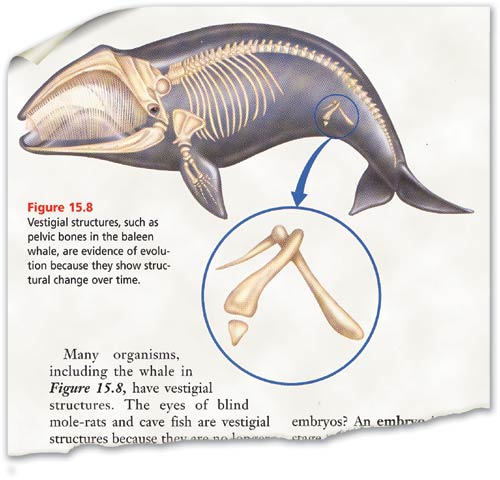
The hip bones in a whale are examples of

a)

homologous structures

b)

analogous structures

c)

fossils

d)

vestigial structures

39.
The white feathers of a snowy owl allow it to blend in with its environment during the winter months (snow). This is an example of ________________
a)
Species
b)
Environmental Change
c)
Adaptation
d)
Variation
40.

The hypothesis that evolution occurs at an irregular rate through geologic time is known as

a)

directional equilibrium

b)

punctuated evolution

c)

directional evolution

d)

punctuated equilibrium

41.

Whales evolved from

a)

four legged wolf like animals

b)

reptiles moving into the water

c)

amphibians spending all their time in water

d)

fish

42.

Natural Selection could not occur without

a)

genetic variation in species

b)

environmental changes

c)

competition for unlimited resources

d)

gradual warming of the Earth

43.
Which of the following ideas is supported by Darwin’s observation of local variation among tortoises in the Galápagos Islands? 
a)
artificial selection
b)
adaptation
c)
acquired characteristics
d)
tendency towards perfection
44.
Jean-Baptiste Lamarck proposed that organisms 
a)
have an innate tendency toward complexity and perfection.
b)
have an innate tendency to become simpler as time passes.
c)
inherit all of the adaptations they display.
d)
belong to species that never change.
45.
Lamarck’s ideas about evolution include the concept that differences among the traits of organisms arise as a result of
a)
continual increases in population size.
b)
the actions of organisms as they use or fail to use body structures.
c)
an unchanging local environment.
d)
the natural variations already present within the population of organisms.
46.
The economist Thomas Malthus suggested that
a)
in the human population, people die faster than babies are born.
b)
without certain checks on population size, there would soon be insufficient food for the growing human population.
c)
in the 1700s, England needed more housing.
d)
the majority of a species’ offspring die.
47.
According to Darwin’s theory of natural selection, individuals who survive are the ones best adapted for their environment. Their survival is due to the 
a)
possession of adaptations developed through use.
b)
 possession of inherited adaptations that maximize fitness.
c)
lack of competition within the species.
d)
choices made by plant and animal breeders.
48.

From watching the movie; eye evolution probably proceeded in what evolutionary steps?

a)

light sensing patches of nervous tissue, lens, constriction of opening, roundness

b)

roundness, light sensing patches of nervous tissue, constriction of opening, lens

c)

lens, roundess, light sensing patches of nervous tissue, constriction of opening

d)

light sensing patches of nervous tissue, roundness, constriction of opening, lens
49.
Two populations of a species of squirrel are isolated from each other. One population is larger in number than the other. A new disease, which is easily spread and extremely contagious, affects both populations at the same time. Which of the following is the best prediction of how the new disease will affect the two populations?
a)
The two populations will be equally affected as they are the same species
b)
The larger population will be more affected as they have greater genetic variation
c)
The smaller population will be more affected as they have less genetic variation
d)
The smaller population will not be affected
50.
The evolution of one species into two or more species as a result of different populations becoming​ reproductively isolated from each other is:
a)
Reproductive selection
b)
Adaptive radiation
c)
Artificial selection
d)
Independent assortment
51.
Scientists conducted a test of two alleles for fur color  in a population of small mammals over a period​of twenty years, Their results showed that the original population expressed one allele for fur color and the population twenty years later showed expression of the other allele. This changed the phenotype from brown to gray. Which of the following statements best describes this shift in the population?
a)
It is an example of artificial selection
b)
Environmental changes have seen one organism been eliminated
c)
One phenotype replaces another
d)
This is an example of predator prey relationships
52.
Different species of animals, living in the same area, cannot interbreed because
a)
They are genetically different
b)
They are predator and prey
c)
They have different food requirements
d)
 They are in different ecological niches
53.
The differences in sparrow songs among similar species of sparrows is an example of what type of evolution?
a)
Adaptive
b)
Convergent
c)
Reproductive
d)
Behavioral
54.
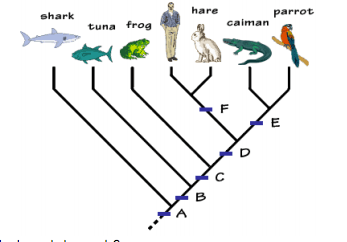
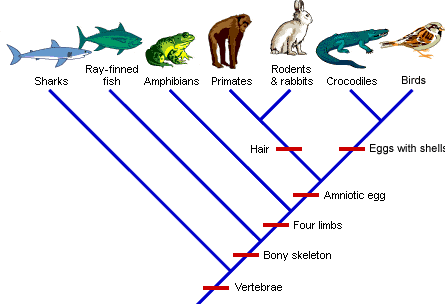
According to this cladogram, primates are most closely related to -
a)
Amphibians
b)
Rodents and rabbits
c)
Crocodiles
d)
Birds
55.
According to this cladogram, birds are LEAST related to -
a)
Amphibians
b)
Sharks
c)
Ray Finned Fish
d)
Crocodiles
56.
Which trait do only humans have, according to the cladogram?
a)
jaws
b)
mammary glands & hair
c)
terrestrial during all life stages
d)
opposable thumbs
57.
According to the cladogram, which organism is most distantly related to the human?
a)
crayfish
b)
rat
c)
perch
d)
frog
58.
On the cladogram, which organism is the closest relative of the human?
a)
Frog
b)
Hare
c)
Caiman
d)
Parrot
59.
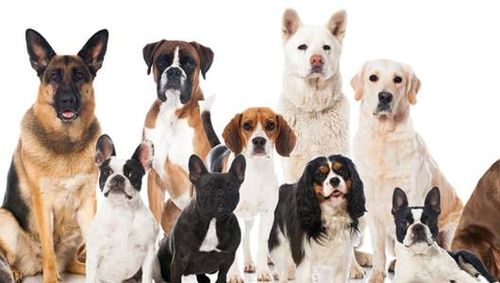
Breeding dogs for specific desired traits is an example of which type of evolutionary evidence?
a)
Artificial selection
b)
Embryology
c)
Fossils
d)
Biochemical molecules
60.
A few deer wander out of their native woods into a completely new park where no deer had ever been before. They go on to create an entirely new population.
a)

Genetic Drift (founder effect)

b)
Natural Selection
c)

Non-random mating

d)
Mutation
61.
Yellow toucan birds seek out one another to make babies together and tend to avoid the green toucan birds.
a)
Genetic Drift
b)
Non-random mating
c)
Gene flow
d)
Mutation
62.
Five hundred years after the deer had established a flourishing population in the park, a few of them venture back to their original woods and have babies with the deer there.
a)
Genetic Drift
b)
Mutations
c)
Non-random mating
d)
Gene flow
63.
Wolves from the Arizona mesa were transferred to the Colorado Rockies after a forest fire destroyed their habitat. They quickly became part of the local pack and had offspring.
a)
Mutation
b)
Natural Selection
c)
Genetic Drift
d)
Gene Flow
64.

7 Wild Mustangs were taken from the prairies of Iowa after a Texan Rancher purchased them and provided them with their own pasture. Those 7 Mustangs eventually became 122.

a)

Genetic Drift (founder effect)

b)

Non-random mating

c)

Gene flow

d)

Genetic Drift (genetic bottleneck effect)

65.

A population of 100,000 bison are reduced to just a few individuals due to near by nuclear explosion. These surviving individuals eventually repopulate the heard. This is example of.....

a)

sexual selection

b)

natural selection and survival of the fittest

c)

genetic drift (genetic bottleneck effect)

d)

genetic drift (founder effect)

66.
States that younger rocks lie above older rocks if the layers have not been disturbed
a)
Law of crosscutting
b)
Law of superposition
c)
Relative Dating
d)
Unconformity
67.
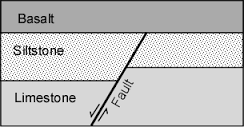
How does the law of crosscutting explain the age of a fault?
a)
The fault is younger than the rocks above it.
b)
The fault is younger than the rocks it cuts through.
c)
The fault is older than the rocks above it.
d)
The fault is older than the rocks it cuts through.
68.
What are the relative ages of the features in order from oldest to youngest?
a)
Limestone, Basalt, Fault, Siltstone
b)
Siltstone, Fault, Basalt, Limestone
c)
Limestone, Fault, Basalt, Siltstone
d)
Limestone, Siltstone, Fault, Basalt
69.
Which of the following is the oldest?
a)
Layer L
b)
Intrusion D
c)
Intrusion H
d)
Layer E
70.

Why are there more animal fossils than plant fossils?

a)

Animals are smaller than plants.

b)

Plants have harder bodies than animals.

c)

Plans have softer bodies than animals.

d)

Animals eat plants.

71.
Which is necessary for speciation to occur?
a)
adaptation
b)
mass extinction
c)

reproductive isolation

d)
acquired traits
72.
Any inherited trait that gives an organism an advantage in its environment is called ___.
a)

a fit mutation

b)
an adaptation
c)

derived trait

d)

ancesteral trait

73.
The evolution of a new species from an existing species is ____.
a)
natural selection
b)

reproductive isolation

c)
speciation
d)

genetic drift

74.
Most organisms have more offspring than will survive 
a)
True
b)
False
75.

How many derived traits do primates and amphibians share?

a)

1

b)

2

c)

3

d)

4

76.
According to this cladogram, birds are LEAST related to -
a)
Amphibians
b)
Sharks
c)
Ray Finned Fish
d)
Crocodiles
77.
Breeding dogs for specific desired traits is an example of which type of evolutionary evidence?
a)
Artificial selection
b)
Embryology
c)

natural selection

d)

evolution by sexual selection

78.

________________ is the time it takes for half of the radioactive atoms in an element to decay.

a)

Half-life

b)

Radiation

c)

Relative age

d)

Full-life

79.

During _________________, the atoms of one element break down to form atoms of another element.

a)

radioactive decay

b)

relative dating

c)

absolute age

d)

tooth decay

80.
What are trace fossils?
a)
Foot prints, burrows, or other impressions made by animals that give use clues to how they lived.
b)
When things die and their remains are buried.
c)
The preserved remains of an organism.
d)
The age determined by the things around it.
81.
What is 'half-life'?
a)
The age determined by the things around it.
b)
The age of an igneous rock.
c)
The age determined by radioactive dating.
d)
The time it takes for 1/2 of the radioactive atoms to decay in an element.
82.
What type of fossil is this?
a)
Mold
b)
Cast
c)
Preserved remains
d)
Trace fossil
83.
Fossils are usually found in 
a)
igneous rock
b)
extrusions
c)
intrusions
d)
sedimentary rock
84.

Alfred Wallace should be paired with which of the following terms

a)

population/

economics

b)

peppered moth

c)

natural selection

d)

Geology

85.

If a bone is found to have 75% daughter isotope than how many half-lives have past?

a)

1

b)

2

c)

3

d)

4

86.

If a bone is found to have 12.5% parent isotope than how many half-lives have past?

a)

1

b)

2

c)

3

d)

4