wayground logo

Free Printable Worksheets

Font size

S
M
L
XL
Worksheets

Genetics and Biotechnology Study Guide

Total questions: 87

Worksheet time: 2hrs 40mins

Name
Class
Date
1.
An offspring will receive how many alleles from each parent to determine a specific trait?
a)
one
b)
two
c)
three
d)
five
2.
Which of the following is a phenotype?
a)
BB
b)
Bb
c)
bb
d)
Blue eyes
3.
having two of the same genes for the trait (sometimes called purebred).
a)
homozygous
b)
hetrozygous
c)
protein
d)
chromosome
4.
Incomplete dominance means that the traits are
a)
expressed equally
b)
dominant
c)
recessive
d)
blended
5.
One form of a gene is called_______________
a)
a DNA
b)
a Phenotype
c)
a trait
d)
an allele
6.
If green is dominant over purple, then what is the genotype for this individual?
a)
Purple
b)
Green
c)
GG
d)
gg
7.
Which is the correct phenotype for this organism?
a)
BB
b)
blue
c)
green
d)
bb
8.
In pea plants, the tall allele is dominant to the short allele. What key would demonstrate this?
a)
Tall = T
Short = S
b)
Tall = T
Short = t
c)
Tall = t
Short = T
d)
Tall = TT
Short = tt
9.
A heterozygous long-tusked elephant is crossed with a homozygous recessive short-tusked elephant. What is the probability of the offspring having short tusks?
a)
0%
b)
25%
c)
50%
d)
75%
10.

Which of the following genotypes is homozygous dominant?

a)

Yy

b)

yY

c)

yy

d)

YY

11.

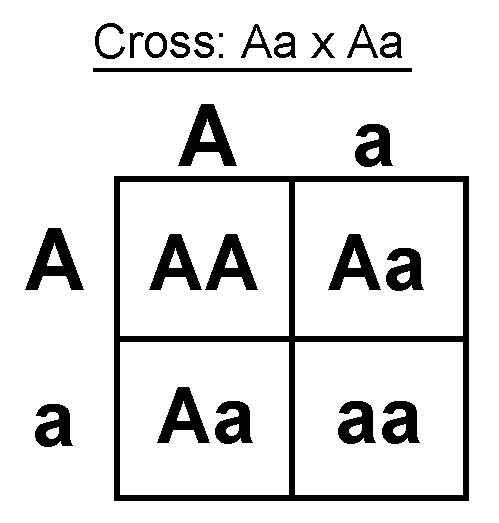
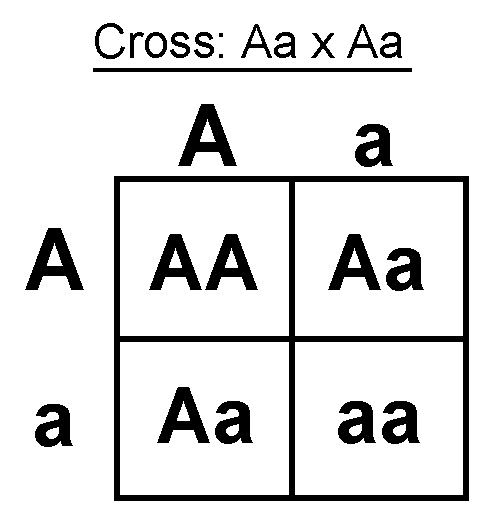
What is the genotypic ratio of the offspring?

a)

3:1

b)

1:3

c)

1:2:1

d)

2:2

12.

What are the phenotype percentages of the offspring?

(A-Brown fur color; a-white fur color)

a)

50 % Brown fur and 50% White fur

b)

25 % Brown fur and 75% White fur

c)

75 % Brown fur and 25% White fur

d)

0% Brown fur and 100% White fur

13.
What are the possible genotypes for this cross?
(Click the picture to see it without the text)
a)
TT = 25% Tt= 50% tt=25%
b)
all tall
c)
TT= 75% tt = 25%
d)
Tt = 100%
14.
If you cross a black guinea pig with a white guinea pig and the offspring are gray, what type of dominant trait would that be.
a)
incomplete dominance
b)
codominance
c)
codependant
d)
cooperative
15.

B=Brown fur

b=tan fur

What percent of the offspring would be tan when you cross BbxBb?

a)

75%

b)

25%

c)

50%

d)

100%

16.
In rabbits, black fur (B) is dominant over brown fur (b). If a rabbit has brown fur, what can you conclude about its genotype?
a)
It is BB.
b)
It is Bb
c)
It is brown
d)
It is bb.
17.
This punnett square shows a cross between
a)
A hybrid Parent and a Homozygous parent
b)
A heterozygous parent and a heterozygous parent
c)
Two homozygous parents
d)
Two Hybrid Parents
18.
This is an example of
a)
Complete dominance
b)
Mendelian Genetics
c)
Codominance
d)
Incomplete Dominance
19.
 One dog carries homozygous, long-haired traits (SS), and its mate carries homozygous short-haired traits (ss). Use a Punnett square to determine the probability of one of their offspring having long hair.
a)
100%
b)
75%
c)
50%
d)
25%
20.
Why are there no white rabbit babies?
a)
The white gene is not present in any of the babies.
b)
It takes two recessive genes to show the trait.
c)
Grey is a better color.
d)
Baby five will be white.
21.

Who is considered the "father" of modern genetics?

a)

Einstein

b)

Mendel

c)

Disney

d)

Washington

22.
TT,tt,PP,pp,SS,ss are examples of alleles that are?
a)
homozygous
b)
heterozygous
c)
different
d)
homologous 
23.
What type of "square" helps us solve genetic problems?
a)
carpenter square
b)
Mendel square
c)
Punnett square
d)
genetic square
24.
Y for yellow body is dominant over y for blue body.  What alleles would produce yellow bodies?
a)
YY,yy
b)
Yy,yy
c)
YY only
d)
YY,Yy
25.
The exact genetic makeup of an organism, such as RR, Tt, PP is its?
a)
phenotype
b)
dominance
c)
genotype
d)
trait
26.
"The Great White Shark was 20 feet in length.  Phenotype or Genotype?
a)
phenotype
b)
genotype
27.
If "T" is the allele for tall and "t" is the allele for short, then Tt would produce?
a)
tall
b)
short
c)
medium
d)
not enough info
28.
A physical characteristic that can be passed from parent to offspring.
a)
behavior
b)
trait
c)
strong muscles
d)
ability to fly a plane.
29.

Alternant or different genes that code for the same trait are called?

a)

chromosomes

b)

segments

c)

alleles.

d)

homozygous.

30.

What plant did Mendel study?

a)

pea plant

b)

spinach

c)

carrots

d)

sunflowers

31.

Which of the following alleles is homozygous (purebred) recessive?

a)

TT

b)

Tt

c)

tt

d)

ts

32.

Red (R) is dominant over white (r). How can a flower be white?

a)

It can have RR and be white.

b)

It has to have rr.

c)

It has to have rR

d)

There is no way it can be white until the third generation.

33.

Which of the following is an inheritable genetic trait?

a)

language

b)

type of music you like

c)

eye color

d)

slow growth due to insufficient nutrition.

34.
Females-XX; MalesXY.  A couple has 4 girls.  What is the chance the next child will be a boy?
a)
75%
b)
100%
c)
25%
d)
50%
35.

A single cross such as flower color, is call

a)

monohybrid

b)

crossing over

c)

dihybrid

d)

homozygous

36.
Genotype refers to the ...
a)
physical expression of the genes
b)
the possible combination of alleles in a gene
c)
whether an allele is dominant or recessive
d)
how an organism will appear
37.
What is a phenotype
a)
The genetic make up (code)
b)
The physical trait
38.
having two of the same genes for the trait (sometimes called purebred).
a)
homozygous
b)
hetrozygous
c)
protein
d)
chromosome
39.
having two different genes for a trait (sometimes called hybrid).
a)
protein
b)
homozygous
c)
heterozygous
d)
genotype
40.
G = green, g = yellow
The genotype for a yellow plant is...
a)
GG
b)
Gg
c)
gg
d)
all of the choices result in yellow
41.
Where, in the eukaryotic cell, is DNA located?
a)
ribosomes
b)
nucleus
c)
E.R.
d)
cytoplasm
42.
Term for an organism that display two dominant phenotypes at the same time
a)
codominance
b)
incomplete dominance
c)
multiple alleles
d)
linked genes
43.
What does heterozygous mean?
a)
An organism that has the same genes for a trait (TT or tt)
b)
An organism that has different genes for a trait (Tt)
c)
When neither gene is fully dominant; offspring is a mixture of both
d)
the different forms of a trait (hair color--> brown, blonde, red
44.
Incomplete dominance means that the traits are
a)
expressed equally
b)
dominant
c)
recessive
d)
blended
45.
Which of the following is homozygous dominant?
a)
Yy
b)
Y
c)
yy
d)
YY
46.
Complex molecule that carries genetic information that defines an organism's traits. It is stored in the nucleus.
a)
DNA
b)
protein
c)
RNA
d)
glucose nucleic acid (GNA)
47.
An allele whose trait only shows up when no dominant allele is present.
a)
hidden allele
b)
dominant allele
c)
recessive allele
d)
present allele
48.
Natural selection is when ____________ decides who survives and who doesn't
a)
nature
b)
humans
c)
animals
d)
years
49.
The inherited combination of alleles is known as the offspring's
a)
heredity
b)
phenotype
c)
genotype
d)
redigree
50.
A heterozygous yellow pea plant's genotype would be:
a)
YY
b)
yy
c)
Yy
d)
Yg
51.
A corn plant heterozygous for tall sprouts mates with a corn plant with short sprouts. If tall sprouts are dominant, how many different phenotypes are possible in the offspring?
a)
1
b)
2
c)
3
d)
4
52.
If T=Tall & t=short, what is the genotypic ratio?
a)
1:3
b)
3:1
c)
1:2:1
d)
2:2
53.
If a heterozygous tall pea plant is crossed with a short pea plant, what are the possible genotypes of the future offspring?
a)
100% Tt
b)
50% Tt, 50% tt
c)
75%Tt, 25%tt
d)
25%TT, 50%Tt, 25%tt
54.

A gene is

a)

a section of DNA

b)

a chemical found in the nucleus of cells

c)

contains instructions for building a protein

d)

all of the above

55.

Human gametes contain how many chromosomes?

a)

46

b)

23

c)

12

d)

28

56.
How do scientists cut DNA into smaller strands?
a)
restriction enzymes
b)
scissors
c)
ligase
d)
agarose
57.
The process of making changes in the DNA code of a living organism is called
a)
selective breeding 
b)
genetic engineering
c)
inbreeding
d)
hybridization
58.
Two organisms that are closely related would have
a)
very similar DNA sequence
b)
exactly the same DNA sequences
c)
no proteins in common
d)
completely different DNA sequence
59.
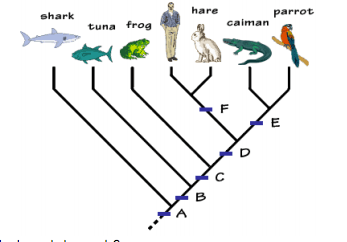
According to this cladogram, birds are LEAST related to -
a)
Amphibians
b)
Sharks
c)
Ray Finned Fish
d)
Crocodiles
60.
On the cladogram, which organism is the closest relative of the human?
a)
Frog
b)
Hare
c)
Caiman
d)
Parrot
61.

The bones of the forelimbs of the whale, the human and the bat are very similar. This indicates that they all may

a)

have descended from a common ancestor

b)

belong to the same species

c)

Have to range great distances to eat

62.
If green is dominant over purple, then what is the genotype for this individual?
a)
Purple
b)
Green
c)
GG
d)
gg
63.
Which of the following terms refers to the different possibilities of a gene?
a)
chromosome
b)
DNA
c)
Punnett Squares
d)
allele
64.
A phenotype is the...
a)
letter combination
b)
dominant gene
c)
recessive gene
d)
physical appearance
65.
Tt is-
a)
homozygous dominant
b)
homozygous recessive
c)
heterozygous
d)
none of these
66.
Which of the following genotypes is homozygous recessive?
a)
RR
b)
Rr
c)
rr
d)
None of the Above
67.
Brown (B) is dominant over white (b). Which genotype is a purebred for brown fur?
a)
BB
b)
Bb
c)
bb
d)
All of the above
68.
Mutations are a change in what?
a)
DNA
b)
tRNA
c)
genotype
d)
phenotype
69.
The differences among a species, like different bird beaks, are called
a)
genes.
b)
variations.
c)
traits.
d)
theories.
70.

In order for natural selection to occur, what must exist in a species?

a)

Stability

b)

Low mutation rate

c)

Variation

71.

The process of man choosing organisms with the most desirable traits and mating them is known as

a)

Cloning

b)

Natural selection

c)

Selective breeding

72.

What number is the common ancestor of C and D

a)

1

b)

2

c)

4

73.

This is the practice of inserting the DNA of another species into an organism's DNA so that the organism gains a new trait.

a)

Cloning

b)

Gel Electrophoresis

c)

Genetic Engineering

d)

DNA Fingerprinting

74.

This is the practice of producing a genetically identical cell or organism

a)

Cloning

b)

Gel Electrophoresis

c)

Genetic Engineering

d)

DNA Fingerprinting

75.

This is the practice of cutting DNA and separating it by the size of the pieces

a)

Cloning

b)

Gel Electrophoresis

c)

Genetic Engineering

d)

DNA Fingerprinting

76.

This is the process of creating a unique image of an individual's alleles based on their size and using that image to identify an individual's DNA

a)

Cloning

b)

Gel Electrophoresis

c)

Genetic Engineering

d)

DNA Fingerprinting

77.

What is the name of the international effort to sequence a human's DNA sequence?

a)

The Gene Sequencing Project

b)

The DNA Fingerprinting Project

c)

The Nuremberg Trials

d)

The Human Genome Project

78.

Which kitten is most likely the offspring of this cat?

a)

1

b)

2

c)

3

d)

4

79.

Which of these is NOT a use for DNA Fingerprinting?

a)

Identifying the person whose DNA was left at a crime scene

b)

Determining the father of a child

c)

Finding the likelihood of inheriting a genetic disorder

d)

Figuring out which species are more closely related

80.

Why did scientists edit the genes of bacteria to produce insulin?

a)

Because the bacteria were diabetic

b)

Because bacteria have simple DNA that is easier to manipulate, making it easy to produce insulin in a lab

c)

Because bacteria's complex DNA was perfect for insulin production

d)

Because insulin has no use outside of a lab setting

81.

Bacterial DNA is _________ than human DNA

a)

More simple

b)

Less simple

c)

uglier

d)

deadlier

82.

This is the practice of choosing individuals of a species to mate based on their desirable characteristics

a)

Bacterial recombination

b)

Natural selection

c)

Genetic modification

d)

Selective breeding

83.

Which of these is the correct definition of genetic modification/genetic engineering?

a)

Choosing individuals to mate based on desired characteristics

b)

Observing genetic changes in populations over time based on adaptive traits

c)

Extracting stem cells to differentiate into specialized tissues

d)

Altering the DNA of an organism at the molecular level

84.

What is the process in which an unspecialized stem cell turns into a specialized body cell?

a)

DNA Replication

b)

Differentiation

c)

Respiration

d)

Genetic Modification

85.

During gel electrophoresis, the _______ pieces of DNA move farthest down the gel

a)

lightest

b)

heaviest

c)

ugliest

d)

deadliest

86.

________ are used to ________ DNA pieces by ________

a)

Restriction enzymes, connect, fission

b)

Restriction enzymes, isolate, "snipping"

c)

Plasmids, connect, fission

d)

Plasmids, isolate, "snipping"

87.

What does transgenic mean?

a)

An organism that can change its genes at will

b)

A stem cell that can differentiate into anything

c)

An organism that has had another species' DNA put in it

d)

A bacteria that reproduces asexually