wayground logo

Free Printable Worksheets

Font size

S
M
L
XL
Worksheets

Biology Midterm Review

Total questions: 87

Worksheet time: 7hrs 34mins

Name
Class
Date
1.
Building blocks of proteins are
a)
Simple sugars
b)
Amino acids
c)
Monosaccharides
d)
Polysaccharides
2.
A scientist was studying the effect of temperature on bacterial growth.  What is the independent variable?
a)
Length of the experiment
b)
Number of bacteria
c)
Reproduction rate
d)
Temperature
3.
Two structures present in plant cells but NOT animal cells are:
a)
Chloroplasts and centrioles
b)
Chloroplasts and cell wall
c)
Chloroplasts and cell membrane
d)
Chloroplasts and ribosomes
4.
Controls what goes in and out of the cell
a)
Cell membrane
b)
Cell wall
c)
Chloroplasts
d)
Nucleus
5.
One of the main difference between prokaryotic and eukaryotic cells is that - 
a)
eukaryotic cells have a more advanced cellular organization
b)
eukaryotic cells have a smaller cell nucleus
c)
prokaryotic cells do not have a plasma membrane
d)
prokaryotic cells are always much larger
6.
If a toxic chemical destroys the ribosomes, which cellular activity would be affected first?
a)
Energy storage
b)
Movement
c)
Protein production
d)
DNA synthesis
7.
Which is NOT TRUE about a prokaryotic bacteria?
a)
It stores its genetic information in DNA
b)
It has ribosomes to make proteins
c)
It has a cell membrane
d)
It has a membrane-bound nucleus
8.
What organelle is used to store food?
a)
Chloroplast
b)
Mitochondrion
c)
Vacuole
d)
Nucleus
9.
The organelle that provides energy for the cell and acts like the "power house" is the
a)
Nucleus
b)
Lysosome
c)
Golgi bodies
d)
Mitochondria
10.
The cell organelle that transports material within a cell is the ____
a)
Nucleus
b)
Endoplasmic Reticulum
c)
Golgi apparatus
d)
Mitochondrion
11.
The main benefit of perspiring (sweating) in animals is that it _____
a)
removes dirt from the surface of the skin
b)
cools the skin with evaporation
c)
relaxes the muscles
d)
removes extra water from the cells
12.
Sugar, starch and cellulose are examples of
a)
Lipids
b)
Carbohydrates
c)
Proteins
d)
Nucleic Acids
13.
Fats, oils and waxes are examples of 
a)
Nucleic Acids
b)
Carbohydrates
c)
Lipids
d)
Proteins
14.
Most cellular activities are processes regulated by the action of ____
a)
Polysaccharides
b)
Lipids 
c)
Enzymes
d)
Carbohydrates
15.
Photosynthesis uses solar energy from the sun to create
a)
High energy sugars like glucose
b)
High energy proteins
c)
High energy lipids
d)
High energy nucleic acids
16.
How are photosynthesis and cellular respiration related processes?
a)
Both provide plant cells with energy
b)
Both provide animal cells with energy
c)
The reactants of respiration are the products of photosynthesis.
d)
The reactants of respiration are the reactants of photosynthesis.
17.
What is an enzyme?
a)
A biological catalyst that works in living cells to speed up chemical reactions.
b)
A biological catalyst that works outside living cells to speed up chemical reactions.
c)
A protein that increases activation energy
d)
A product of chemical reactions.
18.
What is responsible for making a protein?
a)
The sequence of the phosphate-sugar backbone.
b)
The sequence of lipids.
c)
The sequence of nitrogenous bases.
d)
The sequence of carbohydrates.
19.
Which of the following describes transcription?
a)
tRNA is made from a DNA template.
b)
tRNA is made in the ribosome.
c)
mRNA is made in the ribosome.
d)
mRNA is made from a DNA template.
20.
A segment of DNA has the following code: T-A-C-G-C-A-A-C-T. What is the correct mRNA sequence?
a)
A-T-G-C-G-T-T-G-A
b)
A-U-G-C-G-U-U-G-A
c)
U-A-C-G-C-A-A-C-U
d)
T-A-C-G-C-A-A-C-T
21.
A segment of DNA has the following code: T-A-C-G-C-G-A-A-T. Which represents DNA replication correctly?
a)
U-A-C-G-C-G-A-A-U
b)
T-A-C-G-C-G-A-A-T
c)
A-U-G-C-G-C-U-U-A
d)
A-T-G-C-G-C-T-T-A
22.
Which of the following is NOT a difference between a plant and animal cell?
a)
Plant cells have chloroplasts, animal cells do not.
b)
Animal cells are round, plant cells are square.
c)
Animal cells are square, plant cells are round.
d)
Plant cells have a cell wall and large central vacuole.
23.
Which of the following is NOT a difference between DNA and RNA?
a)
DNA is double-stranded, RNA is single-stranded.
b)
DNA contains the sugar deoxyribose, RNA contains the sugar ribose.
c)
DNA contains uracil, RNA contains thymine.
d)
DNA contains thymine, RNA contains uracil.
24.
What is the purpose of DNA replication?
a)
To copy DNA
b)
To copy RNA
c)
To use DNA to make mRNA
d)
To use DNA to make tRNA.
25.
Which organelle provides your body the energy it needs to function?
a)
Chloroplast
b)
Lysosome
c)
Mitochondria
d)
Golgi apparatus
26.
If 10% of a DNA sample is made up of cytosine, what percentage is made up of thymine?
a)
10%
b)
20%
c)
30%
d)
40%
27.

A cell has 20 chromosomes. How many will it have after mitosis?

a)

10

b)

20

28.

Which is made of rRNA? (ribosomal RNA)

a)

A

b)

B

c)

C

29.

Yeast undergoes fermentation. This releases:

a)

Carbon dioxide

b)

oxygen

30.

Which does Fermentation require?

a)

Oxygen

b)

Glucose (sugars)

31.

Which is a way to remove carbon dioxide from the atmosphere?

a)

More plants and more photosynthesis

b)

More cows and cattle ranching

32.

Which type of mutation can be passed on to an organism's offspring?

a)

Somatic

b)

Gamete

33.

Which process is shown here?

a)

Translation

b)

Transcription

34.

Plants release what during photosynthesis?

a)

Carbon Dioxide

b)

oxygen

35.

What mRNA would code for the following strand of DNA?

GATCCTAATC

a)

CUAGGAUUAG

b)

CTAGGATTAG

36.

A DNA strand has 9 bases. How many amino acids will that code for?

a)

3

b)

9

37.

Which organelle makes proteins?

a)

Ribosome

b)

Mitochondria

38.

In a chemical reaction, the elements sodium and chlorine react to form salt. Salt is a:

a)

Element

b)

Compound

c)

Molecule

d)

Atom

39.

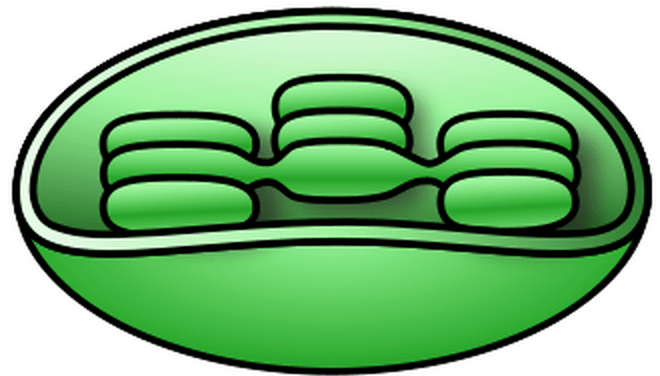
What type of cell is this?

a)

animal

b)

bacterial

c)

fungal

d)

plant

40.

Which of the following is a factual conclusion that may be made from the data in the tables?

a)

As the temperature increases in both air and water the speed of sound stays the same

b)

As the temperature increases in both air and water the speed of sound decreases

c)

As the temperature decreases in both air and water the speed of sound increases

d)

As the temperature decreases in both air and water the speed of sound decreases

41.
In this graph, what is the independent variable? 
a)
Population
b)
Day
c)
Species 5
42.
In this graph, what is the dependent variable? 
a)
Walla Walla Island
b)
Time
c)
Number of Deer
43.

The scatterplot shows the amount of rainfall during six thunderstorms and the length of time that each storm lasted. Based on the scatterplot, which statement is true?

a)

During each storm that lasted longer than 1 hour, there was less than 1 inch of rain.

b)

During each storm that lasted longer than 1 hour, there was more than 1 inch of rain.

c)

No storms produced more than 2 inches of rain.

d)

No storms lasted longer than 1 hour.

44.
How are multi-celled and single-celled organisms different?
a)
Multi-celled organisms need energy to survive, while single-celled organisms need no energy to survive.
b)
Single-celled organisms can be seen without using a microscope, while multi-celled organisms are microscopic.
c)
Multi-celled organisms have large numbers of specialized cells to perform a variety of life functions, while single-celled organisms complete life functions with one cell.
d)
Single-celled organisms have large numbers of identical cells that all perform the same function, while multi-celled organisms have cells that are all different and perform different life functions.
45.
What are the tiny structures that carry out jobs inside cells called?
a)
membranes
b)
nucleus
c)
organelles
d)
animalicules
46.
Where is the DNA found in a prokaryotic cell? 
a)
floating around in the cytoplasm 
b)
in the nucleus 
47.
My main goal is to produce a lot of ATP energy. 
a)
Chloroplast
b)
Mitochondria
48.
I am only found in a plant cell. What am I?
a)
cell wall
b)
mitochondria
c)
cytoplasm
d)
chloroplast
49.
With what 3 letters do enzymes typically end?
a)
-ose
b)
-ase
c)
-ese
d)
-tic
50.
Used for short term (quick) energy.
a)
carbohydrates
b)
lipids
c)
proteins
d)
nucleic acids
51.
Provides long term energy and insulation,
a)
lipids
b)
carbohydrates
c)
nucleic acids
d)
proteins
52.
Contains DNA and RNA
a)
lipids
b)
carbohydrates
c)
proteins
d)
nucleic acids
53.
Contains a phosphate, sugar and nitrogen base
a)
nucleic acid
b)
lipid
c)
carbohydrate
d)
protein
54.
Identify the macromolecule in the picture
*GLUCOSE
a)
lipid
b)
protein
c)
nucleic acid
d)
carbohydrate
55.
Identify the macromolecule in the picture
* cholesterol and triglycerides
a)
carbohydrate
b)
protein
c)
lipid
d)
nucleic acid
56.
Identify the macromolecule in the picture
a)
carbohydrate
b)
lipid
c)
protein
d)
nucleic acid
57.
What are the monomers of DNA?
a)
glycerols
b)
amino acids
c)
fatty acids
d)
nucleotides
58.
What is the monomer of a carbohydrate? 
a)
Monosaccharides
b)
Amino Acids
c)
Fatty Acids
d)
Nucleotides
59.
What are lipids composed of? 
a)
Monosaccharides
b)
Amino Acids
c)
Fatty Acids
d)
Nucleotides
60.

a single unit or molecule

a)

polymer

b)

dimer

c)

monomer

d)

macromolecule

61.

How many monomers are shown here?

a)

1

b)

3

c)

5

d)

7

62.

Which statements explain the primary difference between the structure of a nucleic acid and the structure of a protein?

a)

A nucleic acid has alternating base pairs. A protein has alternating peptides.

b)

Nitrogen bases form the backbone of a nucleic acid. Peptides form the backbone of a protein.

c)

Nucleotides link together to form a nucleic acid. Amino acids link together to form a protein.

d)

A nucleic acid is held together by the sugar-phosphate complex. A protein is held together by the carbon-carbon bonds.

63.

Which organic molecule is paired with its basic building block?

a)

carbohydrate : amino acids

b)

nucleic acid : nucleotides

c)

lipid : monosaccharides

d)

protein : fatty acids

64.

A student identifies the following parts of a cell.


1.cell wall

2.RNA

3.mitochondrion

4.ribosome


The presence of which structure allows the student to conclude that this is a eukaryotic cell?

a)

1

b)

2

c)

3

d)

4

65.

During strenuous exercise, body temperature increases. The body responds to the increase in temperature by sweating, which helps to reduce the body temperature. Which is demonstrated in this situation?

a)

excretion

b)

metabolism

c)

homeostasis

d)

synthesis

66.

What is an example of a positive feedback mechanism?

a)
b)
67.
The two types of feedback systems that help organisms maintain homeostasis are:
a)
positive and negative 
b)
receptor and effector
c)
static and dynamic
d)
minor and major
68.
Maintaining body temperature is an example of a:
a)
negative feedback loop
b)
positive feedback loop
69.
Rapid growth during puberty causes your body to release more and more growth hormones. As you grow, more and more growth hormones are released until puberty is reached, and then the hormones stop.
a)
Positive Feedback Response
b)
Negative Feedback Loop 
70.
If the calcium in your blood decreases below homeostasis levels, a gland in the brain will sense the decrease and send a chemical message to your bones. Your bones will release calcium into the blood, bringing blood calcium levels back up.
a)
Positive Feedback Response
b)
Negative Feedback Loop 
71.
When glucose levels in the blood rise, your brain sends a signal to your pancreas. The pancreas releases insulin, which opens channels in cell membranes to allow glucose to enter the cell, lowering blood sugar levels. 
a)
Positive Feedback Response
b)
Negative Feedback Loop 
72.
Homeostasis
a)
allows for a wildly fluctuating internal environment
b)
is impossible in vertebrates
c)
is the maintenance of a relatively stable internal environment and often incorporates a form of feedback regulation
d)
is the maintenance of a relatively stable external environment and often incorporates a form of feedback regulation
73.
Proteins are made of monomers called ___________
a)
Nucleotides
b)
Monosaccharides
c)
Amino Acids
d)
Glycerol and fatty acids
74.
The element _______is found in all of the organic compounds.
a)
Iron
b)
Nitrogen
c)
Carbon
d)
Oxygen
75.
Monosaccharides are monomers of
a)
Carbohydrates
b)
Lipids
c)
Proteins
d)
Nucleic Acids
76.
Carbohydrates are made of... 
a)
C H O
b)
C H O N
c)
C H O N P
d)
C H O N S
77.
Lipids are made of... 
a)
C H O
b)
C H O N
c)
C H O N P
d)
C H O N S
78.
Proteins are made of... 
a)
C H O
b)
C H O N
c)
C H O N P
d)
C H O N S
79.

What type of boundary is shown in the diagram?

a)

Divergent

b)

Convergent

c)

Transform

80.

What type of boundary is shown in the diagram?

a)

Divergent

b)

Convergent

c)

Slide/Transform

81.

What type of boundary is shown in the diagram?

a)

Divergent

b)

Convergent

c)

Slide/Transform

82.
What phase of mitosis is shown in the picture?
a)
Prophase
b)
Anaphase
c)
Telophase
d)
Metaphase
83.
What phase of mitosis is shown in the picture?
a)
Prophase
b)
Anaphase
c)
Telophase
d)
Metaphase
84.
What phase of mitosis is shown in the picture?
a)
Prophase
b)
Anaphase
c)
Telophase
d)
Metaphase
85.
What mutation has occurred here? 
T-G-A-C-C-A
T-G-A-G-C-A
a)
Substitution
b)
Deletion
c)
Insertion
d)
Frameshift 
86.
Which of the following would result in a frameshift mutation?
a)
Insertions only
b)
Substitution only
c)
Deletion only
d)
Insertions and Deletions
87.
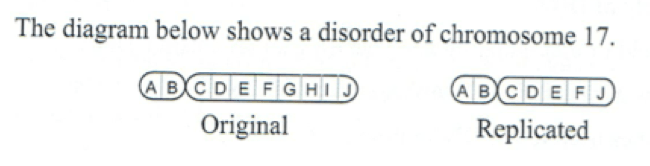
What type of chromosomal mutation has occurred?
a)
substitution
b)
insertion
c)
deletion
d)
nondisjunction