wayground logo

Free Printable Worksheets

Font size

S
M
L
XL
Worksheets

Regents Living Environment

Total questions: 85

Worksheet time: 7hrs 5mins

Name
Class
Date
1.

Humans have an effect on ecosystems when they use native grasslands or forested areas for farming or urban use. One negative effect of these changes on the ecosystem is that there will be

a)

Less biodiversity

b)

More homes

c)

Successful economic growth

d)

Increased food production

2.

The organisms represented by X are

a)

Decomposes

b)

Producers

c)

Carnivores

d)

Scavengers

3.

A certain species of plant serves as the only food for the young larvae of a particular species of butterfly. In a large field, a disease kills all the members of this plant species. As a result of the plant disease, the butterfly population will most likely

a)

quickly adapt to eat other plants

b)

disappear from the area

c)

evolve to form a new species

d)

enter the adult stage more quickly

4.

When handling cat litter, humans can potentially be exposed to a harmful single-celled protozoan. Its primary host is the common domestic cat, but it can also live in humans. This protozoan is an example of a

a)

predator

b)

producer

c)

parasite

d)

scavenger

5.

Certain seaweeds contain a greater concentration of iodine inside their cells than there is in the seawater surrounding them. The energy required to maintain this concentration difference is most closely associated with the action of

a)

ribosomes

b)

mitochondria

c)

vacuoles

d)

nuclei

6.

Doctors sometimes use a vaccine to prepare the body to defend itself against future infections. These vaccines most often contain

a)

antibodies

b)

antibiotics

c)

white blood cells

d)

weakened pathogens

7.

An ameba is a single-celled organism. It uses its cell membrane to obtain food from its environment, digests the food with the help of organelles called lysosomes, and uses other organelles to process the digested food. From this, we can best infer that

a)

all single-celled organisms have lysosomes to digest food

b)

amebas are capable of digesting any type of food molecule

c)

single-celled organisms are as complex as multicellular organisms

d)

structures in amebas have functions similar to organs in multicellular organisms

8.

White blood cells are most closely associated with which two body systems?

a)

circulatory and digestive

b)

immune and circulatory

c)

digestive and excretory

d)

excretory and immune

9.

Carnivorous plants, such as pitcher plants and sundews, live in bogs where many other organisms cannot. Due to the high rate of decomposition occurring in bogs, the environment is acidic and contains very little oxygen and nutrients. The bogs only support certain types of organisms because

a)

organisms in an environment are not limited by available energy and resources

b)

the growth and survival of organisms depends upon specific physical conditions

c)

favorable gene mutations only occur when organisms live in harsh environments

d)

photosynthetic organisms can only inhabit environments that have a low acidity

10.

Anhidrosis is the inability to sweat normally. If the human body cannot sweat properly, it cannot cool itself, which is potentially harmful.

Anhidrosis most directly interferes with:

a)

a feedback mechanism that maintains homeostasis

b)

an immune system response to harmless antigens

c)

the synthesis of hormones in the circulatory system

d)

the enzymatic breakdown of water in cells

11.

The hair colors of the members of a family are listed below.

mother – brown hair

father – blond hair

older son – brown hair

younger son – blond hair

The hair colors of the sons are most likely a direct result of

a)

natural selection in males

b)

heredity

c)

evolution

d)

environmental influences

12.

Carmine, a compound that comes from the cochineal beetle, shown above, is used as a food coloring.The food coloring is not harmful to most people, but in a small number of individuals, it causes a reaction and affects their ability to breathe. This response to carmine is known as

a)

a stimulus

b)

an allergy

c)

natural selection

d)

an adaptation

13.

As a way to reduce the number of cases of malaria, a human tropical disease, a specific DNA sequence is inserted into the reproductive cells of Anopheles mosquitoes. Which process was most likely used to alter these mosquitoes? cloning studies

a)

cloning studies

b)

genetic engineering

c)

natural selection

d)

random mutations

14.

Some salmon have been genetically modified to grow bigger and mature faster than wild salmon. They are kept in fish-farming facilities. Which statement regarding genetically modified salmon is correct?

a)

Genetically modified salmon produce more of some proteins than wild salmon.

b)

Genetically modified salmon and wild salmon would have identical DNA.

c)

Wild salmon reproduce asexually while genetically modified salmon reproduce sexually.

d)

Wild salmon have an altered protein sequence, but genetically modified salmon do not.

15.

Which group of organisms in an ecosystem fills the niche of recycling organic matter back to the environment?

a)

carnivores

b)

decomposers

c)

producers

d)

predators

16.

The use of solar panels has increased in the last ten years. A benefit of using solar energy would include

a)

adding more carbon dioxide to the atmosphere

b)

using less fossil fuel to meet energy needs

c)

using a nonrenewable source of energy

d)

releasing more gases for photosynthesis

17.

In a sewage treatment facility, an optimal environment is maintained for the survival of naturally occurring species of microorganisms. These organisms can then break the sewage down into relatively harmless wastewater. For these microorganisms, the wastewater facility serves as

a)

its carrying capacity

b)

a food chain

c)

an ecosystem

d)

an energy pyramid

18.

The governments of many countries have regulations that are designed to prevent the accidental introduction of nonnative insects into their countries. This is because, in these new habitats, the nonnative insects might

a)

become food for birds

b)

not survive a cold winter

c)

not have natural predators

d)

add to the biodiversity

19.

The process of transferring energy during respiration occurs in a series of steps. This prevents too much heat from being released at one time. Maintaining an appropriate temperature is beneficial to an organism because

a)

enzymes need a proper range of temperatures to catalyze vital reactions

b)

cellular waste products can only be excreted in cooler temperatures

c)

hormones can only produce antibodies if temperatures are not excessive

d)

nutrients diffuse faster into cells when temperatures are lower

20.

Fruits and vegetables exposed to air begin to brown because of a chemical reaction in their cells. This may result in these foods being thrown out. Some people have found that adding lemon juice (citric acid) to apple slices keeps them from turning brown. The prevention of browning is likely the result of

a)

increasing the concentration of enzymes

b)

increasing the temperature

c)

slowing the rate of enzyme action

d)

maintaining the pH

21.

Scientists monitoring frog populations have noticed that the ratio of male frogs to female frogs varies when certain chemicals are present in the environment. The influence of estrogen, for example, has a noticeable effect. In the presence of a higher amount of estrogen, it would be most likely that

a)

fewer males would be found because they are much larger and fewer are produced

b)

fewer females would be found because they are more sensitive to pesticides

c)

more males would be found because estrogen promotes the development of male characteristics

d)

more females would be found because estrogen promotes the development of female characteristics

22.

Which action could humans take to slow the rate of global warming?

a)

Cut down trees for more efficient land use.

b)

Increase the consumption of petroleum products.

c)

Use alternate sources of energy such as wind.

d)

Reduce the use of fuel-efficient automobiles.

23.

Which action could humans take to slow the rate of global warming?

a)

Cut down trees for more efficient land use.

b)

Increase the consumption of petroleum products.

c)

Use alternate sources of energy such as wind.

d)

Reduce the use of fuel-efficient automobiles.

24.

The role of antibodies in the human body is to

a)

stimulate pathogen reproduction to produce additional white blood cells

b)

increase the production of guard cells to defend against pathogens

c)

promote the production of antigens to stimulate an immune response

d)

recognize foreign antigens and mark them for destruction

25.

Since the early 1990s, proton pump inhibitors (PPIs) have been widely used to treat acid reflux disease. Although clinical tests in the 1980s deemed PPIs to be safe for humans, in 2012 the FDA announced warnings that long-term use of PPIs could increase the risk of bone fractures, kidney disease, and some intestinal infections.


Which statement best explains why the safety of PPIs is now in question when clinical experiments in the 1980s provided evidence that they were safe?

a)

Researchers have been able to collect more data than were available in the 1980s.

b)

Fewer people had acid reflux in the 1980s compared to today.

c)

The medication containing PPIs has changed since the 1980s when tests were done.

d)

The original experiments in the 1980s used only test animals and did not use human subjects.

26.

Since the early 1990s, proton pump inhibitors (PPIs) have been widely used to treat acid reflux disease. Although clinical tests in the 1980s deemed PPIs to be safe for humans, in 2012 the FDA announced warnings that long-term use of PPIs could increase the risk of bone fractures, kidney disease, and some intestinal infections.


Which statement best explains why the safety of PPIs is now in question when clinical experiments in the 1980s provided evidence that they were safe?

a)

Researchers have been able to collect more data than were available in the 1980s.

b)

Fewer people had acid reflux in the 1980s compared to today.

c)

The medication containing PPIs has changed since the 1980s when tests were done.

d)

The original experiments in the 1980s used only test animals and did not use human subjects.

27.

The process of embryonic development is represented in the diagram.

The arrows in the diagram each represent a process known as

a)

mitotic cell division

b)

meiotic cell division

c)

fertilization of gamete cells

d)

differentiation of tissues

28.
The failure of the human body to effectively maintain dynamic equilibrium can result in
a)
 reproductive success
b)
 gene manipulation
c)
 differentiation
d)
 disease
29.
Riding a bicycle requires balance and constant adjustment and monitoring by the rider in order to continue cycling. Successfully riding a bicycle most directly results from the ability to
a)
 sexually reproduce
b)
 grow and develop
c)
detect and respond to change
d)
 metabolize food for energy
30.
 The first successful transplant of insulin producing cells from a living donor pancreas was completed in April 2000 in Japan. This enabled the body of the recipient to
a)
regulate fat concentration by a feedback mechanism
b)
provide protection against an infectious disease
c)
 slow down the heart rate after a period of activity ends
d)
 maintain blood sugar levels throughout the day
31.
A 6-year-old child ate a peanut butter sandwich at snack time in school. Five minutes later, her throat became swollen and she collapsed. This allergic reaction occurred because her body
a)
 recognized an antigen in peanut butter and produced antibiotics against it
b)
 digested the white blood cells that can recognize an antigen in peanut butter
c)
 did not recognize an antigen in peanut butter and could not produce antibodies against it
d)
 recognized an antigen in peanut butter and produced an immune response
32.
Which type of organism helps to reduce atmospheric carbon dioxide?
a)
Carnivores
b)
Producers
c)
Decomposers
d)
Herbivores
33.
Which statement best describes an ecosystem maintaining a state of approximate equilibrium?
a)
Nutrients from decayed organisms are recycled in a forest ecosystem.
b)
 All the frog species in a South American rain forest become extinct.
c)
A mutation spreads through a species of bacterium, making them unable to decompose wastes
d)
 Mice are released into a field ecosystem as food for a declining predator population.
34.
In some parts of the world, forests are being cut down and burned to clear land for new homes and new farmland. A negative effect of these activities might be
a)
an increase in global warming
b)
destruction of the ozone shield
c)
 a decrease in the average temperature of the atmosphere
d)
 an increase in biodiversity of the deforested areas
35.
Testosterone directly affects the
a)
formation of a zygote
b)
changes within an ovary
c)
 production of sperm cells
d)
development of a placenta
36.
In the cells of the human body, oxygen molecules are used directly in a process that
a)
 releases energy
b)
 digests fat
c)
synthesizes carbohydrate molecules
d)
 alters the genetic traits of the cell
37.
Which statement explains the importance of maintaining a constant internal environment to ensure proper enzyme functioning?
a)
 Changes in pH and temperature will cause the enzyme reaction rate to be too fast.
b)
Temperature and pH determine amino acid sequences in enzymes
c)
Changes in pH will change the genetic instructions of enzymes
d)
Increasing the temperature and pH can alter the specific shape of enzymes.
38.
Hospital patients are often given intravenous fluids (IVs) to maintain proper levels of water and salts in the body. Great care is used in preparing these solutions. If a manufacturer accidentally prepared a batch of IV fluid that contained much more than the usual amount of salt, harm to the patient could result. The most likely effect on a patient if this incorrectly prepared IV fluid was used is that
a)
water would move into body cells and cause them to burst
b)
 water would move out of body cells and cause them to dehydrate
c)
 salt and water would both move out of body cells and disrupt homeostasis
d)
salt and water would both move into body cells and preserve homeostasis
39.
Which technique could be used to determine the relative number of bases in fragments taken from a sample of DNA?
a)
electrophoresis
b)
cloning
c)
chromatography
d)
light microscopy
40.
Although the digestive system is primarily responsible for the breakdown of food, this process can be disrupted if the circulatory system malfunctions. The best explanation for this disruption is that
a)
human body systems interact with each other to perform life functions
b)
 the circulatory system is the control center of the body
c)
 the digestive system and the circulatory system have many organs in common
d)
the circulatory system is responsible for the coordination of life functions, including the breakdown of food
41.
The resistance to specific pathogens, or disease-causing agents is called _________.
a)
spleen
b)
lymphatic system
c)
anitbodies
d)
immunity
42.
What is the first thing that would happen in this food chain if the grass died?
Sun -> Grass -> Mouse -> Snake -> Hawk
a)
The snake population would increase
b)
the mouse population would increase
c)
the mouse population would decrease
d)
the hawk population would decrease
43.
What is the name given to lichen or algae after a primary succession?
a)
pioneer species
b)
volunteer species
c)
founder species
d)
conqueror species
44.
How much DNA do you receive from one parent in sexual reproduciton
a)
25%
b)
50%
c)
75%
d)
100%
45.
This variable in an experiment is the one being deliberately changed by the scientist. 
a)
dependent variable
b)
independent variable
c)
data
d)
control group
46.

On a karyotype, what is it called when a person has three chromosomes on the 21st pair?

a)

Ups Syndrome

b)

Down Syndrome

c)

The Flu

d)

Common Cold

47.

In mRNA what pairs with Adenine?

a)

Thymine

b)

Cytosine

c)

Guanine

d)

Uracil

48.

What is it called when too many offspring are produced?

a)

Overproduction

b)

Reproduction

c)

Repetition

d)

Competition

49.

If insulin decreases blood sugar, what raises it?

a)

ATP

b)

Glucose

c)

Glucagon

d)

Hormones

50.

Where is DNA stored in a cell?

a)

Nucleus

b)

Cytoplasm

c)

Ribosomes

d)

Vacuole

51.

What is homeostasis?

a)

Being home

b)

Tendency towards a dynamic equilibrium

c)

Cooling of the body

d)

Metabolism

52.

What are the levels of organization?

a)

organelle, cell, tissue, organ, organ system, organism

b)

Tissue, organ system, organelle, organ, cell

c)

Organism, organelle, tissue, organ system, cell, organ

d)

Organism, organ system, organ, tissue, cell, organelle

53.

How many components are in blood?

a)

4

b)

1

c)

9

d)

3

54.

How does hydrolysis work?

a)

Adds water to large molecules to gain smaller molecules

b)

It takes water away from small molecules to make large molecules

c)

It is not a process in the human body

d)

It helps produce progesterone in the female reproductive system

55.

What is this called:

a)

Gel Electrophoresis

b)

Chemical Reaction

c)

Protein Synthesis

d)

Lock and Key Model

56.

The formula for photosynthesis is:

a)

There is no formula

b)

O2+C6H12O6----Chemical Energy--->CO2+H2O+ATP

c)

The formula is unknown

d)

Carbon Dioxide, Water, Chemical Energy, produce glucagon and H2O2

e)

CO2+H2O----Solar Energy--->C6 H12 O6+O2

57.
The analysis of data gathered during a particular experiment is necessary in order to
a)
(1) formulate a hypothesis for that experiment 
b)
(2) develop a research plan for the experiment 
c)
(3) design a control for the experiment 
d)
(4) draw a valid conclusion for that experiment
58.
A student conducted an original, well-designed experiment, carefully following proper scientific procedure. In order for the conclusions to become generally accepted, the experiment must
a)
(1) contain several experimental variables
b)
(2) be repeated to verify the reliability of the data
c)
(3) support the original hypothesis
d)
(4) be conducted by a scientist
59.
Which two cell structures work together in the process of protein synthesis?
a)
nucleus and chloroplast
b)
ribosome and vacuole
c)
nucleus and ribosome
d)
mitochondria and cell membrane
60.
A function of cell membranes in humans is the 
a)
synthesis of the amino acids
b)
production of energy
c)
replication of genetic material
d)
recognition of certain chemicals
61.
A red onion cell has undergone a change, as represented in the diagram below. This change is most likely due to the cell being placed in
a)
distilled water 
b)
salt water 
c)
light 
d)
darkness
62.
In the diagram below; the dark dots indicate small molecules. These molecules are moving out of the cells as indicated by the arrows. The number of dots inside and outside of the two cells represents the relative concentrations of the molecules inside and outside of the cells. ATP is being used to move the molecules out of the cell by
a)
Cell A 
b)
Cell B 
c)
both Cell A and B
d)
neither Cell A or B
63.
The instructions for the traits of an organism are coded in the arrangement of
a)
(1) glucose units in carbohydrate molecules 
b)
(2) bases in DNA in the nucleus
c)
 (3) fat molecules in the cell membrane 
d)
(4) energy rich molecules in starch molecules
64.
Asexually reproducing organisms pass on hereditary information as
 
 
a)
(1) sequences of A, T, C, and G
b)
(2) chains of complex amino acids 
c)
(3) folded protein molecules 
d)
(4) simple inorganic sugars 
65.
Which statement is supported by the information in the graph below?
a)
The enzymes respond in a similar way to changes in temperature.
b)
The enzymes in bacteria function best at 40°C.
c)
The enzymes function best at the same temperature.
d)
The enzymes break down the same substances.Listen
66.
Base your answer to the question on the word equations below and on your knowledge of biology. The equations represent two biochemical processes that occur in living organisms. The letter X represents a molecule produced from process.
Process 1: oxygen + glucose → carbon dioxide + water + X
Process 2: carbon dioxide + water → oxygen + glucose
a)
Process 1
b)
Process 2
c)
Both Process 1 and 2
d)
Neither Process 1 and 2 
67.
Which substance can enter a cell by diffusion without having to be digested?
a)
water 
b)
protein 
c)
starch 
d)
fats
68.
Base your answer to the question on the graph below and on your knowledge of biology. The temperature range in a pond in which all three fish species could grow and survive is most likely
a)
2°C to 8°C
b)
12°C to 18°C
c)
22°C to 28°C
d)
32°C to 38°C
69.
Residents of a town are concerned that a recently built factory could pose health risks. Scientists were asked to investigate the effects of the factory on the health of local residents. The most relevant information they reported was that 
a)
(4) local medical facilities have recently reported a 15% increase in the number of patients treated for asthma
b)
(3) residents have occasionally seen smoke coming from the factory 
c)
(2) there have been reports that other types of factories have been linked with health issues 
d)
(1) in a survey, residents felt that the air in town looks dirtier now 
70.
A farmer wanted to rid his apple trees of a particular leaf-eating insect. He sprayed his trees with an insecticide that killed 98% of the insects. The survival of 2% of this population of insects is most likely due to 
a)
(1) genes obtained from another species 
b)
(2) certain chemicals that stimulated overproduction
c)
 (3) variations that resulted from sexual reproduction 
d)
(4) their ability to produce food from the pesticide
71.
 Which statement is true for all of the organisms in the ecosystem represented in the diagram below? 
a)
Energy is used by the organisms to obtain and transport materials, and to eliminate wastes
b)
Energy stored in inorganic molecules is released during cellular respiration in these organisms. 
c)
Stored energy cannot be used by these organisms as a source of energy for life processes. 
d)
 They use energy to combine the inorganic molecules carbon dioxide and water into energy-rich organic compounds. 
72.
What is it called when cells specialize, and "choose" an identity?
a)
variation
b)
differentiation
c)
biodiversity
d)
abiotic factors
73.
What observation could lead to the conclusion that an object is nonliving?
a)
It passes on hereditary information only through asexual reproduction
b)
It carries out synthesis
c)
It cannot perform metabolic processes
d)
it is composed of a cell, but does not have tissues
74.
A normal sequence of DNA bases in a single human skin cell is CATGGC. If this sequence replicates in this cell and becomes GATGGC, this alteration will most likely be passed to
a)
every cell that develops from it
b)
all human body cells
c)
offspring of the human
d)
all skin cells of this person
75.
Information in segments of human DNA can be expressed by bacterial cells as a result of
a)
sexual reproduction
b)
random mutation
c)
genetic variability
d)
genetic engineering
76.
Natural selection its evolutionary consequences provide a scientific explanation for
a)
the fossil record of ancient life-forms
b)
predictions about the rate of global warming
c)
the amount of precipitation in a rain forest
d)
the amount of soil used to grow certain crops
77.
One function of the male reproductive system in mammals is to
a)
produce insulin necessary for sexual reproduction
b)
transport eggs necessary for fertilization
c)
allow for delivery of gametes needed for reproduction
d)
provide protection for the developing zygote
78.
Nicotine is only one of the many toxic chemicals inhaled while smoking. What effect can such toxic chemicals have on the body?
a)
they stimulate an increase in height
b)
they stimulate uncontrolled cell division
c)
they eliminate carbon dioxide from cells
d)
they eliminate chromosomes from many cells
79.
In the 18th century, Carolus Linnaeus classified organism based on their structural similarities. Modern classification determines relationships more accurately because it is based on genetic and other biochemical similarities. This change in classification method best illustrations that
a)
multiple trials are required to increase the validity of a scientific explanation
b)
scientific explanations are subject to the ethical view of the scientist proposing them
c)
peer review is required to validate the results of scientific investigations
d)
all scientific explanations are tentative and subject to change and improvement
80.
The inability of an organism to produce certain proteins can occur when an organism is lacking an enzyme needed to combine
a)
oxygen molcules
b)
simple sugars
c)
amino acids
d)
biological catalyts
81.

Knowing the type of food consumed by an organism helps to identify the role of the organism in the community. This role is known as its

a)

nesting site

b)

territorial range

c)

biomass

d)

niche

82.
Which activity enables humans to produce new genetic combinations in other organisms?
a)
selecting and breeding the organisms for specific traits
b)
increasing the number of enzymes available to the organisms
c)
 growing organisms that reproduce asexually
d)
 decreasing the amount of DNA in the diet of the organisms
83.
A mutation occurring in a human can be passed from parent to offspring when it occurs in a
a)
lung cell, due to exposure to a toxic gas
b)
 gamete formed in the ovary
c)
 body cell undergoing mitosis
d)
 heart cell with chromosome damage
84.
Base your answer(s) to the following question(s) 8. on the diagram below and on your knowledge of
biology.
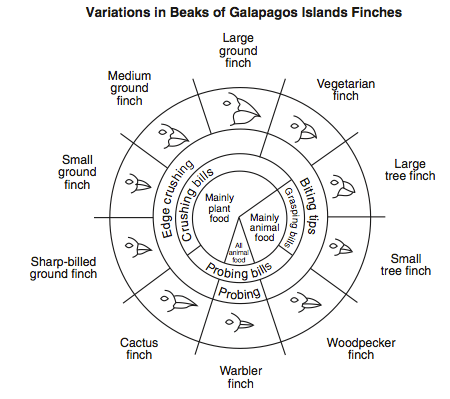
Several of the Galapagos Islands are inhabited by grasshoppers, beetles, flies, bees, and butterflies. Finches that feed on these consumers would have beaks adapted for 

a)
probing, only 
b)
probing or grasping 
c)
crushing or probing 
d)
parrotlike feeding or grasping 
85.
What did the beak type of finches on different islands tell Darwin?
a)
Finch populations evolved over time to favor beaks based on food type
b)
Finch populations had not evolved over time
c)
The finch beaks had no relationship to the available food on the islands
d)
Humans artificially selected finches based on their desired beak type