
 Worksheets
Ecosystems, Population, and Energy Storage
Total questions: 88
Worksheet time: 1hrs 10mins
A population of panthers lives in the southeastern United States. Over 50 years, the size of the panther population in the region increased. What best explains the increase in the size of the panther population?
The panther population is always increasing because no animal eats panthers.
Fewer panthers were born than died.
More panthers were born than died.
A lot of panthers were born and none of them died.
What do birds such as eagles and hawks need energy for?
flying
breathing
digesting food
all of the above

In a rainforest, anteaters eat ants, and ants eat aphids (a type of very small insect). The sizes of the populations have been stable for the last 10 years, but recently the size of the aphid population decreased. What will likely happen to the anteater population?
stay the same. Anteaters do not eat aphids, so the number of births and deaths in the anteater population will stay the same.
decrease. Fewer energy storage molecules will be available to the anteater population from the smaller ant population, so the anteater population will reproduce less. This will lead to fewer births than deaths in the anteater population.
decrease. A decrease in the size of any population leads to a decrease in the sizes of all other populations in an ecosystem.
increase. The smaller aphid population will leave more energy storage molecules available in the ecosystem for the anteater population, so there will be more births in the anteater population.
A population of deer lives in Canada. Over 50 years, the size of the deer population decreased. What best explains the decrease in the size of the deer population?
A lot of deer died and no deer were born.
Fewer deer were born than died.
The deer population is always decreasing because deer are always being eaten.
More deer were born than died.

Scientists have been studying the size of three populations in a grassland. In this ecosystem, hawks (a type of large bird) eat sparrows (a type of small bird), and sparrows eat seeds from buckwheat. The data showed that all three populations were stable. Then the hawk population increased suddenly. What will likely happen to the size of the sparrow population as a result?
stay the same. The size of their resource population did not change, so the amount of energy storage molecules available for the sparrows did not change. There will be the same number of births and deaths in the sparrow population.
decrease. The larger hawk population will leave fewer energy storage molecules available for the sparrows, so the sparrow population will reproduce less. This will lead to fewer births in the sparrow population.
decrease. The larger hawk population will need more energy storage molecules, so they will eat more sparrows. This will leads to more deaths than births in the sparrow population.
increase. An increase in any population leads to an increase in the sizes of all other populations in the ecosystem.
What do mammals like tigers and zebras need energy for?
running
breathing
digesting food
all of the above
Two organisms fighting for the same resources is known as:
predation
competition
symbiosis
dancing
Energy storage molecules are:
molecules required only for the birth rate
potatoes
a molecule organisms use to stabilize a population
a molecule that organisms can use to release the energy needed to survive
A scientist who studies ecosystems is known as:
chemist
biologist
ecologist
zoologist
A resource population is:
a population that is avoided by organisms
a population that is eaten by organisms from another population
a population that is traded between organisms
a flea

The graph shows that the honeybee population was stable and then decreased. Which statement describes births and deaths when the honeybee population was stable?
There was the same amount of births and deaths.
There were more births than deaths.
There were fewer births than deaths.
There were no deaths.
Which statement describes births and deaths when the population was decreasing?
There was the same amount of births and deaths.
There were more births than deaths.
There were fewer births than deaths.
There were no deaths.

The diagram above is called a food web. It shows the relationship between foxes and voles. What does the food web show?
foxes eat voles
voles eat foxes
voles compete with foxes
foxes compete with voles

A population of Tule Elk lives in Bakersfield. Over 150 years, the size of the Tule Elk population decreased. What best explains the decreased in the size of the Tule Elk population?
A lot of Tule Elk were born and none of them died.
The Tule Elk population is always increasing because no animal eats Tule Elk.
Fewer Tule Elk were born than died.
More Tule Elk were born than died

When a populations is known to be STABLE, it:
there are more deaths
stays mostly the same, over time
there are more births
horses live there

Energy storage molecules are:
molecules required only for the birth rate
potatoes
a molecule organisms use to stabilize a population
a molecule that organisms can use to release the energy needed to survive

What do you think would happen to the lion population if the hyena population increases in size? Assume that the populations were stable before this change.
The lion population would increase.
The lion population would not change.
The lion population would decrease.
The hyena population would increase.

A ________________________________ is all the living and non-living things interacting in a particular area.
Populations
Sample
Ecosystem
Organism

In the Arctic Ocean, sharks eat whales, and whales eat crabs. In the last 10 years, the sizes of the populations have been stable, but recently the size of the crab population increased. What will likely happen to the shark population?
The size of the shark population will . . .
decrease. The larger crab population will leave fewer energy storage molecules available in the ecosystem for the shark population, so there would be fewer births in the shark population.
stay the same. Sharks do not eat crabs, so the number of births and deaths in the shark population will stay the same.
increase. More energy storage molecules will be available to the shark population from the larger whale population, so the shark population will reproduce more. This will lead to more births than deaths in the shark population.
increase. An increase in the size of any population leads to an increase in the sizes of all other populations in an ecosystem.
Glucose is an example of ....?
A molecule
An atom
Never heard of that word
An energy storage molecule
When something remains mostly the same over time it is said to have....?
Uneventful
Potential Energy
Stability
Boring
The process of creating offspring is called....?
Sample
Resource Population
Reproduction
Ecosystem
Living things such as plants, animals and bacteria are.....?
Populations
Organisms
Ecosystems
Resource Populations
A small part that is meant to show what the whole is like...?
A piece of something
A fraction
A sample
Competition
An example of stability would be.....?
An increase of births and a decrease of deaths
An increase of deaths and a decrease of births
Both births and deaths are equal
Both births and deaths are unequal
A population of tigers lives in Bangladesh. Over 30 years, the size of the tiger population increased. What best explains the increase in size of the tiger population?
A lot of tigers were born and none of them died
The tiger population is always increasing because no animal eats tigers
Fewer tigers were born than died
More tigers were born than died
A population of mice lives in the northeastern United States. Over the past 40 years, the size of the mouse population decreased. What best explains the decrease in the size of the mouse population?
Fewer mice were born than died
A lot of mice died and no new mice were born
More mice were born than died
The mouse populations is always decreasing because mice are always being eaten
In the Arctic region, polar bears eat seals, and seals eat cod(fish). The past 5 years the sizes of all populations were stable, but recently the size of the polar bear population decreased. What will probably happen to the cod(fish) population?
Increase
Stay the same
Decrease
Not sure
A hawk eats a snake, which has eaten a frog, which has eaten a grasshopper, which has eaten grass. This is an example of .......?
An ecosystem
A food web
Consumer population
Transfer of food energy
Which jelly fish sampling method will give you a estimate of a population over time?
The dip net method
The trawling method once a month
Neither method
Both methods
Which jelly fish sampling method will give you a look at the organism instead of a look at the population?
The trawling method
The net dipping method
Neither method
Scanning method
In an experiment where 2 groups of crickets were given different amounts of sugar in their food. Sugar is a type of energy storage molecule. Group A was given more sugar than Group B,which was given less sugar. Which group reproduced more?
Group A reproduced more
Group B reproduced more
Neither Group A or Group B reproduced
Both Group A and Group B reproduced the same
The sockeye salmon require a lot of energy during reproduction due to.....?
Jumping 12 feet over water falls to get to their laying grounds
Digging 4 or 5 gravel nests at the bottom of the stream to lay their eggs
Females fighting other females to get the best nesting spots
Laying 1,200 eggs in each nest
An example of a population is
all trees in a forest
all maple trees in a forest
all plants in a forest
all animals in a forest
A group of different species that live together and interact in an environment are called a/an ________.
community
habitat
population
ecosystem

In a forest ecosystem, which of the following is the best example of a limiting factor for a rabbit population?
Squirrel Population
Sunlight
Grass available
Fungi growth
foxes


Moon Jelly populations are decreasing. Why?
There are more births than deaths
There are less births than deaths
The population is stable

What do organisms use energy for?
Digesting food
Reproduction
Moving around
Everything they do to survive

The Human population is increasing worldwide. What does that mean?
More births than deaths
Less births than deaths
A lot of births and NO deaths
There is an equal number of births and deaths
A resource population is:
a population that is avoided by organisms
a population that is eaten by organisms from another population
a population that is traded between organisms
a flea


Consumers that eat only plants
Carnivores
Omnivores
Herbivores
Scavengers
Consumers that eat both plants and animals
Omnivores
Carnivores
Herbivores
Scavengers
Consumers that feed on the bodies of dead organisms
Carnivores
Omnivores
Herbivores
Scavengers
A food _______ is a series of events in which one organism eats another and obtains energy.
chain
web
pyramid
plate
A food _______ consists of many overlapping food ________.
web, chains
chain, webs
pyramid, webs
web, pyramids
As you work your way up the energy pyramid, what happens to the energy?
It increases
It decreases
It stays the same
Nothing

In the food web above, what eats the rabbit?
Fox
Hawk
Vole
Grass

In the food web above, what organism is missing from this food chain:
Grass --> Slug --> ________ --> Hawk
Vole
Frog
Insect
Thrush

In the energy pyramid, what is the bottom level composed of?
Producers
First-Level Consumers
Second-Level Consumers
Third-Level Consumers
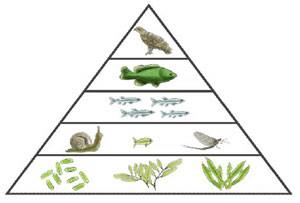
In the energy pyramid, what comes after the producers?
Producers
First-Level Consumers
Second-Level Consumers
Third-Level Consumers

Which organelle is responsible making food (Glucose) using sunlight?
Cell Membrane
Nucleus
Chloroplast
Mitochondria
Select all that are products of Photosynthesis.
Water
Carbon Dioxide
Oxygen
Sunlight (Light Energy)
Glucose (Sugar/food)

Exit: Carbon dioxide
Exit: Glucose
Exit: Oxygen
Exit: Water vapor
Which of the following is the correct equation for PHOTOSYNTHESIS?
light + carbon dioxide + water --> glucose + oxygen
carbon dioxide + sugar + water --> oxygen + light
oxygen + light + water --> carbon dioxide + sugar
carbon dioxide + oxygen + water --> Light+ Sugar


