Wayground logo

Free Printable Worksheets

Font size

S
M
L
XL
Worksheets

Conduction Convection Radiation plus what do you remember

Total questions: 50

Worksheet time: 41mins

Name
Class
Date
1.

What are the three types of heat transfer?

a)

Radaition, Conduction, Convection

b)

Radiation, Conductors, Sun

c)

Insulator, Radiation, Conuction

d)

Thermal Energy, Sun, Heat

e)

Radiation, Conduction, Convection

2.

Which of the following is a type of energy that travels as electromagnetic waves and releases heat to it's surroundings?

a)

Convection

b)

Radiators

c)

Radaition

d)

Radiation

3.

A pot is on a burning stove, what heat transfer is causing the handle to get hot?

a)

Conudction

b)

Convection

c)

Conduction

d)

Radiation

4.

Jonesy has a flamethrower he puts a wooden box in front of him. He torches it and it is now a pile of ashes. what type of heat transfer cause it to burn?

a)

Convection

b)

Coduction

c)

Radiation

d)

Conduction

5.

Jimmy is a astronaut, when he was in space he drifted close to the sun. He said that he felt the hottest he had ever felt. What kind of heat transfer caused this?

a)

Radaition

b)

Radiation

c)

Convection

d)

Conduction

6.

Mike was trying to light a match, when he did he accidently burned his hand. What kind of heat transfer allowed this to happen?

a)

Conduction

b)

Convection

c)

Radiation

7.

What is heat?

a)

Heat

b)

Energy

c)

Thermal energy

d)

Thermal conductivity

8.

Makai is boiling water in a pot on the stove. He wonders how all of the water in the pot gets hot even though only the bottom level of the water is near the heat source. What kind of heat transfer causes all of the water to get hot?

a)

Conduction

b)

Convectoin

c)

Convection

d)

Conuction

9.
What kind of heat transfer happens when the sun is heating your body?
a)
Conduction
b)
Radiation
c)
Convection
d)
Density
10.
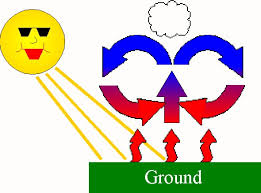
Warm air rises and the cool air sinks demonstrates this type of heat transfer. 
a)
conduction
b)
convection
c)
radiation
d)
Insolation 
11.
Ironing a shirt is an example of...
a)
condensation
b)
conduction
c)
convection
d)
radiation
12.
Transfer of thermal energy through "space"
a)
conduction
b)
convection
c)
radiation
13.
Warm air is __________ dense than cold air and rises creating convection currents.
a)
more
b)
less
14.
"Lava lamps" contain colored liquids. These liquids form globs that rise to the top due to
a)
conduction
b)
convection
c)
radiation
15.
How many kinds of heat transfer are there?
a)
1
b)
2
c)
3
d)
4 or more
16.
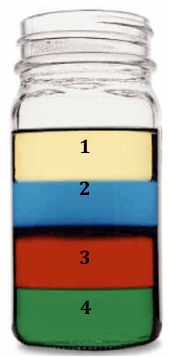
Put the liquids in order from most dense to least dense?
a)
4, 3, 2, 1
b)
1, 2, 3, 4
c)
3, 4, 2, 1, 
d)
4, 3, 1, 2
17.

A hot air balloon rising is an example of ...

a)

conduction

b)

convection

c)

radiation

d)

connection

18.

A snowman melting in the sun

a)

convection

b)

conduction

c)

radiation

d)

connection

19.

Warming up near a campfire is an example of ...

a)

conduction

b)

convection

c)

radiation

d)

connection

20.

What is the Energy Conversion that is shown in the image?

a)

Chemical to Mechanical

b)

Thermal to Chemical

c)

Chemical to Thermal

d)

Mechanical to Chemical

21.

What is the Energy Conversion that is shown in the image?

a)

Radiant to Thermal

b)

Thermal to Chemical

c)

Chemical to Radiant

d)

Radiant to Chemical

22.

At what point does Potential Energy transform into Kinetic Energy?

a)

Point A

b)

Point B

c)

Point C

d)

Point D

23.

At what point does the biker have the greatest Potential Energy?

a)

Point A

b)

Point B

c)

Point C

d)

Point D

24.

Which of the following is not a method for heat transfer

a)

Radiation

b)

Insulation

c)

Conduction

d)

Convection

25.

In which of the following state are the particles closest together?

a)

Fluid

b)

Gas

c)

Liquid

d)

Solid

26.

Heating a room with a fireplace

a)

Conduction

b)

Convection

c)

Radiation

27.
What is the definition of CONDUCTION?
a)
When heat is transferred from objects like rays of light or electromagnetically.
b)
a  hot liquid or air that  expands, becomes less dense, and rises or becomes more dense, and sinks.
c)
When heat transfers from objects that are touching.
d)
When heat transfers through the heater or AC in your house.
28.
What is the definition of CONVECTION
a)
When heat transfers through waves.
b)
When heat transfers from objects that are touching.
c)
a  hot liquid or air that  expands, becomes less dense, and rises or becomes more dense, and sinks.
d)
Heat traveling from the sun
29.
What is a coefficient?
a)
The small number on the right of the chemical symbol.
b)
The large number to the left of a formula.
30.
Which side of a chemical equation is the product side?
a)
Left (before the arrow)
b)
Right (after the arrow)
31.
Which side of a chemical equation is the reactant side?
a)
Left (before the arrow)
b)
Right (after the arrow)
32.
Which problem is balanced?
a)
PbO2 + 2H2
b)
SO2 + H20 --> H2SO4
c)
2Na + 2H2O --> 2NaOH + H2
33.
What is the arrow in a chemical equation...
H2 + O --> H2O
a)
Reactants
b)
Products 
c)
Produces
d)
Chemical Equation 
34.
Balance this equation.
_Mg + _Cl2 --> _MgCl2
a)
1, 2,1
b)
already balanced
c)
2,1,1
d)
1,1,2
35.
What does the Law of Conservation of Mass state?
a)
Matter cannot be gained or lost in a chemical reaction.
b)
Matter can only be lost in a chemical reaction.
c)
Matter can only be gained in a chemical reaction.
d)
Matter can be gained and lost in a chemical reaction. 
36.
KNO3 --> KNO2 + O2
What coefficients are needed to balance the reaction?
a)
2, 2, 1
b)
2, 3, 2
c)
1, 2, 2
d)
1, 3, 1
37.
Balance this equation-
__P4 + __O2 --> __P2O3
a)
it is already balanced
b)
2, 1, 3
c)
1, 2, 3
d)
1, 3, 2
38.
Which side of a chemical equation is the reactant side?
a)
Left (before the yields sign)
b)
Right (after the yields sign)
39.
Which problem is balanced?
a)
PbO2 + 2H2
b)
SO2 + H20 --> H2SO4
c)
2Na + 2H2O --> 2NaOH + H2
40.
What is the little number after an element in a chemical equation called.
Example: H2
a)
Coefficient 
b)
Subscript
c)
Atom
d)
Equation
41.

The two sides of a chemical equation are called?

a)

Reactants (left) and Products (right)

b)

Ingredients (left) and Product (right)

c)

Cations and Anions

d)

Reactants (left) and Results (right)

42.
How many atoms are there TOTAL in:
H2SO4
a)
6
b)
5
c)
7
d)
3
43.
How many Hydrogen are in 4H2O?
a)
6
b)
8
c)
2
d)
4
44.
2H2 + O2 ----> 2H2O What is the product?
a)
------>
b)
2H2O
c)
2H2+ O2
45.
How many elements are in C6H12O6?
a)
1
b)
2
c)
3
d)
4
46.
How many atoms are there TOTAL in:
H2SO4
a)
6
b)
5
c)
7
d)
3
47.
How many Sodium (Na) are in 6NaCl?
a)
1
b)
12
c)
6
48.
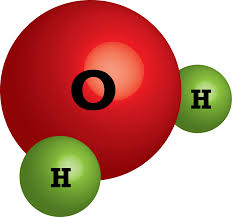
How many atoms of Hydrogen are in this compound
a)
1
b)
2
c)
3
d)
4
49.
How many elements are in C6H12O6?
a)
1
b)
2
c)
3
d)
4
50.
A pure substance that cannot be broken down into simpler substances.
a)
element
b)
compound
c)
molecule
d)
carbon dioxide