wayground logo

Free Printable Worksheets

NEW

Font size

S
M
L
XL
Worksheets

AP Exam Review Units 1-3

Total questions: 64

Worksheet time: 42mins

Name
Class
Date
1.
Which of the following best summarizes the relationship between dehydration reactions and hydrolysis?
a)
Hydrolysis only occurs in the urinary system, and dehydration reactions only occur in the digestive tract.
b)
Hydrolysis creates monomers, and dehydration reactions break down polymers.
c)
Dehydration reactions can occur only after hydrolysis.
d)
Dehydration reactions assemble polymers, and hydrolysis breaks down polymers.
2.
What is the molecule illustrated in the figure below?
a)
a trans polyunsaturated triacylglyceride
b)
a steroid similar to cholesterol
c)
a saturated fatty acid
d)
an unsaturated fatty acid
3.
What is this molecule? (hint: Count the C:H:O)
a)
disaccharide
b)
monosaccharide
c)
polysaccharide
d)
starch
4.
What element is found in proteins and nucleic acids but not carbs nor lipids?
a)
carbon
b)
hydrogen
c)
nitrogen
d)
oxygen
5.
Alpha helix and beta pleated sheets are part of what level of protein structure?
a)
primary
b)
secondary
c)
tertiary
d)
quaternary
6.
Why do lipids provide longer lasting energy than Carbohydrates?
a)
They have many more C-H bonds
b)
They have fewer C-H bonds
c)
They have more Oxygen
d)
They have less Oxygen
7.
The 20 different amino acids found in polypeptides exhibit different chemical and physical properties because of different
a)
amino groups attached to an alpha  carbon
b)
asymmetric carbons.
c)
carboxyl groups attached to an alpha  carbon
d)
side chains (R groups).
8.
Water is polar because...
a)
The unequal sharing of electrons gives the water molecule a slight negative charge near its oxygen atom and a slight positive charge near its hydrogen atoms.
b)
The molecule has two poles, at which the it is colder than other regions of the molecule.
c)
The unequal sharing of electrons gives the water molecule a slight negative charge near its hydrogen atoms and a slight positive charge near its oxygen atom.
d)
The water molecule is neutral.
9.
Water molecules require a lot of energy to break the hydrogen bonds.  This gives water a high
a)
density
b)
polarity
c)
solvency
d)
specific heat
10.
What property of water allows it to be such a versatile solvent that it is often called the "universal solvent?"
a)
Purity
b)
Polarity and cohesion
c)
High heat capacity
d)
Expansion upon freezing
11.
Some insects can stand on the surface of calm water. Their feet push the surface of the water down slightly, but they do not break the surface. Why?
a)
The insects are light enough so they do not break the hydrogen bonds holding the water molecules together
b)
The insects actually use their wings to hover slightly above the water’s surface and they only skim it with their feet.
c)
The insect’s feet are non-polar, so they are repelled by the polar water molecules and are pushed away from the water’s surface.
d)
The insects are small enough to see the individual water molecules, so they are able to step carefully from one molecule to the next
12.
Why does water move from the roots to the leaves of plants?
a)
Water is pushed by solutes.
b)
Capillary action pulls the water molecules like a chain.
c)
Water is pulled by gravity.
d)
Water’s cohesion causes it to “pull” towards the leaves.
13.

Pure water has a pH of

a)

6

b)

15

c)

3

d)

7

14.
Plants can lose water absorbed by roots through the leaves during which process?
a)
reproduction
b)
cellular respiration
c)
transpiration
d)
photosynthesis
15.
What is the effect of increasing humidity on transpiration?
a)
It increases transpiration rate
b)
It decreases transpiration rate
16.
What is the effect of increasing leaf area on transpiration?
a)
It increases transpiration rate
b)
It decreases transpiration rate
17.
For cells to stay alive they require what type of SA:V?
a)
Large SA, Large V
b)
Small SA, Large V
c)
Large SA, Small V
d)
Small SA, Small V
18.
Which way would the purple molecules move through the semi-permeable membrane?
a)
From the  A side  to the B-side
b)
From the B side to the A side
c)
none of the purple molecules would move
d)
they would move equally back and forth in a state of dynamic equilibrium
19.
A saltwater snail is placed in freshwater. What happens to its cells?
a)
They shrink
b)
They swell
c)
Nothing happens
20.
Which of the following is responsible for getting large or charged (polar) molecules across the cell membrane?
a)
E
b)
B
c)
C
d)
D
21.
Which type of membrane protein would likely be most easily removed in a laboratory experiment?
a)
Integral membrane proteins
b)
Channel proteins
c)
Peripheral membrane proteins
d)
Transmembrane proteins
22.
If a hospital patient is mistakenly given an IV of pure water instead of a saline solution that is isotonic to blood, the patient’s red blood cells will
a)
shrink and collapse
b)
release water to the plasma along its concentration gradient
c)
absorb water from the plasma and eventually burst
d)
transport equal amounts of water across the cell membrane in both directions
23.
In a hypothetical study, cells are placed in a solution of glucose in which the concentration of glucose is gradually increased. At first, the rate at which glucose enters the cells is found to increase as the concentration of the glucose solution is increased. But when the glucose concentration of the solution is increased above 10 M, the rate no longer increases. Which of the following is the likely mechanism for glucose transport into these cells?
a)
Facilitated diffusion via a carrier protein
b)
Facilitated diffusion via a channel protein
c)
Pinocytosis
d)
Tertiary active transport
24.
Which statement about cholesterol molecules is true?
a)
They help hold a membrane together.
b)
They alter the fluidity of the membrane.
c)
They attach to carbohydrates.
d)
They disrupt membrane function.
25.
The plasma membranes of winter wheat are able to remain fluid when it is extremely cold by
a)
synthesizing new forms of cholesterol
b)
closing protein channels
c)
decreasing the number of hydrophobic proteins present
d)
replacing saturated fatty acids with unsaturated fatty acids
26.

If a cells  Ψp\Psi p = 3 bars and its  Ψs\Psi s = -4.5 bars, what is the resulting  Ψ\Psi  ?

a)

-7.5

b)

7.5

c)

-1.5

d)

1.5

27.

The cell from question 1 is placed in a beaker of sugar water with Ψs\Psi s  = -4.0 bars.  In which direction will the net flow of water be?

a)

Out of the cell

b)

Into the cell

c)

Both into and out of the cell

d)

Neither into nor out of the cell

28.

The value for  Ψ\Psi  in root tissue was found to be -3.3 bars.  If you take th root tissue and place it in a 0.1 M solutin of sucrose at 20 °\degree C in an open beaker, what is the  Ψ\Psi  of the solution, and in which direction would the net flow of water be?

a)

 Ψs\Psi s  = -3.3, net flow into the root

b)

 Ψs\Psi s  = 3.3, net flow out of the root (into the solution)
c)

 Ψs\Psi s  = -2.43, net flow into the root

d)

 Ψs\Psi s  = 2.43, net flow out of the root (into the solution)

29.
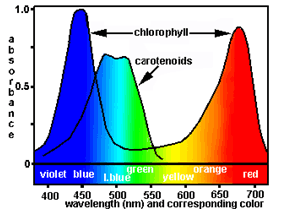
What is one function of the other pigments  besides chlorophyll, in the chloroplast?
a)
to block damaging wavelengths of light
b)
to absorb different wavelengths than the chloroplasts
c)
to provide different colors to the leaves
d)
to transfer energy to a separate photosystem beside the one using chlorophyll a and b.
30.
What is the primary function of the light reactions of photosynthesis?
a)
To produce glucose
b)
To produce NADPH and ATP
c)
To use ATP
d)
To produce RuBP
31.
The light reactions occur in the ________ and the dark reactions take place in the ________.
a)
Chloroplast / thylakoid membrane
b)
stroma / thylakoid
c)
mesophyl / stomata
d)
thylakoid membrane / stroma
32.
Where does the carbon come from that is used to form glucose?
a)
The soil
b)
CO2 in the air
c)
From other carbohydrates
d)
Calvin Cycle
33.
When oxygen is released as a result of photosynthesis, it is a direct by-product of
a)
reducing NADP+
b)
splitting water molecules
c)
chemiosmosis
d)
electron transfer in photosystem II and I
34.
What is the primary function of the Calvin cycle?
a)
regenerate ATP for use in the light reactions of photosynthesis
b)
produce carbon dioxide for use in the light reactions of photosynthesis
c)
produce oxygen by oxidizing water
d)
produce simple sugars from carbon dioxide
35.

What is the name of the microscopic holes in leaves that are opened and closed to allow water to TRANSPIRE?

a)

water doors

b)

stomata

c)

leaf eyes

d)

transpiration holes

36.

What is the purpose of the XYLEM?

a)

To bring food from the soil to the whole plant.

b)

To carry water and nutrients from the roots to the whole plant.

c)

To carry food from the chloroplasts around to all parts of the plant.
37.
Homeostasis
a)
allows for a wildly fluctuating internal environment
b)
is impossible in vertebrates
c)
is the maintenance of a relatively stable internal environment and often incorporates a form of feedback regulation
d)
is the maintenance of a relatively stable external environment and often incorporates a form of feedback regulation
38.
If the environment gets cold, we will often shiver in order to:
a)
keep body temperature the same as the external temperature
b)
decrease body temperature
c)
increase body temperature
d)
regulate blood pressure
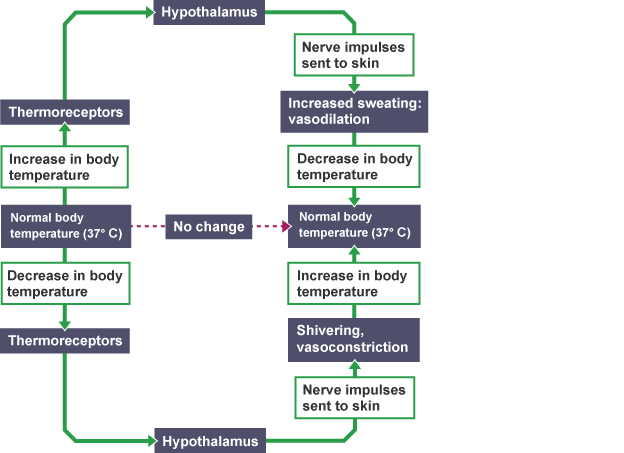
39.
What type of feedback loop is shown?
a)
Positive
b)
Neutral
c)
Negative
40.
Negative Feedback Loops:
a)
amplify processes
b)
prevent small changes from getting larger
c)
are initiated during childbirth
d)
are found only in plants
41.
When glucose levels in the blood rise, your brain sends a signal to your pancreas. The pancreas releases insulin, which opens channels in cell membranes to allow glucose to enter the cell, lowering blood sugar levels. 
a)
Positive Feedback Response
b)
Negative Feedback Loop 
42.
As you get dehydrated, your blood becomes thicker and harder to pump. Your kidneys will respond by stopping urine production, sending the water from urine into your bloodstream to thin your blood back to normal level.
a)
Positive Feedback Response
b)
Negative Feedback Loop 
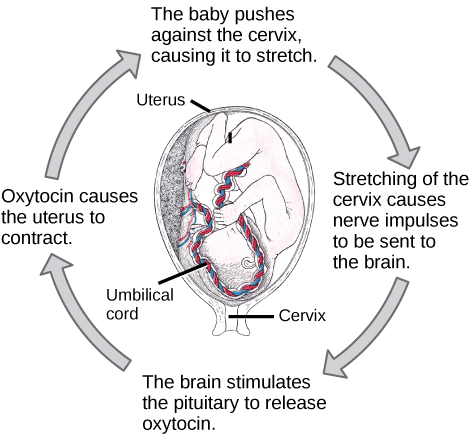
43.
What type of feedback loop is shown?
a)
negative
b)
neutral 
c)
positive
44.
Which of these is NOT true?
a)
Enzymes can denature (change shape) when the temperature gets too high.
b)
Enzymes can only be used once in a chemical reaction. 
c)
Extreme pH can denature enzymes.
d)
Enzymes speed up chemical reactions. 
45.

Which of the following is directly responsible for the shape of an enzyme/protein?

a)

The amino acid sequence of the protein and the properties of the amino acids that make up the protein.

b)

The temperature of the surrounding environment.

c)

The pH of the surrounding environment.

d)

The amount of substrate present.

46.
Blocking Active site of an enzyme
a)
competitive inhibition
b)
allosteric inhibition
47.

If a mutation occurs in a DNA sequence that codes for an enzyme, what is the most likely result?

a)

There will likely be no change in the shape and function of the enzyme.

b)

The enzyme will most likely fold in a way that makes its shape incompatible with the substrate and the enzyme will not function correctly.

c)

The enzyme will not be produced at all.

d)

The enzyme will have an enhanced ability to bind with the substrate.

48.
Vitamin C
a)
Cofactor
b)
Coenzyme
c)
Competitive inhibitor
49.
Zinc and Iron
a)
Coenzymes
b)
Cofactors
c)
Organic
50.
What was the substrate in our enzyme lab?
a)
Hydrogen peroxide
b)
Catalase
c)
Yeast
d)
Oxygen gas
51.
Large numbers of ribosomes are present in cells that specialize in producing which of the following molecules?
a)
glycogen
b)
cellulose
c)
proteins
d)
lipids
52.
Increasing the substrate concentration in an enzymatic reaction could overcome which of the following?
a)
denaturation of the enzyme
b)
noncompetitive inhibition
c)
allosteric inhibition
d)
competitive inhibition
53.
Which of the following would likely move through the lipid bilayer of a plasma membrane most rapidly?
a)
CO2
b)
an amino acid
c)
starch
d)
glucose
54.
Binding of a signaling molecule to which type of receptor leads directly to a change in the distribution of ions on opposite sides of the membrane?
a)
phosphorylated tyrosine kinase dimer
b)
ligand-gated ion channel
c)
receptor tyrosine kinase
d)
G protein-coupled receptor
55.
Which temperature and pH profile curves on the graphs were most likely generated from analysis of an enzyme from a human stomach where conditions are strongly acid?
a)
curves 2 & 5
b)
curves 1 & 5
c)
curves 1 & 4
d)
curves 2 & 4
56.
hold/store water, mainly found in plant cells
a)
nuclolus
b)
ribosomes
c)
golgi bodies
d)
vacuoles
57.
____________ & _________________ are organelles that definitely arose from endosymbiosis.
a)
Rough ER & Smooth ER
b)
Mitochondria & Flagellum
c)
Chloroplast & Mitochondria
d)
Chloroplast and Golgi apparatus
58.

What did the host cell receive from its endosymbiont (cell living inside of it)?

a)

Shelter

b)

Energy

c)

Motility/movement

d)

Reproduction

59.

What did the endosymbiont (cell living inside another) receive from its host cell?

a)

Shelter

b)

Motility

c)

Energy

d)

Reproduction

60.
This term refers to the production of ATP without oxygen being present.
a)
anaerobic
b)
prokaryotic
c)
biogenic
d)
organic
61.
What is the correct equation for cellular respiration?
a)
6O2 + C6H12O6 -> 6CO2 + 6H2O + Energy
b)
6O2 + C6H12O6 + Energy -> 6CO2 + 6H2O
c)
6CO2 + 6H2O -> 6O2 + C6H12O6 + Energy
d)
6CO2 + 6H2O + Energy -> 6O2 + C6H12O6
62.
What is the main job of the electron carriers in cellular respiration? 
a)
Transport electrons and hydrogen atoms to the electron transport chain 
b)
Capture energy throughout the process of cellular respiration
c)
Provide the reactants for the process of cellular respiration
d)
Pump positive hydrogen ions and shuttle electrons across the electron transport chain and contribute to chemiosmosis
63.
Cellular respiration involves the net _______ of glucose.
a)
Reduction
b)
Oxidation
c)
ATP
d)
REDOX
64.
What enzyme in the ETC is responsible for generating the ATP molecules?
a)
ATPase
b)
ATP synthase
c)
Hexokinase
d)
none of the above