
 Worksheets
Periodic Table Test Review 8.5ABC
Total questions: 40
Worksheet time: 3hrs 20mins
protons & neutrons
proton
electron
neutron
If you subtract the atomic mass (rounded) and the atomic number, you calculate...
the number of protons & neutrons in the nucleus
the number of electrons in the cloud
the number of neutrons in the atom's nucleus
the number of protons in the atom's nucleus

Electrons in the outermost energy level are called...
Valence Electrons
Protons
Neutrons
Electrons
Elements in the same _________ have the same number of valence electrons.
Period
Group
Elements that do not conduct well, such as metalloids, are called___________
Semiconductors
Metals
Non Metals
Conductors
Number of electron shells
An atom has 18 protons and 8 valence electrons. Which statement would best identify this element?
The element is unreactive (stable) because of its 8 valence electrons.
The element has an atomic mass of 18.
The element is reactive because of the eight valence electrons.
The element is a metal.
Poor conductor of heat and electricity (insulator) is a property of ___________.
metals
nonmetals
metalloids

What group number would this element belong in?
Group 8 (8B)
Group 3 (3B)
Group 18 (8A)
Group 17 (7B)

Which statement describes the reactivity of this element?
highly reactive because it has 3 energy levels
least reactivity because it has 7 valence electrons
highly reactive because it has 7 valence electrons
least reactivity because it is in group 17

Which elements would have similar reactivity as the element shown in the picture?
Helium (He), Neon (Ne), Argon (Ar)
Beryllium (Be), Magnesium (Mg), Calcium (Ca)
Fluorine (F), Chlorine (Cl), Bromine (Br)
Sulfur (S), Selenium (Se), Tellurium (Te)

Which element shown is least reactive (stable)?
Neon (Ne)
Chlorine (Cl)
Gallium (Ga)
Tin (Sn)

Which descriptions below apply to this atom? You may select more than one answer.
the element is stable and a noble gas
the element is Argon because it has 18 protons
the element is in period 3 because it has three energy levels
the element is in group 18 because it has 8 valence electrons

Sodium (Na) has an atomic number of 11, how many protons would an atom of Sodium (Na) have?

Which group on the periodic table contains elements that are all non reactive (stable)?
Group 1 (1A) Alkali metals
Group 2 (2A) Alkaline earth metals
Group 17 (7A) Halogens
Group 18 (8A) Noble gases
Which is a member of Group 1 (Alkali metal)?
Magnesium
(Mg)
Iron
(Fe)
Sodium
(Na)
Europium
(Eu)
Which is a member of Group 17 (Halogen)?
Helium
He
Chlorine
Cl
Oxygen
O
Neptunium
Np
Elements in a .................. have similar chemical properties.
period
group
row
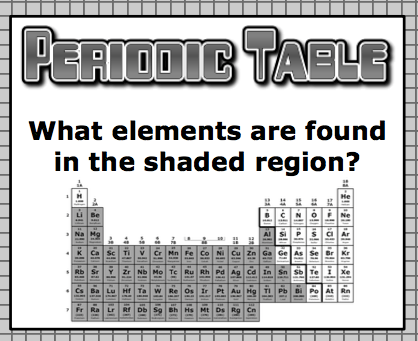
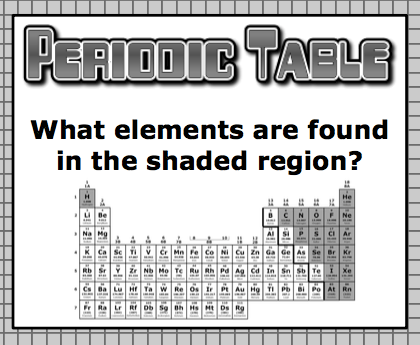
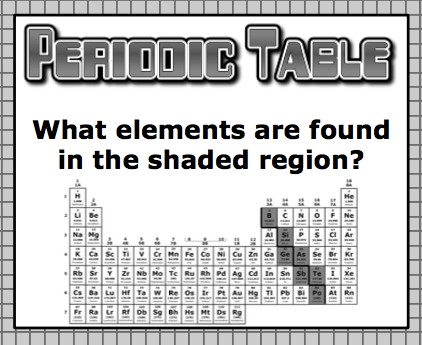
Select the diagram that highlights the group with the most reactive metals.


These two elements have similar chemical properties to Barium (Ba).
Calcium (Ca) and Radium (Ra), because they are in the same group.
Cesium (Cs) and Lanthanum (La), because they are in the same period number.
Calcium (Ca) and Yttrium (Y), because they are close to each other.
Metals are found on the ______________ side of the periodic table.
nonmetals
left
right
metals
This group of elements have properties that are opposite those of metals. ______________________
luster
nonmetals
metalloids
metals
This group of elements sit along a stair step line on the periodic table and have properties of both metals and nonmetals. _________________________
luster
metals
nonmetals
metalloids
Elements in the same ________ are similar in properties and reactivity.

Which of the following elements has similar properties to Potassium (K) because it is in the same group?
Sodium (Na)
Magnesium (Mg)
Calcium (Ca)
Gold (Au)

