
 Worksheets
Ag Biology Spring Final Review
Total questions: 71
Worksheet time: 55mins
What is a genotype
The genetic make up
The physical trait
What is a phenotype
The genetic make up
The physical trait

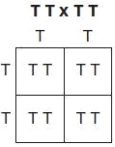
What is the genotypic ratio from this punnet square?
1:0
3:1
1:1
1:2:1

A homozygous dominant plant with brown seed pods is crossed with a heterozygous plant with brown seed pods. Does this punnet square correctly show this cross?
YES
NO

The genotypic ratio for this cross is:
3:1
1:2:1
9:3:3:1
1:0
1:1
The phenotypic ratio for this cross is:
3:1
1:2:1
9:3:3:1
1:0
1:1

The result of this cross produces genotypic and phenotypic ratios that are the:
SAME
DIFFERENT


It is otherwise known as "Resting stage" because the cell is not dividing.
Interphase
prophase
metaphase
anaphase
in the cell cycle, what is the next stage after TELOPHASE (most of the time)?
Metaphase
anaphase
cytokinesis
interphase
In what stage do the chromosomes line up along the equator of the cell?
interphase
prophase
metaphase
anaphae


Structure (c) is a ____. Hint: It is one half of the X shape.
chromosome
chromatid
centromere

Name the phase:
Hint: Chromosomes are moving apart.
Anaphase
Telophase
Metaphase
Prophase


What structure in the cell stores the DNA
Nucleus
Smooth ER
Golgi Apparatus
Mitochondria
What structure in the cell is responsible for cellular respiration?
nucleus
smooth endoplasmic reticulum
golgi apparatus
mitochondria
What structure in the cell is responsible for protein synthesis
nucleus
smooth endoplasmic reticulum
ribosome
mitochondria
Where in the cell does photosynthesis occur?
nucleus
chloroplast
central vacuole
mitochondria
Cellular respiration and breathing are part of what cycle in the ecosphere?
Heat
Energy
Nitrogen
Carbon
What is the role(s) of bacteria within the exosphere?
A. decompose dead matter and digestive waste given off by the shrimp and the algae
B. take in energy to make its own food through the process of photosynthesis?
C. convert nitrogen compounds into a usable form that can be taken in by the algae
both A and B
both A and C
Which of the following is true about the relationship between the algae and the shrimp in the ecosphere?
the algae gets carbon and nitrogen by eating the shrimp
the shrimp gets carbon and nitrogen by eating the algae
the shrimp eats the dead matter from the algae
the algae eats the dead matter from the shrimp
What material is NOT cycled in the ecosphere?
energy / heat
oxygen
carbon
nitrogen
How is matter in the system of an ecosphere similar to the earth?
Both the earth and ecosphere are open systems to matter
Both the earth and ecosphere are closed systems to matter
The earth and ecosphere both create matter
The earth and ecosphere both destroy matter
How is energy in the system of an ecosphere similar to the earth?
Both the earth and ecosphere are open systems to energy
Both the earth and ecosphere are closed systems to energy
The earth and ecosphere both create energy
The earth and ecosphere both destroy energy
What is the original source of energy for nearly all of the organisms on Earth?
Glucose
Sun
Water
Carbon Dioxide
Which type of organisms provide all of the energy to support an ecosystem?
Producers
Primary consumers
Secondary consumers
Decomposers

If the grass collected 100 units of energy in the food chain shown above, about how much energy would be available to the grasshopper?
10 units
30 units
1 Unit
0.1 units
Where does the energy that is not passed on from one level of a food chain to the next go?
The energy is stored in the organisms tissues
The energy goes into the atmosphere in the form of carbon dioxide
All of the energy taken in by an organism is passed to the next level of the food chain
The lost energy is used by the organism for life processes and lost as heat
Most of the biomass in an ecosystem is made up of
Producers
Primary consumers
Secondary consumers
Top consumers
How do the continuous survival of peacocks conflict with Darwin’s model of natural selection?
According to Darwin, the large, bright feathers should increase a peacock’s chance of survival
According to Darwin, the large, bright feathers should decrease a peacock’s chance of survival
According to Darwin, the large, bright feathers should not affect a peacock’s chance of survival
How can Darwin's model of natural selection (survival of the fittest) explain organisms that evolve elaborate traits which are not beneficial to their individual survival? (ex: peacock)
The most fit organisms are the strongest and fastest in their population
The most fit organisms are those that can survive the longest
The most fit organisms are those that can survive and pass their traits on to the next generation
Sexual selection involves
Competing for the chance to find a mate
Trait variation between the different sexes
Characteristics that increase attractiveness
All of these
When we say that an individual organism has greater fitness than another individual, we specifically mean that the organism
Lives longer than others of its species
Competes better for food and resources
Has traits including speed and camouflage
Survives and reproduces more frequently
What nitrogen base is only present in RNA
Adenine
Guanine
Cytosine
Thymine
Uracil
What 5 carbon sugar is found in the nucleotide with uracil
deoxyribose
glucose
ribose
sucrose
where are the weak bonds in DNA found?
between the bases
between the sugar and phosphate
on the outside
at the top
What happens to the weak bonds of DNA during protein synthesis?
They cross over
They break or "unzip"
They stay bonded together
They become strong bonds
What is the information stored in DNA use for?
to make proteins
to make cell membranes
to make decisions for the cell like a brain
to tell the cell how to make babies
How many nucleotides make up the codon for one amino acid in a protein?
1
2
3
4
What information is contained on a gene?
The information to make all proteins
The information to make one protein
The information to make part of the mitochondria
The information for one amino acid
What determines an individual's traits?
The type of glucose they eat
The specific mitochondria they have
The specific proteins they make
Their fatty acids
Where in the cell are proteins assembled?
the mitochondria....in the cytoplasm
the ribosome... in the cytoplasm
the centriole...in the nucleus
How is the information encoded in DNA get from the nucleus to the site of protein synthesis?
DNA goes there and returns to the nucleus
proteins are made directly from the DNA in the nucleus
amino acids carry the information
mRNA takes the information there
What is the matching (complementary) base sequence of the following section of DNA: TACCTGATT
ATGGACTAA
UACUGAAUU
AUGGACUAA
GTAGTTGG
What is the matching (complementary) sequence of mRNA coded by the following section of DNA: TACCTGATT (remember to use the RNA code!)
ATGGACTAA
UACUGAAUU
AUGGACUAA
GTAGTTGG

What is the amino acid sequence of the protein coded by a section of DNA with the order: TACCTGATT (use the codon chart below)
Methionine, Glutamic Acid, Stop
Methionine Aspertic Acid, Stop
Methionine, Aspertic Acid, Tyrosine
Tyrosine, Cytostine, Isoleucine
Which type of cell division is responsible for growth and development?
Meiosis
Fertilization
Crossing over
Mitosis
What is the result of mitosis?
Formation of gametes
Formation of cancer cells
Formation of identical cells
Formation of mutated cells
What statement below best defines the process of differentiation?
Cells becoming smaller in size over time
Cells being able to stop dividing before death
Cells developing into a certain type of cell
Cells developing into larger cells over time
How can the fact that all cells in an organism have very different functions be explained?
There is different DNA in each of your cells
All of the proteins are made by all cells, but different cells use different ones.
Only some of the DNA is transferred into new cells
Sections of DNA can be turned on or off so each cell only makes certain proteins
What process is used to form gametes?
Fertilization
Meiosis
Asexual reproduction
Mitosis
Diploid cells
are found in fewer areas of the body than haploid cells
contain half as much DNA as haploid cells
contain twice as much DNA as haploid cells
have the same function as haploid cells
When one diploid cell goes through meiosis, it results in _______________________________________.
two haploid cells
two diploid cells
four haploid cells
four diploid cells
How do sperm and egg cells differ from all other cells in the body?
They are both diploid, and contain 46 chromosomes each
They are both haploid, and contain 23 chromosomes each
They contain more DNA than any other cells
They are the most common cell in the body
Which factor in sexually reproducing organisms leads to increased variation among offspring?
Crossing over
Random assortment of chromosomes
Combining the gametes of both parents (fertilization)
All of these increase variation
The gametes (sex cells) produced in meiosis...
are all genetically identical
are all genetically different
have all of the chromosomes found in the parent's skin cells
have completely different DNA than the parent cell
Each of the following is a mutated form of the sentence THECATATETHERAT. Which of the following is represents a frame shift mutation of the original sentence?
THERATATETHECAT
THETACATETHERAT
THECATARETHERAT
THECATATTHERAT
Evolution occurs as a result of
meiosis
random mutation
natural selection
both random mutation and natural selection
We live in what California growing region?
San Juaquin
Delta
Sacramento
North Coast
True or False: California is the largest at producing state in the US
True
False
True or False: California is the largest at producer of almonds in the world
True
False

