wayground logo

Free Printable Worksheets

Font size

S
M
L
XL
Worksheets

Evolution Unit Review

Total questions: 55

Worksheet time: 1hrs 7mins

Name
Class
Date
1.

"Diversity of species" refers to the idea that:

a)

Organisms can be classified.

b)

Not every individual in a species is identical.

c)

There are many different kinds of organisms.

d)

Organisms of the same species share the same species name.

2.

Which of the following could cause the extinction of a species?

a)

Environmental change.

b)

Disease.

c)

Loss of food.

d)

All of the above.

3.

Charles Darwin developed his theories based on his work with:

a)

giraffes.

b)

Galapagos finches.

c)

Asian elephants.

d)

toothpick worms.

4.

Which of the following provides the LEAST evidence for the theory of evolution?

a)

DNA

b)

fossils

c)

skeletons

d)

weather

5.

Which of the following is NOT used to determine how a species is classified?

a)

DNA

b)

Skeleton

c)

Environment

d)

Physical characteristics

6.
_______ believed that organisms develop traits needed for survival and that traits that were unused would become weaker and gradually disappear. 
a)
Darwin
b)
Lamarck
c)
Mendel
d)
Watson
7.
____________ believed that those organisms that were best suited for their environment would survive and pass on their beneficial traits to their offspring. 
a)
Darwin
b)
Lamarck
c)
Watson
d)
Mendel
8.
Similar structures that are found in different species are called _____________. 
a)
Homologous Structures
b)
Vestigial Structures 
c)
Identical Structures
d)
Necessary Structures
9.
A structure or organ that seems to serve no purpose, but resembles structures with functional roles in other organisms are called ____________. 
a)
Necessary Structures
b)
Homologous Structures
c)
Vestigial Structures 
d)
Ancestry Structures
10.
Wisdom teeth in humans would be an example of what? 
a)
Homologous Structures
b)
Mandatory Structures
c)
Ancestry Structures
d)
Vestigial Structures
11.
True or False:
Two organisms with similar amino acid sequences must have a more resent common ancestor than two organisms with dissimilar amino acid sequences. 
a)
True
b)
False
12.
Looking at the similarities in development between different organisms would be an example of which piece of evidence?
a)
Palentology
b)
Embryology
c)
Cytology
d)
Structure Analysis
13.
When analyzing fossils, where would the oldest fossils be found?
a)
Closest to the surface
b)
The lowest level 
c)
In the middle
14.

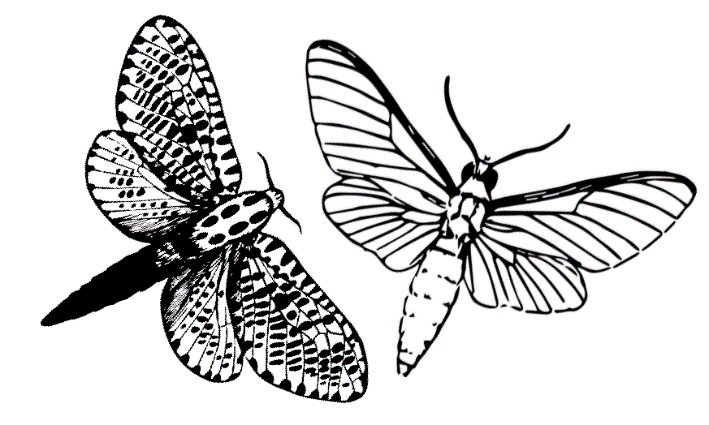
According to natural selection, light colored tree trunks would favor

a)

light colored moths

b)

dark colored moths

c)

red colored moths

d)

red and light colored moths

15.

Genetic diversity in a species makes long term survival of some members

a)

impossible

b)

improvable

c)

more likely

d)

less likely

16.

A physical trait favored by an environmental change can be called an

a)

adaptation

b)

extinction

c)

possibility

d)

mutation

17.

Natural Selection is driven by a change in the environment and survival of the

a)

Earth

b)

Fastest

c)

Fittest

d)

Biggest

18.

Organisms of the same species can no longer interbreed therefore creating two species.

a)

Gene Pool

b)

Genetic Drift

c)

Gene Frequency

d)

Speciation

19.
How do adaptations help animals?
a)
to hide from predators
b)
to hunt for food
c)
to survive in their habitats
d)
All of these are correct
20.
An animal's color or pattern that helps it blend into its surroundings
a)
Environment 
b)
Mimicry
c)
Camouflage
d)
Habitat
21.
A scientist puts 100 houseflies in a sealed container; then sprays an insecticide into the container.  Ninety-six of the flies die.  Four survive.  The scientist lets the survivors mate and produce offspring, then repeats the experiment with 100 offspring.  Fifty-six of them survive the spray.  This experimental result is evidence of – 
a)
adaptive radiation 
b)
speciation
c)
natural selection
d)
extinction
22.
Who organized living things by creating binomial nomenclature?
a)
Carolus Linnaeus
b)
Robert Hooke
c)
Anton van Leeuwenhoek
d)
James Watson
23.
What are the 8 levels of classification of living things from most general to most specific?
a)
domain, kingdom, phylum, class, order, family, genus, species
b)
domain, kingdom, phylum, class, order, family, genius, species
c)
domain, kingdom, phamily, class, order, family, genus, species
d)
domain, king, phillip, class, order, family, genus, species
24.
The scientific name for water bear is Hypsibius dujardini.  What is its genus?
a)
Hypsibius 
b)
dujardini
c)
water 
d)
tardigrade
25.
How do scientists organize living things?
a)
by looks
b)
by shared characteristics
c)
by size
d)
by differences
26.
What is the science of organizing, classifying and naming living things.
a)
taxonomy
b)
taxadermy
c)
taxicab
d)
toxicology
27.
Who is the closest relative to the sharks?
a)
crocodiles
b)
sharks
c)
ray-finned fish
d)
amphibians
28.
The scientific name for an organism is made from the:
a)
class and family name
b)
genus and species name
c)
domain and kingdom name
d)
kingdom and phylum name
29.
Term given to describe the 2 name naming system is:
a)
dichotmous key
b)
binomial nomenclature
c)
2 scientific names
d)
binomial key
30.
What is the most specific level of classification?
a)
Family
b)
Domain
c)
Species
d)
Carolus Linnaeus
31.
A dichotomous key for trees is provided. Hikers found a tree that has large brown cones and single sharp needles. What species of tree have the hikers found?
a)
Juniper
b)
Pine
c)
Spruce
d)
Fir
32.
A dichotomous key for insects is given. To what order does an insect with two pairs of scaly wings belong?
a)
Coleoptera
b)
Heteroptera
c)
Diptera
d)
Lepidoptera
33.
A student discovers an arachnid with a segmented abdomen, long legs, and a tail with no stinger. The student uses the dichotomous key below to identify it. Which arachnid has the student found?
a)
Whip Scorpion
b)
Wind Scorpion
c)
Daddy long legs
d)
Scorpion
34.
The opossum and kangaroo both incubate their young in a pouch. This provides evidence that they---
a)
are descended from a common ancestor
b)
Have very similar skeletal structures
c)
belong to the same species
d)
must range great distances to eat
35.

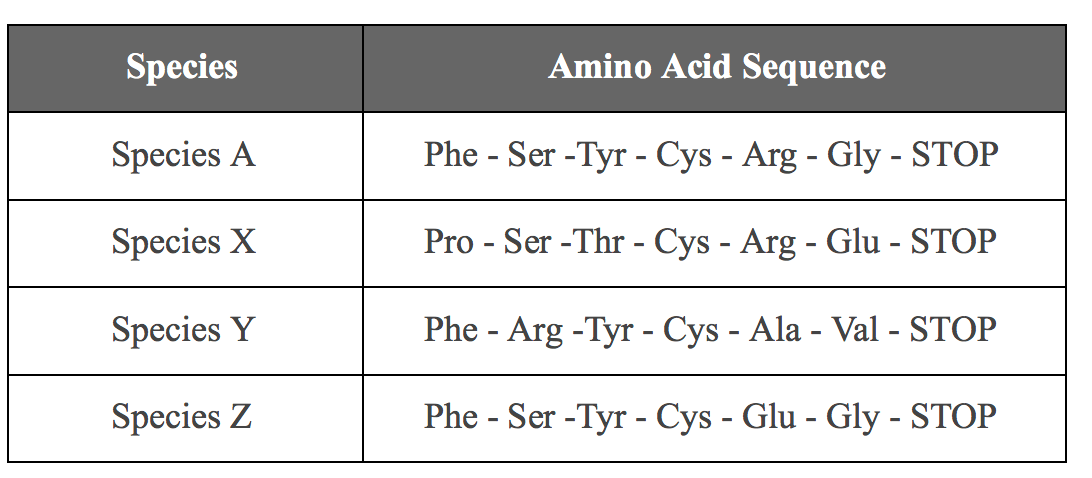
A scientist compares DNA taken from four different living species. Which of the following statements is true?

a)

Species X evolved from Species Y.

b)

Species A and Z share a recent common ancestor.

c)

Species A and Species Y are the same.

d)

Species Y and Species Z can interbreed.
36.

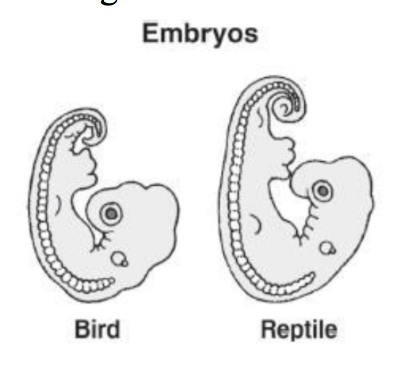
The diagram illustrates an embryonic stage of two organisms. Which of the following can be determined by observing the embryos shown in the diagram?

a)

The organisms belong to the same genus.

b)

The organisms are native to the same geographic areas.

c)

The organisms share a common ancestry.

d)

The organisms will grow into anatomically similar adults.

37.
The most recent ancestral form or species from which two different species evolved is known as ________________________.
a)
a common ancestor.
b)
an embryonic stage.
c)
development.
d)
evolution.
38.
When scientists compare the amino acid sequences for the red blood cell protein hemoglobin between various species, what can they determine about the evolutionary relationship between the species?
a)
It can be determined how efficient hemoglobin is for different species
b)
It can provide evidence about the relatedness of the different species: if they are more similar they have a more recent common ancestor.
c)
It cannot determine relatedness between different species, only individuals of the same species
d)
It can show which species evolved first
39.
How do fossils provide evidence that evolution has happened on Earth?
a)
Fossils show how the sizes of certain animals has changed drastically over millions of years
b)
Fossils show that some species have gone extinct
c)
Fossils show how life forms present today are different than those from the past
d)
Different sedimentary rock layers provide evidence for how the environment has changed over time
40.
When scientists compare animals currently living on different continents, they often find those with similar characteristics, who are not actually close relatives, living in similar environmental conditions even though they are geographically very distant. One example is the Anteater/Armadillos of the Americas and the Pangolin of Africa. What can we deduce from this evidence?
a)
Living things can adapt similarly to similar environments over time.
b)
Living things do not change over time
c)
They must all have the same recent common ancestor
d)
I don’t know
41.
When an organism of a species has an adaptation, it will compete for resources better, survive longer and pass that adaptation on to it's offspring. This process is called
a)
evolution by natural selection
b)
artificial selection
c)
inbreeding
d)
outbreeding
42.
What is it called when humans decide which traits of an organism are the most desirable and only allow those organisms with the specific, desired traits to breed.
a)
biological evolution
b)
evolution by natural selection
c)
artificial selection
d)
inbreeding
43.
When an organism has a trait that makes it resemble another species, either in looks or behavior, we call that ____
a)
mimicry
b)
camouflage
c)
copycatting
d)
sonic hedgehog gene
44.
The English naturalist that developed the theory of how evolution works.
a)
Charles Darwin
b)
Charles M. Schulz
c)
Charles Dickens
d)
Charles Norris
45.
Drawn observed several different types of finches.  Why are there so many different types?
a)
Finches live in different places, but eat the same food.
b)
Finches live in the same place, but eat different types of food.
c)
Finches live in different habitats and eat different types of food.
d)
Finches are found all over the world.
46.
Organisms with the most beneficial traits will survive.  This is commonly known as
a)
theory of evolution.
b)
variations.
c)
survival of the fittest.
d)
ecosystems.
47.
Why are advantageous traits more likely to be passed onto offspring?
a)
Because they are more likely to survive and reproduce.
b)
Because they come from dominant alleles.
c)
Because they come from recessive alleles.
d)
Because the trait is an acquired phenotype.
48.
Do organisms "decide" to evolve and change?
a)
Yes, they know they need to change to survive 
b)
No, they change because of natural selection
49.
A lion makes more cubs than the Sahara Desert can support (there's not enough prey around), so only a few of the cubs survive to become adults. They live on to reproduce.
Of the four parts of natural selection, which is this an example of?
a)
overproduction
b)
genetic variation
c)
selection
d)
adaptation
50.
Tigers with larger paws hunt deer more easily to survive in an environment where resources are limited. As a result, the tigers with larger paws are “selected” (the larger paws become more common in the next generation of tigers).
Of the four parts of natural selection, which is this an example of?
a)
overproduction
b)
genetic variation
c)
selection
d)
adaptation
51.
A beetle's ability to camouflage (blend in) with a nearby leaf allows it to escape a hungry frog's appetite.
Of the four parts of natural selection, which is this an example of?
a)
overproduction
b)
genetic variation
c)
selection
d)
adaptation
52.
Due to a mutation, some jaguars inherit larger jaw sizes than other jaguars within that population and this trait is passed down from parent to offspring. This gives those jaguars an advantage when it comes to hunting down turtles as prey.
Of the four parts of natural selection, which is this an example of?
a)
overproduction
b)
genetic variation
c)
selection
d)
adaptation
53.
Populations of species which do not adapt to their environment can eventually become...
a)
stronger
b)
humans
c)
extinct
d)
angry
54.
Four present-day realities that some scientists use to support Darwin's theory of evolution?
a)
fossils
DNA
common bone structures
developmental similarities
b)
fossils
DNA
common bone structures
saliva
c)
fossils
common bone structures
plants
developmental similarities
d)
H2O
DNA
common bone structures
developmental similarities

55.
In both the past and the present, humans have selected plants or animals for breeding based on desirable traits. This process is known as...
a)
artificial selection
b)
natural selection
c)
farming
d)
cropping