Wayground logo

Free Printable Worksheets

Font size

S
M
L
XL
Worksheets

Revising test - Grade 9

Total questions: 79

Worksheet time: 2hrs 47mins

Name
Class
Date
1.
Which particles make up the nucleus of an atom?
a)
protons and neutrons
b)
electrons and protons
c)
electrons, protons, and neutrons
d)
electrons and neutrons
2.
Two objects with LIKE static charges will
a)
attract each other
b)
even out in the end
c)
repel each other
d)
cause a spark
3.

LED

a)
b)
c)
d)
4.

Diode

a)
b)
c)
d)
5.

Lamp

a)
b)
c)
d)
6.
Current is...
a)
moving protons
b)
moving electrons
c)
measured in volts
d)
measured in ohms
7.

A potential difference of 24 V is applied to a 150 resistor. How much current flows through the resistor?

a)

0.15 A

b)

3600 A

c)

6.25 A

d)

0.16 A

8.

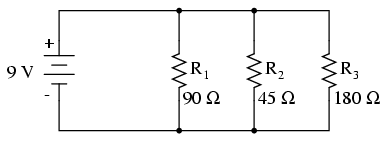
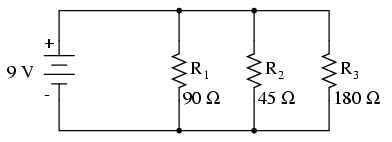
This is an example of a _______ circuit

a)

open

b)

series

c)

parallel

d)

square

9.
What is current measured in?
a)
Ω (Ohms)
b)
V (Volts)
c)
A (Amps)
d)
W (Watts)
10.
The current going through the 45 ohm resistor is 
a)
0.05 amps
b)
0.2 amps
c)
0.1 amps
d)
5 amps
11.
The total resistance of this circuit is 
a)
25.7 ohms
b)
315 ohms
c)
324 ohms
d)
90 ohms
12.

What type of transformer increases voltage?

a)

Step-Up

b)

Step-Down

13.

Why is the voltage increased in the national grid?

a)

Stops electricity being lost.

b)

Stops energy loss by heat

c)

To increase safety

d)

Stops energy loss through leaking electricity

14.
The power of an appliance is...
a)
the amount of voltage going through it 
b)
the amount of energy transferred per second
c)
the amount of charge that passes through per second
15.
a)

6 W

b)

100 W

c)

6000 W

d)

3.24 x 10⁸ W

16.

If a bulb uses 10A, which fuse would be best?

a)

10A

b)

13A

c)

8A

d)

5A

17.

This car needs 8600J of energy to power it. If 5000J is changed into useful energy, how much energy is wasted?

a)

13600J

b)

3600J

c)

5000J

d)

8600J

18.

The area around a magnet is called the .....

a)

attraction zone

b)

work area

c)

magnetic field

d)

hot zone

19.

What would happen is a north pole of a magnet came close to a north pole of another magnet?

a)

they would be attracted to each other

b)

they would be repelled from each other

20.
How are electromagnets different from magnets?
a)
magnets can be turned on/off
b)
you can turn an electromagnet on/off
c)
magnets are more powerful
d)
magnets have a North and South pole
21.
What would happen if I move a bar magnet in and out of a coil of copper wire?
a)
Electric current would disappear 
b)
The magnet would explode 
c)
Electric current will flow through the wire
d)
It would produce a gravitational field
22.

A current (I) is moving through a wire in the upward direction through a magnetic field directed to the right. What is the direction of the force on the wire?

a)

Up

b)

Down

c)

Into the page

d)

Out of the page

e)

No Force

23.

Calculate potential difference in the secondary coil based on the information given below.


Vp = 240 V

Np = 20

Ns = 125

Vs ?

a)

1500

b)

500

c)

1000

d)

2000

24.

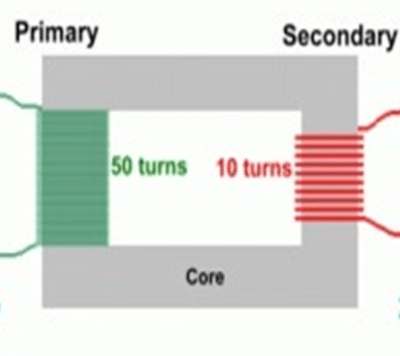
This picture is an example of a ________________.

a)

Motor

b)

Generator

c)

Step-up transformer

d)

Step-down transformer

25.

As our sun continues through its life cycle, it will _________ and turn into a _______________.

a)

gradually get smaller and smaller until it dies out/ black hole

b)

Gradually get larger until its outer layers drift off/ white dwarf

c)

become denser and denser/ protostar

d)

become hotter and hotter blue/ hypergiant.

26.
A gigantic explosion that causes the death of a large star is called
a)
pulsar
b)
red giant 
c)
supernova
d)
black hole
27.

Average size stars will turn into a _____ star next.

a)

protostar

b)

red giant

c)

supergiant

d)

black hole

28.
What is the name of baby stars?
a)
Dwarf
b)
Supergiant
c)
Protostars
d)
Nebulas
29.
If a star is being observed from Earth and it's light has shifted towards the red side of the electromagnetic spectrum it would be...
a)
Moving towards the Earth
b)
Moving away from the Earth
c)
This is a trick question that cannot be answered
d)
It isn't a star, it is a very large blueberry.
30.
An object that is moving VERY fast away from Earth would have ________ than an object that is moving very slow away from Earth.
a)
More Redshift
b)
More Blueshift
c)
Less Redshift
d)
Less Blueshift
31.

How does Cosmic Microwave Background Radiation support the Big Bang Theory?

a)

Microwaves are found everywhere in the universe.

b)

Microwaves occurred at the time of the Big Bang

c)

Microwaves are useful in our everyday lives

32.

The Big Bang Theory explains the formation of the...

a)

Earth

b)

Sun

c)

Universe

d)

Solar System

33.
What does the Big Bang theory suggest?
a)
The universe was just there
b)
The Milky Way is the only solar system
c)
The universe is continually expanding
d)
The universe is collapsing in toward a single point
34.

Energy stored in objects being stretched or squashed...

a)

Elastic Potential Energy

b)

Kinetic Energy

c)

Chemical Energy

d)

Thermal Energy

35.

When a ball falls from a height the energy is transferred from _________ energy store to __________ energy store

a)

gravitational potential, kinetic

b)

kinetic, chemical

c)

elastic potential, kinetic

d)

thermal, gravitational potential

36.
A 40 kg crate is picked up by a crane to a height of 50m. The crate falls. What is the velocity of the crate just before it hits the ground?
a)
2000 Joules
b)
19,600 Joules
c)
19,600 m/s
d)
31.3 m/s
37.

A crane lifts an 8-m long steel girder weighing 2600 N up 15 m off the ground. The crane did ___ of work.

a)

0 J

b)

39000 J

c)

20800 J

d)

2600 J

38.

A 40-kg person is climbing 3 m up a flight of stairs in 6 seconds. How much power did they exert climbing the stairs?

a)

400 W

b)

1200 W

c)

200 W

d)

120 W

39.

What force causes a roller coaster cart to slow down the most?

a)

friction

b)

weight

c)

gravity

d)

air resistance

40.

A car transfers 100 J of chemical energy in order to gain 50 J of kinetic energy. The efficiency of the car is

a)

20%

b)

0.5%

c)

50%

d)

200%

41.
Thermal conductivity is....
a)
How fast heat passes through something
b)
How hot certain materials get
c)
Something that doesn'treadily allow heat to pass theough
d)
Metals
42.

A copper block and air mass having similar dimensions are subject of symmetrical heat transfer from once face each block . the other face of that block will be reaching to the same temperature at a rate

a)

Faster in air block

b)

Faster in copper block

c)

Equal in both

d)

Cannot be predicted

43.
All objects emit infrared radiation (T/F)
a)
True
b)
False
44.
The hotter an object the more infrared radiation is given off (T/F).
a)
Frue 
b)
False
45.
Which of the following is best at reflecting infrared radiation?
a)
Dark, matt surface
b)
Light, shiny surface
c)
Dark, shiny surface
46.
Which of the following is the best at emitting infrared radiation?
a)
Dark, matt surface
b)
Light, shiny surface
c)
Dark, shiny surface
47.

20 g of water. specific heat of water is 4.18 J/g°C. temperature changes from 25° C to 20° C, how much heat energy (Q) moves from the water to the surroundings?

a)

418 J

b)

209 J

c)

83 J

d)

4.18 J

48.

What insulation stops heat conducting through a surface of a building?

a)

Draught excluder

b)

Cavity wall insulation

c)

Solar panels

d)

Central heating

49.
What characteristic do all renewable resources share?
a)
Produced by waste products
b)
Form underground from dead organisms.
c)
Replaced in a short period of time
d)
Allow energy to pass through them easily
50.
Which of the following is a fossil fuel?
a)
Wind
b)
Coal
c)
Solar
d)
Biomass
51.
Fossil fuels are classified as nonrenewable because they.......
a)
require expensive equipment
b)
take millions of years to replace
c)
can be found all over 
d)
provide all the energy we use
52.

A fuel formed from living organisms such as plants & animals.

a)

Fossil Fuel

b)

Bio Fuel

c)

Eco Fuel

d)

Plant Fuel

53.

Producing electricity from movement from liquid water is called

a)

Nuclear

b)

Hydroelectricity

c)

Turbinicitry

d)

Hydromorphism

54.

Solar Cells convert light into electricity?

a)

True

b)

False

55.

Energy stored in the earth in the form of heat.

a)

GEOTHERMAL

b)

SOLAR ENERGY

c)

WIND ENERGY

d)

NUCLEAR ENERGY

56.

The use of flowing water from waterfalls and dams to produce electricity.

a)

HYDRO & TIDAL POWER

b)

SOLAR ENERGY

c)

WIND ENERGY

d)

NUCLEAR ENERGY

57.
Why is burning fossil fuels harmful? 
a)
then we won't have any fossil fuels if we burn them all
b)
They can get extremely hot
c)
Increases the amount of greenhouse gases in the air
d)
this would destroy fossils
58.
How do nuclear power-plants work?
a)
Fusion
b)
Half-life
c)
Fission
d)
Fusion or fission
59.
Takes two small nuclei and combines them into a larger nucleus
a)
fission
b)
fusion
60.
Where does fusion occur naturally?
a)
Underwater
b)
All around us
c)
In the radioactive waste
d)
On the sun
61.
What is a half-life?
a)
The average time it takes for any element to disappear completely 
b)
The time it takes for a radioactive atom to lose half its neutrons
c)
The time it takes for half of any number of radioactive atoms to decay
d)
The time it takes for a radioactive atom to lose half its electrons 
62.
What is an advantage  of nuclear energy?
a)
radioactive waste
b)
no air pollution
c)
we will never run out
d)
it is the safest way to make energy
63.

What are the benefits of nuclear energy?

a)

It is renewable

b)

It produces radioactive waste.

c)

It causes heat pollution to cooling ponds.

d)

Does not cause air pollution, global warming or acid rain.

64.

All of the following are problems caused by burning coal, except

a)

Creates smog

b)

It is radioactive

c)

Contributes to acid rain

d)

Contributes to global warming

65.

What is the structure of an alpha particle?

a)

a fast-moving electron

b)

an electromagnetic wave

c)

a fast-moving positron

d)

2 protons and 2 neutrons

66.
The least penetrating form of radiation is _____.
a)
alpha
b)
beta
c)
gamma
d)
UV
67.
The most penetrating form of radiation is _____.
a)
alpha
b)
beta
c)
gamma
d)
UV
68.
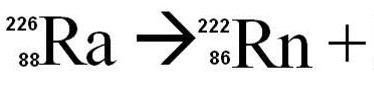
Complete the nuclear equation and determine the type of decay that is occurring in this reaction. 
a)
alpha
b)
beta
c)
gamma
d)
none
69.

When a nucleus undergoes gamma decay, the atomic number of the element....

a)

remains the same

b)

decreases by one.

c)

increases by one.

d)

increases by two.

70.

Identify the missing substance in each of the following nuclear reactions.

_____→13756 Ba + 0−1B

a)

13755Ba

b)

13757La

c)

13856Ba

d)

13755Cs

71.

Who discovered that atoms have a nucleus?

a)

Dalton

b)

Thompson

c)

Rutherford

d)

Bohr

72.
If 10 mg of iodine 131 is given to a patient, how much is left after 24 days? The half-life of iodine-131 is 8 days.
a)
1.25mg
b)
1.25g
c)
10g
d)
10mg
73.

Why are radioactive isotopes with 2 second half-lives not used as medical tracers?

a)

It would be too ionising

b)

It would decay before a scan could be taken

c)

It's too hazardous for the medical staff

74.

Which types of radiation can be used as a tracer, and can pass out of the body and be detected?

a)

Alpha and beta

b)

Alpha and gamma

c)

Beta and gamma

d)

Gamma only

75.

Why should radioactive tracers not be strongly ionising?

a)

To minimise damage to the body tissue

b)

So it can be detected outside the body

c)

So it doesn't decay into another isotope

d)

So it can destroy cancer cells

76.
Which of these statements correctly describes how the chain reaction occurs in nuclear fission.
a)
Uranium releases electrons to create   electricity
b)
When a nuclear fission reaction occurs, the electrons emitted can strike other nuclei in the sample, and cause them to split
c)
When a nuclear fission reaction occurs, the neutrons emitted can strike other nuclei in the sample, and cause them to split
d)
 Protons and neutrons change to electrons because the nuclei are so big
77.

The name of the only nuclear power plant to experience a core explosion was

a)

Ignalina

b)

Chernobyl

c)

Oklaham

d)

Three Mile Island

78.

Which risk is associated with using nuclear fission to produce energy in a power plant?

a)

depletion of hydrocarbons

b)

depletion of atmospheric oxygen

c)

exposure of workers to radiation

d)

exposure of workers to sulfur dioxide

79.

What is a problem commonly associated with nuclear power facilities?

a)

A small quantity of energy is produced.

b)

Reaction products contribute to acid rain

c)

It is impossible to control nuclear fission.

d)

It is difficult to dispose of wastes.