
NEW
Font size
S
M
L
XL
 Worksheets
Science Form 2_Chap 8 Force and Motion (Part 1)
Total questions: 40
Worksheet time: 21mins
Name
Class
Date
1.
What is motion?
a)
a push or pull
b)
a change in position
c)
a law stated by Newton
d)
a change in velocity
2.

Two forces act on a bumper car as shown in the picture. what will MOST LIKELY be the direction of the change in motion?
a)
north
b)
east
c)
south
d)
west
3.
Balanced forces acting on an object will
a)
cause the object to change direction
b)
have no effect on the object's motion
c)
cause the object to accelerate
d)
cause the object to change speed
4.
Friction
a)
causes an object's motion to speed up
b)
causes an object's motion to slow down
5.
What force causes a roller coaster to go down a hill?
a)
inertia
b)
gravity
c)
friction
6.
The measure of the force of gravity on your body is your _________________
a)
height
b)
length
c)
weight
d)
age
7.
A _____________________ must be exerted on an object at rest to cause it to move.
a)
weight
b)
inertia
c)
force
d)
gravity
8.
A push or pull that causes an object to move, stop, or change direction.
a)
force
b)
motion
c)
energy
d)
inertia
9.
Newton's Third Law says that for every ______ there is an ________ and _________ reaction.
a)
action, equal, opposite
b)
push, pull, contact
c)
motion, unbalanced, equal
10.
Friction is
a)
Is a property of matter, the more mass an object has the more force is required to move the object.
b)
The resistance that one surface has when moving over another surface.
c)
Is a force which tries to pull two objects toward each other.
11.
You toss a football into the air as high as you can. What makes it come back down to earth?
a)
Friction
b)
Gravity
c)
Motion
12.

What is air resistance?
a)
friction in the air that slows things down
b)
when an airplane flies into a cloud
c)
when you feel the air hitting your face
13.
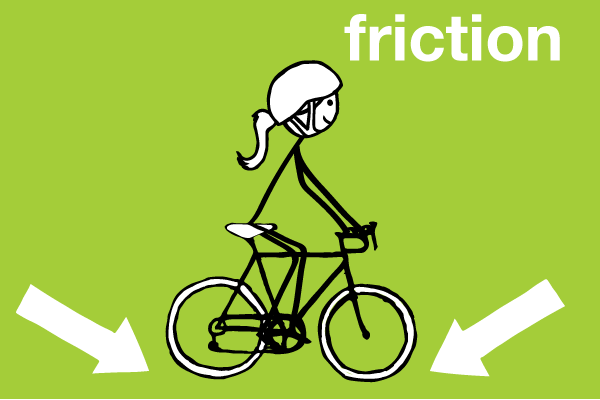
Why do we need friction?
a)
It helps objects go faster.
b)
It helps objects go up higher.
c)
It helps make objects go slower or stop.
14.
Force with which objects tend to return to its original state after being stretched or compressed by an external force.
a)
Push or pull
b)
Tension
c)
Elasticity
d)
Friction
15.
Is the force usually exerted by a surface on an object that is resisting against it.
a)
Friction
b)
Normal force
c)
Elasticity
d)
Tension
16.
Earth behave like a huge magnet.
a)
True
b)
False
c)
I don't know
17.

Name the missing force....
a)
weight force
b)
normal force
c)
frictional force
d)
tension force
18.
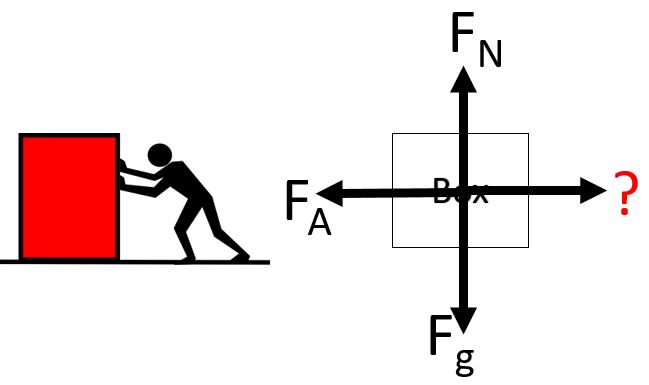
Name the missing force...
a)
frictional force
b)
weight force
c)
thrust
d)
buoyant force
19.
Friction is a force that acts in an ___________ direction of movement.
a)
similar
b)
opposite
c)
parallel
d)
west
20.

The SI Unit of force is
a)
Pascal
b)
Meter/second
c)
Newton
d)
kg
21.
A buoyant force is an upward force applied on an object by a
a)
Substance
b)
Fluid
c)
Pressure
d)
Displacement
22.
A buoyant force is a(n) ______ force
a)
Upward
b)
Downward
c)
Side ways
23.
An object will _______ if the weight of it is equal to the weight of the water in which it is in.
a)
Float
b)
Sink
c)
Expand
d)
Shrink
24.
An object will ______ if its' density is greater than the density of the fluid it is in.
a)
Expand
b)
Shrink
c)
Float
d)
Sink
25.
An object with a very low buoyant force acting on it will _____.
a)
Sink
b)
Float
c)
Expand
d)
Shrink
26.
Which object, if thrown into a liquid, will have a greater buoyant force?
a)
Balloon
b)
Apple
c)
Rock
d)
Cell Phone
27.
When the weight of an object is greater than the buoyant force, the object will ...
a)
Sink
b)
Float
c)
Expand
d)
Shrink
28.

3. Which type of lever is this?
a)
First Class Lever
b)
Second Class Lever
c)
Third Class Lever
29.
For a lever to be a first class lever the fulcrum needs to be ..
a)
between the load and the effort
b)
on one side and the load and effort on the other side
c)
on the same side as the load arm.
30.

6. What kind of lever is this?
a)
First Class Lever
b)
Second Class Lever
c)
Third Class Lever
31.
Levers make work ________.
a)
Harder
b)
Easier
c)
Alright
d)
OK
32.
In second class lever, the load is between the fulcrum and _______.
a)
Load
b)
Effort
c)
Stone
33.

A see saw is an example of a:
a)
1st class lever
b)
2nd class lever
c)
3rd class lever
34.

What class lever is a pair of scissors?
a)
1st
b)
2nd
c)
3rd
35.

What class lever is a wheelbarrow?
a)
1st
b)
2nd
c)
3rd
36.

What class lever is a nutcracker?
a)
1st
b)
2nd
c)
3rd
37.

What class lever are tongs?
a)
1st
b)
2nd
c)
3rd
38.

What class lever is a fishing rod?
a)
1st
b)
2nd
c)
3rd
39.

What class lever is a baseball bat?
a)
1st
b)
2nd
c)
3rd
40.

A ___________ is a bar that pivots on a fixed point.
a)
wheel and axle
b)
pulley
c)
lever
d)
wheel
Reset

