wayground logo

Free Printable Worksheets

Font size

S
M
L
XL
Worksheets

RL Summary of all units

Total questions: 114

Worksheet time: 7hrs 44mins

Name
Class
Date
1.
A runner races in the 100 meter dash.  It takes her 10 seconds to finish.  What is her average speed?
a)
10 m/s
b)
1000 m/s
c)
100 seconds
d)
10 seconds
2.
What does this graph represent?
a)
Constant Speed
b)
Acceleration
c)
Not moving
3.
What is happening at D?
a)
Stationary
b)
Accelerating
c)
Fast steady speed; moving away from the starting position
d)
Slower steady speed; moving away from the starting position
4.
What is happening at E?
a)
Stationary
b)
Accelerating
c)
Fast steady speed; moving away from the starting position
d)
Steady speed; returning to start position
5.
What is happening at A?
a)
Stationary
b)
Accelerating
c)
Slower steady speed; moving away from the starting position
d)
Steady speed; returning to start position
6.
Which runner had a head start?
a)
A
b)
B
c)
C
d)
None of them
7.
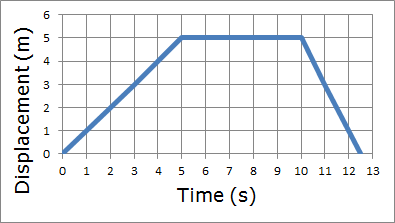
What is the person doing from 5 seconds to 10 seconds?
a)
Walking 
b)
Running
c)
Standing Still 
d)
Walking Fast
8.
How far is the person from the starting point after 3 seconds?
a)
0 m
b)
2 m 
c)
3 m
d)
6 m 
9.

What is the average velocity of the person during the first 5 seconds?

a)

0 m/s

b)

1 m/s

c)

3 m/s

d)

6 m/s

10.
The graph below represents
a)
Speed
b)
Velocity
c)
Acceleration
d)
Deceleration
11.
Which is TRUE?
a)
A is slowing down
b)
B is speeding up
c)
A is going in the negative direction
d)
A is moving slower than B
12.

What is the velocity of an object at the top of it's path?

a)

0 m/s

b)

9.8 m/s

c)

-9.8 m/s/s

d)

Depends on how fast it was moving initially

13.

What is the acceleration of an object at the top of it's path?

a)

0 m/s/s

b)

9.8 m/s/s

c)

-9.8 m/s/s

d)

Depends on how quickly it was moving initially

14.

If an object is dropped it has an acceleration of:

a)

0 m/s

b)

9.8 m/s/s

c)

-9.8 m/s/s

15.

If an object is thrown up it has an acceleration of:

a)

0 m/s

b)

9.8 m/s/s

c)

-9.8 m/s/s

16.

On the way up, an object's velocity is:

a)

positive and increasing

b)

positive and decreasing

c)

negative and increasing

d)

negative and decreasing

17.

On the way down, an object's velocity is:

a)

positive and increasing

b)

positive and decreasing

c)

negative and increasing

d)

negative and decreasing

18.

If your velocity and acceleration have opposite directions, you will:

a)

Speed up

b)

Slow down

c)

Have constant velocity

19.

If your velocity and acceleration have the same directions, you will:

a)

Speed up

b)

Slow down

c)

Have constant velocity

20.

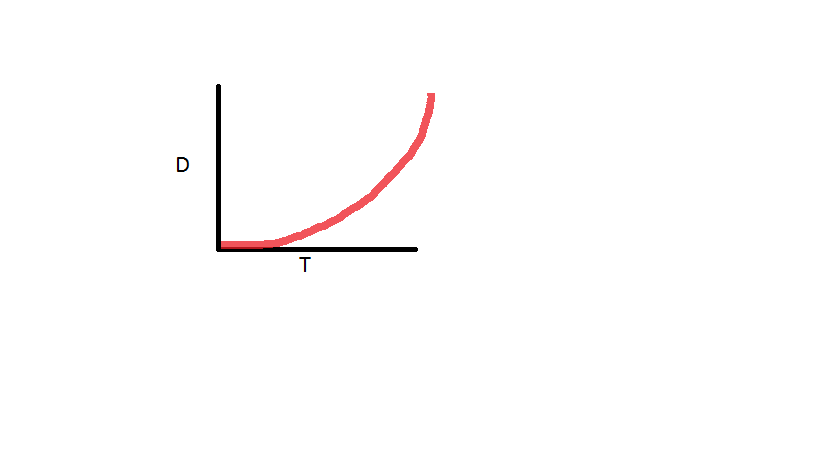
If a tennis ball is falling, the position time graph for it will look like:

a)

a straight horizontal line

b)

a straight line with a positive slope

c)

a straight line with a negative slope

d)

a curve

21.
What is the horizontal acceleration of a projectile?
a)
0 m/s2
b)
-9.8 m/s2
c)
0 m/s
d)
-9.8 m/s
22.
The horizontal component of a projectile's velocity is independent of...
a)
it's range
b)
time
c)
the vertical component
d)
none of these
23.
A ball is thrown horizontally at a height of 2.2 meters at a velocity of 65 m/s. Assume no air resistance. How far did the ball travel horizontally when it hit the ground?
a)
14.3 m
b)
30.55 m
c)
65 m
d)
43.55 m
24.
A bullet is fired horizontally at a height of 1.3 meters at a velocity of 950 m/s. Assume no air resistance. How long until the bullet reaches the ground?
a)
0.52 s
b)
0.27 s
c)
0.13 s
d)
0.36 s
25.
A bullet is fired horizontally at a height of 1.3 meters at a velocity of 950 m/s. Assume no air resistance. How far did the bullet travel horizontally when it hit the ground?
a)
252.04 m
b)
489.32 m
c)
126.02 m
d)
346.00 m
26.
A ball is thrown horizontally at a height of 2.2 meters at a velocity of 65 m/s. Assume no air resistance. How long until the ball reaches the ground?
a)
0.45 s
b)
0.67 s
c)
0.22 s
d)
0.47 s
27.
If a bullet is horizontally shot at the same moment another bullet is dropped from the same height, which will hit the ground first?
a)
Shot Bullet
b)
Dropped Bullet
c)
Hit at Same Time
28.
An object is projected horizontally from a cliff.  The time it takes to hit the ground is
a)
more than if it was just dropped
b)
less than if it was just dropped
c)
the same amount of time than if it was just dropped
d)
impossible to determine
29.
What angle will give you the greatest range in the x direction?
a)
30 degrees
b)
45 degrees
c)
60 degrees
d)
90 degrees
30.
If you throw a baseball straight up, what is its velocity at the highest point?
a)
9.8 m/s2
b)
9.8 m/s
c)
0 m/s2
d)
0 m/s
31.
An object is released from rest and begins freefalling. How far has the object fallen in three seconds?
a)
9 m
b)
44 m
c)
55 m
d)
60 m
32.
A ball is thrown into the air. At the highest point, the ball has zero velocity and zero acceleration.
a)
True
b)
False
33.
In the absence of air resistance, as an object travels through the air, its horizontal velocity
a)
changes continuously
b)
not enough information
c)
remains the same
34.
Harry accidentally falls out of a helicopter that is traveling horizontally at 60 m/s. He plunges into the water below 3.00 second later. What is the horizontal distance he traveled while falling? 
a)
20 m
b)
180 m
c)
30 m
d)
300 m
35.
Which of the following values remain constant during projectile motion?             
a)
vy
b)
vx
c)
vertical acceleration
d)
both Vand vertical acceleration
36.
A ball tossed vertically upward rises, reaches its highest point, and then falls back to its starting point. During this time the acceleration of the ball is always 
a)
in the direction of motion.
b)
opposite its velocity. 
c)
directed downward.
d)
directed upward.
37.
For a fast ball to pass the height of a batter’s chest, the pitcher must aim the ball ______. 
a)
just above the height of the batter's chest.
b)
exactly at the height of the batter’s chest 
c)
slightly below the height of the batter’s chest
38.

Centripetal force, created by swinging something in a circle, acts in a direction--

a)

along the path of motion

b)

away from the center of the circle

c)

toward the center of the circle

d)

tangent to the circle

39.

A 10kg car travels at a constant speed of 20.0 m/s around a horizontal circular track. Which diagram correctly represent the direction of the car's velocity (v) and the direction of the centripetal force (Fc) acting on the car at a particular moment?

a)
b)
c)
d)
40.

As the car goes around the curve, the centripetal force is directed--

a)

toward the center of the circular curve

b)

away from the center of the circular curve

c)

tangent to the curve in the direction of motion

d)

tangent to the curve opposite the direction of motion

41.

A curved groove is place on the top of a level table as shown in the diagram. A ball is pushed in the groove at P so that it leaves at Q. Which picture shows how the ball will move when it leaves the groove at Q?

a)
b)
c)
d)
42.

At the instant shown in the diagram, the car's centripetal acceleration is directed-

a)

toward E

b)

toward N

c)

toward W

d)

clockwise

43.

At the position shown in the diagram, which arrow indicates the direction of the centripetal acceleration of the cart?

a)

A

b)

B

c)

C

d)

D

44.

At the position shown in the diagram, which arrow indicates the direction the instantaneous velocity of the cart?

a)

A

b)

B

c)

C

d)

D

45.
Which represents the acceleration of the ball?
a)
A
b)
B
c)
C
d)
D
46.
A bus hits a bug and the bug splatters on the windshield, which force is greater?
a)
The Bus
b)
The Bug
c)
They're the same
d)
Gravity acting on the bus
47.
Newton's third law states that any action will have a(n) _______ and ______ reaction
a)
Equal and similar
b)
Equal and opposite
c)
Equal and different
d)
Greater and opposite
48.
You hit a wall with a stick.  The equal but opposite reaction is _____
a)
the wall pushes against you
b)
the stick pushes against you
c)
you push against the stick
d)
the wall pushes against the stick
49.
What is a PUSH or PULL of an object?
a)
Motion
b)
Force
c)
Friction
d)
Gravity
50.
What is a force that works AGAINST MOTION?
a)
Force
b)
Motion
c)
Gravity
d)
Friction
51.
The amount of matter in an object
a)
weight
b)
force
c)
gravity
d)
mass
52.
Which of the following statements is true? 
a)
Balanced forces cause a change in motion. 
b)
Unbalanced forces cause a change in motion. 
c)
Forces do not effect the change in motion. 
53.

What is the unit of measurement for force?

a)

m/s

b)

N

c)

cm

54.
8 N to the left , and 4 N to the right. Find the net force. Is this balanced 
a)
12 N Right  No
b)
4 N Left  No
c)
12 N Right  Yes
d)
4 N Left  Yes
55.

If all the forces acting upon an object at constant velocity are balanced, what will the the object do?

a)

The object will stay at constant velocity

b)

The object will slow down.

c)

The object will accelerate.

d)

The object will change position.

56.

The force that is always perpendicular to the surface

a)

Normal

b)

Gravitational

c)

Friction

d)

Applied

57.

The force that is also called the weight force

a)

Normal

b)

Gravitational

c)

Friction

d)

Applied

58.

What are the units for weight?

a)

Newtons

b)

Pounds

c)

Kilograms

d)

Meters/second/second

59.

An object's resistivity to changes in its motion is defined as:

a)

Force

b)

Weight

c)

Inertia

d)

Friction

60.

Which of the following situations CAN be true if the net force is zero? (There may be more than one answer)

a)

The object is moving at constant velocity

b)

The object is at rest

c)

The object is accelerating

d)

The object is changing its motion

61.

True or False: If your net force is to the right, you must be moving to the right.

a)

True

b)

False

62.

How much tension must a rope withstand if it is used to accelerate a 1050 kg car horizontally at 1.20 m/s2? Ignore friction.

a)

1260 N

b)

875 N

c)

.0011 N

d)

1200 N

63.

What average force is required to stop an 1100 kg car in 8.0 s if it is originally traveling at 25 m/s?

a)

27500 N

b)

3437.5 N

c)

-27500 N

d)

-3437.5 N

64.

A 10 kg bucket is moved by a rope in which there is 63 N of tension. What is the acceleration of the bucket?

a)

6.3 m/s/s

b)

35 m/s/s

c)

630 m/s/s

d)

-3.5 m/s/s

65.

A force of 40.0 N is required to start a 5.0 Kg box moving across a horizontal concrete floor. What is the coefficient of static friction between the box and the floor?

a)

.816

b)

.125

c)

8

d)

1.23

66.

A 72-kg skydiver is falling from 10000 feet. At an instant during the fall, the skydiver encounters an air resistance force of 540 Newtons. Determine the acceleration of the skydiver at this instant.

a)

-9.8 m/s/s

b)

-17.3 m/s/s

c)

-2.3 m/s/s

d)

5.4 m/s/s

67.

A 5.20-N force is applied to a 1.05-kg object to accelerate it rightwards across a friction-free surface. Determine the acceleration of the object. (Neglect air resistance.)

a)

4.95 m/s/s

b)

5.46 m/s/s

c)

.202 m/s/s

d)

0 m/s/s

68.

A 5.20-N force is applied to a 1.05-kg object to accelerate it rightwards. The object encounters 3.29-N of friction. Determine the acceleration of the object. (Neglect air resistance.)

a)

4.95 m/s/s

b)

8.09 m/s/s

c)

1.91 m/s/s

d)

1.82 m/s/s

69.
A force exerted over a distance to move an object is ______________________.
a)
power
b)
work
c)
momentum
d)
Watt
70.

How far does a car go if you push with 5,000 N of force and do 18,000 J of work on it?

a)

3.8 m

b)

3.7 m

c)

3.2 m

d)

3.6 m

71.
The amount of work done in a certain amount of time is known as 
a)
work
b)
effort force
c)
resistance force 
d)
power
72.

You push against the back of your friend's car that is stuck. You push and become very tired. Did you do work?

a)

Yes, work was done

b)

No, work wasn't done

73.
Person A is twice the weight of Person B and climb the same hill. If person A gets the top in half the time then...
a)
Person A is twice as powerful
b)
Person B is twice as powerful
c)
Person A is four times as powerful
d)
Person B is four times as powerful 
74.
If an object has a mass "m" and increases it's speed by 2 times, what happens to the amount of kinetic energy?
a)
Increases by two
b)
Increases by four
c)
Decreases by two 
d)
Decreases by four
75.
This type of energy requires that the object is in motion...
a)
Elastic Potential Energy
b)
Chemical Energy
c)
Gravitational Potential Energy
d)
Kinetic Energy
76.

Which equation represents kinetic energy?

a)

1/2 m v2

b)

1/2 k x2

c)

mgh

d)

v/t

77.
A 70 kg runner has a velocity of 5 m/s. Her kinetic energy is
a)
875 J
b)
175 J
c)
1750 J
d)
350 J
78.

A 5 kg ball is lifted 12 m above the ground. It's gravitational potential energy is about:

a)

60 J

b)

600 J

c)

17 J

d)

2.4 J

79.
You drop a 5 kg ball from a height of 2 m. Just before it reaches the ground, what type of energy does it have?
a)
Potential Energy
b)
Kinetic Energy
c)
Nuclear Energy
d)
Chemical Energy
80.
What does the Law of Conservation of Energy state?
a)
Energy cannot be created or destroyed
b)
Nothing can exchange energy
c)
Energy will increase over time.
d)
Energy will decrease over time.
81.
As a pendulum swings from its highest to lowest position, what happens to its kinetic and potential energy? 
a)
The PE and KE increase and decrease together
b)
The PE decreases while the KE increases 
c)
Impossible to know without knowing the mass  
82.
A 40 kg crate is picked up by a crane to a height of 50m. The crate falls. What is the velocity of the crate just before it hits the ground?
a)
2000 Joules
b)
19,600 Joules
c)
19,600 m/s
d)
31.3 m/s
83.
When my velocity triples, my kinetic energy increases by ______ times.
a)
9
b)
 3 
c)
1.5
d)
4.5
84.

Suppose a cart has a kinetic energy of 0.5 J. If you add enough mass to double the mass and make the cart go three times as fast, its kinetic energy is now ---.

a)

6 J

b)

3 J

c)

18 J

d)

9 J

85.

Momentum is the product of:

a)

mass and velocity

b)

mass and acceleration

c)

force and velocity

d)

force and acceleration

86.

What causes a change in an object's momentum?

a)

Mass

b)

Velocity

c)

Impulse

d)

Time

87.

If identical eggs are thrown, one at a wall and one at a bedsheet, both eggs will experience the same: (choose two answers)

a)

Force

b)

Time

c)

Impulse

d)

Change in Momentum

88.

An elastic collision conserves

a)

momentum only

b)

energy only

c)

both momentum and energy

d)

neither momentum nor energy

89.

An inelastic collision conserves

a)

momentum only

b)

energy only

c)

both momentum and energy

d)

neither momentum nor energy

90.
A 35 kg child runs across a store at 4 m/s and jumps onto a 30 kg shopping cart initially at rest. At what speed will the shopping cart and the child move together across the store? 
a)
1 m/s
b)
2.2 m/s
c)
5 m/s
d)
6.2 m/s
91.
The momentum of an object depends upon the object's ___________&_____________.  
a)
size and shape
b)
mass and speed
c)
mass and veloctiy
d)
mass and energy
92.
Determine the momentum of 1000-kg car moving southward at 20 m/s......... 
a)
20000 N
b)
20000 Joules
c)
20000 Kg * m/s south
d)
10000 kg * m/s south
93.
A 9 kg blob moving at 5 m/s collides and sticks to a second blob with a mass of 5 kg. If the two bobs stick together, what will the velocity of the two blobs move at?
a)
3.57 m/s
b)
3.2 m/s
c)
10.0  m/s
d)
9.0  m/s
94.
The impulse is ______ the change in momentum
a)
Greater than
b)
Equal to
c)
less than
d)
always double
95.
A boy kicks a football with a force of 20 N, the time the force acts for is 0.3 s.
Calculate the impulse on the ball.
a)
1 N*s
b)
6 N*s
c)
33.3 N*s 
d)
None of these
96.
How can a tennis ball and a bowling ball have the same momentum?
a)
have the same speed
b)
have different speeds
c)
one is moving backwards
d)
they can't
97.
T/F:  A big truck will always have more momentum than a small car.
a)
True
b)
False
98.

The purpose of crumple zones on a car is to

a)

decrease time of impact.

b)

increase force of impact.

c)

increase the time of impact.

d)

decrease the impulse during impact.

99.

Impulse can be found by looking at:

a)

the area of a force vs. time graph

b)

the area of a force vs. distance graph

c)

the slope of a force vs. time graph

d)

the slope of a force vs. distance graph
100.

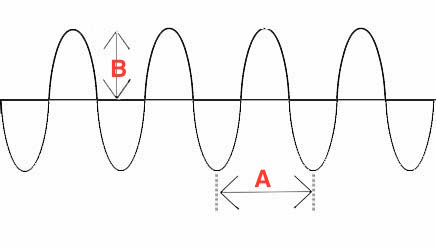
What property of this wave is represented by the letter "A"

a)

amplitude

b)

crest

c)

trough

d)

wavelength

101.
Which vocabulary term is used to identify the distance between points C & G?
a)
Amplitude
b)
Crest
c)
Frequency
d)
Wavelength
102.
When the frequency of a wave increases, what happens to the wavelength?
a)
The wavelength is not directly affected by the frequency of a wave.
b)
The wavelength increases.
c)
The wavelength decreases.
d)
More specific information is needed to form a conclusion about the wavelength.
103.
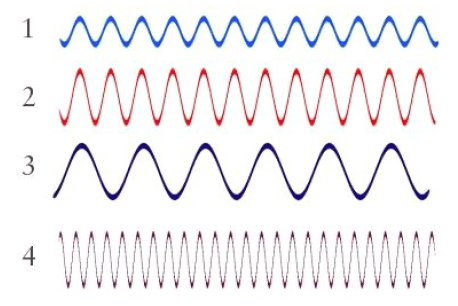
Which wave in the diagram has the greatest wavelength?
a)
1
b)
2
c)
3
d)
4
104.

A measurement made from crest to crest or trough to trough is defined as:

a)

crest

b)

trough

c)

amplitude

d)

wavelength

105.
A wave has wavelength of 10 m and a speed of 340 m/s. What is the frequency of the wave?
a)
34 m/s
b)
3400 Hz
c)
3400 m/s
d)
34 Hz
106.
Which has the longest wavelength?
a)
A
b)
B
c)
C
d)
D
107.
A wave that moves the medium in the same direction that the wave travels is a
a)
transverse wave
b)
longitudinal wave
c)
standing wave
d)
mechanical wave
108.

A string fixed at both ends, supports standing wave with a total of 4 nodes. If the length of the string is 12 m, what is the wavelength of the wave?

a)

A) 4 m

b)

B) 6 m

c)

C) 6.67 m

d)

D) 8 m

e)

E) 12 m

109.

Which of the following is equivalent to a Hz?

a)

meters/second

b)

1/meters

c)

1/seconds

d)

seconds/meter

110.

A water wave has a period of 0.25 seconds and a wavelength of 0.6 meters. What is the speed of the wave?

a)

2.4 meters

b)

0.15 meters

c)

0.85 meters

d)

2.1 meters

111.

What type of interference is represented in this diagram?

a)

Constructive

b)

Destructive

112.
What phenomenon does this image demonstrate?
a)
Constructive interference
b)
Destructive interference
c)
Increasing frequency
d)
Increasing period
113.

Which of these waves has the smallest amplitude?

a)

P

b)

Q

c)

S

d)

T

114.

Which statement is correct about the wave shown in the diagram?

a)

It is a transverse wave because the particles are moving perpendicular to the motion of the wave.

b)

It is a transverse wave because the particles are moving parallel to the motion of the wave.

c)

It is a longitudinal wave because the particles are moving perpendicular to the motion of the wave.

d)

It is a longitudinal wave because the particles are moving parallel to the motion of the wave.