wayground logo

Free Printable Worksheets

NEW

Font size

S
M
L
XL
Worksheets

G10 MYP - End of year

Total questions: 80

Worksheet time: 1hrs 5mins

Name
Class
Date
1.

Which of these animals is prey for frogs?

a)
b)
c)
d)
2.

What is the abiotic factor in the picture?

a)

deer

b)

water

c)

fish

d)

plants

3.

This picture shows what type of biome?

a)

rain forest

b)

tundra

c)

desert

d)

deciduous forest

4.

Windy, cloudy, rainy, and cold are words that describe –

a)

evaporation

b)

weather

c)

matter

d)

energy

5.

There is a ___________ chance that the baby will have blue eyes.

a)

25%

b)

50%

c)

75%

d)

100%

6.

This is the Periodic Table of --

a)

Molecules

b)

Compounds

c)

Chemicals

d)

Elements

7.

Look at the food chain. What is the producer?

a)

cat

b)

flower

c)

bird

d)

butterfly

8.

The amount of space occupied by an object is its ________________.


a)

length

b)

volume

c)

mass

9.

Observations that deal with a number or amount are called

a)

qualitative

b)

quantitative

10.

The variable that is changed by the scientist to test a hypothesis is called the _________________________ .

a)

dependent variable

b)

independent variable

c)

control

11.

The _________________________ is the base metric unit of mass.

a)

Liter

b)

meter

c)

gram

12.

Which is the best description of the dependent variable?

a)

the variable that is changed by the scientist

b)

the measurable variable

c)

the variable that does not change

13.

One way to analyze data from a study is to _____________

a)

make a graph

b)

develop a hypothesis

c)

recognize a problem

14.

Which of these solutions has the highest concentration?

a)

Two scoops of detergent in 500 ml of water

b)

Two scoops of detergent in 1000 ml of water

c)

one scoop of detergent and 500 ml of water

d)

one scoop of detergent and 1000 ml of water

15.

Jessica made a pitcher of lemonade. What can she do to dilute it if she thinks it doesn't taste right?

a)

Refrigerate the lemonade.

b)

Add water.

c)

Add sugar.

d)

Boil the lemonade.

16.

Material is added to a beaker of clear, colorless liquid. Which of these is evidence that a chemical reaction took place?

a)

One material dissolves in the other.

b)

Bubbles are created.

c)

They do not mix.

d)

It looks cloudy.

17.

The glow stick reaction is a

a)

Chemical change

b)

Physical change

18.

In the reaction above water is a ________________.

a)

Reactant

b)

Product

19.

A catalyst

a)

Speeds up a reaction.

b)

Slows down a reaction

c)

Has no effect on a reaction

20.

What is the term for a solid that is formed by mixing together two solutions?

a)

Heat of reaction

b)

Precipitate

c)

Aqueous solution

d)

Exothermic

21.

A reaction where more energy is released when the bonds of the products are formed than it takes to break the bonds of the reactants. Example: An explosion

a)

Exothermic reaction

b)

Endothermic reaction

22.

In a chemical reaction, if the reactants are heated, the reaction usually happens

a)

Faster

b)

Slower

c)

At the same rate

d)

In a smaller volume

23.

How many water molecules are on the product side of the equation?

a)

1

b)

2

c)

3

d)

4

24.

Atoms that are not in the reactants can end up in the products of a chemical reaction?

a)

True

b)

False

25.
A metal like copper is said to be ductile. This means it can be ... 
a)
corroded easily
b)
bent into wires 
c)
heat up and conduct heat
d)
bent into sheets 
26.
In another reaction, the student places a piece of metal into a test tube and adds an acid again. Its fizzes ..
The gas produced is called...
a)
nitrogen 
b)
Oxygen gas
c)
sulphur dioxide 
d)
Hydrogen gas 
27.
The number of atoms of oxygen in 
Cu(NO3)2 is ...
a)
2
b)
5
c)
6
d)
zero 
28.
The correct chemical formula for calcium carbonate is ....
a)
CaCO3
b)
Ca2CO3
c)
Na2CO3
d)
CO2
29.

Why is electrical wiring usually made from copper?

a)

Because copper is shiny

b)

Because copper conducts electricity

c)

Because copper is not magnetic

d)

Because copper insulate electricity

30.

1. Which switch or switches must be closed to make the lamps light?

a)

Only switch 1

b)

Only switch 1

c)

Switches 1 and 2

d)

Switches 1 , 2 and 3

31.

Tammy makes a complete simple circuit with one bulb and three batteries. The bulb lights for an instant and then goes out. Why?

a)

Too much electricity flows through the bulb's filament

b)

Not enough electricity flows around the circuit

c)

The batteries are flat

d)

The batteries are not good

32.

If lamp 1 is unscrewed from its holder, what will happen to lamp 2?

a)

It will get brighter

b)

It will stay the same brightness

c)

It will go out

d)

Nothing will happen

33.

A material that does NOT let electricity pass through it is called ...

a)

An electrical conductor

b)

An electrical insulator

c)

An electrical source

d)

An electric appliance

34.
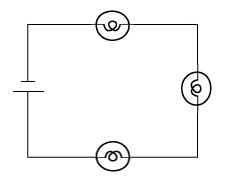
This is an example of a _______ circuit
a)
open
b)
series
c)
parallel
d)
square
35.
The picture shows an electrical circuit. This circuit is a series circuit because: 
a)
It has 3 light bulbs.
b)
The same current flows through all three light bulbs.
c)
It uses a single battery.
d)
The electrical current is divided between the three light bulbs.
36.
A material in which electrons are able to move easily
a)
Circuit
b)
Insulator 
c)
Resistance 
d)
Conductor 
37.
This circuit has more than one loop. When one light goes out, the others stay on. 
a)
closed circuit
b)
series circuit
c)
parallel circuit
d)
open circuit
38.
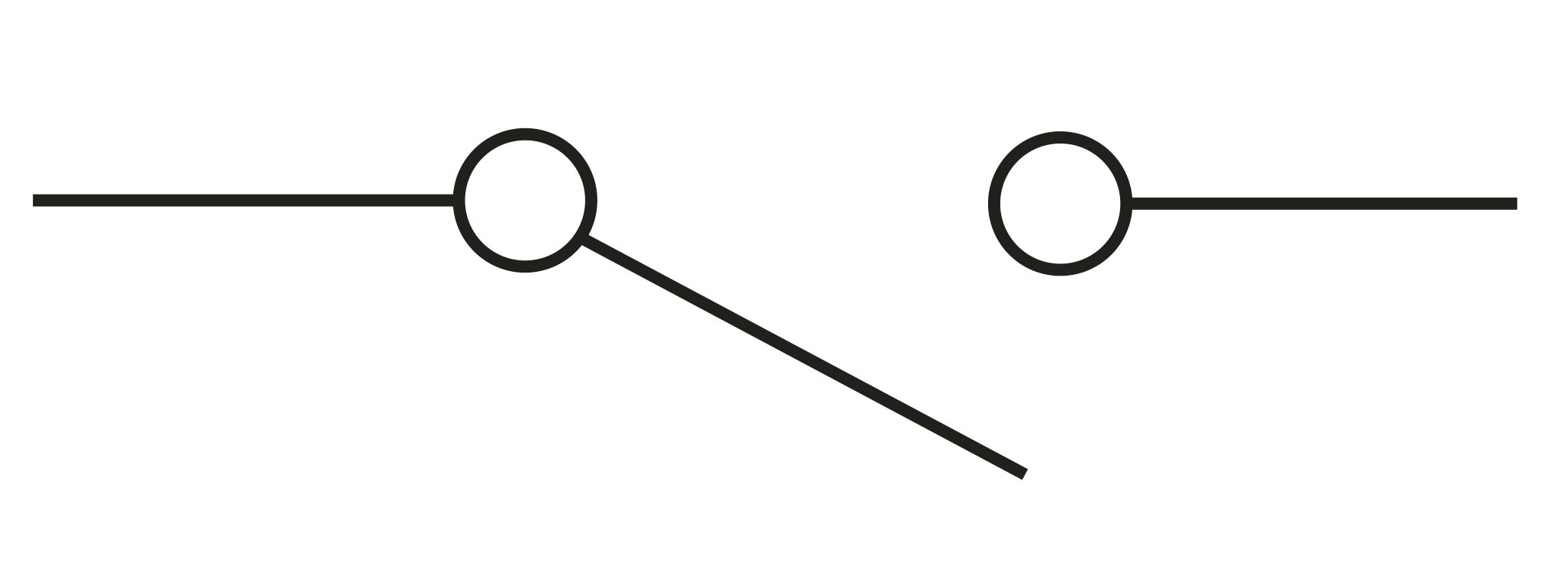
this is the symbol for a _____?
a)
switch
b)
light 
c)
battery
d)
wires
39.
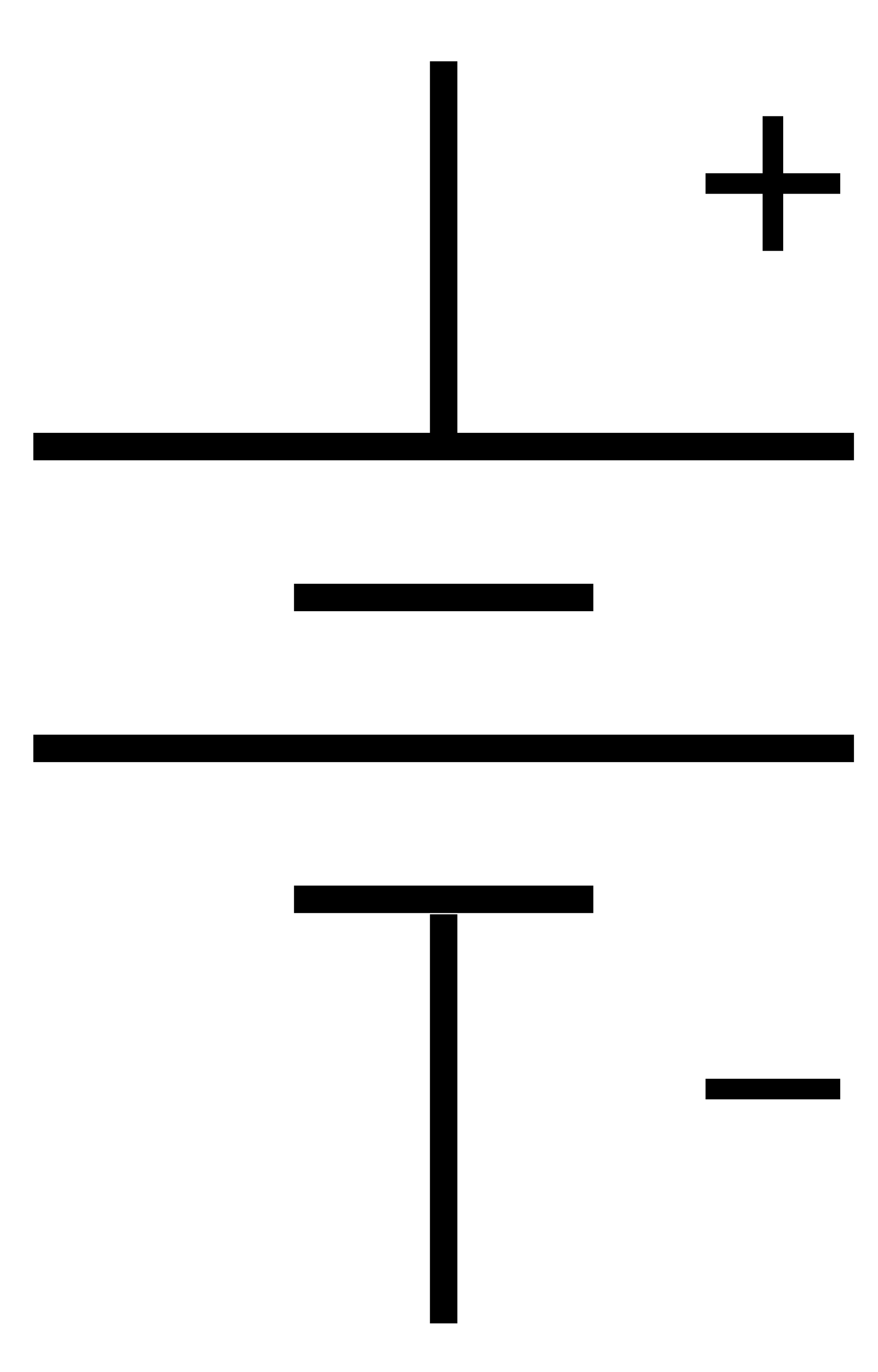
what is this symbol for?
a)
light bulb
b)
switch
c)
battery
d)
resistor
40.
Flow of electricty in a wire or other conductor
a)
closed circuit
b)
current
c)
open circuit
d)
conductor
41.
Voltage is measured in __.
a)
volts.
b)
watts.
c)
coulombs. 
42.
As the resistance of a circuit increases, the current will
a)
increase
b)
decrease
c)
stay the same
43.
Current has units: 
a)
kilowatt·hour 
b)
ampere 
c)
coulomb 
d)
volt 
44.

What type of circuit is the image showing?

a)

Parallel

b)

Series

c)

No circuit

45.
How many Volts would it take to push 1 Amp through a resistance of 1 Ohm
a)
10 volts
b)
1 volt
c)
48 volts
d)
5 volts
46.
What would the circuit resistance be if a 7.5 Amp draw was present with the engine running and the charging system producing 15 Volts
a)
15 Ohms
b)
4 Ohms
c)
0.3333 Ohms
d)
2 Ohms
47.
A green pea plant (Gg) is crossed with a yellow pea plant (gg). Describe the genotype of the offspring. (Be sure to remember that the capital letter is dominant).
a)
50% heterozygous and 25% homozygous recessive
b)
50% heterozygous and 50% homozygous recessive
c)
100% homozygous recessive
d)
25% heterozygous and 50% homozygous
48.
A tall plant (Tt) is crossed with a short plant (tt). What is the phenotype of the offspring?
a)
75% tall; 25% short
b)
25% tall; 75% short
c)
50% tall; 50% short
d)
100% tall
49.
A white flower (rr) is crossed with a white flower (rr). What is the phenotype of the offspring? Draw a Punnett square and answer the question.
a)
100% white
b)
75% white; 25% red
c)
75% red; 25% white
d)
100% red
50.
A homozygous dominant brown mouse (BB) is crossed with a heterozygous brown mouse (tan is the recessive color). List the offspring genotype and phenotype.
a)
50% homozygous dominant; 50% heterozygous and 100% tan
b)
25% homozygous dominant; 75% heterozygous; 100% brown
c)
50% homozygous dominant; 50% heterozygous and 100% brown
d)
75% homozygous dominant; 25% heterozygous and 100% tan
51.

The study of ____________ is called genetics

a)

heredity

b)

dominance

c)

pea plants

d)

mutations

52.

_________________ describes a trait that is covered over, or masked by another form of that trait.

a)

dominant

b)

punnett

c)

recessive

d)

gene

53.

Different forms of a gene are called

a)

alleles

b)

traits

54.

The letters representing the phenotype is called

a)

phenotype

b)

genotype

55.
If green is dominant over purple, then what is the genotype for this individual?
a)
Purple
b)
Green
c)
GG
d)
gg
56.
Which is the correct phenotype for this organism?
a)
BB
b)
blue
c)
green
d)
bb
57.
Tt is-
a)
homozygous dominant
b)
homozygous recessive
c)
heterozygous
d)
none of these
58.
The process of making changes in the DNA code of a living organism is called
a)
selective breeding 
b)
genetic engineering
c)
inbreeding
d)
hybridization
59.
Which statement is part of Darwin’s theory of evolution by natural selection?
a)
More offspring are produced than can possibly survive.
b)
The organisms that are the fittest are always largest and strongest.
c)
The number of offspring is not related to fitness.
60.
When every organism of a species has died.
a)
Evolution
b)
Natural Selection
c)
Extinction
d)
Artificial Selection
61.
Where the better adapted organisms survive to pass traits along to offspring.
a)
Evolution
b)
Natural Selection
c)
Extinction
d)
Artifical Selection
62.
Why are advantageous traits more likely to be passed onto offspring?
a)
Because they are more likely to survive and reproduce.
b)
Because they come from dominant alleles.
c)
Because they come from recessive alleles.
d)
Because the trait is an acquired phenotype.
63.
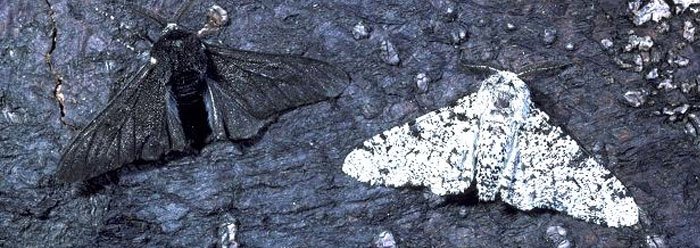
The trees these moths used to live on were white, but have been covered in soot from coal factories. Which moth will be more successful in this environment?
a)
Dark moth
b)
Light moth
c)
Both will be equally successful
d)
Neither will be successful
64.
These moths are all the same species. The differences between their wings is an example of ________________
a)
Natural Selection
b)
Variation
c)
Homeostasis
d)
Extinction
65.
What are study skills? 
a)
Cramming for a test
b)
Staying up all night 
c)
Approaches applied to learning 
d)
Finishing all of your homework 
66.
Independent Learners... 
a)
Ask questions
b)
Discuss topics with peers
c)
Speak up 
d)
All of the above 
67.
Why are notes important?
a)
Busy work...
b)
It takes too long to look it all up
c)
So we can remember the important stuff teachers taught us today.
d)
Notes, don't we just google all the information. 
68.
A good place and time to study might be:
a)
In the den with the tv on.
b)
At 10:00 when you're really tired.
c)
In a quiet, well-lit place.
d)
In the pool with your dog.
69.
To reduce test anxiety you should:
a)
Start studying early - don't cram.
b)
Take a deep breath.
c)
Get a good night's rest before.
d)
All of these.
70.
True of False: A exam is a way to demonstrate your understanding. 
a)
False
b)
True 
71.

Studying in 20 -30 minutes sessions over time trains your brain to effectively remember content.

a)

True

b)

False

72.

Re-reading your notes is more beneficial than study cards.

a)

True

b)

False

73.

Studying while listening to your favorite music is an effective way of developing great study habits.

a)

True

b)

False

74.

Before you take a test, it does not matter if you talk with other students who have negative thoughts, saying things such as, "I'm going to fail this test anyway."

a)

True

b)

False

75.

The first step in getting help to start improving your grades is _______.

a)

Talking to your teachers

b)

Getting your parent to call the school board

c)

Reporting your situation to the principal

d)

None of the above

76.
If you are assigned an essay or longer assignment, it is easier to do all of the work at one time.
a)
True - getting it all done at the same time, saves time for me.
b)
False - breaking it into smaller "chunks" a little bit each day is a bit more manageable to complete it.  
77.
Paraphrase means to:
a)
put it in your own words
b)
cut the phrase in half
c)
delete the unimportant facts
d)
none of the above
78.
To summarize means to:
a)
dress in cool clothing
b)
listen to beach music
c)
re-word the text
d)
briefly restate the important facts or main point
79.
What does the word "illustrate" mean in the following sentence:
By using a ruler, the teacher was able to illustrate how to measure. 

a)
Draw a picture
b)
Explain or make clear
c)
Measure something 
d)
Listen carefully
80.
Present a detailed argument or consideration.
a)
evaluate
b)
discuss
c)
interpret
d)
sequence