Wayground logo

Free Printable Worksheets

Font size

S
M
L
XL
Worksheets

Chemistry- Unit 1 revision

Total questions: 61

Worksheet time: 2hrs 59mins

Name
Class
Date
1.
What is the electron configuration for this atom?
a)
1s22s22p6
b)
1s22s22p5
c)
1s22s22p3
d)
2s22p3
2.
What atom matches this electron configuration?
1s2 2s2 2p6 3s2
a)
Neon
b)
Magnesium
c)
Aluminum
d)
Potassium
3.
Which is the electron configuration for an oxygen atom?
a)
1s22s22p63s23p64s2
b)
1s22s22p4
c)
1s22s22p6
d)
1s22s22p63s23p6
4.
How many electrons can the d sublevel hold?
a)
8
b)
10
c)
2
d)
4
5.
What is this element? 
1s22s22p63s23p6
4s23d104p6
a)
Argon
b)
Krypton
c)
Selenium
d)
Bromide
6.

found in group 1 of the periodic table; highly reactive

a)

alkali earth metals

b)

Transition Metals

c)

alkali metals

d)

halogens

7.

A subatomic particle that has a positive charge and that is found in the nucleus of an atom

a)

Proton

b)

elecrtron

c)

groups

d)

neutrons

8.

A subatomic particle that has a negative charge

a)

nobles gases

b)

protons

c)

electrons

d)

neutrons

9.

The electrons in the outermost shell (main energy level) of an atom; these are the electrons involved in forming bonds

a)

alkali metals

b)

Halogens

c)

atomic number

d)

valence electrons

10.
Which of the following will have a larger radius than Zinc?
a)
Gallium
b)
Aluminum
c)
Magnesium
d)
Strontium
11.
As you move down the periodic table atoms get bigger.  This is because ____________.
a)
The atoms have more mass.
b)
The atoms have more protons.
c)
The atoms have more energy levels
d)
The atoms have more neutrons
12.
Electronegativity is...
a)
the ability of an atom to attract/ accept electrons
b)
the ability of an atom to lose electrons
c)
the energy required to remove an electron from a specific atom
d)
how easy it is to make friends. 
13.
Ionization energy is...
a)
the energy required to add an electron to a specific atom
b)
how much energy it takes to remove an electron from an atom
c)
the energy required to shield the outer electrons from the nucleus
d)
a measure of the ability of an atom to attract electrons
14.
The atom with the largest atomic radius in Group 18 is - 
a)
Ar
b)
He
c)
Kr
d)
Rn
15.
Which element has a full valence shell?
a)
F
b)
D
c)
C
d)
E
16.

Which element has 3 valence electrons?

a)

A

b)

B

c)

E

d)

C

17.
Which element belongs to the group that is made up of only gases?
a)
D
b)
L
c)
E
d)
A
18.
Is this a metal, nonmetal or metalloid?
a)
Metal
b)
Nonmetal
c)
Metalloid
19.
How many energy levels does an atom of Chlorine have?
a)
2
b)
3
c)
4
d)
7
20.
What is the group number of this atom?
a)
2
b)
7
c)
14
d)
15
21.
Sodium (Na) and potassium (K) are in the same group on the periodic table. Based on their locations, which statement about sodium and potassium is true?
a)
Sodium is less electronegative than potassium. 
b)
Sodium has fewer energy levels than potassium. 
c)
Sodium has a larger ionic radius than potassium. 
d)
Sodium has lower ionization energy than potassium. 
22.

What is the formula for sodium bromide?

a)

NaBr

b)

NaBr2

c)

Na2Br

d)

SoBr

23.

What is the formula for diphosphorus pentoxide?

a)

P2O5

b)

PO5

c)

P5O2

d)

Po2O5

24.

What is the name for SiCl4?

a)

silicon tetrachloride

b)

silicon quadchloride

c)

monosilicon tetrachloride

d)

silicon chloride

25.

What is the formula for copper(I) sulfate?

a)

CuSO3

b)

CuSO4

c)

Cu2SO3

d)

Cu2SO4

26.

What is the formula for sodium nitrate?

a)

Na3NO

b)

NaNO2

c)

Na3NO3

d)

NaNO3

27.

What is the name of FeCl₂?

a)

iron chloride

b)

iron (II) chloride

c)

iron (I) chloride

d)

iron dichloride

28.
What is the formula for magnesium chloride?
a)
MgCl
b)
Mg2Cl
c)
MgCl2
d)
Mg(ClO3)2
29.
What is the charge on the hydroxide ion?
a)
0
b)
-1
c)
-2
d)
-3
30.
What is Avogadro's Number? 
a)
6.02 x 10²³
b)
- 6.02 1023
c)
6.02 x 10²²
d)
6,020,000,000,000
31.
Find the percent composition of N2S2.
a)
N: 69.6%  S: 30.4%
b)
N:36% S: 75.6%
c)
N: 96.6% S: 3.4%
d)
N: 30.4% S: 69.6%
32.
Find the percent composition of Cu2S?
a)
%Cu= 67.987 %S= 32.013
b)
%Cu= 79.854   %S= 20.145
c)
%Cu= 35.946   %S= 64.054
33.
A compound consists of 72.2% magnesium(Mg) and 27.8% nitrogen(N) by mass. What is the empirical formula?
a)
Mg4N3
b)
MgN2
c)
Mg3N2 
d)
MgN
34.
What is the empirical formula if you have 81.82% carbon and 18.18% hydrogen?
a)
C3H8
b)
CH4
c)
C2H2
d)
C4H10
35.
What is the percentage of chlorine in sodium chloride? (NaCl)
a)
60.7%
b)
39.3%
c)
60%
d)
40%
36.
Given the following: 42.07% Na, 18.89% P, and 39.04% O, determine the empirical formula.
a)
 NaPO2
b)
Na2PO3
c)
Na3PO4
d)
NaPO4
37.
What is the empirical formula of the following molecular formula:  C3H6
a)
C3H6
b)
CH2
c)
C2H4
d)
CH3
38.
What is the molecular formula if the empirical formula is C2H5 and the molecular molar mass is 58.14 g/mol?
a)
C2H5
b)
C4H10
c)
C1H2.5
d)
C4H8
39.
Balance this equation:
MgCl2 --> Mg4+ Cl2
a)
It's already balanced.
b)
4MgCl2 --> Mg4+ 4Cl2
c)
4MgCl2 --> Mg4+ 5Cl2
40.
Is the following equation balanced or unbalanced ? 
Al + O2 --> Al2O3
a)
Balanced
b)
Unbalanced
41.
How many atoms of aluminum are on each side of the following equation: 4Al + 3O2 --> 2Al2 O3
a)
2
b)
6
c)
1
d)
4
42.
What are the coefficient used to balance the equation below?
__Ag2O →__ Ag +___O2
a)
2,4,1
b)
1,1,1
c)
2,1,2
d)
2,2,2
43.
In an electron dot diagram, two pairs of shared electrons represents a ...
a)
single bond
b)
double bond
c)
triple bond
d)
quadruple bond
44.
A Nitrogen molecule (N2) has one triple bond. How many electrons do the nitrogen atoms share?
a)
1
1
b)
3
c)
4
d)
6
45.
 A lone pair is defined as
a)
A pair of bonding electrons
b)
One non-bonding electron
c)
A pair of non-bonding electrons
d)
A pair of electrons on the central atom
46.
What is the VSEPR theory used to predict?
a)
Bond Strength
b)
Polarity
c)
Molecular Shape
d)
Electronegativity
47.

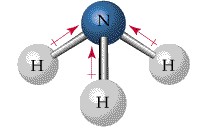
What 3-D VSEPR shape does this molecule exhibit?

a)

linear

b)

tetrahedral

c)

trigonal pyramidal

d)

trigonal planar

48.

Which Lewis Dot Model drawing correctly shows an O2 molecule?

a)
b)
c)
d)
49.
What molecular shape is the structure shown here? (H2O)
a)
tetrahedral
b)
trigonal planar
c)
bent
d)
trigonal pyramidal
50.

Use your knowledge and electronegativity sheet to predict what the following compound is classified as.

a)

polar covalent

b)

nonpolar covalent

c)

ionic

d)

metallic

51.

Use your knowledge and electronegativity sheet to predict what the following compound is classified as.

a)

nonpolar covalent

b)

polar covalent

c)

ionic

d)

metallic

52.
In this Lewis structure, the symbol above F means...
a)
electrons are being transferred to Fluorine
b)
electrons are less attracted to F than H
c)
electrons are more attracted to F than H
d)
Fluorine has formed a cation
53.

Is this molecule polar or non-polar?

a)

Polar

b)

Non-polar

54.

Is this molecule polar or non-polar?

a)

Non-polar

b)

Polar

55.
In a polar covalent bond, electrons are shared ___________.
a)
equally
b)
unequally
c)
between non-metals with similar electronegativities
d)
between a metal and a non-metal
56.
What geometry will this molecular structure have?: H2S
a)
bent
b)
tetrahedral
c)
linear
d)
trigonal pyramidal
57.
What geometry will this molecular structure have?: CCl4
a)
bent
b)
tetrahedral
c)
linear
d)
trigonal pyramidal
58.
Choose the correct shape for this molecule:
a)
Bent
b)
Linear
c)
Tetrahedral
d)
Trigonal pyramidal
59.

What is the molecular geometry for this molecule?

a)

Bent

b)

Trigonal pyramidal

c)

Trigonal planar

d)

Linear

60.

Polymers are made of

a)

Acids

b)

Hydrogen

c)

Carbons

d)

Monomers

61.

Polymer made by repeating units of Ethene

a)

Polyethylene

b)

Polyethene

c)

PVC

d)

polypropylene