wayground logo

Free Printable Worksheets

Font size

S
M
L
XL
Worksheets

Chapter 6, 7 & 9

Total questions: 90

Worksheet time: 1hrs 15mins

Name
Class
Date
1.
How many valence electrons does nitrogen have?
a)
3
b)
2
c)
5
d)
1
2.
What can be generalized about covalent bonds?
a)
Electrons will be exchanged.
b)
Electrons will be transferred.
c)
Electrons will be given and taken.
d)
Electrons will be shared.
3.
What is it called if there are three-pairs of electrons being shared?
a)
Triple bond
b)
Bond length
c)
Tribond
d)
Chocolate Mousse
4.
Which of the following is the correct Lewis dot structure for the molecule fluorine (F2)?
a)
A
b)
B
c)
C
d)
D
5.
How many electrons should Carbon have around its Lewis dot structure?
a)
1
b)
3
c)
4
d)
5
6.
What two types of atoms make a covalent bond?
a)
2 Nonmetals
b)
1 Nonmetal & 1 Metal
c)
2 Metals
d)
2 Noble Gases
7.
What is a diatomic element?
a)
a metal bonded with a nonmetal
b)
2 or more nonmetals bonded together
c)
2 or more metals bonded together
d)
2 atoms of the same element bonded together
8.
How many electrons are shared in a double bond?
a)
2
b)
4
c)
6
d)
8
9.
When two nonmetals do not share electrons evenly, the resulting covalent bond will be
a)
nonpolar
b)
polar
c)
ionic
d)
metallic
10.
The only truly nonpolar molecules are between
a)
metals and nonmetals
b)
different nonmetals
c)
nonmetals of the same element
d)
metalloids of the same element
11.
Which element below is not diatomic?
a)
hydrogen
b)
oxygen
c)
nitrogen
d)
sulfur
12.
If a molecule contains polar bonds, the molecule MAY OR MAY NOT be polar overall. 
a)
True 
b)
False
13.
In a(an) POLAR bond, one atom pulls on the shared electrons more than the other atom. 
a)
True
b)
False
14.
What part of an atom is involved in chemical bonding?
a)
protons
b)
neutrons
c)
electrons
d)
nucleus
15.
A ________ is a model of an atom in which each dot represents a valence electron.
a)
Valence electron
b)
Electron dot diagram/Lewis dot structure
c)
Lewis bond structure
16.
How many valence electrons does hydrogen have?
a)
3
b)
2
c)
5
d)
1
17.
The chemical formula shows one carbon atom bonded to __________ oxygen atoms.
a)
one
b)
two
c)
three
d)
four
18.
How many electrons should Lithium have around its Lewis dot model?
a)
1
b)
2
c)
3
d)
4
19.
Hydrogen needs _____ electrons in its valence shell to be stable.
a)
4
b)
6
c)
8
d)
2
20.
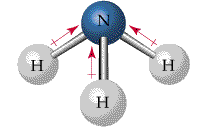
What is the correct formula for this molecule?
a)
NH
b)
N3H
c)
NH3
d)
NH4
21.
Which of the following is the correct Lewis structure for CH2O?
a)
Option A
b)
Option B
c)
Option C
d)
Option D
22.
In the correct Lewis structure for water, how many unshared pairs of electrons will oxygen have?
a)
1
b)
4
c)
3
d)
2
23.

Which of the following is the correct LD Diagram for Hydrogen Cyanide, HCN?

a)

A

b)

B

c)

C

d)

D

24.
Which LD Diagram is correct for chloromethane (CH3Cl)
a)
A
b)
B
c)
C
d)
D
25.

Which is the correct molecular structure for carbon dioxide CO2?

a)
b)
c)
d)
26.

Is this molecule polar or non-polar?

a)

Polar

b)

Non-polar

27.

Is this molecule polar or non-polar?

a)

Polar

b)

Non-polar

28.

Is this molecule polar or non-polar?

a)

Non-polar

b)

Polar

29.

Is this molecule polar or non-polar?

a)

Non-polar

b)

Polar

30.
What geometry will this molecular structure have?: H2S
a)
bent
b)
tetrahedral
c)
linear
d)
trigonal pyramidal
31.
What geometry will this molecular structure have?: CCl4
a)
bent
b)
tetrahedral
c)
linear
d)
trigonal pyramidal
32.
What geometry will this molecular structure have?: PH3
a)
bent
b)
tetrahedral
c)
linear
d)
trigonal pyramidal
33.
What geometry will this molecular structure have?: CCl4
a)
bent
b)
tetrahedral
c)
linear
d)
trigonal pyramidal
34.
Will this molecule be polar or nonpolar? H2S
a)
polar
b)
nonpolar
35.
Choose the correct shape for this molecule:
a)
Bent
b)
Linear
c)
Tetrahedral
d)
Trigonal pyramidal
36.

When you have Br-Br, what is the polarity?

a)

Polar

b)

nonpolar

c)

Ionic

37.

When you have H-Cl, what is the polarity?

a)

nonpolar

b)

polar

c)

ionic

38.

When you have Si-O, what is the polarity?

a)

nonpolar

b)

polar

c)

ionic

39.

When you have F-F, what is the polarity?

a)

nonpolar

b)

polar

c)

ionic

40.

When you have C-H, what is the polarity?

a)

nonpolar

b)

polar

c)

ionic

41.

Use your knowledge and electronegativity sheet to predict what the following compound is classified as.

a)

polar covalent

b)

nonpolar covalent

c)

ionic

d)

metallic

42.

Use your knowledge and electronegativity sheet to predict what the following compound is classified as.

a)

nonpolar covalent

b)

polar covalent

c)

ionic

d)

metallic

43.

Use your knowledge and electronegativity sheet to predict what the following compound is classified as.

a)

non-polar covalent

b)

polar covalent

c)

ionic

d)

metallic

44.
In this Lewis structure, the symbol above F means...
a)
electrons are being transferred to Fluorine
b)
electrons are less attracted to F than H
c)
electrons are more attracted to F than H
d)
Fluorine has formed a cation
45.
Which molecule contains bonds of GREATER polarity?
a)
H2O
b)
OF2
46.
Which molecule contains bonds with a GREATER polarity?
a)
HCl
b)
CCl4
47.
A diatomic molecule like O2 is always_______ because electrons are shared ________.
a)
nonpolar; equally
b)
polar; equally
c)
nonpolar; unequally
d)
nonpolar; unequally
48.
How many carbon atoms are in methane?
a)
1
b)
2
c)
3
d)
4
49.
How many carbon atoms are in ethane?
a)
1
b)
2
c)
3
d)
4
50.
Hydrocarbons are compounds that contain
a)
  Carbon and Nitrogen
b)
Carbon and Hydrogen 
c)
  Carbon, and Oxygen
d)
Carbon, Oxygen, and  Hydrogen 
51.
Which of the following elements must be present in any organic compound?
a)
Carbon
b)
Oxygen
c)
Potassium
d)
Hydrogen
52.
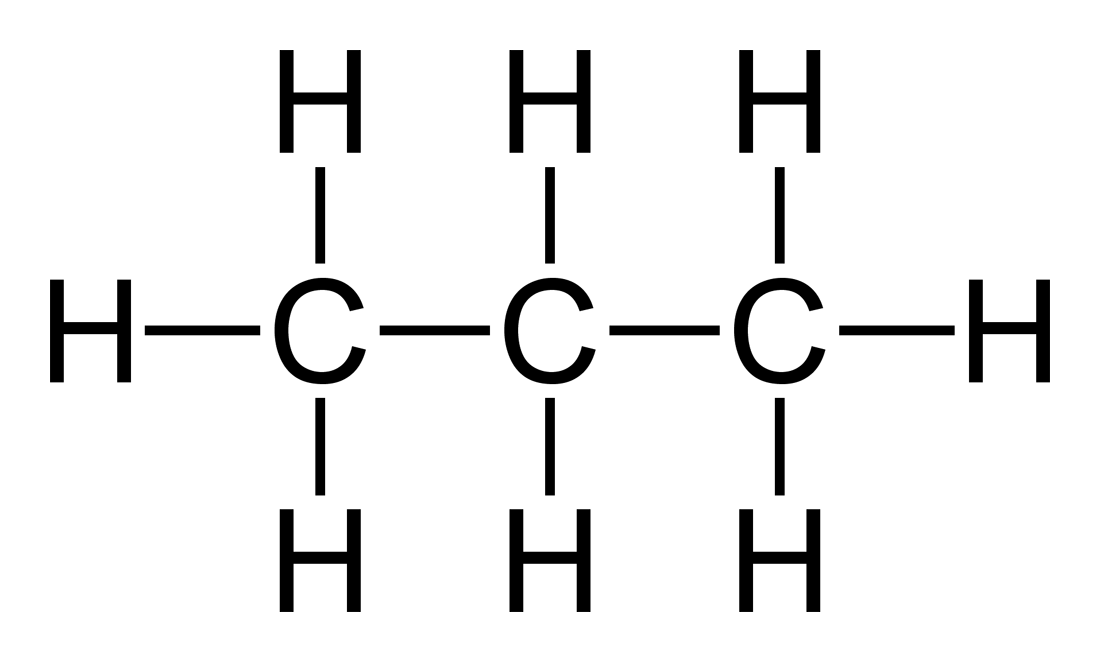
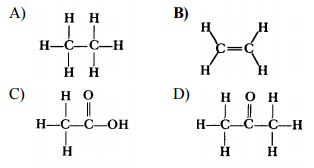
Name this alkane
a)
Methane
b)
Ethane
c)
Propane
d)
Butane
53.
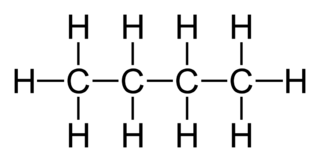
Name this alkane
a)
Methane
b)
Ethane
c)
Propane
d)
Butane
54.
Name this alkane
a)
Methane
b)
Ethane
c)
Propane
d)
Butane
55.
The following compounds have a molecular formula of
a)
CnH2n+2
b)
CH4
c)
C6H14
d)
CH3CH2CH2CH2CH2CH3
56.

What is the general formula of the alkenes?

a)

CnH2n+1

b)

CnH2n+2

c)

CnH2n

d)

CnH2n+1OH

57.

molecules with double/tripple bond

a)

carbocilic acids

b)

alkynes

c)

unsaturated fats

d)

saturated fats

58.

The group made up of alcohols and acids

a)

esters

b)

carbocilic acids

c)

ethers

d)

alkynes

59.

molecule with the same molecular structure but different structural formula

a)

fats

b)

lipids

c)

fossil fuels

d)

isomers

60.

the type of reaction that occur in alkenes

a)

elimination

b)

substitution

c)

addition

61.
How many carbon atoms are in propane?
a)
1
b)
2
c)
3
d)
4
62.
Which of the following would have the highest melting point?
a)
C3H8
b)
C4H8
c)
C5H12
d)
C22H44
63.
Which of the following could contain a triple bond?
a)
C4H10
b)
C4H8
c)
C4H6
d)
C4H12
64.
Which one of the following is saturated?
a)
water
b)
C4H8
c)
C4H10
d)
C5H8
65.
Which of the following does not contain only carbon and hydrogen
a)
alkanes 
b)
alkenes
c)
alkynes
d)
alkanols
66.

What term describes alkene molecules that contain a C=C double bond?

a)

saturated

b)

unsaturated

67.

Name the following hydrocarbon

a)

butane

b)

hexane

c)

heptane

d)

hexene

68.
How many carbons are in the backbone (longest chain) of this organic compound: 2,3,3-triethyl-4-nonene
a)
2
b)
6
c)
7
d)
9
69.
Which formula represents an unsaturated hydrocarbon?
a)
A
b)
B
c)
C
d)
D
70.
If an alkane has 20 carbon atoms, how many hydrogen atoms will it have?
a)
20
b)
22
c)
40
d)
42
71.
Name this alkyne.
a)
propyne
b)
butyne
c)
heptyne
d)
ethyne
72.

CH2=CH2 is a type of_______.

a)

saturated hydrocarbon

b)

unsaturated hydrocarbon

c)

supersaturated hydrocarbon

d)

none of the above

73.
As the number of carbons increases in an homologous series the melting point generally...
a)
increase
b)
decrease
c)
stay the same
d)
varies
74.
The functional group of the monomer react to bond each other and produce water.
a)
condensation
b)
thermosetting
c)
copolymer
d)
addition
75.
Which functional group is present in this molecule? 
a)
Hydroxyl only 
b)
Hydroxyl and Amino 
c)
Carboxyl and Amino 
d)
Hyroxyl and Carboxyl 
76.
How is a Carboxyl Group commonly written?
a)
-OH
b)
 -COOH
c)
-COH
d)
-CHOH
77.
Which functional group is present in this molecule? 
a)
Hydroxyl 
b)
Carboxyl 
c)
Amino 
d)
Phosphate 
78.

Is the name of the representation showed in the image.

a)

Condensed Formula

b)

Structural Formula

c)

Line Diagram/Skeletal Formula

79.
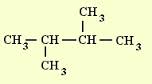
Name the compound.
a)
hexane
b)
2,3-dimethylbutane
c)
ethylbutane
d)
2,2-dimethylbutane
80.

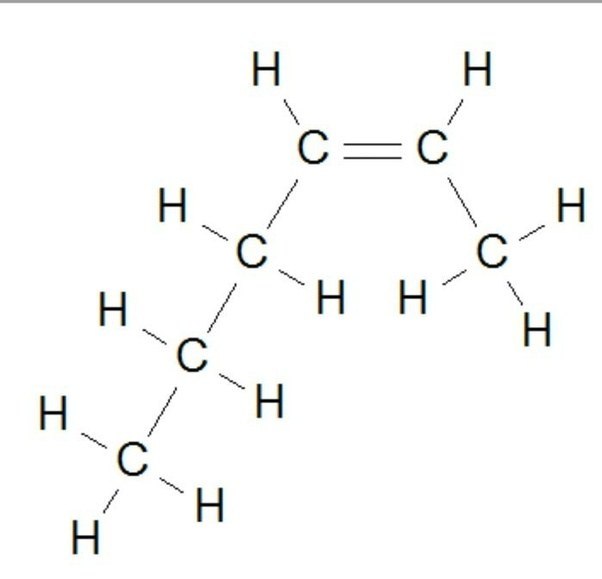
What chemical is this? (C5H10)

a)

Pent-1-ene

b)

Pent-2-ene

c)

Pent-3-ene

d)

Pent-4-ene

81.
a)

Pentane

b)

3-methylpentane

c)

2-ethylbutane

d)

Butane

82.

Name the following branched alkane

a)

4-ethyl-4,6-dimethyl-5-propyl nonane

b)

4-ethyl-4,6-dimethyl-5-propyl heptane

c)

6-ethyl-4,6-dimethyl-5-propyl nonane

d)

6-ethyl-4,6-dimethyl-5-propyl heptane

83.

Which of these structures represent

4-ethyl-2,3-dimethyl-2-heptene?

a)
b)
c)
d)
84.
Is this hydrocarbon saturated or unsaturated? 
a)
saturated
b)
unsaturated
85.
a)

4-decylbutane

b)

decane

c)

alkane

d)

5-butyldecane

86.
a)

3-ethyl-2,2-dimethylbutane

b)

3,4,4-Trimethylpentane

c)

Pentane

d)

2,2,3-Trimethylpentane

87.

What is the name of this compound?

a)

3-ethyl-3-propyl hexane

b)

3-propyl-3-ethyl hexane

c)

4-ethyl-4-propyl hexane

d)

4-propyl-4-ethyl hexane

88.

What is the name of this compound?

a)

2-ethyl pentane

b)

3-methyl hexane

c)

4-methyl hexane

d)

3-ethyl pentane

89.
a)

4-ethyl-5-propyl octane

b)

3,4-dipropyl heptane

c)

4,3-dipropyl heptane

d)

4-propyl-5-ethyl octane

90.

What is the name of this compound?

a)

3,6,6-trimethyl-4,5,5-triethyl nonane

b)

3,3,4,5-tetraethyl-2,5-dimethyl-2-propyl heptane

c)

4,5,5-triethyl-3,6,6-trimethyl nonane

d)

5,5,6-triethyl-4,4,7-trimethyl nonane