
 Worksheets
EOT-HSS631 Physiological Coordination
Total questions: 114
Worksheet time: 1hrs 18mins
From the perspective of the cell receiving the message, the three stages of cell signalling in order are:
The paracrine, local and synaptic stages
Signal reception, signal transduction and cellular response
Signal reception, nucleus disintegration and new cell generation
The alpha, beta and gamma stages
At puberty, an adolescent female body changes in both structure and function of several organ systems, primarily under the influence of changing concentrations of estrogen and other steroid hormones. How can one hormone, such as estrogen, mediate so many effects?
Estrogen is produced in very large concentrations and therefore diffuses widely
Estrogen has specific receptors inside several cell types, but each cell responds in the same way to its binding.
Estrogen is kept away from the surface of any cells not able to bind to it at the surface.
Estrogen binds to specific receptors inside many kinds of cells, each of which have different responses to its binding.
Binding of a signalling molecule to which type of receptor leads directly to a change in distribution of ions on opposite sides of the membrane?
Receptor tyrosine kinases
G- protein coupled receptors
Phosphorylated receptor tyrosine kinase dimer
Ligand-gated ion channel
Many of the extracellular signal molecules that regulate inflammation are released locally at the site of infection. What form of cell-to-cell signaling is being used?
Endocrine
Paracrine
Autocrine
Intracellular
When the hormone insulin is released into the bloodstream, what form of cell-to-cell signaling is being used?
Paracrine signalling
Synaptic signalling
Autocrine signalling
Endocrine signalling
What does a target cell require to respond to an extracellular signal molecule?
Access to the signal molecule
An appropriate receptor for the signal molecule
Appropriate intracellular signaling pathways
All of the above
When cells respond to an extracellular signal, they most often convert the information from one form to another. This process is called:
Signal transformation
Signal transduction
Signal interference
Signal amplification
What is a phosphorylation cascade?
travelling of hormones through the air
travelling of hormones through the blood
the removal of a phosphate
a series of molecules that get phosphorylated and change in shaped


What type of transmembrane receptor is being shown?
G-protein receptor
tyrosine kinase receptor
gated ion channel


A series of chemical reactions that relay chemical message inside the cell; may amplify the signal
reception
transduction
response
activation
the change in cell activity that results from the binding of the ligand to the receptor
reception
transduction
integration
response

Which of the following molecules act as a second messenger in the cascade by which epinephrine stimulates the activation of the enzyme glycogen phosphorylase?
Many signal transduction pathways use second messengers to:
transport a signal through the lipid bilayer portion of the plasma membrane.
relay a signal from the outside to the inside of the cell.
relay the message from the inside of the membrane throughout the cytoplasm.
amplify the message by phosphorylating proteins.
What is the amplification of a series of kinases called?
phosphorylation cascade
kinase cascade
phosphatase cascade
ATPase cascade
How do bacteria sense local population density?
quorum sensing
bacteria sensing
signal sensing
population sensing
In cell signaling, how is the flow of specific ions
regulated?
Opening and closing of ligand-gated channels
Transduction
Cytoskeleton rearrangement
Endocytosis
Which of the following transduction signal molecules pass through the plasma membrane and bind to the intracellular receptors that move into the nucleus and function as transcription factors to regulate gene expression?
epinephrine
growth factors
yeast mating factors
testosterone, a steroid hormone
Which of the following statements best describes the action of testosterone on cells of the human gonads?
The hormone acts as the first messenger when it binds to and activates the G protein-coupled receptors on the surface of cells in the testes. This activates the mobile G protein located inside the cell.
The hormone enters the cells in the testes by first binding with a membrane receptor, which causes a channel to open in the membrane, allowing testosterone to flood into the cell.
The hormone readily passes through the cell membrane and binds to a receptor in the cytoplasm. The hormone and receptor then enter the nucleus and act as a transcription factor that turns on one or more genes.
The hormone binds with cAMP on the surface of the cell. Once attached to cAMP the hormone enters the cell and initiates a signal transduction pathway.
What could happen to the target cells in an animal that lack receptors for local regulators?
They could compensate by receiving nutrients via an α factor.
They could develop normally in response to neurotransmitters instead.
They could divide but never reach full size.
They would not be able to multiply in response to growth factors from nearby cells.

which of the following is true about the following images
It is a kind of direct signaling
the ligand is hormone
it is paracrine process
it is membrane bound receptors
which of the following is not an example of a response
stop RNA translation
Stop RNA transcription
Stop gene expression
change vesicle activity
which of the following is correct about homeostasis
It needs coordination between Nervous and Endocrine system
it can be achieved by both positive and negative feedback mechanism for all conditions
it can contribute for internal stability of the body
positive feedback is more common than negative feedback
Which of the following is not a function of the medulla oblongata?
Control vomiting reflexes
Control blood pressure
Control cardiac rate
Control breathing rate
Control speech patterns
Which of the following statements about axons is true?
There are often numerous axons for each neuron
The axon is the site of neurotransmitter production
The axon carries action potentials away from the cell body of a neuron
The axon contains the cell nucleus
Which of the following structures is found only in the peripheral nervous system?
Free nerve ending
Gray matter
Oligodendrocytes
Interneurons
White matter
Which of the following is responsible for creating myelin, for the myelin sheaths of axons?
Schwann cells only
Oligodendrocytes only
Schwann cells and oligodendrocytes
None of the other answers are correct
During an action potential, why is there a hyperpolarization phase?
The sodium-potassium pump is active
Negatively charged chloride ions enter the cell to end the action potential
Voltage-gated sodium channels remain open
Voltage-gated potassium channels remain open
Which of the following is true about cells at resting potential?
There is a higher concentration of sodium inside of the cell
They have a resting potential of -30mV relative to the outside of the cell
There is a higher concentration of potassium outside of the cell
A sodium-potassium pump keeps the membrane polarized
A patient is taken to the hospital after suffering severe head trauma. He is unconscious for two days before waking up. Upon standing, the patient finds he has moderate trouble walking straight and has difficulty maintaining his balance.
Based on these symptoms, what part of the patient's brain do you suspect was damaged in the accident?
medulla oblongata
cerebrum
hypothalamus
amygdala
cerebellum
When stimulated, the vagus nerve slows down heart rate. We can assume that the vagus nerve is classified under which branch of the nervous system?
Parasympathetic nervous system
Neuroglia
Sympathetic nervous system
Somatic nervous system
Central nervous system
Action potentials move down myelinated axons via salutatory conduction. This is because __________.
they jump from gap to gap in between the myelin sheaths
they speed up dramatically in areas with more myelin wrapping, depending on the thickness of the sheath
additional impulses boost their speed periodically
they jump from the middle of the gaps to the middle of the myelin sheaths
Which of the following reasons best explains the "hyperpolarization" phenomenon during an action potential?
Sodium channels close slowly, thus allowing too much sodium into the cell
Potassium channels close slowly, thus allowing too much potassium out of the cell
Hyperpolarization only occurs in cells that are not able to be depolarized
Sodium channels close quickly, not allowing enough sodium into the cell
Electrical activity in the nervous system is transmitted by impulses known as action potentials. An action potential generally begins when a stimulus reaches the dendrites of a neuron, triggering a number of cell membrane conductivity changes. After the stimulus, there is a period of time during which no second stimulus, no matter how strong, can cause a second action potential. What is the name for this period of time?
Apoptosis
Threshold period
Depolarization
Saltatory conduction
Absolute refractory period
Which of the following is characterized by having a membrane potential below -70mV?
Refractory period
Resting potential
Action potential
Threshold
Which portion of a neuron receives neurotransmitters from a previous neuron, signaling the need for propagation of action potential?
Dendrites
Axon
Synaptic terminal
Soma
An example of DIRECT cell communication is:
White blood cells bumping into each other sharing antigen info
Neurons communicating across a synapse
Hormones traveling through the blood stream to target tissues
An example of DIRECT cell communication is:
White blood cells bumping into each other sharing antigen info
Neurons communicating across a synapse
Hormones traveling through the blood stream to target tissues

Name the structure labeled 'B' (see image)
Post synaptic terminal
Receptor
Ligand
Neurotransmitter

The structure labeled 'E' is called _____ and is filled with ______
Vacuole; lipids
Synapse; neurotransmitters
Membrane; lipids
Vesicle; neurotransmitters
The structure labeled 'E' is called _____ and is filled with ______
Vacuole; lipids
Synapse; neurotransmitters
Membrane; lipids
Vesicle; neurotransmitters
Sensory neurons are also called ____________ neurons
Afferent
Efferent

During an action potential, what occurs during 'A' (see graph)?
Sodium rushes into the cell
Potassium rushes out of the cell
The sodium potassium pump carefully resets the original internal and external charges
Failure to reach threshold - no action potential
During an action potential, what occurs during 'C' (see graph)?
Sodium rushes into the cell
Potassium rushes out of the cell
The sodium potassium pump carefully resets the original internal and external charges
Failure to reach threshold - no action potential
During an action potential, what are sections A, B, and C (in that order) called?
Depolarization, Repolarization, Hyperpolarization
Repolarization, Depolarization, Hyperpolarization
Hyperpolarization, Depolarization, Repolarization
What is the main function of the endocrine system?
It creates chemicals, or hormones, that are sent around the body to maintain homeostasis.
It creates electrical messages that are sent around the body to maintain homeostasis.
It maintains the correct level of oxygen in the body to maintain homeostasis.
It releases waste from the body to maintain homeostasis.

The CENTRAL nervous system is made up of which two organs?
Brain and Spinal Cord
Spinal Cord and Peripheral Nerves
Peripheral Nerves and Heart
Heart and Lungs

Label the Neuron-What does the letter "G" represent?
Dendrite
Axon
Myelin Sheath
Node of Ranvier
Which two systems work together to maintain homeostasis while transporting oxygen throughout the body and removing carbon dioxide?
circulatory and respiratory
respiratory and excretory
circulatory and digestive
respiratory and digestive
The adrenal glands release adrenaline to help the body regulate _________________.
diseases
body temperature.
stress.
hormones.
Which of the following are chemicals that travel in the blood and cause changes in different parts of the body?
Hormones
Glands
Parathyroid
Adrenal Gland
The response to stress is called
Stay or Stray Response
Fight or Stay Response
Flee or Stray Response
Fight or Flight Response
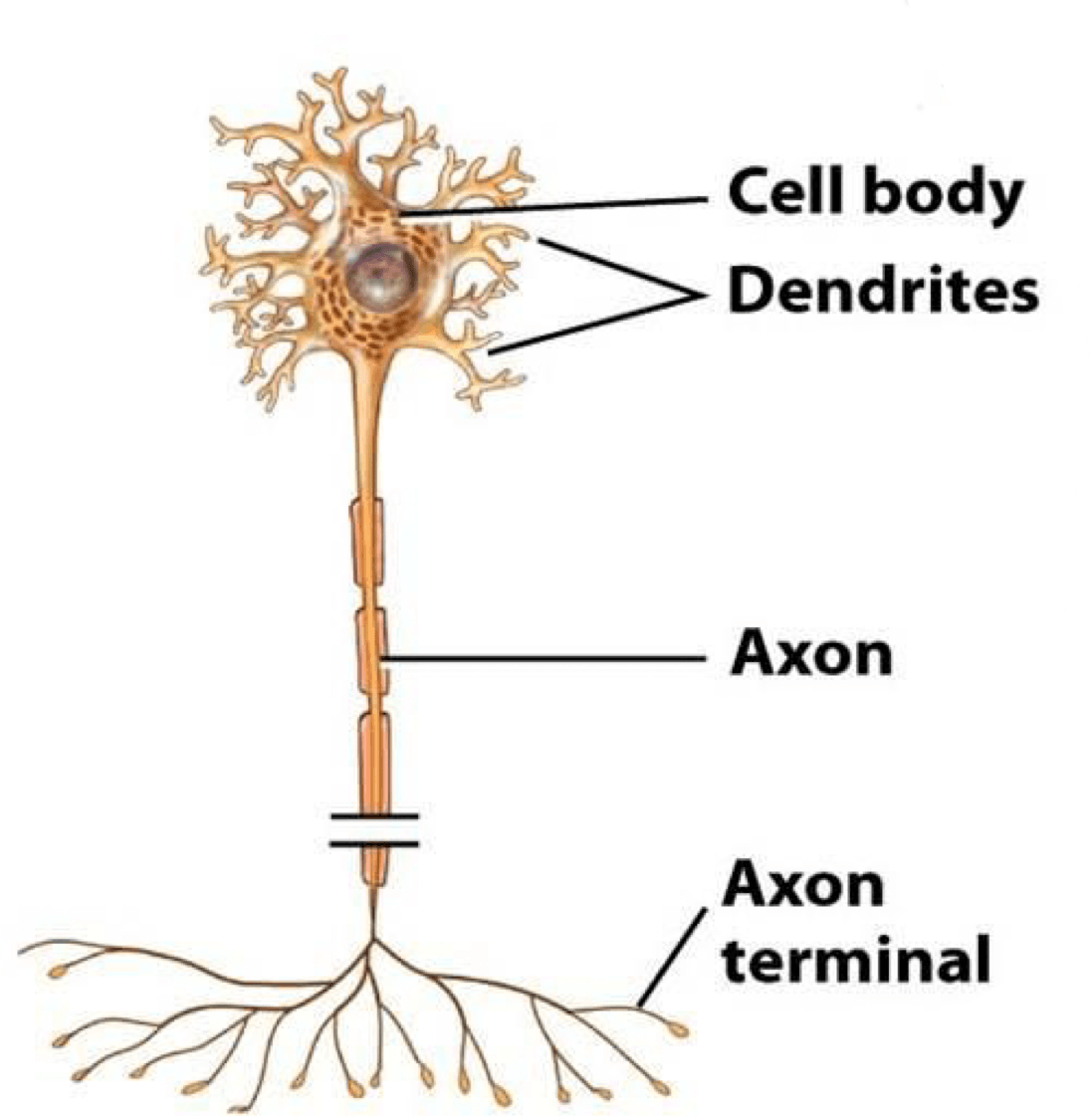
What type of neuron is represented on the image?
Motor Neuron
Interneuron
Sensory Neuron
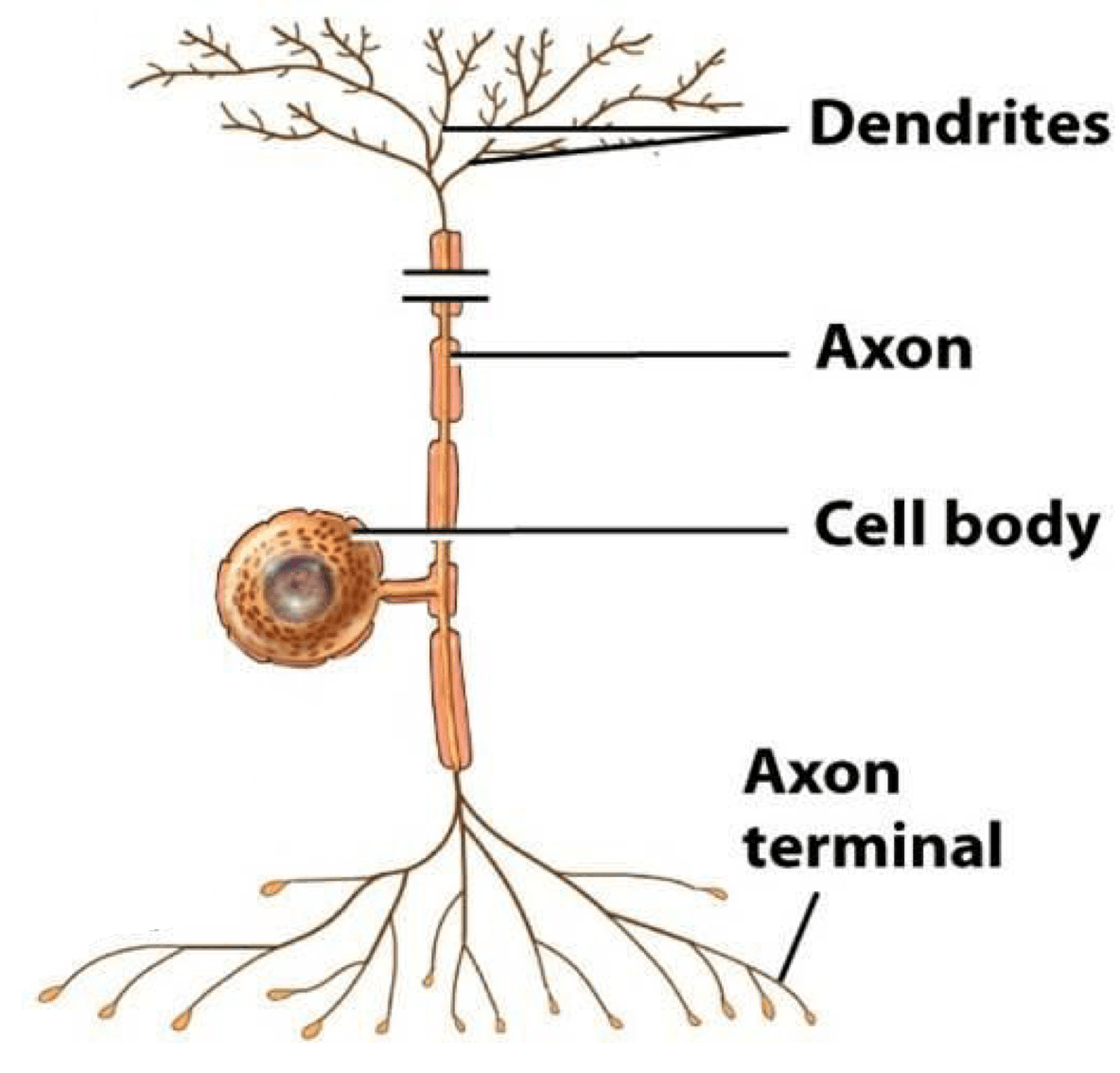
What type of neuron is represented on the image?
Motor Neuron
Interneuron
Sensory Neuron

What type of neuron is represented on the image?
Motor Neuron
Interneuron
Sensory Neuron
What do Nodes of Ranvier do?
Intakes information from other neurons
Produces fatty tissue for the Myelin Sheath
Sends information to the next cell
Controls the speed of electrical signal through the axon
Neurons communicate with each other through electrical and chemical impulses. Which of the following is true?
Neurons communicate electrically through neurotransmitters and chemically through hormones.
Neurons communicate electrically through action potentials and chemically through neurotransmitters.
Neurons communicate electrically through neurotransmitters and chemically through action potentials
In which direction does an electrical signal transmit along a neuron?
Dendrite -> Axon terminal -> Cell body -> Axon
Axon terminal -> Axon -> Dendrite -> Cell body
Cell body -> Axon -> Axon terminal -> Dendrite
Dendrite -> Cell body -> Axon -> Axon terminal

Identify the type of neuron labelled 'B'
(a)

Neuron A in the image is what type of neuron?
Sensory neuron
Relay neuron
Motor neuron
Neuron B in the image is what type of neuron?
Sensory neuron
Relay neuron
Motor neuron
Which neuron carries nerve impulses between neurons?
Neuron A
Neuron B
Neuron C

If I step on a nail...what type of neurons send the response from the brain to my muscles?
motor
interneurons
sensory
not neurons, muscle tissue sends the response
If I step on a nail...what type of neurons send the response from the brain to my muscles?
motor
interneurons
sensory
not neurons, muscle tissue sends the response
Taste and smell are similar because:
They are both located on the face
They both detect chemicals
They both require conscious effort to detect
They both bypass the brain
the part of the eye that controls the amount of light to get inside the eye is
pupil and cortex
cornea and the iris
irsis and the pupil
retina and the lens
Which sense detects pressure and heat
sight
hearing
taste
touch
________________________ cells are the cells in the papillae that react with chemicals to send electrical signals to the brain.
Odorant receptor
Olfactory receptor
Gustatory receptor
Taste receptor

The nerves associated with smell are referred to as the:
olfactory receptor cells
smell cells
gustatory receptor cells
umami cells
The ear has three parts
outer ear, outer ear and midle ear
middle ear, inner ear and ear
outer ear, middle ear and inner ear
The cochlea sends the sound through
the ear canal to the brain
the cochlea to the brain
the auditory nerve to the brain
What three primary colors of light are detected by your cones?
Green, red, and blue
Black, gray, and white
Blue, red, and yellow
Blue, green, and purple
Cyan, magenta, and yellow
The skin senses for which of the following?
Temperature
Pressure
Pain
Touch
The skin can sense all of these
Which two senses are directly connected?
Sight and touch
Taste and smell
Smell and sight
Hearing and taste

The illustration below shows the structure of the human eye. The sensory receptors on the back of the eye react to light. The pupil is a hole in the iris, a structure in the front of the eye. Movements of the iris can cause the pupil to become larger or smaller. What observation would provide evidence for the claim that, by controlling the size of the pupil, the iris controls the amount of light that reaches the receptors in the eye?
Other animals, such as fish and cats, have a pupil with a very different shape.
The pupil becomes larger in dim light and smaller in bright light.
There are no sensory receptors directly on the pupil at the front of the eye.
Shining a bright light directly away from the eye causes no change in the pupil.
When exposed to a bright light, a pupil will...
Dilate
Go Away
Constrict
Get Bigger
Muscle and pressure receptors in the skin
Nociceptor
Thermoreceptor
Olfactory Receptor
Mechanoreceptor

Look at the picture. In this scenario: name the stimulus, the receptor, the effector and the response.
Stimulus = fire
Receptor = hand
Effector = skin
Response = move hand away.
Stimulus = hot pan
Receptor = skin
Effector = muscles in arm and hand
Response = move hand away
Stimulus = fire
Receptor = fingers
Effector = muscles in arm and hand
Response = move hand away
Stimulus = hot pan
Receptor = skin
Effector = muscles in arm and hand
Response = clench hand tighter
The growth hormone affect all cells. The body part stimulates it's release.
Parathyroid
Hypothalamus (Pituitary)
Pancreas
Thyroid
What gland secretes the hormones corticosteroids and adrenaline?
Adrenals
Parathyroids
Pineal Body
Thyroid

melatonin that maintains circadian cycles
Pancreas
Parathyroid
Pineal
Pituitary

