
 Worksheets
cell cycle and cell division
Total questions: 118
Worksheet time: 1hrs 25mins
During interphase, ________is replicated.
ATP
DNA
RNA
FBI

Select ALL stages of Interphase
G1
S
G2
Mitosis
In which stage of the cell cycle does the cell grow in size?
G1
S
G2
Mitosis
In which stage of the cell cycle does the DNA replicate?
G1
S
G2
Mitosis
The following describes_________________________ during mitosis. The chromatin condenses and spindle fibers form at each side of the cell. The chromosomes begin to form and nuclear membrane disappears.
prophase
anaphase
metaphase
telophase
The following describes_________________________ during mitosis. The chromosomes line up along the middle of the cell and the spindle fibers attach to each chromosome at the centromere.
prophase
metaphase
anaphase
telophase
When you start with 1 cell, at the end of mitosis, how many identical cells will you have?
1
2
3
4


Substage of interphase in which the cell prepares for nuclear division and a protein that makes microtubules for cell division is synthesized
Interphase
G1
Synthesis
G2

In which stage of the cell cycle do the nucleus and its contents divide?
synthesis
growth/gap 1
mitosis
growth/gap 2
What might be a reason for a cell to divide?
growth
repair of damaged cells
replacement of dying cells.
All of the above
Which of the following does not occur during interphase?
Replication
Translation
Cytokinesis
An increase in the number of mitochondria
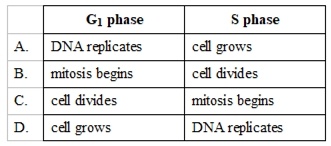
Which events occur during the G1 phase and S phase of the cell cycle?
A
B
C
D
What happens during the G2 stage of interphase?
Homologous chromosomes pair
Synthesis of proteins
Homologous chromosomes separate
Replication of DNA
What happens during the G2 stage of interphase?
Homologous chromosomes pair
Synthesis of proteins
Homologous chromosomes separate
Replication of DNA
How do prokaryotic cells divide?
By mitosis
By meiosis
By budding
By binary fission
During reproduction in flowering plants an embryo sac is produced, containing one haploid nucleus.
This haploid nucleus divides by mitosis three times.
What is produced?
One diploid nucleus
Four diploid nuclei
Four haploid nuclei
Eight haploid nuclei
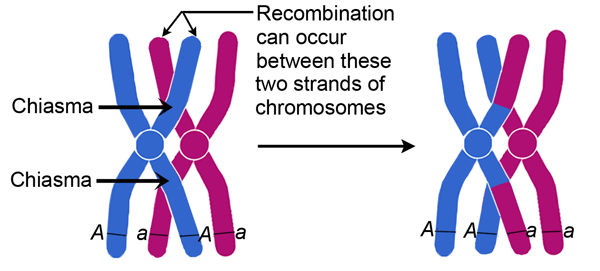
What happens in crossing over?
Exchange of genetic material between homologous chromosomes
Exchange of genes during metaphase of mitosis
Random distribution of chromosomes during meiosis
Homologous chromosomes fail to separate during meiosis
What are homologous chromosomes?
Identical chromosomes
Non-identical chromosomes with different genes
Non-identical chromosomes with the same genes in the same sequence but not necessarily the same alleles
Non-identical chromosomes with the same genes in a different sequence and not necessarily the same alleles
Which of the following will promote variation in a species?
I. Meiosis
II. Fertilization
III. Natural selection
I only
II only
I and II only
I, II and III
A cell in the testis of a male chimpanzee (Pan troglodytes) contains 48 chromosomes. It is about to undergo meiosis.
How many molecules of DNA will be present in the nucleus of the sperm cells just after meiosis?
96
48
24
12
If the haploid number of a species is 14, how many chromatids will there be in metaphase I in a dividing diploid cell?
7
14
28
56
If the amount of DNA in a haploid gamete is represented by 'x', what is the net quantity of DNA in a cell from the same organism at the start of meiosis?
4 x
2 x
x
0.5 x
Which of the following is/are true of the second division of meiosis?
I. sister chromatids are separated
II. crossing over of alleles occurs between non-sister
chromatids
III. it halves the chromosome number
I only
III only
I and III only
I, II and III

The diagram below shows the cell of an organism going through the first division of meiosis.
How many different combinations are possible for these chromosomes in the haploid cells formed by meiosis?
9
8
6
2


Which is Metaphase?
A
E
C
F
Uncontrolled cell division which usually leads to tumors and disease is called:
Metaphase
Cytokinesis
Cancer
Diabetes
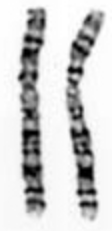


Neuron cells, like the one pictured, rarely replicate. Therefore, we consider them to be in the _____ phase.
G0
S
G1
G2
Sister chromatids are
found only when a cell is not actively dividing
formed when chromatids separated during cell division
tightly linked together at the centromere
made only of DNA
When a eukaryotic cell is not dividing, its genetic material can be found in the form of very long thin fibers called
chromatin
the nucleolus
chromosomes
DNA
The diploid chromosome compliment of human somatic cell consists of how many chromosomes?
32
46
23
64
If the S-phase was eliminated from the cell cycle, the daughter cell would
have half the genetic material found in the parental cell
be genetically identical to the parent cell
be genetically identical
synthesize the missing genetic material on their own
Diploid Cells are represented by
2n
4n
n
1/2 n



The diagram shows an animal cell undergoing meiosis at anaphase II.
How many chromosomes are there in the diploid cell of this animal?
3
6
12
24
Synaptonemal complex is visible from
Leptotene through diplotene
Pachytene through diplotene
Zygotene through pachytene
Diplotene through metaphase
The genome of onion has 8 chromosomes (n = 8). In a root tip cell undergoing anaphase the number of chromosomes will be -
8
16
32
Indetermine
Which of the following statements about meiosis is Not true?
Kinetochore of sister chromatids attach to opposit poles in Meiosis I.
Kinetochore of sister chromatids attach to opposit poles in Meiosis II.
Chiasma is formed in Prophase I.
Homologous chromosomes are segregated in Meiosis I.
Which one is correct about bivalent ?
I. Bivalent are tetrads
II. A bivalent means 4 chromatids and 2 centromere
III. One bivalent consists of 2 homologous chromosomes, each and sister chromatids
IV. Bivalents form in zygotene
All
Only III
III and IV
Only IV
The number of chromosomes is reduced to half during –
Anaphase of mitosis and meiosis
Meiosis II
Meiosis I
Fertilization
Synaptonemal complex is more conspicious at
Zygotene
Pachytene
Diplotene
Leptotene
During meiosis, the sister chromatids separate during –
Anaphase II
Anaphase I
The S phase
Synapsis
During meiosis I in human, one of the daughter cells receives –
Only maternal chromosomes
A mixture of maternal and paternal chromosomes
The same number of chromosomes as a diploid cell
A sister chromatid from each chromosome
At what phase of meiosis are homologous chromosomes separated?
Anaphase II
Anaphase I
Prophase I
Prophase II
Which statement is/are NOT true about cytokinesis in animal?
I Cleavage occurs through furrowing
II A shallow groove is formed in the cell surface
III A contractile ring forms on the ring contract
I only
I and II only
II and III only
I, II and III
Which statement is/are NOT true about cytokinesis in animal?
I Cleavage occurs through furrowing
II A shallow groove is formed in the cell surface
III A contractile ring forms on the ring contract
I only
I and II only
II and III only
I, II and III
Cytokinesis usually, but not always, follows mitosis. If a cell completed mitosis but not cytokinesis, the result would be a cell with
a single large nucleus
two abnormally small nuclei
two normal size nuclei
two nuclei but with half amount of DNA
Synapsis could be defined as
region where crossing over has occurred in prophase 1 between homologous nonsister chromatids
the reciprocal exchange of genetic material between nonsister chromatids during prophase I of meiosis.
the pairing and physical connection of one duplicated chromosome to its homolog during prophase I of meiosis
the two chromosomes having the same length, centromere position and staining pattern.
Crossing over is one of the most important events in meiosis because
it produces new recombination of alleles on homologous chromosomes
homologous chromosomes must be separated into different daughter cells
homologous chromatids must be separated into different daughter cells
the number of chromosomes to each daughter cell must be halved
Which of the following event does not occur in anaphase II?
Centromeres are split
Homologous chromosome is separate
Spindle fibres shortened
Sister chromatids are moved to the opposite poles of the cell
If your cell has 48 chromatids, what will be the number of a chromosome at each pole after anaphase I?
12
24
36
48
Which statement correctly describes homologous chromosomes?
They are formed during meiosis
They are held together by centromeres
They are not identical
They carry the same gene loci
Prophase I of meiosis I divided into 5 distinctive sub-phases. Arrange this sub-phases in correct order
Leptotene – zygotene – pachytene – diplotene – diakinesis
Leptotene – diplotene – zygotene – pachytene – diakinesis
Diplotene - leptotene – zygotene – pachytene – diakinesis
Diplotene – pachytene – zygotene – diakinesis – leptone
A cluster of four chromatids of homologous chromosomes formed by synapsis is called
Crossing over
Bivalent
Tetrad
Chiasmata

FIGURE shows a cell undergoing meiosis. What is this stage of meiosis?
Anaphase I
Prophase I
Anaphase II
Telophase II
During gamete formation, the enzyme recombinase participates during
a) Metaphase I
b) Anaphase II
c) Prophase I
d) Prophase II
5. The complex formed by a pair of synapsed homologous chromosomes is called
a) Bivalent
b) Axoneme
c) Equatorial plate
d) Kinetochore
6. During which phase(s) of cell cycle, amount of DNA in a cell remains at 4C level if the initial amount is denoted as 2C?
a) G0 and G1
b) G1 and S
c) Only G2
d) G2 and M
8. A somatic cell that has just completed the S phase of its cell cycle, as compared to gamete of the same species, has
a) Twice the number of chromosomes and four times the amount of DNA
b) Four times the number of chromosomes and twice the amount of DNA
c) Twice the number of chromosomes and twice the amount of DNA
d) Same number of chromosomes but twice the amount of DNA
9. Select the correct option.
Column I Column II
A. Synapsis aligns homologous chromosomes (i) Anaphase II
B. Synthesis of RNA and protein (ii) Zygotene
C. Action of enzyme recombinase (iii) G2 phase
D. Centromeres do not separate but chromatid (iv) Anaphase I
Move towards opposite poles (v) Pachytene
a) A-(i), B-(ii), C-(v), D-(iv)
b) A-(ii), B-(iii), C-(iv), D-(v)
c)A-(ii), B-(i), C-(iii), D-(iv)
d) A-(ii), B-(iii), C-(v), D-(iv)
10.Arrange the following events of meiosis in correct sequen
(i) Crossing ove
(ii) Synapsis
(iii) Terminalisation of chiasmata
(iv) Disappearance of nucleolus
a) (i), (ii), (iii),(iv)
b) (ii), (iii),(iv), (i)
c) (ii), (i), (iv), (iii)
d) (ii), (i), (iii), (iv)
What will be the number of chromosomes and amount of DNA respectively in a diploid cell undergoing meiotic division after completion of meiosis I?
n and 2C
n and 2C
2n and 2C
2n and 4C
A somatic cell that has just completed the S phase of its cell cycle, as compared to a gamete of the same species, has
twice the number of chromosomes and twice the amount of DNA
the same number of chromosomes but twice the amount of DNA
twice the number of chromosomes and four times the amount of DNA
four times the number of chromosomes and twice the amount of DNA

