wayground logo

Free Printable Worksheets

Font size

S
M
L
XL
Worksheets

Bio1 2nd Semester Review Questions

Total questions: 109

Worksheet time: 1hrs 29mins

Name
Class
Date
1.
Glucose and oxygen becomes carbon dioxide and water and ATP
a)
Photosynthesis
b)
Chemosynthesis
c)
Cellular Respiration
2.
Carbon dioxide and water and sunlight becomes oxygen and glucose
a)
Photosynthesis
b)
Chemosynthesis
c)
Cellular Respiration
3.
What are products in photosyntheis?
a)
oxygen and carbon dioxide
b)
carbon dioxide and water
c)
glucose and oxygen
d)
sunlight and oxygen
4.
Cellular respiration produces ___ molecules that directly power many proteins and processes within the cell.
a)
glucose
b)
ATP
c)
sunlight
d)
O2
5.
What is the cellular respiration chemical equation?
a)
C6H12O6 + 6O2----6CO2+6H2O + energy
b)
C12HO6 + 6C2---5CO2+6H2O + energy
c)
C6H12O6 + 6O2---energy
d)
c612O6 + 6O2----12HO2 + energy
6.

What is the overall purpose of photosynthesis?

a)

To use energy from the sun to produce food

b)

To use energy from the sun to produce oxygen

c)

To use energy from the sun to produce carbon dioxide

d)

To use energy from the sun to produce water

7.

What is the ultimate ORIGINAL source of energy for living things?

a)

Moon

b)

Sun

c)

Mars

d)

Pluto

8.

Cellular respiration takes place in which eukaryotic organelle?

a)

Mitochondria

b)

Ribosome

c)

Chloroplast

d)

Cytoplasm

9.
What is the name of the 1st step of cellular respiration?
a)
Glycolysis
b)
Kreb's Cycle
c)
ETC
d)
Anaerobic respiration
10.
Which type of respiration occurs in the presence of oxygen?
a)
Aerobic
b)
Anaerobic
11.
Which of the following is the correct equation for PHOTOSYNTHESIS?
a)
CO+ light + H2O --> O+ Sugar
b)
CO+ sugar + H2O --> O+ light
c)
O2 + light + H2O --> CO+ Sugar
d)
CO+ O2 + H2O --> Light+ Sugar
12.
Which organelle performs PHOTOSYNTHESIS?
a)
Chloroplast
b)
Mitochondria
13.
Which organisms perform Photosynthesis?
a)
Only Autotrophs
b)
Only Heterotrophs
c)
Autotrophs and Heterotrophs
14.
Which step of cellular respiration makes the most ATP?
a)
Glycolysis
b)
Krebs Cycle
c)
Electron Transport Chain
d)
Light Dependent Reactions
15.
The two main types of fermentation are called
a)
alcoholic and aerobic
b)
aerobic and anaerobic
c)
alcoholic and lactic acid
d)
lactic acid and anaerobic
16.
When animals exercise with a lack of oxygen their muscles can form
a)
lactic acid
b)
alcohol
c)
minions
d)
oxygen
17.
What are the phases in order of the cell cycle?
a)
Interphase, Prophase, Metaphase, Anaphase, Telophase, Cytokinesis
b)
Prophase, Anaphase, Telophase, Cytokinesis
c)
Interphase, Mitosis, Telophase, Anaphase
d)
Cytokinesis, Interphase, Metaphase, Telophase
18.
Interphase has 3 stages; G1, S, and G2.  What happens during synthesis?
a)
Cells grow and carry out normal functions
b)
Cells copy organelles and prepare for a critical checkpoint
c)
The cell splits into two new daughter cells
d)
The cell makes a copy of its DNA
19.
In what phase do the chromosomes line up in the middle of the cell?
a)
Interphase
b)
Anaphase
c)
Metaphase
d)
Telophase
20.
A cells size is limited by what?
a)
surface area to volume ratio
b)
the cells life span
c)
it's not limited
d)
the type of cell
21.
Most cells grow in a single layer and stop growing when they touch each other.  What types of cells continue growing?
a)
cancer cells
b)
animal cells
c)
plant cells
d)
skin cells
22.
Name the phase:
a)
Prophase
b)
Metaphase
c)
Anaphase
d)
Telophase
23.
Structure (a) is a ____.
a)
chromosome
b)
chromatid
c)
centromere
24.
In mitosis, the two resulting cells are
a)
different from the starting cell and identical to each other.
b)
different from the starting cell and different from each other.
c)
identical to the starting cell and different from each other.
d)
identical to the starting cell and identical to each other.
25.
How many chromosomes do humans have?
a)
46
b)
21
c)
10
26.

What causes genetic variation in meiosis? (differences in traits)

a)

chromosomes lining up

b)

crossing over of chromosomes

c)

separation of chromosomes

d)

chromosomes pulling apart

27.
When an area of a chromatid is exchanged with the matching area on a chromatid of its homologous chromosome, _________________ occurs
a)
crossing over
b)
mutagenesis
c)
hybridization
d)
fertilization
28.
Which process and type of resulting cells are represented?
a)
mitosis, gametes
b)
mitosis, body cells
c)
meiosis, gametes
d)
meiosis, body cells
29.
In order to obtain nutrients and oxygen quickly, a cell needs a large:
a)
Volume
b)
Surface area
c)
Density
d)
Mass
30.
The three phases of interphase are:
a)
G1, S, G2
b)
G1, G2, G3
c)
S1, G, S2
d)
S1, S2, S3
31.
Environmental agents that cause cancer are called
a)
Carcinogens
b)
Antigens
c)
Androgens
d)
Histogens
32.
A change in the sequence of an organism's genetic code is known as
a)
mitosis
b)
meiosis
c)
differentiation
d)
mutation
33.
The process by which the nuclear material is divided equally between two new cells
a)
mitosis
b)
cancer
c)
spindle
d)
centromere
34.
The passing of traits from one generation to another.
a)
Cell Division
b)
Dominance
c)
Heredity
d)
Recessiveness
35.
A segment of DNA found on a chromosome that determines the inheritance of a particular trait.
a)
Cell
b)
Gene
c)
Phenotype
d)
Trait
36.
The set of genes carried by an organism is called this.
a)
dominant
b)
genotype
c)
phenotype
d)
recessive
37.
The physical expression of the genes is called this.
a)
allele
b)
chromosome
c)
gene
d)
phenotype
38.
A trait that will always be expressed in the phenotype if it is in the genotype.
a)
acquired
b)
dominant
c)
hybrid
d)
recessive
39.
A trait that will be expressed in the phenotype only if both alleles are the same.
a)
acquired
b)
dominant
c)
hybrid
d)
recessive
40.
In chickens, the allele for feathers on the legs (F) is dominant to the allele for no feathers (f). Which choice is a genotype for these chickens?
a)
F
b)
f
c)
Ff
d)
ff
41.
In human beings, the allele for freckles (F) is dominant to the allele for no freckles (f). Which choice shows a freckle genotype?
a)
F
b)
f
c)
FF
d)
ff
42.
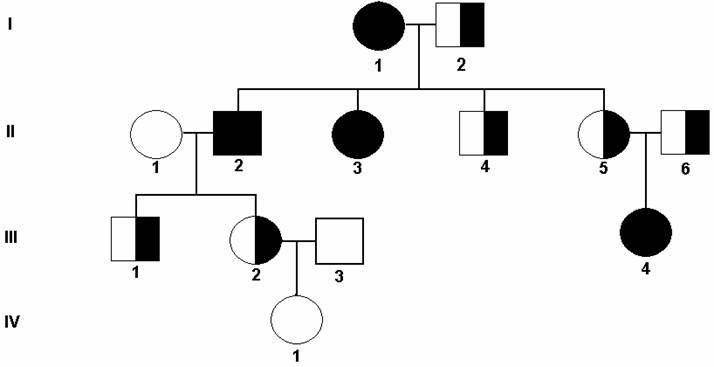
Looking at this pedigree, how many female family members are carriers?
a)
1
b)
3
c)
10
d)
7
43.
Which sequence of DNA bases would pair with this partial strand
ATG TGA CAG
a)
ATG TGA CAG
b)
TAC ACT GTC
c)
GTA AGT GAC
d)
CAT TCA CTG
44.
This type of inheritance pattern shows BOTH traits in possible offspring
a)
complete dominance
b)
incomplete dominance
c)
co-dominance
d)
dominant pattern
45.
Both parents in this Punnet square
a)
are homozygous dominant
b)
are homozygous recessive
c)
are heterozygous
d)
have blue eyes
46.
Axial flowers is dominant to terminal. What is the probabilty of offspring being terminal?
a)
1/4
b)
2/4
c)
3/4
d)
4/4
47.
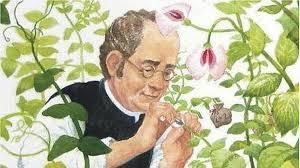
Who is the father of genetics? 
a)
Charles Darwin 
b)
Gregor Mendel
c)
Dimitri Mendeleev 
d)
Hans Krebs 
48.
In the second generation-how many people have the disease or display the physical trait?
a)
2
b)
4
c)
5
d)
6
49.
This type of inheritance pattern is a MIXTURE of both traits.
a)
incomplete dominance
b)
codominance
c)
complete dominance
d)
recessive pattern
50.
Which of the following best describes a DNA molecule?
a)
double helix
b)
contains ribose
c)
made of amino acids
d)
contains Uracil
51.
Which of the following units are repeatedly joined together to form a strand of DNA?
a)
amino acids
b)
nucleotides
c)
fatty acids
d)
polysaccharides
52.
Adenine bonds with ______________.
a)
Guanine
b)
Thymine
c)
Cytosine
d)
Adenine
53.
Given the following sequence - ATGCGTGACGATA
The complimentary sequence would be...
a)
ATGCGTGACGATA
b)
UACGCACUGCUAU
c)
TACGCACTGCTAT
d)
TACGTCGATATGE
54.
What was Watson and Crick's main scientific accomplishment?
a)
Building the first accurate model of DNA
b)
Isolating strains of pneumonia causing bacteria
c)
Determining base pairing rules
d)
Discovering the process of genetic transformation
55.
Rosalind Franklin's "Photo 51" allowed Watson and Crick to determine the _______ of DNA.
a)
Shape
b)
Backbone
c)
Nitrogen bases
d)
Hydrogen bonds
56.
Which sugar is contained in DNA
a)
Dextrose
b)
Ribose
c)
Deoxyribose
d)
Glucose
57.
Guanine bonds with ______________.
a)
Adenine
b)
Guanine
c)
Cytosine
d)
Thymine
58.
The enzyme that constructs the new strand of DNA during replication is known as...
a)
DNA Helicase
b)
DNA Polymerase
c)
DNA Ligase
d)
RNA Polymerase
59.
What do we call the process of turning DNA into mRNA?
a)
replication
b)
transcription
c)
translation
60.
What type of RNA carries the DNA message out of the nucleus to the ribosomes?
a)
mRNA
b)
tRNA
c)
rRNA
61.
when DNA is transcribed to RNA.... 
a)
A pairs with U
b)
G pairs with U
c)
C pairs with T
d)
A pairs with C
62.
Which of these is the Central Dogma of Biology in the correct order?
a)
DNA --> mRNA --> polypeptide (protein) chain
b)
DNA --> polypeptide chain (protein) --> mRNA
c)
mRNA --> DNA --> polypeptide (protein) chain
d)
polypeptide chain (protein) --> DNA --> mRNA
63.
_______ is made during transcription and ________ is made during translation.
a)
mRNA / a protein
b)
a protein / mRNA
c)
Ribosome / Nucleus
d)
mRNA / tRNA
64.
Which RNA bases would pair with TACGAA in transcription
a)
AUGCUU
b)
ATGCTT
c)
GCATCC
d)
GCAUCC
65.
Amino acids are joined together in order to form
a)
DNA
b)
ribosomes
c)
proteins 
d)
RNA
66.
The process of making RNA (i.e. mRNA) from DNA is called
a)
Replication
b)
Transcription
c)
Translation
d)
Protein synthesis
67.
Translation takes place in the 
a)
ribosome
b)
chloroplast
c)
nucleus
d)
mitochondria
68.
Using the table what does the codon CUG code for?
a)
alanine
b)
Proline
c)
Leucine
d)
Methionine
69.
Besides genetics, what can alter or change a gene? (HINT: Height is an example.)
a)
cancer
b)
environment
c)
doctors
d)
television
70.

What can affect person's height or skin color?

a)

Genetics

b)

Environmental factors

c)

Parents

d)

Genetics and environmental factors

71.
If a trait, like colorblindness, is a sex-linked trait, who is more likely to get the disorder?
a)
Females
b)
Males
c)
Females and males equally
d)
No one is likely to get the disorder
72.
Gametes are produced by the process of
a)
crossing-over
b)
meiosis
c)
replication
d)
mitosis
73.
Male chromosomes
a)
XX
b)
XY
c)
XXY
74.
The cause of many genetic disorders, like Down Syndrome, is...
a)
Nondisjunction
b)
Overfertilization
c)
Uncontrolled Meiosis
d)
Translocation
75.
Which of the following combinations of sex chromosomes represents a female?
a)
XX
b)
XY
76.
Homozygous Dominant
a)
TT
b)
Tt
c)
tt
d)
Rr
77.
a)
Not Affected Male
b)
Not Affected Female
c)
Affected Male
d)
Affected Female
78.
What is the mode of inheritance shown here?
a)
 Recessive
b)
Sex Linked
c)
 Dominant
79.
What is the mode of inheritance shown here?
a)
Autosomal Dominant
b)
Sex Linked
c)
Autosomal Recessive
80.
In the second generation-how many people are carriers of the trait?
a)
2
b)
3
c)
5
d)
6
81.

What does a Punnett square show?

a)

all the possible outcomes of a genetic cross

b)

only the dominant alleles in a genetic cross

c)

only the recessive alleles in a genetic cross

d)

all of Mendel’s discoveries about genetic crosses
82.
What is another name for heterozygous?
a)
Hybrid
b)
Purebred
c)
Codominant
d)
Mixed Breed
83.
Who is the father of evolution?
a)
Darwin
b)
Mendel
c)
Newton
d)
Einstein
84.
What is another name for natural selection?
a)
survival of the smartest
b)
survival of the fastest
c)
survival of the biggest
d)
survival of the fittest
85.
What is an organism that has similar characteristics and can reproduce?
a)
species
b)
organism
c)
embryology
d)
vestigial 
86.
Which term refers to the process by which individuals that are better suited to the environment survive and reproduce therefore passing down their genes to their offspring? 
a)
Evolution 
b)
Variation 
c)
Adaptation
d)
Natural Selection 
87.
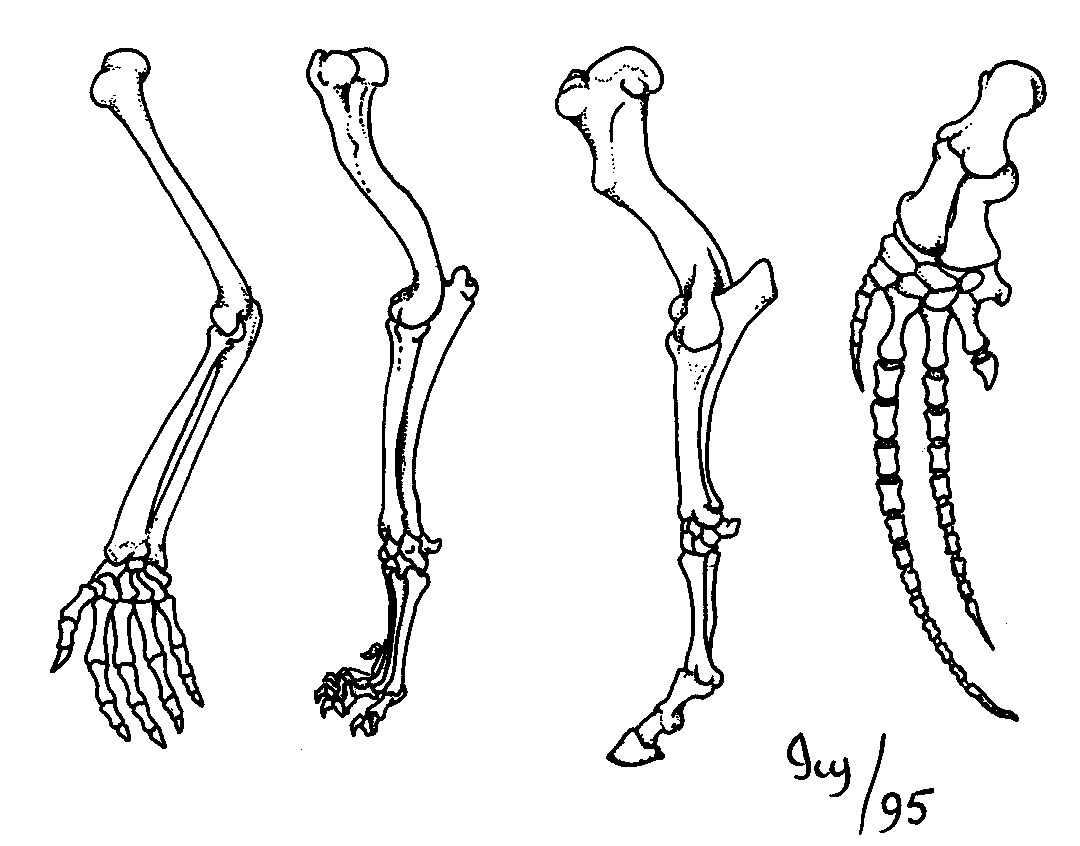
Structures with the same parts have different functions; suggests that organisms share a common ancestry
a)
vestigial structures
b)
homologous structures
c)
adaptive radiation
d)
fossil
88.
The ability of an organism to survive and reproduce in its specific environment 
a)
diversity.
b)
evolution
c)
adaptation
d)
 fitness
89.
The gradual change in species over time is...
a)
Evolution
b)
Nucleotide 
c)
Adaptation
d)
Natural Selection
90.

What is suggested by the anatomical similarity of different species of vertebrates?

a)

no evolutionary relationships between the groups

b)

recent common ancestry

c)

similar environments in the past

d)

evolution from a distant common ancestor

91.
What is speciation?
a)
combining of tow species to form one with different traits
b)
isolation that affects mating behaviors
c)
timing of mating that prevents normal sexual selection
d)
divergence of two or more species from an existing one
92.
The Aztecs and Maya Tribes of Mexico where some of the first humans to slowly change wild corn to the corn we know today. What process did these tribes use?
a)
Natural Selection
b)
Artificial Selection "Selective Breeding"
c)
Mitosis
d)
Cell Membrane
93.
What is an example of a vestigial structure of a HUMAN?
a)
Femur
b)
Wisdom Teeth
c)
Brain
d)
Finger
94.
What type of selection is depicted in the picture? 
a)
stabilizing 
b)
directional 
c)
disruptive 
d)
the answer is not here
95.
What does the image represent?
a)
Founder effect
b)
Bottleneck effect
c)
Mutation
d)
Natural Selection
96.
The diagram shows a random change in the population which is:
a)
Gene flow
b)
Gene pool
c)
Genetic drift
d)
Natural selection
97.
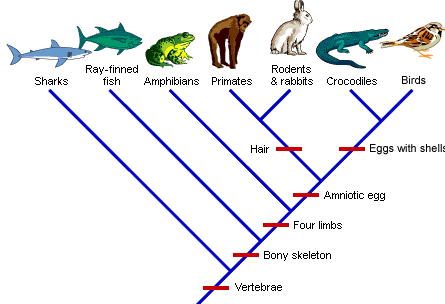
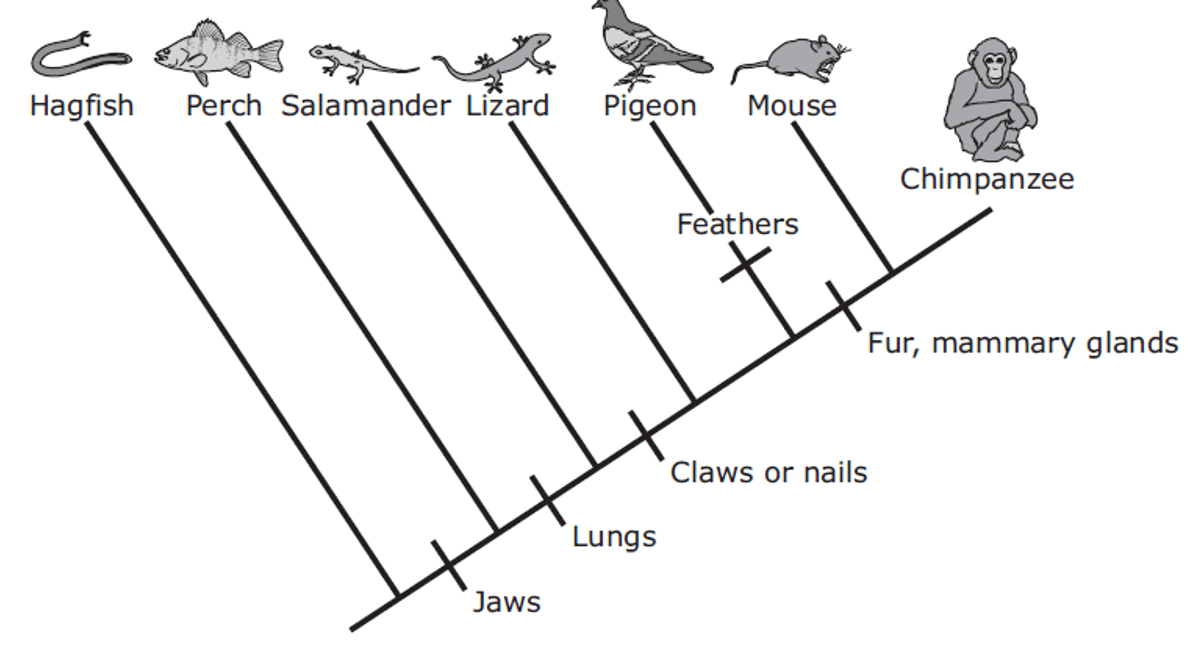
According to this cladogram, birds are LEAST related to: 
a)
Amphibians
b)
Sharks
c)
Ray Finned Fish
d)
Crocodiles
98.
All the animals to the right of the hagfish would have the common characteristic of -
a)
Fur
b)
Claws or nails
c)
Lungs
d)
Jaws
99.

the total genetic information available in a population

a)

population genetics

b)

microevolution

c)

gene pool

d)

allele frequency

100.

A type of isolation in which two populations become separated by a physical barrier such as a canyon, river, lake, preventing the two populations from interbreeding.

a)

Geographic isolation

b)

Behavioral isolation

c)

Temporal isolation

101.
Which kingdoms are prokaryotic?
a)
Archaebacteria and Animalia
b)
Eubacteria and Archaebacteria
c)
Fungi and Protista
d)
Plantae and Eubacteria
102.
Animals contain what type of cell? 
a)
Prokaryotic
b)
Eukaryotic
103.
What is occurring in this picture?
a)
Translation
b)
Replication
c)
Translocation
d)
Transcription
104.
Which process is happening in this picture?
a)
Transcription
b)
Translation
c)
Replication
105.
Process that produces two daughter cells.
a)
Mitosis
b)
Meiosis
c)
Both Mitosis and Meiosis
106.
What type of selection?
a)
Directional 
b)
Stabilizing
c)
Disruptive
107.
The term for the formation of new and distinct species over the course of evolution is...
a)
speciation
b)
biological species concept
c)
reproductive barrier
d)
natural selection
108.
According to all of the scientific evidence that we can gather; how old is the Earth?
a)
6,000 years
b)
3 years
c)
4.6 billion years
d)
3 million years
109.
The evidence suggests that the first organism was:
a)
Eukaryotic
b)
Prokaryotic
c)
An animal
d)
A plant