wayground logo

Free Printable Worksheets

Font size

S
M
L
XL
Worksheets

Semester 2 Final Molecular Biology

Total questions: 107

Worksheet time: 3hrs 7mins

Name
Class
Date
1.
When particles move from areas of high concentration to areas less concentrated, this has taken place.
a)
diffusion
b)
mitosis
c)
endocytosis
d)
photosynthesis
2.
What process occurs when WATER diffuses across a membrane?
a)
endocytosis
b)
mitosis
c)
osmosis
d)
nuclear fission 
3.
When both inside and outside of a cell have the same amount of water it is said that the cell has reached a state of ___________.
a)
osmosis
b)
equilibrium
c)
diffusion
d)
hypertonic
4.
Osmosis is the movement of _____ across a membrane.
a)
food
b)
energy
c)
oxygen
d)
water
5.
Passive transport requires no
a)
concentration gradients
b)
osmosis
c)
motion
d)
energy
6.
The cell below is in a _________ solution.
a)
Hypotonic
b)
Hypertonic
c)
Isotonic
7.
The cell below is in a _____________ solution.
a)
Hypertonic
b)
Hypotonic
c)
Isotonic
8.
Moving from areas of LOW concentration to areas of HIGH concentration is called?
a)
Passive Transport
b)
Active Transport
c)
Diffusion
d)
Osmosis
9.

My cells are Shriveled! What type of solution are my cells in?

a)

Hypertonic

b)

Hypotonic

c)

Isotonic

d)

Diffusion

10.
Uses ATP (energy)
a)
Passive Transport
b)
Active Transport
11.
Which way is the water moving in this cell?
a)
The water level will increase on the right side
b)
The water level will increase on the left side
c)
The water level on both sides will increase
d)
The water level on both sides will decrease
12.

Which solution is more concentrated?

Solution 1:

500 mL of water

100 g of salt


Solution 2:

500 mL of water

90 g of salt

a)

Solution 1

b)

Solution 2

c)

They have the same concentration

d)

I have no idea

13.

What is defined as a difference in concentration on either side a membrane

a)

gradient

b)

hypotonic

c)

hypertonic

d)

facilitated diffusion

14.

maintain stable internal environment

a)

receptor

b)

type 2 diabetes

c)

homeostasis

d)

insulin

15.
The "cause" for something to happen is the
a)
response
b)
effect
c)
stimulus
d)
homeostasis
16.
The "effect" of a given stimulus is the...
a)
response
b)
stimulus
c)
cause
d)
result
17.
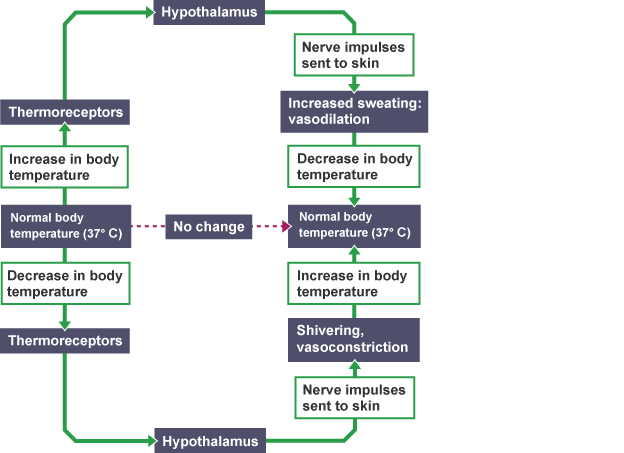
What type of feedback loop is shown?
a)
Positive
b)
Neutral
c)
Negative
18.
Negative Feedback Loops:
a)
amplify processes
b)
prevent small changes from getting larger
c)
are initiated during childbirth
d)
are found only in plants
19.
Maintaining body temperature is an example of a:
a)
negative feedback loop
b)
positive feedback loop
20.
When glucose levels in the blood rise, your brain sends a signal to your pancreas. The pancreas releases insulin, which opens channels in cell membranes to allow glucose to enter the cell, lowering blood sugar levels. 
a)
Positive Feedback Response
b)
Negative Feedback Loop 
21.

An example of a positive feedback loop is ____________.

a)

Childbirth

b)

Blood Pressure regulation

c)

Body Temperature regulation

d)

All of the above

22.
Antigens are part of...
a)
Your own immune system.
b)
The pathogen.
23.
Antibodies are made by...
a)
Your own cells.
b)
The pathogen.
24.
What is the role of antibodies?
a)
Kills pathogens
b)
Helps activate other immune cells
c)
Produces antibodies
d)
Binds to antigens and neutralizes pathogen
25.

Antibodies ...

a)

bind to foreign cells and make them easier to engulf

b)

are kept as a "memory" so that if the body encounters the same foreign agent, they can respond more quickly

c)

are specific to a particular antigen

d)

all other answers are correct

26.
Stem cells are
a)
cells that grow uncontrollably.
b)
undifferentiated and can develop into many types of cells.
c)
cells that never go through cell division.
d)
only found in embryos.
27.
Cancer creates abnormal cells by disrupting
a)
the cell cycle
b)
red blood cell formation
c)
DNA replication
d)
ATP synthesis
28.
Any substance that is known to cause cancer is called a
a)
carcinogen
b)
nicolyte
c)
pathogen
d)
retrovirus
29.
Metastasis is
a)
the spread of cancer from one part of the body to another.
b)
the growth of tumors in the lungs
c)
cancer of the blood cells
d)
cancer that is found in connective tissues
30.
During the cell cycle, the resting phase is ...
a)
G0
b)
G1
c)
G2
d)
S
31.
What causes genetic variation in meiosis?
a)
chromosomes lining up
b)
crossing over of chromosomes
c)
separation of chromosomes
d)
chromosomes pulling apart
32.
What kind of cells are made in MEIOSIS?
a)
Haploid cells
b)
Diploid Cells
c)
Skin Cells
d)
Liver Cells
33.
The chromosomes that pair up during meiosis, are called __________ chromosomes.  
a)
homozygous 
b)
asexual
c)
homologous
d)
genes
34.
Which cellular process is shown?
a)
meiosis
b)
endocytosis
c)
mitosis
d)
phagocytosis
35.
Which of the following best describes meiosis?
a)
It is carried out in all tissues theat require cell replacement
b)
It occurs only in cells in the reproductive structures of an organism
c)
It happens in all of the tissues except the brain and spinal cord
d)
It is the first stage of mitosis
36.
products of meiosis are genetically
a)
different
b)
identical
37.
A human zygote should have _____ chromosomes inside.
a)
46
b)
23
c)
92
d)
64
38.
Which of the following represents chromosome # during fertilization?
a)
n+n=2n
b)
n=n
c)
2n=n+n
d)
2n=2n
39.
Meiosis makes sperm and egg cells. In humans, sperm and egg cells each have _____ chromosomes. Therefore a fertilized human egg cell (sperm and egg cell combined) would create a cell with _____ chromosomes.
a)
23, 46
b)
46, 23
c)
2, 4
d)
50, 100
40.
How many daughter cells does Meiosis create?
a)
2
b)
4
c)
8
d)
1
41.
During which part of the cell cycle does the cell divide?
a)
Interphase
b)
Mitosis
c)
S phase
42.
During which part of the cell cycle is DNA copied?
a)
Mitosis
b)
Cytokinesis
c)
S phase
43.
During which parts of the cell cycle does the cell grow?
a)
G1 and G2
b)
G1 and S
c)
M phase and cytokinesis
44.
Which phase of mitosis is shown in the picture?
a)
Interphase
b)
Metaphase
c)
Telophase
45.

A segment of DNA that codes for a trait

a)

gene

b)

allele

c)

chromosome

d)

chromatid

46.

A version or variation of a gene

a)

trait

b)

gene

c)

allele

d)

DNA

47.

The alleles that an organism has

a)

genotype

b)

phenotype

c)

chromosome

d)

recessive

48.

The observable expression of a trait

a)

phenotype

b)

genotype

c)

chromosome

d)

allele

49.

When an organism has two of the same alleles, it is called

a)

homozygous

b)

heterozygous

c)

recessive

d)

dominant

50.

When an organism has two different alleles, it is called

a)

homozygous

b)

heterozygous

c)

recessive

d)

dominant

51.

This type of allele is expressed whether there are one or two copies present.

a)

dominant

b)

recessive

c)

homozygous

d)

heterozygous

52.

These types of alleles are only expressed if the organism has two copies

a)

dominant

b)

recessive

c)

homozygous

d)

heterozygous

53.
This is an example of ___________?
a)
Incomplete dominance
b)
Co-Dominance
54.
This is an example of ___________.
a)
 Incomplete Dominance
b)
 Codominance
55.
What type of inheritance do two alleles have if their traits blend together? 
a)
Incomplete Dominance
b)
Co-Dominance
56.
A calico cat shows both the traits for orange fur and black fur. What kind of allele expression is this?
a)
Incomplete Dominance
b)
Co dominance
57.
This is an example of ___________.
a)
Incomplete Dominance
b)
Codominance
58.
The visual representation of an individual's chromosomes is a 
a)
phenotype
b)
genotype
c)
karyotype
d)
stereotype
59.
Why is the gene for a disease or disorder more likely to be found on the X chromosome than Y?
a)
The X chromosome has many more genes
b)
The Y chromosome has many more genes
60.
Males are more likely to suffer from a sex-linked disease or disorder because
a)
males are the weaker sex
b)
males have less DNA
c)
males have 1 X chromosome, so the disorder is more likely to be expressed
61.
Why are men 16 times more likely to be color-blind than women?
a)
to be color-blind, you must have a Y chromosome
b)
to be color-blind, all of your X chromosomes must have the gene
c)
color-blindness is caused by testosterone
d)
color-blindness is caused by the same gene as baldness
62.
If a gene is found only on the X chromosome and not the Y chromosome, it is said to be 
a)
sex-linked trait
b)
polygenic trait
c)
codominant trait
d)
incomplete dominance trait
63.
Hemophilia is a recessive x-linked disorder.
Which genotype represents a female who is a carrier for hemophilia?
a)
XHXh
b)
XhXh
c)
XHXH
d)
XhY
64.
The sex of a child is determined by
a)
whether the father's sperm contains an x or y chromosome
b)
whether the mother's egg contains an x or y chromosome
c)
the age of the parents
65.
How many generations are shown in this pedigree?
a)
1
b)
2
c)
3
d)
4
66.
What do half colored symbols represent?
a)
The individual is a carrier (heterozygous).
b)
The individual expresses the trait.
c)
The individual has both recessive alleles.
d)
The individual has both dominant alleles.
67.
What does an open circle represent?
a)
Not Affected Male
b)
Not Affected Female
c)
Affected Male
d)
Affected Female
68.
In the second generation-how many people are carriers of the trait?
a)
2
b)
3
c)
5
d)
6
69.
Which gender can be carriers of colorblindness and not have it?
a)
Just males
b)
Just females
c)
Both genders
70.
AB blood type is an example of what type of inheritance?
a)
complete dominance
b)
incomplete dominance
c)
codominance
d)
polygenic inheritance
71.
How many PAIRS of chromosomes do humans have?
a)
23
b)
46
c)
1
d)
2
72.
A trait that can be covered up and seems to disappear is known as a(n) _____________ trait.
a)
Dominant
b)
Gene
c)
Allele
d)
Recessive
73.

A mutation is defined as:

a)

A change in the cell's structure

b)

Anything that changes in an embryo

c)

Any change in the physical features of a human

d)

A change in the DNA sequence

74.
What causes mutations?
a)
Mistakes in replication or environmental substances
b)
The amino acids
c)
Passed down by genetics
d)
It's how your born
75.

ATTTGAGCC- Original

ATTGAGCC - Mutated

The example above is an example of a

a)

Insertion

b)

Point mutation

c)

Deletion

d)

Substitution

76.

Who does a mutation effect?

a)

individuals

b)

only parents

c)

a person's children

d)

only children

77.

Mutations are random.

a)

True

b)

False

78.

What type of evidence is represented in the picture above:

a)

Fossils

b)

Vestigial Structures

c)

DNA

d)

Homologous Structures

79.

What type of evidence is shown in this picture?

a)

Fossils

b)

Homologous Structures

c)

Vestigial Structures

d)

DNA

80.

Adaptations are:

a)

physical or behavioral tendencies.

b)

physical or behavioral characteristics that help an organisms survive and reproduce.

c)

physical or behavioral characteristics that do not help the organism in any way.

d)

genetic mutations that have gone wrong.
81.
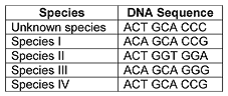
According to this data, the unknown bacterial species is most closely related to: 
a)
Species I
b)
Species II
c)
Species III
d)
Species IV
82.
What process is being shown in this image?
a)
Variation
b)
Natural Selection
c)
Selective Breeding
d)
Homeostasis
83.

A species is defined as:

a)

a group of organisms that are extremely different.

b)

a group of organisms that have similar characteristics and always live in the same place.

c)

a group of organisms with similar characteristics and can reproduce to make fertile offspring.

d)

any two organisms to make a hybrid.

84.
From where do autotrophs obtain their energy?
a)
The sun
b)
Other organisms
85.
Which of the following is the correct equation for PHOTOSYNTHESIS?
a)
CO+ light + H2O --> O+ Sugar
b)
CO+ sugar + H2O --> O+ light
c)
O2 + light + H2O --> CO+ Sugar
d)
CO+ O2 + H2O --> Light+ Sugar
86.
What process occurs when light energy is captured in autotrophs and converted into sugar?
a)
Photosynthesis
b)
Cellular Respiration
87.
Use the diagram to answer the question. Which molecule is an electron carrier?
a)
H2O
b)
carbon dioxide
c)
NADP+
d)
oxygen
88.
What is the function of NADPH and ATP?
a)
They absorb light
b)
They power the light-dependent reactions
c)
They are light-reflecting pigments
d)
They are short term energy carriers
89.
The calvin cycle takes place in __________.
a)
stroma
b)
thylakoid membrane
c)
chlorophyll
d)
granum
90.
#4 is pointing to an individual "pancake" in this stack.  What is this called?
a)
Stroma
b)
Thylakoid
c)
Granum
d)
Stomata
91.
What are the products of photosynthesis?
a)
water and carbon dioxide
b)
oxygen and glucose
c)
oxygen and carbon dioxide
d)
oxygen and water
92.
This is referred to as the energy currency of the cell
a)
ADP
b)
ATP
c)
Mitochondria
d)
Nucleus
93.
This is the first step of cellular respiration
a)
Glycolysis
b)
Lactic Acid Fermentation
c)
Alcoholic Fermentation
d)
Aerobic Respiration
94.
This means that oxygen is needed
a)
anaerobic 
b)
aerobic
95.
What is the correct equation for cellular respiration?
a)
6O2 + C6H12O6 -> 6CO2 + 6H2O + Energy
b)
6O2 + C6H12O6 + Energy -> 6CO2 + 6H2O
c)
6CO2 + 6H2O -> 6O2 + C6H12O6 + Energy
d)
6CO2 + 6H2O + Energy -> 6O2 + C6H12O6
96.
Which molecule isn't an energy carrier?
a)
FADH2
b)
NADH
c)
oxygen
d)
ATP
97.
Where does glycolysis take place?
a)
Cytoplasm
b)
Stroma
c)
Thylakoid
d)
Mitochondria
98.

The release in energy from the sugar that are in plant and animal cells is called...

a)

photosynthesis

b)

transpiration

c)

cellular respiration

d)

transition

99.

Which of the following organelles is responsible for cellular respiration?

a)

Mitochondria

b)

Nucleus

c)

Endoplasmic Reticulum

d)

Ribosome

100.

C6H12O6 is the chemical formula for

a)

Carbon Dioxide

b)

Water

c)

Oxygen

d)

Glucose

101.
Cellular Respiration's goal is to
a)
make water
b)
make ATP
c)
make glucose
d)
make  oxygen
102.
What is the net gain of ATP during glycolysis?
a)
1
b)
2
c)
4
d)
34
103.
What is needed from the Krebs Cycle in order for the Electron Transport Chain to occur?
a)
ATP
b)
FADH2
c)
CO2
d)
H20
104.

How does the electron transport chain use the high-energy electron from the Krebs cycle?

a)

The electron transport chain uses the high-energy electrons from the Krebs cycle to convert ADP to ATP

b)

The electron transport chain uses the high-energy electrons from the Calvin cycle to convert ADP to ATP

c)

The electron transport chain uses the high-energy electrons from the Krebs cycle to convert ATP to ADP

d)

The electron transport chain uses the high-energy electrons from the Calvin cycle to convert glucose to glycogen

105.

What happens to pyruvic acid during the Krebs cycle?

a)

Pyruvic acid is broken down into carbon dioxide in a series of energy-extracting reactions

b)

Pyruvic acid is broken down into water in a series of energy-extracting reactions

c)

Pyruvic acid is broken down into glucose in a series of energy-extracting reactions

d)

Pyruvic acid is broken down into ATP in a series of energy-extracting reactions

106.

What are the products of glycolysis?

a)

Pyruvic Acid, 3-Carbon molecule, ATP, and 4 high energy electrons

b)

Glucose and ATP

c)

Pyruvic Acid, ATP and 4 high energy electrons

d)

Lactic Acid, Pyruvic Acid and Glucose

107.

How is the function of NAD+ similar to that of NADP+?

a)

Both are electron carriers

b)

Both require ATP

c)

Both occur in Photosynthesis

d)

Both breakdown H2O