wayground logo

Free Printable Worksheets

Font size

S
M
L
XL
Worksheets

Biology Fall Test

Total questions: 107

Worksheet time: 54mins

Name
Class
Date
1.

This is on the outside of a cell, it helps recognize other cells and allows specific particles to enter when needed.

a)

Carbohydrate

b)

Glycoprotien

c)

Glycolipid

d)

Cholesterol

2.
This is on the outside of a cell, it helps recognize other cells and allows specific particles to enter when needed.
a)
Carbohydrate
b)
Glycoprotein
c)
Glycolipid
d)
Cholesterol
3.
This provides structure and stability with in the phospholipid bilayer
a)
Carbohydrate
b)
Cholesterol
c)
Glycoprotein
d)
Glycolipid
4.
Electrolytes are materials that dissolve in water to form an electrically conductive solution. Electrolytes are often salts, which form ions that carry current in the solution. They are important to the body because they regulate nerve and muscle function. Electrolytes are released in sweat, so they are found in sports drinks. Which of these components of sports drinks are both electrolytes?
a)
Sucrose and Sodium
b)
Dextrose and Potassium
c)
Potassium and Sodium
d)
Dextrose and Sucrose
5.
What does the brain monitor to control the rate of breathing during normal activities?
a)
The level of carbon dioxide in the blood
b)
The level of carbon dioxide in the cells
c)
The level of carbon dioxide in the lungs
d)
The level of carbon dioxide in the air.
6.
What are the 3 types of passive transport?
a)
Diffusion, Osmosis, Exocytosis
b)
Facilitated diffusion, Molecular Pump, Osmosis
c)
Osmosis, Simple diffusion, Facilitated diffusion
d)
Molecular pump, Endocytosis, Exocytosis.
7.
What type of transport is moving glucose from high concentration to low concentration
a)
Simple Diffusion
b)
Facilitated Diffusion
c)
Osmosis
d)
Molecular Pump
8.
When white blood cells engulf viruses to begin the immune response, what type of transport is this?
a)
Endocytosis
b)
Exocytosis
c)
Facilitated Diffusion
d)
Osmosis
9.
Which is a feedback mechanism the human body uses to maintain homeostasis?
a)
Copying genetic material during cell division
b)
Rejection of a flu vaccine by the immune system
c)
Perspiring to lower the body temperature
d)
Learning a new behavior to survive in a new environment.
10.
The diffusion of water across a selectively permeable membrane is called:
a)
Active Transport
b)
Diffusion
c)
Osmosis
d)
Endocytosis
11.
What process does your body use to move oxygen to the cells and carbon dioxide out of the cells?
a)
Osmosis
b)
Simple Diffusion
c)
Molecular Pump
d)
Active Transport
12.
When a person is hydrated, their cells will have the same osmotic pressure as their bloodstream, but when they lose fluids due to sweating their cells will shrink due to water loss. This is called
a)
Hypotonic
b)
Isotonic
c)
Diffusion
d)
Hypertonic
13.
The human body temperature is relatively constant. Which feedback mechanism helps the human body maintain its normal temperature in a cold environment?
a)
Water is released from the skin
b)
Muscle shake in small movements
c)
The rate of heartbeats slow
d)
The lungs take in additional air.
14.
What type of transport is when cells of the nervous system transmit electrical impulses from cell to cell based on stimuli
a)
Endocytosis
b)
Exocytosis
c)
Molecular Pump
d)
Facilitated Diffusion
15.
What type of transport is the sodium-potassium pump, which exchanges sodium for potassium ions across the cell membrane against the concentration gradient?
a)
Endocytosis
b)
Exocytosis
c)
Molecular Pump that uses ATP
d)
Facilitated diffusion
16.
The need of an organism to maintain and regulate constant or stable internal conditions.
a)
Cellular Respiration
b)
Photosynthesis
c)
Homeostasis
d)
Protein Synthesis
17.
A person hasn’t eaten for a while and becomes shaky, what does the child need to do to maintain homeostasis?
a)
Drink water
b)
Eat something with sugar
c)
Eat nothing
d)
Take a nap
18.
A test tube of water containing 2.5 mg of salt, holding a cell whose cytoplasm has a concentration of 1.0 mg of salt.
a)
Hypertonic
b)
Hypotonic
c)
Isotonic
19.
A test tube of water containing 1.0 mg of salt, holding a cell whose cytoplasm has a concentration of 2.5 mg of salt.
a)
Hypertonic
b)
Hypotonic
c)
Isotonic
20.
A test tube of water containing 0.8 mg of salts, holding a cell whose cytoplasm has a concentration of 0.8 mg of salts.
a)
Hypertonic
b)
Hypotonic
c)
Isotonic
21.
If someone is not drinking the correct amount of water the osmoreceptors in the brain detect the decreased level of water in the blood. Hormones act on the kidney to increase the reabsorption of water, which returns that water to the blood. This retention of water has the additional effect of decreasing urinary output. What is the stimulus that caused the body to leave Homeostasis?
a)
Decrease in water in the blood
b)
Decrease in urination
c)
Low blood sugar
d)
Low blood pressure
22.
If someone is not drinking the correct amount of water the osmoreceptors in the brain detect the decreased level of water in the blood. Hormones act on the kidney to increase the reabsorption of water, which returns that water to the blood. This retention of water has the additional effect of decreasing urinary output. What would someone need to do to return the body back to homeostasis.
a)
Drink more water
b)
Eat food with glucose
c)
Stop exercise
d)
Take medication to increase water retention
23.
What temperature is the homeostasis in this diagram?
a)
98.6℉
b)
100 ℉
c)
102 ℉
d)
96 ℉
24.
What was the highest this patient's fever got?
a)
98.6℉
b)
100 ℉
c)
102 ℉
d)
104 ℉
25.
What time did the fever spike (reach the highest) in the morning?
a)
2:00 AM
b)
4:00 AM
c)
8:00 AM
d)
10:00 AM
26.
The patient was given fever-reducing medication, it takes about 20-30 minutes for the medicine to begin working. Approximately what time was the medication given?
a)
12:00 AM
b)
4:00 AM
c)
2:00 PM
d)
8:00 AM
27.
What is the stimulus that would cause a person to have a fever?
a)
There isn't one
b)
A hot day will cause a sever fever
c)
The invasion of a virus or bacteria , the body raises its temperature to keep the invader from replicating
d)
Low Blood Pressure cause the body to raise it temperature
28.
What time of day do the light-independent reactions occur?
a)
Night Only
b)
Anytime
c)
Day time only
29.
Which process is considered Endothermic?
a)
Cellular Respiration
b)
Photosynthesis
c)
Enzyme reaction
d)
Diffusion.
30.
What are the products of photosynthesis?
a)
Glucose and Oxygen
b)
Carbon Dioxide and Water
c)
Water and Oxygen
d)
Glucose and Water
31.
What is added to photosynthesis that makes it an endothermic reaction?
a)
Solar Energy/Sunlight
b)
ATP
c)
Water
d)
Nothing, it isn't an endothermic reaction.
32.
The Light-Dependent Reactions are also known as the ____________.
a)
Kreb Cycle
b)
Calvin Cycle
c)
Electron Transport Chain
d)
Enzyme reaction
33.
Where in the chloroplast does the light-independent reaction take place?
a)
the stroma
b)
thylakoid membrane
c)
matrix
d)
inner membrane.
34.
What are the reactants of photosynthesis?
a)
Glucose and Oxygen
b)
Carbon Dioxide and Water
c)
Water and Oxygen
d)
Glucose and Water
35.
What organelle does photosynthesis take place in?
a)
Chloroplast
b)
Central Vacuole
c)
Mitochondria
d)
Cytoplasm
36.
What are stacks of thylakoid membranes called?
a)
Stroma
b)
Thylakoid Membrane
c)
Grana
d)
Inner Membrane
37.
Where does the light-dependent reaction occur?
a)
Stroma
b)
Thylakoid Membrane
c)
Matrix
d)
Inner Membrane
38.
How does the Carbon Dioxide enter a plant?
a)
Through the roots
b)
Through the stomata, pores in a leaf
c)
Absorbed into the stem
d)
Through the plants' fruit
39.
What is the green pigment that becomes excited by the sun to break water down into Oxygen and Hydrogen ions?
a)
Chlorophyll
b)
Xanthophyll
c)
Carotene
d)
Anthocyanins
40.
What time of day do the light-dependent reactions occur?
a)
Night Only
b)
Anytime
c)
Day time only
41.
The light independent-reaction is also called:
a)
Electron Transport Chain
b)
Kreb Cycle
c)
Calvin Cycle
d)
Glycolysis
42.
Where is the water stored in the plant cell?
a)
The roots
b)
The central vacuole
c)
The stem
d)
The cytoplasm
43.
What biomolecule is glucose?
a)
Sugar
b)
Enzyme
c)
Amino Acid
d)
Fatty Acid
44.
What biomolecules are responsible for breaking down food into glucose needed for cellular respiration
a)
Enzymes
b)
Amino Acids
c)
Glycolysis
d)
Nucleic Acids
45.
Which process is considered Exothermic?
a)
Photosynthesis
b)
Cellular Respiration
c)
Fermentation
d)
Glycolysis
46.
Why is Cellular Respiration important to the body?
a)
Cellular Respiration breaks Water and Carbon Dioxide to make Glucose.
b)
Cellular Respiration breaks down one molecule of glucose, in the absence of oxygen, to create 4 ATP
c)
It isn’t, Cellular Respiration only occurs in plants
d)
Cellular Respiration breaks down one molecule of glucose, in the presence of oxygen, to create 36 ATP. This is the best way our body receives energy.
47.
What are the reactants in Cellular Respiration?
a)
Oxygen and Glucose
b)
Carbon Dioxide and Water
c)
Glucose and Water
d)
Carbon Dioxide and Oxygen
48.
What it is the pre-step to cellular respiration
a)
Photosynthesis
b)
Glycolysis
c)
Electron Transport Chain
d)
Kreb Cycle
49.
When there isn’t Oxygen readily available in the cell _______________ occurs
a)
Fermentation
b)
Cellular Respiration
c)
Photosynthesis
d)
Glycolysis
50.
When ATP is used how is the energy released as:
a)
Heat
b)
Water
c)
Carbon dioxide
d)
It isn't released
51.
What are the products of Cellular Respiration?
a)
Oxygen and Glucose
b)
Carbon Dioxide and Water
c)
Glucose and Water
d)
Carbon Dioxide and Oxygen
52.
What is #2?
a)
Outer Membrane
b)
Inner Membrane Space
c)
Inner Membrane
d)
Matrix
53.
Where does glycolysis occur
a)
Cytoplasm
b)
Inner Membrane
c)
Matrix
d)
Thylakoid Membrane
54.
What organelle does Cellular Respiration happen in?
a)
mitochondria
b)
chloroplasts
c)
cytoplasm
d)
lysosome
55.
What builds up in the cells if fermentation occurs?
a)
Oxygen
b)
Lactic Acid
c)
Carbon dioxide
d)
ATP
56.
Where does the Electron Transport happen in the Mitochondria?
a)
Matrix
b)
Inner Membrane
c)
Thylakoid Membrane
d)
Stroma
57.
Why does glycolysis have to happen before Cellular Respiration
a)
Glucose is to large to enter the mitochondria
b)
Oxygen needs to be present to complete cellular respiration
c)
It doesn't really need this process.
d)
Both, Glucose is too large and oxygen must be present for cellular respiration to occur.
58.
Why is oxygen needed for cellular respiration?
a)
To keep the process from ending
b)
Joining with carbon in glucose to make carbon dioxide and the hydrogen ions to make water.
c)
To join with the Hydrogen ion to make water only
d)
To join with carbon to make carbon dioxide only.
59.
What is #4
a)
Outer Membrane
b)
Inner Membrane Space
c)
Inner Membrane
d)
Matrix
60.
Where does the Electron Transport Chain occur during cellular respiration
a)
Inner Membrane
b)
Matrix
c)
Thylakoid Membrane
d)
Stroma
61.
How many ATP are made in Fermentation?
a)
36-38
b)
2-4
c)
6-8
d)
24
62.
How many total ATP are made during the process of Cellular Respiration:
a)
2
b)
4
c)
30
d)
36
63.
What fuels the Electron Transport Chain in both cycles?
a)
Water
b)
Oxygen
c)
Hydrogen ions
d)
Glucose
64.
What are the products of Cellular Respiration?
a)
Glucose and Oxygen
b)
Glucose and Carbon Dioxide
c)
Carbon Dioxide and Water
d)
Water and Oxygen
65.
Where does the Kreb cycle happen in the Mitochondria?
a)
Matrix
b)
Inner Membrane
c)
Thylakoid Membrane
d)
Stroma
66.
This is the breaking and creating of bonds between different substances
a)
Chemical Reaction
b)
Activation Energy
c)
Active Site
d)
Catalyst
67.
The amount of energy needed to make a chemical reaction start
a)
Chemical Reaction
b)
Activation Energy
c)
Active Site
d)
Catalyst
68.
The place on an enzyme where a substrate fits and the chemical reaction takes place.
a)
Chemical Reaction
b)
Activation Energy
c)
Active Site
d)
Catalyst
69.
An enzyme is considered a ______________ because it speeds up the chemical reaction and is used over and over again.
a)
Chemical Reaction
b)
Activation Energy
c)
Active Site
d)
Catalyst
70.
The substrate is the _________ in a biochemical reaction.
a)
Product
b)
Reactant
c)
Enzyme
d)
Activation energy
71.
An enzyme is what type of biomolecule?
a)
Protein
b)
Carbohydrate
c)
Lipid
d)
Nucleic Acid
72.
Enzymes can increase the rate of a chemical reaction within a living cell. Enzymes accomplish this through which of the following means?
a)
reducing the number of products
b)
reducing the activation energy
c)
increasing the temperature of the cell
d)
increasing the concentration of reactants
73.
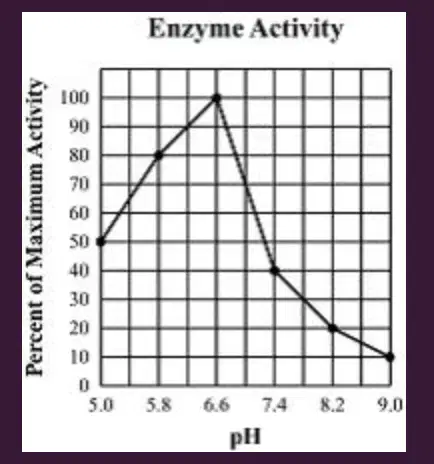
What conclusion can be made from this graph?
a)
The optimum pH of the enzyme is 6.6.
b)
The optimum pH of the enzyme is 5.8
c)
The enzyme’s activity increases as pH increases 5.0 to 9.0
d)
The enzyme’s activity is greater around pH of 8.0
74.
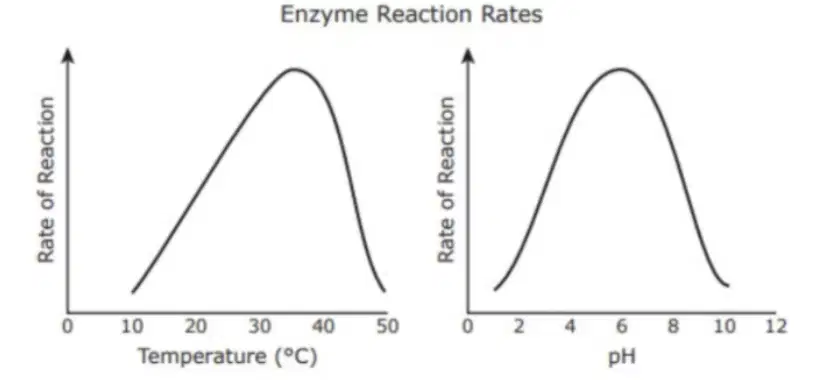
Based on the data, this enzyme functions best at what temperature and pH?
a)
Temperature of 27C and a pH of 4
b)
Temperature of 37C and a pH of 6
c)
Temperature of 40C and a pH of 8
d)
Temperature of 50C and a pH of 10
75.
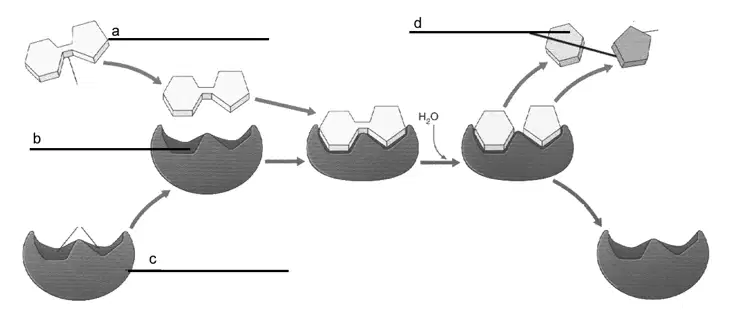
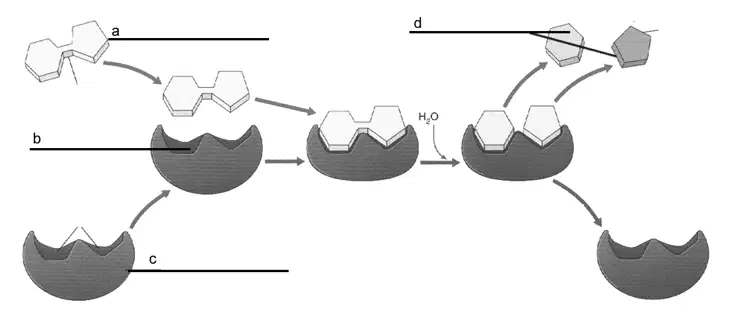
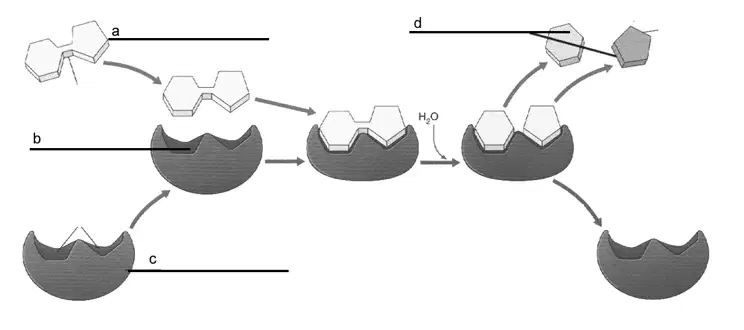
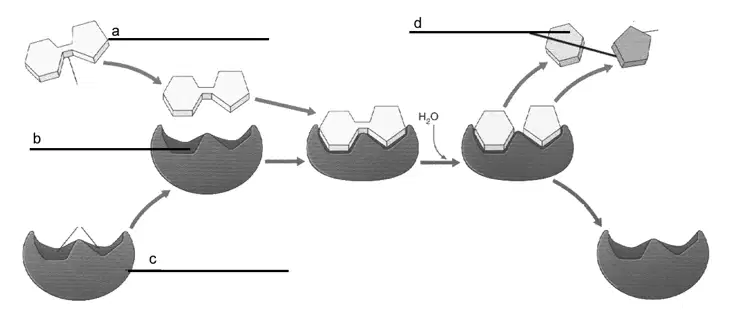
What is a?
a)
Enzyme
b)
Active Site
c)
Substrate
d)
Product
76.
What is b?
a)
Enzyme
b)
Active Site
c)
Substrate
d)
Product
77.
What is c?
a)
Enzyme
b)
Active Site
c)
Substrate
d)
Product
78.
What is d?
a)
Enzyme
b)
Active Site
c)
Substrate
d)
Product
79.
This is when an enzyme becomes deformed and loses its specific shape, which causes a loss in biochemical function.
a)
Active Site
b)
Denatured
c)
Chemical Reaction
d)
Activation Energy
80.
Mark all that would cause an enzyme to become denatured.
a)
Temperature
b)
Change in pH
c)
Ion Strength
d)
Solubility
81.
What 3 elements are cycled through Cellular Respiration and Photosynthesis?
a)
Carbon, Oxygen, and Nitrogen
b)
Water, Phosphorus, and Nitrogen
c)
ATP, Light Energy, and Glucose
d)
Carbon, Hydrogen, and Oxygen
82.
How are Cellular Respiration and Photosynthesis related:
a)
They aren’t related
b)
They are opposite: the products of one process are the reactants of the other process
c)
They work independently, they are not connected
d)
They are only connected by one molecule.
83.
Which biomolecule is the source of instance energy?
a)
Lipid
b)
Protein
c)
Nucleic Acid
d)
Carbohydrate
84.
What is the monomer for a protein?
a)
Amino acids
b)
Monosaccharide
c)
Triglyceride
d)
Nucleotide
85.
What are the functions of lipids?
a)
Quick source of energy
b)
Builds muscles & skin, enzymes, hormones
c)
Stores genetic information
d)
Stores energy, insulation, plasma membrane
86.
Which of the following is an example of a nucleic acid?
a)
Glucose
b)
Phospholipid
c)
Enzymes
d)
DNA
87.
What is the function of a nucleic acid?
a)
Stores genetic information
b)
Stores energy
c)
Quick source of energy
d)
Builds structures
88.
Nucleotides are monomer for
a)
Nucleic Acids
b)
Proteins
c)
Carbohydrates
d)
Lipids
89.
Which is the monomer for a Carbohydrate?
a)
monosaccharide
b)
disaccharide
c)
polysaccharide
d)
Polypeptide
90.
Which is NOT considered a lipid?
a)
Triglyceride
b)
Phospholipid
c)
Steroids
d)
Glycogen
91.
The monomer for a protein is
a)
Amino Acids
b)
Monosaccaride
c)
Nucleotide
d)
Triglyceride
92.
What makes up a nucleotide? (there are 3)
a)
Phosphate Group
b)
Sugar
c)
Nitrogen Base
d)
Protein
e)
Lipid
93.
What biomolecule is responsible for the growth and repair of tissue, enzymes, and aid thin transport across a cell membrane?
a)
Protein
b)
Lipds
c)
Carbohydrate
d)
Nucleic Acid
94.
Which is a common polysaccharide?
a)
Glucose
b)
Fructose
c)
Starch
d)
Lactose
95.
What is the polymer for a protein
a)
Polysaccharide
b)
Polypeptides
c)
Amino Acid
d)
Triglyceride
96.

This protects the DNA of the cell.

a)

Nucleus

b)

Nucleolus

c)

Smooth Endoplasmic Reticulum

d)

Rough Endoplasmic Reticulum

97.

This is the jelly-like substance mainly made up of water that holds everything in place.

a)

cytoplasm

b)

Rough Endoplasmic Reticulum

c)

Smooth Endoplasmic Reticulum

d)

Golgi Body

98.

Attached to the Rough ER, makes lipids and detoxifies drugs.

a)

Smooth Endoplasmic Reticulum

b)

Lysosome

c)

Golgi Body

d)

Central Vacuole

99.

Located inside the nucleus and makes rRNA which makes up ribosomes.

a)

Nucleus

b)

Nucleolus

c)

Nuclear Membrane

d)

Ribsosomes

100.

A folded membrane that processes, sorts, and ships proteins where needed

a)

Golgi Body

b)

Lysosome

c)

Rough Endoplasmic Reticulum

d)

Smooth Endoplasmic Reticulum

101.

Their job is to make proteins, they are located on the Rough Endoplasmic Reticulum and float in the cytoplasm.

a)

Ribosome

b)

Lysosome

c)

Rough Endoplasmic Reticulum

d)

Smooth Endoplasmic Reticulum

102.

Consists of microtubules and appears during cell division in an animal cell. Helps pull apart chromosomes.

a)

Centrioles

b)

Nucleolus

c)

Ribosomes

d)

Lysosome

103.

Contains enzymes that breakdown dead organelles and complete apoptosis.  

a)

Lysosome

b)

Smooth Endoplasmic Reticulum

c)

Rough Endoplasmic Reticulum

d)

Golgi Body

104.

Located next to the nucleus and has ribosomes covering the exterior, it makes proteins that form hormones.

a)

Rough Endoplasmic Reticulum

b)

Smooth Endoplasmic Reticulum

c)

Golgi Body

d)

Centrioles

105.

 These types of cells do not have a nucleus or membrane-bound organelles. They divide through binary fission and have a cell wall made of peptidoglycan.

a)

Prokaryote

b)

Eukaryote

c)

Animal

d)

Plant

106.

These types of cells have a nucleus and membrane-bound organelles. They divided by mitosis. They can be multicellular or unicellular.

a)

Prokaryote

b)

Eukaryote

c)

Animal

d)

Plant

107.

This is filled with pours and lets ribosomes enter and leave the nucleus  

a)

Nuclear Membrane

b)

Cell Membrane

c)

Centriole

d)

Golgi Body