wayground logo

Free Printable Worksheets

Font size

S
M
L
XL
Worksheets

LE Midterm Review

Total questions: 112

Worksheet time: 1hrs 16mins

Name
Class
Date
1.
A testable explanation to a problem that has not yet been tested. 
a)
data
b)
theory
c)
hypothesis
d)
fact
2.
This variable in an experiment is the one being changed by the scientist. 
a)
dependent variable
b)
independent variable
c)
data
d)
control group
3.
Testing a hypothesis often involves a(n):
a)
answer
b)
experiment
c)
problem
d)
safety check
4.
What is a hypothesis?
a)
A hypothesis is the right answer to an experiment.
b)
A hypothesis is the wrong answer to an experiment.
c)
A hypothesis is an educated guess.
d)
I don't know.
5.
The name of the information that you get from your experiment (you organize it into charts and graphs).
a)
observations
conclusion
b)
data
c)
variables
d)
hypothesis
6.
An experiment is performed on plants to see how different liquids affect plant growth. Each plant in the experiment is given a different liquid; water, apple juice, or milk. Each plant has the same amount of soil, sunlight, and listens to the same music. In this investigation, the independent variable is ...
a)
The type of plant
b)
The amount of sunlight
c)
The type of music
d)
The type of liquid
7.
Dependent variable means
a)
the scientist controls what to test
b)
educated guess
c)
ask a question
d)
what is being measured
8.
If you increase the amount of spinach you eat, then you will increase the iron in your blood. 
What's the dependent variable?
a)
increase the amount of iron in your blood
b)
spinach you eat
9.
Will a construction paper air plane fly faster than an airplane made from notebook paper? Choose the best hypothesis.
a)
If I make a paper airplane from notebook paper, then it will fly faster than construction paper.
b)
Yes.
c)
No.
d)
I think the construction paper air plane will fly faster.
10.
Which side of a penny will hold more drops of water? Choose the best hypothesis.
a)
If I use the heads side of a penny, then it will hold more drops of water than tails.
b)
Heads
c)
Tails
d)
Tails will hold more drops of water.
11.
If I study for my scientific method test, then I will have a better test score. What is the dependent variable?
a)
Scientific Method
b)
Studying
c)
Independent variable
d)
Test score
12.
If I read this question carefully, then I will answer it correctly. What is the independent variable?
a)
I hope so
b)
Yes
c)
Reading or not reading carefully
d)
Likelihood of a correct answer
13.
What is the part of the experiment that is left alone or “natural", and is used to compare back to?
a)
Independent Variable
b)
Dependent Variable
c)
Control Group
d)
Experimental Group 
14.
You will want your experiment to have ____ independent variable(s) in it for the experiment to be valid.
a)
1
b)
2
c)
3
d)
4
15.
Nick wanted to see how high an ice cube would float in different temperatures of water. Identify the DEPENDENT variable
-Amount of water
-Height of Ice cube
-Temperature the ice cube was at its highest height
-Temperature of the water
-Size of the ice cube
a)
Amount of water 
b)
Height of Ice cube
c)
Temperature the ice cube was at its highest height 
d)
Size of the ice cube
16.
Mario studied how far room temperature water would spurt out of a plastic milk carton when 3mm holes were punched at different heights from the bottom of the container. Identify the DEPENDENT variable
-3mm holes
-Distant water traveled out of carton
-Different heights of the holes in the container
-Ice water from Iceland
a)
3mm holes
b)
Distant water traveled out of carton
c)
Different heights of the holes in the container 
d)
Ice water from Iceland
17.
The following statement is a hypothesis formed about marsh grass: 
If the amount of nitrogen marsh grass receives is increased, then the height of the grass will increase, because nitrogen is an essential nutrient needed for marsh grass to grow.
What is the independent variable of the statement above? 
a)
Height of grass
b)
Amount of nitrogen
c)
Essential nutrient
d)
Amount of growth
18.
A scientist hypothesizes the the temperature at which an alligator's egg is incubated will determine whether the alligator will be male or female. The independent variable is
a)
the male alligators
b)
the incubator
c)
the gender of the alligator
d)
the temperature
19.
A scientist hypothesizes the the temperature at which an alligator's egg is incubated will determine whether the alligator will be male or female. The dependent variable is
a)
the size of the baby alligators
b)
the gender of the baby alligators
c)
the incubator
d)
the temperature
20.
In this graph, what is the independent variable? 
a)
Population
b)
Day
c)
Species 5
21.
In this graph, what is the dependent variable? 
a)
Walla Walla Island
b)
Time
c)
Number of Deer
22.
All living things are made of...
a)
atoms 
b)
cells 
c)
bacteria 
d)
plants 
23.
control, read, and direct the cell using DNA instructions
a)
nucleus
b)
mitochondria
c)
endoplasmic reticulum
d)
lysosome
24.
Controls what enters/leaves a cell
a)
cell membrane
b)
Nuclear membrane
c)
cell wall
d)
cytoplasm
25.
stiff, protective outer layer of plant cells
a)
cell membrane
b)
nuclear membrane
c)
cell wall
d)
cytoplasm
26.
Amino acids link together to form proteins. In which organelle would this process occur?
a)
Lysosome
b)
Ribosome
c)
Centriole
d)
Mitochondria
27.

releases energy for cells to use

a)

mitochondria

b)

ribosomes

c)

lysosomes

d)

nucleolus

28.
collect sunlight which it converts to sugars
a)
chloroplasts
b)
cytoplasm
c)
cell wall
d)
mitochondria
29.
hold/store water, mainly found in plant cells
a)
nuclolus
b)
ribosomes
c)
golgi bodies
d)
vacuoles
30.
What am I?
a)
cell wall
b)
mitochondria
c)
cytoplasm
d)
chloroplast
31.
What am I?
a)
Nucleus
b)
Golgi Body
c)
Mitochondrion
d)
Plasma Membrane
32.
Cellular Respiration's goal is to
a)
make water
b)
make ATP
c)
make glucose
d)
make  oxygen
33.
In photosynthesis ...
a)
water is chloronated
b)
light energy is changed to glucose
c)
osmosis happens
d)
ATP is made
34.
What is cellular respiration?
a)
the breakdown of glucose  to release ATP
b)
the breakdown of glucose to release NADH
c)
the breakdown of glucose to release FADH
d)
the breakdown of glucose to release carbon
35.
What are the products of photosynthesis?
a)
sugar and glucose
b)
carbon dioxide 
c)
sugar and Oxygen
d)
water and energy
36.
A plant is releasing a gas. What is the mosl tlikely the gas?
a)
co2
b)
methane
c)
water vapor
d)
oxygen
37.
All living things do which of the following?
a)
Chemosynthesis
b)
Respiration
c)
photosynthesis
d)
all of the answers
38.
you breathe in oxygen for
a)
photosynthesis
b)
anaerobic respiration
c)
 fermentation
d)
aerobic respiration
39.
Which statement about photosynthesis is correct?
a)
Plants get the energy they need for photosynthesis from water.
b)
Plants get the energy they need for photosynthesis from soil.
c)
Plants get the energy they need for photosynthesis from sunlight.
d)
Plants do not require energy to perform photosynthesis.
40.
Which gas is removed from the atmosphere during photosynthesis?
a)
hydrogen
b)
oxygen
c)
nitrogen
d)
carbon dioxide
41.

How do humans get the simple sugar they need to use during cellular respiration?

a)

taking in sunlight through skin

b)

breathing it in

c)

breathing it out

d)

eating plants, which produce glucose

42.

Which gas is a product of respiration?

a)

carbon dioxide

b)

nitrogen

c)

oxygen

d)

hydrogen

43.

What simple sugar that was created during photosynthesis is a reactant of cellular respiration?

a)

sucrose

b)

glucose

c)

maltose

d)

fructose

44.

What helps photosynthesis and respiration reactions occur at a faster rate?

a)

DNA

b)

enzymes

c)

pyruvic acid

d)

carbohydrates

45.

C6H12O6 + O2 --> CO2 + H2O + ATP

a)

photosynthesis

b)

respiration

46.

CO2 + H2O + light energy --> C6H12O6 + O2

a)

respiration

b)

photosynthesis

47.

What 2 processes form a cycle that keep oxygen and carbon dioxide steady in the atmosphere?

a)

photosynthesis and digestion

b)

photosynthesis and breathing

c)

respiration and photosynthesis

d)

respiration and breathing

48.
Enzymes are considered to be 
a)
Lipids
b)
Carbohydrate
c)
Protein
d)
Nucleic Acid
49.
What is the purpose  of an enzyme?
a)
give permission for the reaction
b)
raise activation energy
c)
speed up reactions
d)
control how many reactions occur
50.
Where do substrates bind on an enzyme?
a)
voltage-gated channels
b)
surface receptor
c)
calcium channels
d)
active site
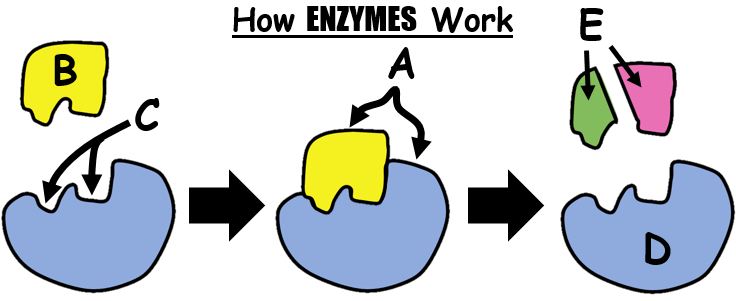
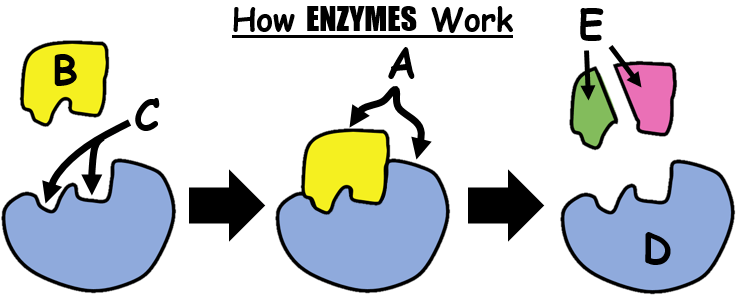
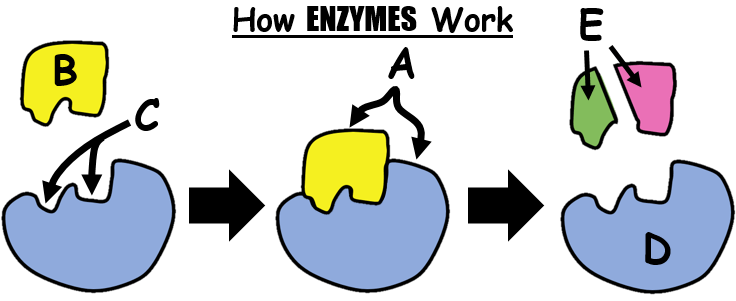
51.
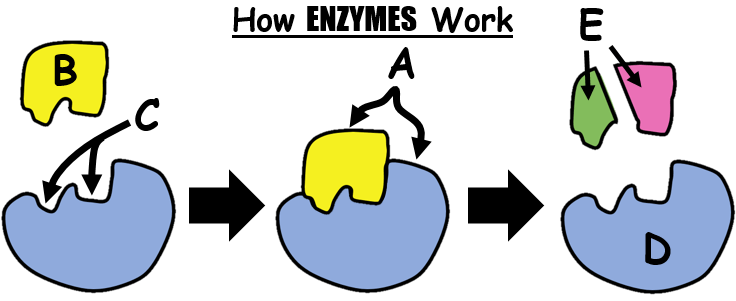
What is structure A?
a)
Substrate
b)
Active site
c)
Enzyme
d)
Products
52.
What is structure D?
a)
Substrate
b)
Active site
c)
Enzyme
d)
Products
53.
What is structure C?
a)
Substrate
b)
Active site
c)
Enzyme
d)
Products
54.
What is structure E, F, G?
a)
Substrate
b)
Active site
c)
Enzyme
d)
Products
55.
What is a substance called if it speeds up a chemical reaction?
a)
reusable
b)
catalyst
c)
specific
d)
fragile
56.
Each enzyme only has 1 substrate that will fit its active site.  What is this called?
a)
reusable
b)
catalyst
c)
specific
d)
fragile
57.
Once a new product leaves an enzyme, the enzyme is unchanged and ready for the next substrate.  What is this called?
a)
reusable
b)
catalyst
c)
specific
d)
fragile
58.
Which of the following conclusions can be drawn from this graph?
a)
The optimum pH of the enzyme is 6.6.
b)
The optimum pH of the enzyme is 5.8
c)
The enzyme’s activity increases as pH increases 5.0 to 9.0
d)
The enzyme’s activity is greater around pH of 8.0 .
59.
What is the name for the mechanism of enzyme activity?
a)
Lock and key
b)
jigsaw puzzle
c)
hammer and nail
d)
two hands pattern
60.
The "lock and key hypothesis" attempts to explain the mechanism of?
a)
Vacuole formation
b)
Pinocytosis
c)
Sharing of electrons
d)
Enzyme specificity 
61.
After the enzyme and substrate bind together and perform the reaction, what does the substrate become?
a)
a substrate
b)
an enzyme
c)
a product
d)
an active site
62.
Any substance that is acted upon by an enzyme is called a(n)?
a)
Coenzyme
b)
Substrate
c)
Vitamin
d)
Polypeptide
63.
What is a substance called if it speeds up a chemical reaction?
a)
reusable
b)
catalyst
c)
specific
d)
fragile
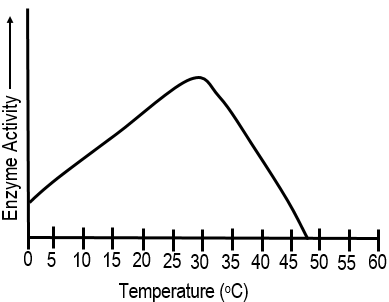
64.
Based on the graph, what is the optimal temperature for this enzyme? 
a)
15oC
b)
40oC
c)
30oC
d)
35oC
65.
In the diagram, what is letter A? 
a)
product
b)
substrate
c)
enzyme-substrate complex
d)
active site
66.
What happens when enzymes are heated to a high temperature?
a)
The enzymes die.
b)
The shapes of the enzyme are altered denature
c)
The enzymes' amino acid sequence changes.
d)
The enzymes remain the same
67.
Which of these is NOT true?
a)
Enzymes can denature (change shape) when the temperature gets too high.
b)
Enzymes can only be used once in a chemical reaction. 
c)
Extreme pH can denature enzymes.
d)
Enzymes speed up chemical reactions. 
68.
Which is NOT true?
a)
Enzymes speed up chemical reactions.
b)
Enzymes react best at a specific temperature.
c)
Enzymes only control ONE type of reaction.
d)
Enzymes are made of fatty acids.
69.
What is another name for enzymes?
a)
chemical catalysts
b)
microorganisms
c)
biological catalysts
d)
inorganic catalysts
70.
The pH at which an enzyme is most efficient is called the _________ pH of an enzyme.
a)
neutral
b)
optimum
c)
minimum
d)
experimental 
71.
Letter D...
a)
active site
b)
enzyme
c)
substrate
d)
products
72.
Letter B...
a)
active site
b)
enzyme
c)
substrate
d)
products
73.
Letter E...
a)
active site
b)
enzyme
c)
substrate
d)
products
74.

What is the Endocrine System?

a)

the body's defense against infectious organisms and other invaders

b)

a biological system consisting of specific organs and structures used for gas exchange in animals and plants

c)

a system of sex organs within an organism which work together for the purpose of sexual reproduction

d)

a system that produces and secretes hormones

75.
on the surface of cells, receives hormone messages
a)
receptor
b)
receiver
c)
neurotransmitter
d)
hormone
76.
hormones travel through the 
a)
blood
b)
lymph
c)
neuron
d)
cytoplasm
77.
structure that secretes hormones
a)
gland
b)
neuron
78.
word that describes the release of a hormone
a)
excrete
b)
secrete
c)
absorb
d)
inhale
79.
The functions of the immune system are 
1. prevent pathogens from entering the body
2. destroy pathogens that have entered the body
a)
True
b)
False
80.
The purpose of your endocrine system is to
1. release chemical messages into the bloodstream
2. use hormones to create slower changes that last longer
a)
True
b)
False
81.
_________ are disease-causing agents, such as bacteria and viruses.
a)
bacteria
b)
pathogens
c)
diseases
d)
cancer
82.
The immune system works to maintain your body's homeostasis.
a)
True
b)
False
83.
The  __________  system consists of glands that release messages into the body by way of hormones.
a)
immune
b)
nervous
c)
excretory
d)
endocrine
84.
What is the endocrine system?
a)
senses the hormone levels in the blood
b)
controls all other endocrine glands
c)
A group of glands that work together with the nervous system to coordinate all body functions
d)
decreases bone calcium levels
85.

The purpose of the endocrine system is to

a)

maintain homeostasis by reacting quickly to stimuli

b)

produce substances that protect the body from bacteria

c)

maintain metabolism, growth and development in homeostasis

d)

transport molecules throughout the body

86.

The process by which an organism’s internal environment is kept stable in spite of changes in the external environment.

a)

Positive Feedback

b)

Negative Feedback

c)

Homeostasis

d)

Targeted Cells

87.

The chemical product of an endocrine gland.

a)

Homeostasis

b)

Hormone

c)

Nerve Cell

d)

Neurotransmitter

88.

What is the main function of the endocrine system?

a)

it creates chemicals that are sent around the body to maintain homeostasis

b)

it creates electrical messages that are sent around the body to maintain homeostasis

c)

it maintains the correct level of oxygen in the body to maintain homeostasis

d)

it releases waste from the body to maintain homeostasis

89.

Which gland secretes insulin?

a)

Pancreas

b)

Ovaries

c)

Pituitary

d)

Thymus

90.

Insulin causes

a)

a decrease in the concentration of blood glucose

b)

a decrease in the permeability of cell membranes to glucose

c)

an increase in the production of glucose from glycogen

d)

a release of adrenaline into the body

91.

Feedback loops are important because they allow organisms and the environment to

a)

change based on new inputs

b)

fall apart

c)

change based on new outputs

d)

maintain balance

92.
What is another word that can be used to describe "homeostasis"?
a)
STABLE
b)
EQUAL
c)
COMPLETE
d)
CORRECT
93.
Failure to maintain homeostasis could result in:
a)
lack of internal balance
b)
eventual death
c)
difficulty carrying on metabolism 
d)
all three
94.
Homeostasis
a)
allows for a wildly fluctuating internal environment
b)
is impossible in vertebrates
c)
is the maintenance of a relatively stable internal environment and often incorporates a form of feedback regulation
d)
is the maintenance of a relatively stable external environment and often incorporates a form of feedback regulation
95.
Homeostasis in the human body is often maintained by a: 
a)
neutral feedback loop 
b)
solar feedback loop
c)
positive feedback loop
d)
negative feedback loop
96.
If the calcium in your blood decreases below homeostasis levels, a gland in the brain will sense the decrease and send a chemical message to your bones. Your bones will release calcium into the blood, bringing blood calcium levels back up.
a)
Positive Feedback Response
b)
Negative Feedback Loop 
97.
As you get dehydrated, your blood becomes thicker and harder to pump. Your kidneys will respond by stopping urine production, sending the water from urine into your bloodstream to thin your blood back to normal level.
a)
Positive Feedback Response
b)
Negative Feedback Loop 
98.
Which of the following is a chemical message that usually travels through the bloodstream to target cells?
a)
hormone
b)
local regulator
c)
endocrine cell
99.
The soil surrounding the roots of a plant has a water potential of -15 bars. The leaves of the plant have a water potential of -18 bars.
What will happen?
a)
Water will leave the plant and the plant will wilt.
b)
Water will move from the roots to the leaves of the plant.
c)
Nothing - these solutions are isotonic.
d)
IDK - What is a bar????
100.
The difference in the concentration of a substance from one location to another is called 
a)
diffusion
b)
osmosis
c)
concentration gradient
d)
passive transport
101.

The major function of the cell membrane is _

a)

selective permeability

b)

permeability

c)

impermeability

102.

If a solute is moving down its concentration gradient what does this mean?

a)

It is moving from high concentration to low concentration

b)

It is moving from low concentration to high concentration

c)

It is moving towards an area of opposite charge

d)

It is moving towards an area of the same charge

103.
What is diffusion?
a)
when molecules move 
b)
when molecules move from a high concentration to a low.
c)
no movement 
d)
molecules move everywhere
104.
What a cell needs to transport particles by active transport?
a)
Sun
b)
Wind
c)
Energy
d)
Channels
105.
When both inside and outside of a cell have the same amount of water it is said that the cell has reached a state of
a)
Osmosis
b)
Diffusion
c)
Equilibrium
106.
A person would never have pure water put into their veins in a hospital because their cells would...
a)
Shrink/Dehydrate
b)
Expand
107.
A person should never drink salty water because their cells would
a)
shrink
b)
expand
108.
If there is 5 percent water inside a cell and 5 percent water outside a cell
a)
more water will move inside the cell
b)
more water will move outside the cell
c)
There will be no movement of water cells
109.
Passive transport requires no
a)
concentration gradients
b)
osmosis
c)
motion
d)
energy
110.
The movement of molecules against a concentration gradient
a)
simple diffusion
b)
facilitated diffusion
c)
active transport
d)
osmosis
111.
The picture is an example of...
a)
active tranport
b)
passive transport
c)
diffusion
d)
osmosis
112.
Sometimes, energy is required for ____ molecules to go in or out of the cell because they cannot fit into the membrane.
a)
big
b)
small
c)
crunchy
d)
water