
 Worksheets
BIO120 Ch 10 lecture 1
Total questions: 56
Worksheet time: 54mins

Skeletal muscle tissue is
Striated and involuntary
Striated and voluntary
Non- striated and involuntary
Non-striated and voluntary
Cardiac muscle tissue is
Striated and involuntary
Striated and voluntary
Non- striated and voluntary
Non- striated and involuntary
Smooth muscle tissue is
Striated and involuntary
Striated and voluntary
Non- striated and involuntary
Non- striated and voluntary
Skeletal tissue is
Multinucleated
Uninucleated
This is an involuntary muscle tissue found in the blood vessels and stomach
Skeletal
Smooth
Cardiac
This is the only voluntary muscle type
Skeletal
Smooth
Cardiac
The ability of a muscle to respond to stimulus is
Contractability
Elasticity
Excitability
Extensibility
The ability of a muscle to get shorter and thicker is
Contractability
Elasticity
Excitability
Extensibility
The ability of a muscle to be stretched beyond its original length
Contractability
Elasticity
Excitability
Extensibility
The ability of a muscle to return to its original length
Contractability
Elasticity
Excitability
Extensibility
The connective tissue wrapper around an entire muscle
Endomysium
Epimysium
Perimysium
Exomysium
The connective tissue wrapper around a single muscle fiber
Endomysium
Epimysium
Perimysium
Exomysium
The plasma membrane of a muscle cell is called the
Epimysium
Endomysium
Sarcolemma
Sarcoplasm
The cylindrical thread like organelle that run the length of the muscle cell
Myofibers
Myofilaments
Myofibrils
Fasicles
Organelle that store calcium ions in a muscle cell
Sarcolemma
Sarcoplasm
Sarcoplasmic Reticulum
Sarcoma
Extensions of sarcolemma that carry the muscle impulse deep into the core of a muscle cell
Transverse Tubule
Sarcoplasmic Reticulum
Fasicles
Myofibrils
Which of the following wraps around a fasicle?
Sarcolemma
Sarcolplasmic Reticulum
Tendon
Permysium
Which is arranged smallest to largest?
Myofilament-Myofibril-Fiber-Muscle
Fiber-Myofilament-Myofibril-Muscle
Myofibril-Fiber-Myofilament-Muscle
Myofilament-Fiber-Myofibril-Muscle
The functional unit of a muscle
Fascicle
Myofiber
Myofibril
Sarcomere
Thick myofilaments are made of which protein?
Actin
Myosin
Troponin
Tropomyosin
What attaches directly to the z-line in the sarcomere?
Endomysium
Tendon
Thin myofilament
Sarcoplasmic Reticulum
The region of a sarcomere where only thick myofilaments is found
A-band
I-band
H-zone
Z-line
The region in a sarcomere where both thin and thick myofilaments are found
A-band
I-band
H-zone
Z-line


Which of the following are functions of the muscular system?
Produce body movement
Stabilize body position
Store and move substances in the body
Thermoregulation

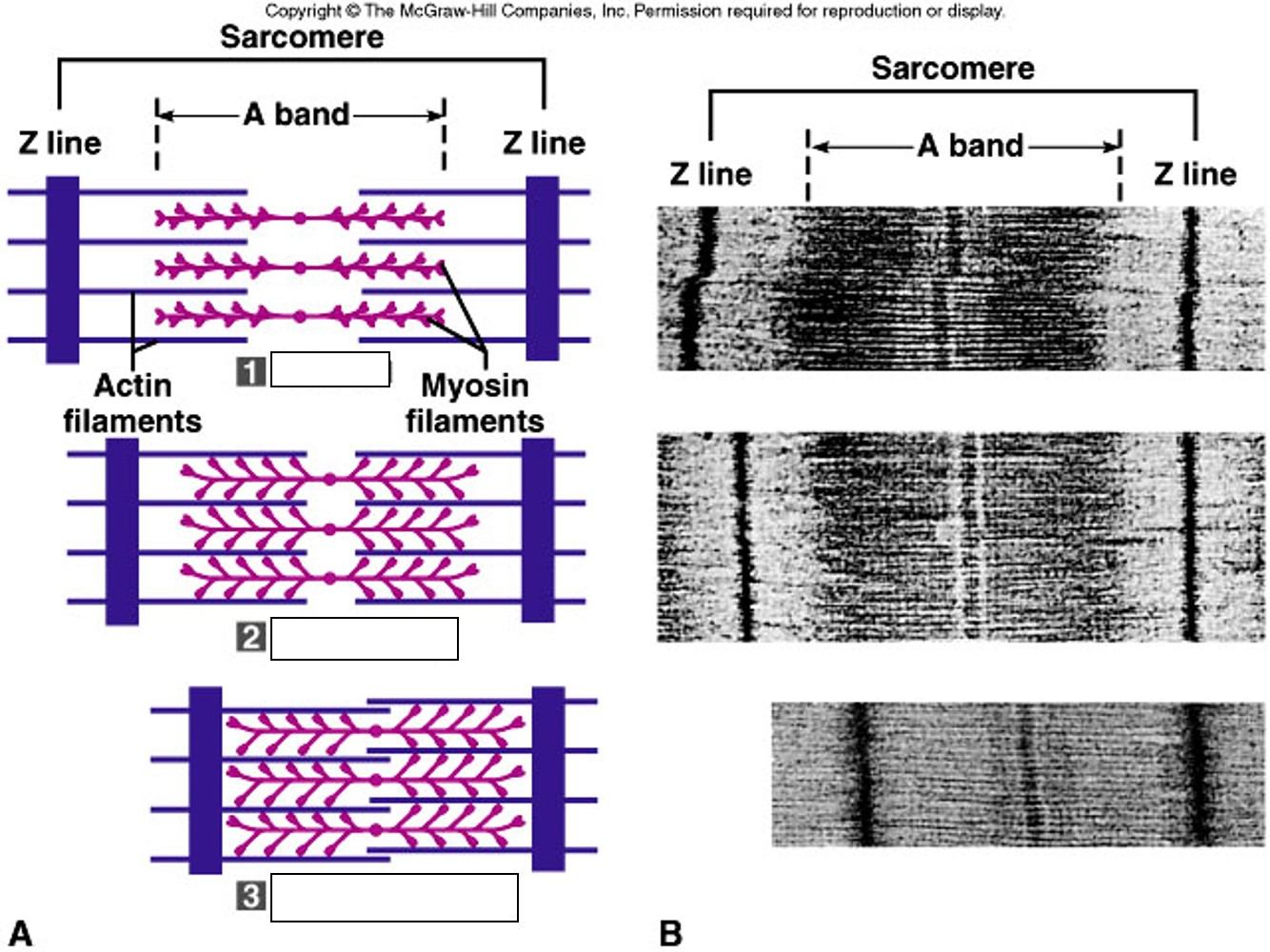
What happens to the I zones during a sarcomere contraction?
It shortens
It stays the same
It lengthens
None of these
What structure is the start and stopping point for what separates sarcomeres?
Z-disc
M-line
H-line
Titin filaments
In the sliding filament theory, what change occurs when muscles contract?
Myosin becomes shorter
Actin becomes shorter
Myosin and actin become shorter
Neither; neither protein shortens
Oxygen is stored in the muscle by...
hemoglobin
myoglobin

A broad, flat tendon that connects two muscles together is known as a
Fascicle
Perimysium
Aponeurosis
Myofibril

