Worksheets
class 10 current electricity
Total questions: 40
Worksheet time: 31mins
Electrical potential is ------------
scalar quantity
vector quantity
both scalar and vector
neither scalar nor vector
SI unit of resistivity (specific resistance) is ----------
ohm
ohm meter
volt
ampere
How is a voltmeter connected in the circuit to measure the potential difference between two points?
series
parallel
according to the situation either series or parallel
none
SI unit of electric current is -----------
volt
coulomb
ampere
ohm
SI unit of resistance is ------------
ohm
volt
ampere
coulomb
kilowatt hour is unit of
energy
power
momentum
force
An electric bulb is rated 220 V and 100 W. When it is operated on 110 V, power consumed will be ---------------. [Use P = (V X V)/R]
100 W
75 W
50 W
25 W
The property of a conductor by which it obstructs the flow of current is known as ------------------ of the conductor
voltage
conductivity
power
resistance
Ammeter is used to measure ----------------.
voltage
electric current
resistance
resistivity
What is the direction of conventional current?
positive terminal to negative terminal
negative terminal to positive terminal
depends on the condition
none
Ohm's law is applicable only when ----------------
temperature remains constant
temperature increases
temperature decreases
none
Keeping the potential difference constant, the resistance of the circuit is halved, the current will become --------------
four times
half
double
one-third
Electrical resistivity of a given metallic wire depends upon ----------
its length
its thickness
its shape
nature of the material
What is the SI unit of electric charge?
ampere
volt
ohm
coulomb
What is the maximum resistance which can be made using five resistor each of 1/5 ohm?
1/5 ohm
10 ohm
5 ohm
1 ohm
What is the minimum resistance which can be made using five resistors each of 1/5 ohm?
1/5 ohm
1/25 ohm
1/10 ohm
1/25 ohm
When a 4 ohm resistor is connected across the terminals of a 2 V battery, the number of coulombs passing through the resistor per second is --------------
0.5
1
2
4
If the current flowing through a fixed resistor is halved, the heat produced in it will become -----------------
one-fourth
one-half
double
four times
The solution which conducts electricity is known as --------
conductor
electrolyte
insulator
none
The work done to bring unit positive charge from infinity to a point in an electric field is known as ----------
potential
resistance
current
charge
An electric iron of resistance 20 ohm takes a current of 5 A. Calculate the heat developed in 30 s.
1000 joules
2000 joules
15000 joules
30000 joules
An electric iron has a rating of 750 W, 220 V. Calculate current passing through it.
5 A
6 A
3.4 A
7 A
Calculate the amount of charge that would flow in 1 hour through the element of an electric bulb drawing a current of 0.2 A. [Use I = Q/t]
300 C
320 C
700 C
720 C
Calculate resistance of an electric bulb which allows a 10 A current when connected to 220 V power source. [Use V = IR]
10 ohm
12 ohm
22 ohm
32 ohm
When a 12 V battery is connected across an unknown resistor, there is a current 2.5 mA in the circuit. Find the value of resistance of the resistor. [Use V = IR]
1000 ohm
2000 ohm
4800 ohm
6700 ohm

A potential difference of 24 V is applied to a 150 resistor. How much current flows through the resistor?
0.15 A
3600 A
6.25 A
0.16 A

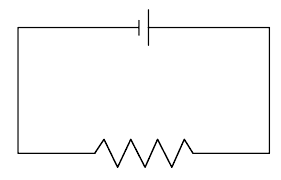
This is an example of a _______ circuit
open
series
parallel
square

This is an example of a ______ circuit
Series
Parallel
Open
Dihexihedral