wayground logo

Free Printable Worksheets

Font size

S
M
L
XL
Worksheets

Earth and Life

Total questions: 40

Worksheet time: 26mins

Name
Class
Date
1.
In order for life as we know it to exist, a planet must have ______________________
a)
heat
b)
animals
c)
liquid water
d)
solar energy
2.
Earth’s atmosphere contains water vapor and carbon dioxide. These greenhouse gases are important because they -
a)
are substances animals need to breathe.
b)
trap thermal energy in the atmosphere.
c)

protect against magnetic particles.
d)
create Earth’s gravitational field.
3.
Which is NOT considered one of the four main earth systems?
a)
atmosphere
b)
hydrosphere
c)
exosphere
d)
biosphere
4.
A system is...
a)
a moving object
b)
a collection of interacting parts
c)
a way of doing things
d)
something made by humans
5.
The four subsystems of Earth are...
a)
the troposphere, stratosphere, mesosphere, and thermosphere
b)
the inner core, outer core, mantle, and crust
c)
Jimmy Johns, Subway, Potbelly, and Firehouse
d)
the geosphere, hydrosphere, atmosphere, and biosphere
6.
The natural chemical or physical processes that breaks down rock on Earth's surface.
a)
weathering
b)
erosion
c)
deposition
d)
jackhammering
7.
What are the 3 major types of rocks?
a)
Igneous, Metamorphic, Sedimentary
b)
Metamorphic, Igneous, Cementation
c)
Brown, Red, Gray
d)
Streak, Hardness, Breakage
8.

We are part of which subsystem?

a)

Atmosphere

b)

Biosphere

c)

Geosphere

d)

Hydrosphere

9.
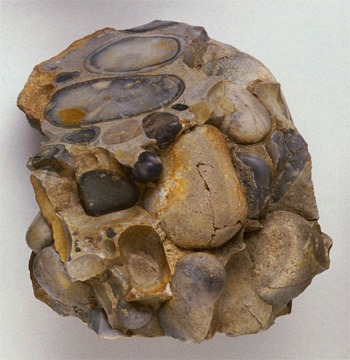
This rock was formed by smaller pieces of rock that settled at the bottom of a lake millions of years ago. What type of rock is this?
a)
Sedimentary
b)
Igneous
c)
Metamorphic
10.
The process when rocks break into smaller pieces due to exposure to natural elements is called
a)
erosion
b)
weathering
c)
sediments
11.
Rocks are formed by
a)
minerals
b)
other metals
c)
small particles
d)
sediments
12.

All solar energy absorbed by the atmosphere, air, land, and oceans must be radiated back to space.

a)

TRUE

b)

FALSE

c)

MAYBE

13.

The atmosphere protects the earth from the heat of the sun.

a)

TRUE

b)

FALSE

14.

The planets that contain life are Mars and Earth.

a)

TRUE

b)

FALSE

15.

The biggest terrestrial planet is Jupiter.

a)

TRUE

b)

FALSE

16.

How do you describe Earth?

a)

It is the third planet from the sun with extreme temperature.

b)

It is the fourth planet from the sun with enough amount of temperature.

c)

It is the third planet from the sun with atmosphere rich in oxygen and liquid water.

d)

It is the fourth planet from the sun with atmosphere rich in carbon dioxide and water.

17.

What are the neighboring planets of Earth?

a)

Mars and Mercury

b)

Mars and Venus

c)

Mercury and Venus

d)

Planet Earth has no neighboring planets

18.
When water freezes, its volume ____.
a)
Decreases slightly
b)
Increases
c)
Stays the same
d)
Decreases greatly
19.
What is the energy source for the water cycle shown in the picture?
a)
Running water
b)
The sun
c)
Earth's internal heat
d)
Gravity
20.
Earth and the other planets closest to the Sun are MOSTLY made up of...
a)
Gas
b)
Metal
c)
Water
d)
Rock
21.

What is the layer of air around the Earth called?

a)

trophosphere

b)

atmosphere

c)

hemisphere

22.

The air is mainly made up of ........

a)

nitrogen

b)

oxygen

c)

carbon dioxide

23.

The force that pulls you back to Earth is called .......

a)

activity

b)

heaviness

c)

gravity

24.

Water that is floating in the air is called .......

a)

precipitation

b)

water

c)

water vapour

25.

In the top layer of air you find ........ (2)

a)

satellites

b)

areoplanes

c)

International Space Station

26.

Your brain can survive without oxygen for .......

a)

8 minutes

b)

3 minutes

c)

4 minutes

27.

If I climb Mount Everest I must take .........

a)

cell phone

b)

warm clothes

c)

oxygen

28.

Plants use what gas in photosynthesis?

a)

carbon dioxide

b)

oxygen

c)

helium

29.

What gas do animals use from the air?

a)

carbon dioxide

b)

oxygen

c)

helium

30.

What gas in the air is causing global warming?

a)

carbon dioxide

b)

oxygen

c)

helium

31.

A fire uses which gas to burn?

a)

carbon dioxide

b)

oxygen

c)

helium

32.

The layer of air does two things for us on earth ......

a)

keeps the warmth in at night

b)

makes rain

c)

protects us from meteorites

33.

What layer protects us from the sun's harmful rays?

a)

protection layer

b)

ozone layer

c)

atmospheric layer

34.

As we go higher up in the atmosphere the air gets .........

a)

heavier

b)

thinner

c)

colder

35.

What do we call harmful gases in the air?

a)

solution

b)

creation

c)

pollution

36.
Which layer is the layer we walk on?
a)
Core
b)
Mantle
c)
Crust
37.
Which layer is the INNER CORE?
a)
1
b)
2
c)
3
d)
4
38.
Which layer is the THICKEST layer?
a)
Core
b)
Mantle
c)
Crust
39.
Which layer is the MANTLE?
a)
1
b)
2
c)
3
d)
4
40.
Which layer is the CRUST?
a)
1
b)
2
c)
3
d)
4