wayground logo

Free Printable Worksheets

NEW

Font size

S
M
L
XL
Worksheets

Chapter 1 Intro to Anatomy Exam Review

Total questions: 72

Worksheet time: 46mins

Name
Class
Date
1.

Measuring an organ's size and location within the human body would relate more closely to the science of ...

a)

anatomy

b)

physiology

2.

Analyzing the acid content of the stomach and developing an understanding of in job related to digesting food would relate more closely to the science of ...

a)

anatomy

b)

physiology

3.
The basic unit of structure and function for the body.
a)
cell
b)
atom
c)
organelle
d)
nucleus
4.

A structure made up of different types of tissue and performs a specific job.

a)

cells

b)

tissue

c)

organ

d)

organ system

5.
A group of similar cells that perform the same function.
a)
tissue
b)
organelle
c)
mass
d)
tendon
6.
A group of organs that work together to perform a major function is an organ
a)
system
b)
column
c)
bank
d)
stack
7.

Which set of Organs belongs to the Excretory System?

a)

Heart, blood vessels

b)

Trachea, larynx, pharynx, and lungs

c)

Kidneys, urinary bladder

d)

Brain, spinal column

8.

Which set of organs belong to the Nervous System?

a)

Heart, blood vessels

b)

Kidneys, urinary bladder

c)

Esophagus, stomach, intestines

d)

Brain, spinal column

9.

What is the purpose of the Skeletal System?

a)

Transports oxygen and nutrients

b)

Supports and protects the body, creates blood

c)

Movement and heat production

d)

Gas exchange in the body and lungs

10.

What is the purpose of the Nervous System?

a)

Transports oxygen and nutrients

b)

Removes extra water and wastes

c)

Supports and protects the body and produces blood

d)

Collects, transfers and processes information

11.

What is the purpose of the Muscular System?

a)

Movement and heat production

b)

Supports and protects the body and produces blood

c)

Digests food and absorbs nutrients

d)

Transports oxygen and nutrients

12.
What is involuntary contractions of voluntary muscles to warm up?
a)
Shivering
b)
Sweating
c)
Vasodilation
d)
Vasoconstriction
13.
What is the evaporation of a liquid to cool the body?
a)
Shivering
b)
Sweating
c)
Vasodilation
d)
Vasoconstriction
14.
Homeostasis
a)
allows for a wildly fluctuating internal environment
b)
is impossible in vertebrates
c)
is the maintenance of a relatively stable internal environment and often incorporates a form of feedback regulation
d)
is the maintenance of a relatively stable external environment and often incorporates a form of feedback regulation
15.
Homeostasis in the human body is often maintained by a: 
a)
neutral feedback loop 
b)
solar feedback loop
c)
positive feedback loop
d)
negative feedback loop
16.
Positive feedback is when the change caused by the stimulus is
a)
decreased
b)
non existant
c)
increased
d)
changes constantly
17.
When you get cut, your skin cells release hormones that signal platelets to come and stop the bleeding. Platelets then release more hormones that signal even more platelets to help stop bleeding. The hormone signals continue until the cut is closed.
a)
Positive Feedback Response
b)
Negative Feedback Loop 
18.
When you are cold, you shiver and your blood vessels contract, which warms you up. When you are hot, you sweat and your blood vessels expand, which cools you down.  
a)
Positive Feedback Response
b)
Negative Feedback Loop 
19.

During child birth a woman's body over produces a hormone called oxytocin until the baby is born. What kind of feedback loop would this be?

a)

Negative Feedback Loop

b)

Positive Feedback Loop

c)

Neutral Feedback Loop

d)

Linear Feedback Loop

20.

The 4 parts of the communication pathway to maintain homeostasis listed in order are:

a)

target/effector, sensory receptor, efferent pathway, control center, afferent pathway

b)

afferent pathway, sensory receptor, target/effector, control center

c)

stimulus, sensory receptor, afferent pathway, control center, efferent pathway, target/effector

21.

These detect changes in the environment

a)

Control Center

b)

Sensors

c)

Communication System

d)

Target

22.

This takes the messages from the sensors and is known as the control center

a)

Brain

b)

Kidney

c)

Liver

d)

Heart

23.

This responds to messages from the communication system and changes its level of activity to help you maintain homeostasis?

a)

sensors

b)

target organ or muscle

c)

communication system

d)

brain

24.

Negative Feedback loops are...

a)

Purposeful pushes above normal set values.

b)

Counteract a change to bring it back to normal set values

c)

Are rare

d)

Help with childbirth

25.
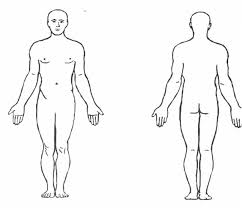
Anatomical Position 
a)
Posterior
b)
Anterior
c)
Inferior
d)
Superior
26.
Anatomical Position 
a)
Posterior
b)
Medial
c)
Proximal
d)
Anterior
27.
Anatomical Position 
a)
Inferior
b)
Proximal
c)
Superior
d)
Superficial
28.
Anatomical Position 
a)
Inferior
b)
Proximal
c)
Superior
d)
Superficial
29.
Anatomical Position 
a)
Deep
b)
Medial
c)
Lateral
d)
Distal
30.
Anatomical Position 
a)
Deep
b)
Medial
c)
Lateral
d)
Distal
31.
Anatomical Position 
a)
Deep
b)
Medial
c)
Lateral
d)
Distal
32.
Anatomical Position 
a)
Prone
b)
Lateral
c)
Supine
d)
Proximal
33.
Anatomical Position 
a)
Prone
b)
Lateral
c)
Distal
d)
Proximal
34.

Which anatomical plane is the ONLY horizontal plane (separating superior from inferior)?

a)

sagittal

b)

transverse

c)

frontal

35.

Which anatomical plane divides the body into equal right and left sides?

a)

Transverse

b)

Horizontal

c)

Sagittal

36.

Which anatomical plane divides the body into front and back

a)

frontal/coronal

b)

transverse/horizontal

c)

sagittal plane

d)

none of the above

37.
Superficial (external)
a)
away from the body surface; more internal
b)
toward or at the body surface
c)
divides the body into right and left parts
d)
cuts made diagonally
38.
If you were using anatomical terms to describe a location on the femur (thigh bone), you should use 
a)
Cranial and caudal
b)
Proximal and distal
c)
Inferior and superior
39.
The bone is _____ to the skin.
a)
inferior
b)
superficial
c)
deep
d)
posterior
40.
The knee is _______ to the ankle.
a)
proximal
b)
lateral
c)
distal
d)
medial
41.
Body is standing straight, facing forward, upper limbs at side and palms facing forward. 
*right and left refer to "right" and "left" of the body in position.
a)
Sagittal
b)
Anatomical Position
c)
Anterior Position
d)
Anatomical Plane
42.

This term refers to the arm

a)

Brachial

b)

Carpal

c)

Clavicular

d)

Bilateral

43.

This term refers to the stomach region

a)

acromial

b)

abdominal

c)

ocular

d)

thoracic

44.

This term refers to the eyes

a)

cranial

b)

cervical

c)

clavicular

d)

ocular

45.

This term refers to the neck region

a)

geniculate

b)

carpal

c)

cervical

d)

unilateral

46.

This term refers to the wrist

a)

palmar

b)

carpal

c)

brachial

d)

cubital

47.

This term pertains to the sole of the foot

a)

plantar

b)

pubic

c)

femoral

d)

unilateral

48.

This term refers to the thigh region

a)

pelvic

b)

pubic

c)

plantar

d)

femoral

49.
Front of the knee
a)
Popiteal
b)
Patellar
c)
Plantar
d)
Cervical
50.
Heel Area
a)
Plantar
b)
Popiteal
c)
Patellar
d)
Calcaneal
51.
Head Region
a)
Acrominal
b)
Cephalic
c)
Cervical
d)
Occipital
52.
Area behind the knee
a)
Patellar
b)
Popiteal
c)
Cephalic
d)
Cervical
53.
Point of the shoulder
a)
Cephalic
b)
Calcaneal
c)
Deltoid
d)
Acrominal
54.
Lower posterior region of the head
a)
Cervical
b)
Occipital
c)
Popiteal
d)
Cephalic
55.
Ankle Area
a)
Plantar
b)
Tarsal
c)
Patellar
d)
Calcaneal
56.
Armpit
a)
Brachial
b)
Axillary
c)
Deltoid
d)
Acromila
57.
a)
Cephalic
b)
Oral
c)
Popiteal
d)
Axillary
58.

Thumb

a)

Carpal

b)

Pollex

c)

Digital

d)

Brachial

59.
The ___ separates the two sections of the ventral cavity
a)
heart
b)
lungs
c)
spleen
d)
diaphragm
60.
The uterus can be found in this cavity
a)
thoracic
b)
pleural
c)
pelvic
d)
mediastinum
61.
The lungs are located within this cavity
a)
pleural
b)
mediastinum
c)
brachial
d)
pelvic
62.
The brain is located in the 
a)
vertebral canal
b)
cranial cavity
c)
mediastinum
d)
umbilical region
63.
The __ contains the trachea, esophagus, and large blood vessels such as the aorta
a)
cranial
b)
abdominopelvic
c)
dorsal
d)
thoracic
64.

What abdominal region is #1?

a)

Right Hypochondriac Region

b)

Left Hypochondriac Region

c)

Right Lumbar Region

d)

Right Lumbar Region

65.

What abdominal region is #6?

a)

Hypogastric

b)

Right Inguinal

c)

Left Lumbar

d)

Umbilical

66.

What abdominal region is #2?

a)

Hypogastric

b)

Right Inguinal

c)

Epigastric

d)

Umbilical

67.

What abdominal region is #4?

a)

Right Lumbar

b)

Left Hypochondriac Region

c)

Epigastric

d)

Umbilical

68.

What abdominal region is #5?

a)

Right Lumbar

b)

Left Hypochondriac Region

c)

Epigastric

d)

Umbilical

69.

What abdominal region is #7?

a)

Right Inguinal

b)

Left Hypochondriac Region

c)

Epigastric

d)

Left Inguinal

70.

What abdominal region is #8?

a)

Right Inguinal

b)

Left Hypochondriac Region

c)

Epigastric

d)

Hypogastric

71.

What is a?

a)

Right Upper Quadrant

b)

Left Upper Quadrant

c)

Right Lower Quadrant

d)

Left Lower Quadrant

72.

What is d ?

a)

Right Upper Quadrant

b)

Left Upper Quadrant

c)

Right Lower Quadrant

d)

Left Lower Quadrant