wayground logo

Free Printable Worksheets

Font size

S
M
L
XL
Worksheets

Re-intro to science Quiz!

Total questions: 70

Worksheet time: 58mins

Name
Class
Date
1.
What is at the center of the Solar System?
a)
Earth
b)
Moon
c)
Sun
d)
Jupiter
2.
When the Earth travels all the way around the Sun, it is called a . . .
a)
Day
b)
Rotation
c)
Year
d)
Spin
3.
What is the phase of this moon?
a)
Third Quarter
b)
Waning Crescent
c)
First Quarter
d)
Waning Gibbous
4.

When the Earth rotates around its own axis one whole time, it is called a ....

a)

Year

b)

Day

c)

Hemisphere

d)

Seasons

5.
At position A, which hemisphere would have summer?
a)
Northern hemisphere
b)
Southern hemisphere
6.
What happens when the area in which you live tilts away from the sun?
a)
It is summer.
b)
It is spring.
c)
It is winter.
d)
It is fall.
7.
A full revolution of the Earth around the sun takes 365.25 days.  What happens every 4 years to make up for the .25 day?
a)
new year
b)
leap year
c)
solstice
d)
eclipse
8.
When is ovulation most likely to occur?
a)
About halfway between the start of one menstruation and the next
b)
At the start of menstruation
c)
1-5 days before the start of menstruation
d)
5-10 days after the start of menstruation
9.

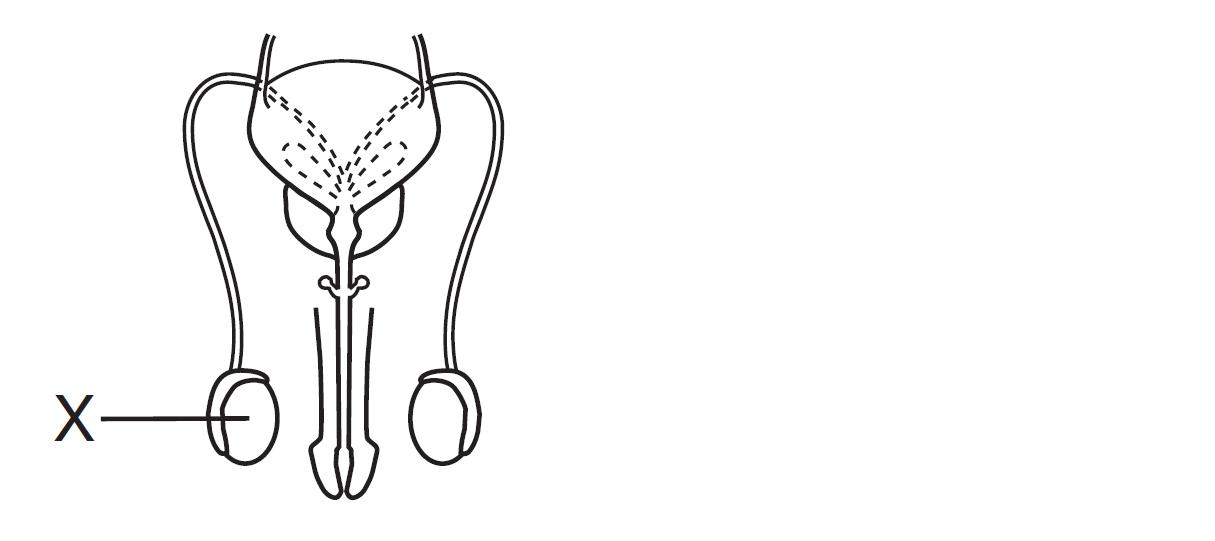
The diagram below represents a system in the human body. The function of structure X is to _____________

a)

produce energy needed for sperm to move

b)

provide food for the sperm to carry to the egg

c)

produce and store urine

d)

produce sperms and male sex hormones

10.

What is Birth Control?

a)

Pills that prevent STD

b)

A method of preventing pregnancy

c)

Sexually Transmitted Disease

d)

Getting impregnated

11.

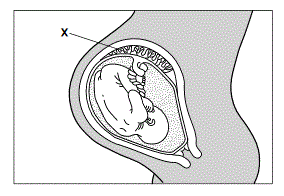
Which statement best describes an important

process carried out by structure X (placenta)

a)

Milk passes from the mother to the fetus

b)

Material are exchanged between fetal and maternal blood.

c)

Maternal blood is converted into fetal blood

d)

Oxygen diffuses from fetal blood to maternal blood.

12.

Which color on the image of the periodic table corresponds with the halogens.

a)

red

b)

black

c)

blue

d)

orange

13.

Vertical columns on the periodic table are called ___?

a)

groups

b)

periods

c)

rows

d)

families

14.

Horizontal rows on the periodic table are called ___?

a)

groups

b)

periods

c)

rows

d)

families

15.

The periodic table is mostly comprised of what type of element?

a)

Metals

b)

Nonmetals

c)

Metalloids

16.
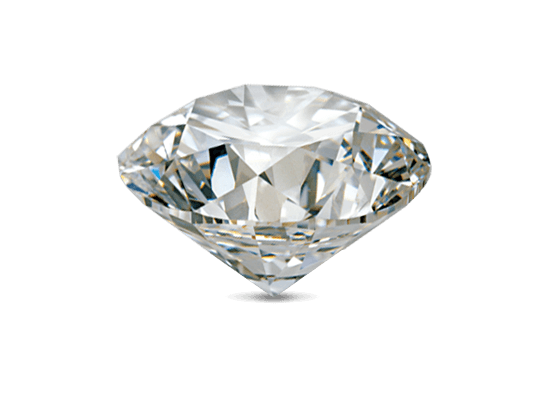
What element primarily makes a diamond?
a)
Hydrogen
b)
Silver
c)
Carbon
d)
Calcium
17.
What is the symbol for Potassium?
a)
P
b)
K
c)
Pb
d)
Pd
18.
What two elements come together to make this substance in the picture?
a)
Oxygen and Carbon
b)
Sodium and Calcium
c)
Sodium and Chlorine
d)
Helium and Nitrogen
19.
___________ is the only metal that is a liquid at room temperature.
a)
Platinum
b)
Water
c)
Tin
d)
Mercury
20.
What is this tool to get volume?
a)
triple beam balance
b)
ruler
c)
thermometer
d)
graduate cylinder
21.
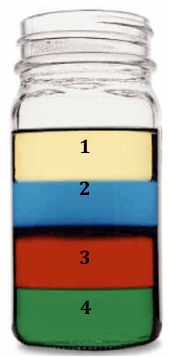
Put the liquids in order from most dense to least dense?
a)
4, 3, 2, 1
b)
1, 2, 3, 4
c)
3, 4, 2, 1, 
d)
4, 3, 1, 2
22.
Why does ice float?
a)
Liquid water is less dense than solid water.
b)
Solid water is less dense than liquid water.
c)
Gaseous water is less dense than solid water.
d)
Liquid water is less dense than gaseous water.
23.
What do we know about the density of lamp oil, rubbing alcohol, and vegetable oil?  
a)
The density is greater than 1.0 g/mL
b)
The density is less than 1.0 g/mL
c)
The density is equal to 1.0 g/mL
d)
The density can not be determined
24.
Jack has a rock. The rock has a mass of 14 g and a volume of 2 cm3. What is the density of the rock?
a)
7 mL
b)
7 g/cm3
c)
28 g/cm3
d)
1/7 g/cm3
25.
Which substance is the MOST dense?  ** Use the key
a)
A
b)
B
c)
C
d)
Cannot be determined by the data provided.
26.
Where are Asteroids found in the Solar System?
a)
Between Earth and Mars
b)
In the Oort Cloud beyond Neptune
c)
In the Asteroid Belt between Mars and Jupiter
d)
Close to the Sun
27.
The orbit of comets is which shape?
a)
Circular
b)
Elliptical/Oval
c)
Comets do not orbit the Sun
28.
What are comets made of?
a)
Metals like iron and nickel
b)
Gas
c)
Hydrogen Gas
d)
Ice and rock
29.
In the diagram, A and C refer to which part of a comet?
a)
Nucleus
b)
Tail
c)
Coma
30.
In the diagram, a comet's tail always points where?
a)
Towards the Sun
b)
Away from the Sun
c)
Towards Earth
d)
Away from Earth
31.
Meteorites...
a)
 hit the ground
b)
burn up completely in the atmosphere
c)
debris from asteroids/comets that float around in space
32.

A substance that is 3 on the pH scale would be a(n):

a)

acid

b)

base

c)

neutral

d)

solute

33.
Which one of the following is an example of a base?
a)
orange juice
b)
dish soap
c)
vinegar
d)
lemons
34.
A substance that changes color when mixed with an acid or base is a(n) ___.
a)
indicator
b)
neutralizer
c)
corrosive
d)
electricity
35.
Since some acids seemingly "eat away" certain substances, acids are ____.
a)
bitter
b)
sliipery
c)
corrosive
d)
weak
36.
What color does litmus paper turn in the presence of an acid?
a)
blue
b)
black
c)
green
d)
red
37.

According to the pH scale, which item is more acidic than lemons?

a)

battery

b)

vinegar

c)

milk

d)

blood

38.

According to the pH scale, which item is a stronger base than soap?

a)

baking soda

b)

ammonia solution

c)

tomato

d)

bleach

39.

What is the definition of the phenotype?

a)

The physical traits of an organism

b)

The genetic makeup of an organism

c)

The letters eg, Aa

d)

How the genotype is expressed.

40.

Which answer includes the dominant homozygous genotype?

a)

AA

b)

Aa

c)

aa

41.

Which answer contains the heterozygous genotype?

a)

AA

b)

aa

c)

Aa

42.
An allele whose trait only shows up when no dominant allele is present.
a)
hidden allele
b)
dominant allele
c)
recessive allele
d)
present allele
43.

What is the definition of a genotype?

a)

The genetic makeup of an organism

b)

The physical traits of an organism.

c)

When one allele is dominant and one allele is recessive.

d)

When both alleles are dominant.

44.
What are small stretches of DNA that code for traits
a)
Nucleus
b)
Chromosomes
c)
Gene
d)
Centromeres
45.
Chromosomes are found in the ____________ of the cell
a)
Chloroplast
b)
Nucleus
c)
Cytoplasm
d)
Mitochondria
46.
Which of the following is a term for a group of similar organisms that can reproduce fertile offspring?
a)
individual
b)
population
c)
species
d)
fossil
47.
Mutations are important because they bring about
a)
death of the organism in which they develop
b)
genetic variation needed for a population to evolve
c)
benefits for the individual, not for the population
d)
Hardey-Weinberg equilibrium within a population
48.
Finches on the Galapagos Islands had different beaks in order to help them do what?
a)
Build nests
b)
Fight off predators
c)
Collect food sources
d)
Compete with rivals
49.
This scientist came up with the idea of natural selection.
a)
Jean Baptiste Lamarck
b)
Gregor Mendel
c)
Charles Darwin
d)
Thomas Malthus
50.
Inherited trait that helps an organism survive is a(n) __________.
a)
Fossil
b)
Adaptation
c)
Ancestor
d)
Natural selection
51.
Why are advantageous traits more likely to be passed onto offspring?
a)
Because they are more likely to survive and reproduce.
b)
Because they come from dominant alleles.
c)
Because they come from recessive alleles.
d)
Because the trait is an acquired phenotype.
52.
Which of these is a property of metals?
a)
It's malleable
b)
It can't conduct electricity
c)
They are used in food
d)
It's very brittle
53.

A metal high in the reactivity series.....

a)

Forms unstable compounds.

b)

Can be obtained by the reduction of the ore with the carbon.

c)

Readily gains electrons.

d)

Burns to form basic oxides.

e)

Reacts readily with cold water to form Hydrogen.

54.

Which of the following is true of all metals?

a)

They react with acids to form Hydrogen

b)

They are denser than water

c)

They conduct electricity

d)

They're silver in colour.

55.
If a student observes a silvery solid that is malleable, good conductor, and ductile it is a...
a)
nonmetal 
b)
metal 
c)
metalloid
56.

Which of these elements are a Non-Metal?

a)

Copper

b)

Gold

c)

Oxygen

57.
What is an organism that needs to feed on other organisms called?
a)
Consumer
b)
Producer
c)
Autotroph
d)
Photosynthetic
58.
What is this type of diagram called?
a)
Food chain
b)
Consumer report
c)
Food web
59.
What type of consumer would the titmouse be?
a)
Carnivore
b)
Herbivore
c)
Omnivore
d)
Detritivore
60.
A place where an organism lives.
a)
Terrain
b)
Habitat
c)
Community
d)
Population
61.
What does every food chain start with? (Even if it's not drawn or written there!)
a)
producers
b)
sun
c)
consumer
d)
decomposers
62.
What is a decomposer?
a)
Life
b)
Organisms that decompose plants
c)
Organisms that eat dead stuff
d)
Organisms that break down dead and/or decaying organisms
63.
The non-living part of an ecosystem
a)
Ocean
b)
Biotic
c)
Algae
d)
Abiotic
64.
______________ occurs when more than one individual or population tries to use the same limited resource.
a)
Niche
b)
Predator-prey
c)
Availability
d)
Competition
65.

A bee gets food from a flower, whilst this helps with pollination. This is an example of

a)

Interdependence

b)

community

c)

competition

d)

adaptation

66.
What is an adaptation?
a)
A feature or behavior that helps an animal survive.
b)
The food that an animal eats.
c)
How energy moves in a food web.
d)
How animals evolve throughout time.
67.
These can only be separated by chemical means. 
a)
element 
b)
compound 
c)
mixture 
d)
stuff 
68.
These contain only one kind of atom. 
a)
element 
b)
compound 
c)
mixture 
d)
water 
69.
The air is a _________. 
a)
element 
b)
mixture 
c)
compound 
d)
energy 
70.
The things in a mixture always retain their........
a)
smell properties 
b)
physical and chemical properties 
c)
shape 
d)
color