Wayground logo

Free Printable Worksheets

Font size

S
M
L
XL
Worksheets

KS3 Rotation 1 Revision

Total questions: 71

Worksheet time: 47mins

Name
Class
Date
1.

What is the control centre of the cell called?

a)

Nucleus

b)

Cell membrane

c)

Cytoplasm

d)

Mitochondria

2.

What is the role of the cell membrane?

a)

Site of respiration

b)

Is the control centre of the cell.

c)

Allows substances to enter and leave the cell.

d)

Gives the cell structural support.

3.

What is jelly like substance where cell reactions take place?

a)

mitochondria

b)

cell membrane

c)

cytoplasm

d)

vacuole

4.

Which cell organelles are ONLY found in PLANT cells.

a)

nucleus, cytoplasm, cell membrane

b)

cell membrane, chloroplasts, large vacuole

c)

cell wall, mitochondria, large vacuole.

d)

cell wall, chloroplasts, large vacuole.

5.

What is chlorophyll?

a)

It is another name for the chloroplast.

b)

The green pigment found in chloroplasts that absorbs light.

c)

The green pigment found in mitochondria that absorbs light.

d)

A pathogen

6.

What type of cell is this?

a)

Animal cell

b)

Plant Cell

7.

Which letter on the diagram represents the nucleus?

a)

C

b)

D

c)

E

d)

F

8.

Which letter shows the site of photosynthesis?

a)

B

b)

C

c)

D

d)

F

9.

Which letters represent organelles found in both plant AND animal cells?

a)

A, E, F

b)

B, E, F

c)

B, F, D

d)

A, C, D

10.

Which letter represents the cytoplasm?

a)

E

b)

F

c)

G

d)

D

11.

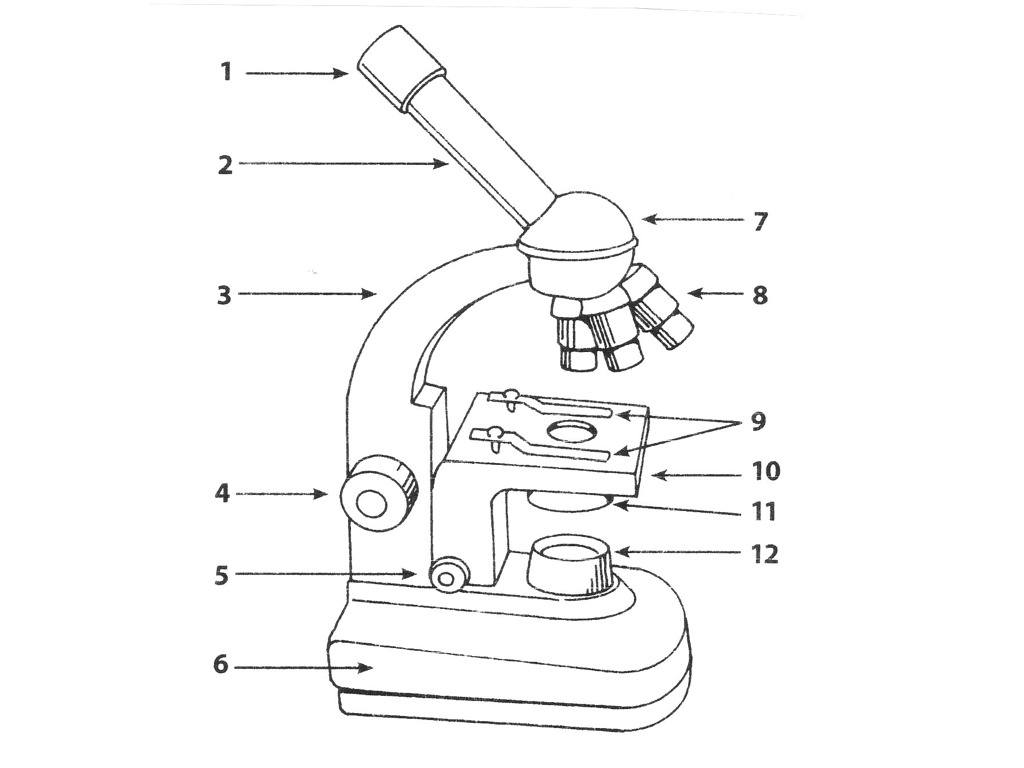
What is the name of this part?

a)

base

b)

leg

c)

arm

d)

eyepiece

12.

What is the name of this part?

a)

base

b)

leg

c)

arm

d)

eyepiece

13.

What is the name of this part?

a)

stageclips

b)

leg

c)

body tube

d)

coarse adjustment knob

14.

What is the name of this part?

a)

objective lens

b)

eyepiece/ocular lens

c)

diaphragm

d)

slide

15.

What is the name of this part?

a)

fine adjustment knob

b)

eyepiece/ocular lens

c)

stage

d)

body tube

16.

What is the name of this part?

a)

lamp

b)

eyepiece/ocular lens

c)

leg

d)

objective lens

17.

What is the name of this part?

a)

arm

b)

eyepiece/ocular lens

c)

nosepiece

d)

objective lens

18.

What is the name of this part?

a)

stageclips

b)

stage

c)

nosepiece

d)

slide

19.

What is the name of this part?

a)

stageclips

b)

stage

c)

nosepiece

d)

slide

20.
A microscope is an instrument that.
a)
makes faraway objects look closer.
b)
makes small objects appear larger.
c)
decreases the size of small objects.
d)
increases the size of small objects.
21.

____________________________________: magnifies the image by 10x. This is where you put your eyes.

a)

eye piece

b)

stage

c)

fine adjustment knob

d)

objective lens

e)

slide clip

22.

____________________________________: Three separate lenses to magnify the image (4X, 10X, and 40X). The one in use is the one above the object being viewed.

a)

objective lens

b)

eye piece

c)

stage

d)

slide clip

e)

coarse adjustment knob

23.
What is the smallest unit that can carry on all functions of life?
a)
cells 
b)
elements
c)
atoms
d)
organelles
24.
Which statement would help determine if a cell is a plant or animal cell?
a)
If the cell has a cell wall, it can be an animal cell.
b)
If the cell has a nucleus, then it can only be an animal cell. 
c)
If the cell has a cell wall, it can be a plant cell.
d)
If the cell has a nucleus, then it can only be a plant cell.
25.

What do animal and plant cells have in common?

a)

Both have central vacuoles,cytoplasm and nucleus.

b)

Both have chloroplasts,cytoplasm and nucleus.

c)

Both have cell membranes, cytoplasm and nucleus.

d)

Both have cell walls, cytoplasm and nucleus.

26.
What structures distinguish a plant cell from an animal cell?
a)
Plant cells have cell walls and ribosomes.
b)
Plant cells have cell walls and chloroplasts.
c)
Plant cells have chloroplasts and ribosomes.
d)
Plant cells have chloroplasts and mitochondria.
27.

What is the name of the green subtance that capture light in plant cell?

a)

Nucleus

b)

Chlorophyll

c)

Membrane

d)

Organelles

28.

A group of cells forms...

a)

Multicellular organism

b)

Organs

c)

Systems

d)

Tissues

29.

A very easy one... check the true statement. look at the picture and put in order

a)

Cell, tissue, organ, organ system,organism

b)

Cell, organ, system, organism, organ system

c)

Cell, tissue, organism, organ, system

d)

Cell, tissue, organism, system, organ

30.

Letter B is which organelle?

a)

Nucleus

b)

Cytoplasm

c)

Vacuole

d)

Mitochondria

31.

Reorder the following (smallest to biggest)

a)

Cell

b)

Tissue

c)

Organ

d)

Organ System

e)

Organism

1)
2)
3)
4)
5)
32.

What organelles are in plant cells only (tick all correct answers)

a)

Cell Wall

b)

Cell Membrane

c)

Nucleus

d)

Permanent Vacuole

e)

Chloroplasts

33.

Match the following

a)
1.

Sperm Cell

b)
2.

Muscle Cell

c)
3.

Root Hair Cell

d)
4.

Palisade Cell

e)
5.

Ciliated Cell

34.

Match the following cells to their adaptations

a)
1.

Has a streamlined shape

b)
2.

Contains lots of mitochondria for contracting

c)
3.

Has a large surface area

d)
4.

Contains lots of chloroplasts

e)
5.

Has hairs for moving mucus

35.

Match the following cells to their functions

a)
1.

Swims towards an egg cell

b)
2.

Contracts to move

c)
3.

Absorbs nutrients and water

d)
4.

Carries out photosynthesis

e)
5.

Removes mucus from airways

36.
Matter that has its own shape and takes up space.
a)
solid
b)
liquid
c)
gas
37.
Matter that always fills the shape in a container, such as air.
a)
solid
b)
liquid
c)
gas
38.
Molecules are closest together in a 
a)
Solid
b)
Liquid
c)
Gas
d)
plasma
39.
What term describes a liquid changing to a solid?
a)
Deposition
b)
Sublimation
c)
Evaporation
d)
Freezing
40.
At higher temperatures
a)
particles in an object have less energy
b)
particles in an object move faster
c)
a gas contracts
41.
A gas
a)
has a definite shape but no definite volume
b)
has a definite volume but no definite shape
c)
has fast-moving particles
42.
Boiling
a)
liquid to gas
b)
gas to solid
c)
gas to liquid
d)
solid to liquid
43.

___________ is anything that has mass and takes up space.

a)

Molecules

b)

Matter

c)

Volume

44.

________ is the amount of space an object takes up.

a)

Mass

b)

Matter

c)

Volume

45.

Which state of matter does not have a definite shape but does have a definite volume?

a)

Solid

b)

Liquid

c)

Gas

46.

What is the process called when a gas turns into a liquid?

a)

Condensation

b)

Melting

c)

Freezing

d)

Evaporation

47.

What is the process called when a solid changes to a liquid?

a)

Freezing

b)

Evaporation

c)

Melting

d)

Condensation

48.

What is the process called when a liquid changes into a gas?

a)

Freezing

b)

Evaporation

c)

Melting

d)

Condensation

49.

Match the following

a)

Solid to Liquid

1.

Melting

b)

Liquid to Gas

2.

Evaporating

c)

Solid to Gas

3.

Sublimation

d)

Gas to Liquid

4.

Condensing

e)

Liquid to Solid

5.

Freezing

50.
What is the formula for density?
a)
density = mass x volume
b)
density = mass / volume
c)
density = mass + volume
d)
density = mass - volume
51.
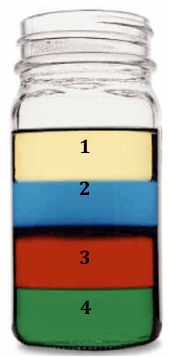
Put the liquids in order from most dense to least dense?
a)

4

b)

3

c)

2

d)

1

1)
2)
3)
4)
52.
Why does ice float?
a)
Liquid water is less dense than solid water.
b)
Solid water is less dense than liquid water.
c)
Gaseous water is less dense than solid water.
d)
Liquid water is less dense than gaseous water.
53.
What units are used to measure Density?
a)
cm3/g
b)
g
c)
g/cm3
d)
cm3
54.
Jack has a rock. The rock has a mass of 14g and a volume of 2cm3. What is the density of the rock?
a)
7 mL
b)
7 g/cm3
c)
28 g/cm3
d)
1/7 g/cm3
55.
Helium balloons rise on earth because
a)
helium is less dense than air
b)
helium is more dense than air
c)
helium is cooler than air
d)
helium is warmer than air
56.
A force can be described as ________
a)
A push or a pull.
b)
An up or a down.
c)
A left or a right.
d)
Movement.
57.
Which of these is not a contact force? 
a)
Tension
b)
Gravitational force
c)
Reaction force
d)
Friction
58.
Which one of the following statements is true?  
a)
Gravitational force only exists on Earth.
b)
Gravitational force can attract and repel.
c)
Gravitational force causes air resistance.
d)
Gravitational force is always attractive.
59.
In which situation is friction a useful force? 
a)
On a playground slide.
b)
In the moving parts of gears.
c)
Car tyres gripping the road.
d)
In a bicycle chain.
60.
What is a general name for a force that makes a vehicle move? 
a)
Thrust
b)
Friction
c)
Power
d)
Air resistance
61.
When a force can act without touching the object, what type of force is it?
a)
Friction
b)
Contact
c)
Non-contact
d)
Air resistance
62.
Which scientific instrument is used to measure forces? 
a)

Scale

b)

Newton meter

c)

Force device

d)

Top pan balance

63.
In which direction does air resistance always act? 
a)
Upwards
b)
Downwards
c)
Against the direction of movement.
d)
Behind boat sails.
64.
What is the size and direction of the normal reaction force which would balance a 50N dog? 
a)
5 kg upwards
b)
50 N upwards
c)
50 N downwards
d)
It is already balanced.
65.
For a boat to float, the upthrust and the weight must
a)
Be the same size in opposite directions.
b)
Both be upwards.
c)
Be identical.
d)
Add up to cause it to float.
66.

An apple has a mass of 0.2 kg. Calculate the weight of the apple on Earth (g = 10 N/kg).

(a)  

67.

What is the net force on the car?

a)

400 N forward (left)

b)

0 N (balanced forces)

c)

200 N forward (left)

d)

200 N backward (right)

68.

What will the net force on the soccer ball be?

a)

50 N to the left

b)

50 N to the right

c)

200 N to the left

d)

200 N to the right

69.

Person on the left = 45 N

Person on the right = 32 N

What is the net force?

a)

zero N

b)

10 N

c)

77 N

d)

13 N

70.
Are forces balanced or unbalanced when a marble speeds up rolling down a ramp?
a)
Balanced
b)
Unbalanced
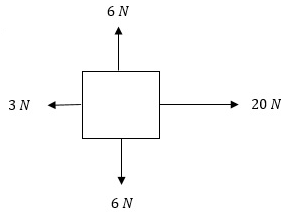
71.

What is the NET FORCE of this diagram?

a)

17 N, right

b)

17 N, left

c)

23 N, right

d)

12 N, up