
 Worksheets
Yr 12 - Biology - Changes in the genetic makeup of a pop
Total questions: 70
Worksheet time: 2hrs 20mins
A flash flood carried a raft of Amazon ants away from their original population. There is enough distance between the two groups, that they will never meet in nature again. What type of isolation is this?
Behavioral isolation
Temporal isolation
Geographic isolation
Which of the following is NOT true in the formation of a new species?
A mutation causes a population to breed with a different species.
Reproductive isolation can occur by the formation of a mountain range.
A population needs to become reproductively isolated.
An isolated population has adapted to new ecological niches eventually result in the inability to reproduce with the original population.

You are researching reptiles and encounter two garter snakes on a hike. Both snakes are brown and white, but their patterns are slightly different. You bring them back to the lab for further study. What is the BEST way to determine if these two are the same species?
Their appearance - if they look similar, they must be the same species
Their adaptations - if they have the same traits, they must be the same species
A breeding experiment - if they are able to produce offspring, they must be the same species
DNA testing - if their DNA/genes are the same, they must be the same species
Temporal isolation is different from behaviorial isolation because, temporal isolation means...
Organisms are not reproducing at the same time
Organisms are physically separated
Organisms are not attracted to the mates attraction signals

What type of isolation has occurred in the image?
Geographic isolation
Temporal isolation
Behavioral isolation

What type of isolation has occurred in the image?
Geographic isolation
Temporal isolation
Behavioral isolation

A population of fruit bats is active at night. Part of the population is most active from 8pm to midnight, and the rest of the bats eat from 1am to 5am. Eventually, the bats don't interact with each other at all. What type of isolation is this?
Behavioral isolation
Temporal isolation
Geographic isolation
Which are causes of speciation? Choose all that apply
Isolation caused by mountains, rivers and man-made structures
change in timing of mating
change in environment
different mating behaviors
when the organism develops different courtship rituals which do not attract main population this is a part of ____________ speciation.
Allopatric
Sympatric
Simple
Temporal
Orcas occur in the same habitat but some are avoiding each other and do not interbreed. They have different diets, vocal behavior, and social structures. What type of speciation is this?
Allopatric
Sympatric
Complex
Covergent
The emergence of a mountain range is an event that would lead to _______________ speciation
Allopatric
Sympatric
Temporal
Behavioral
A gene pool consists of
all of the genes, including all the different alleles, that are present in a population
some of the genes, including the different alleles, that are present in a population
all of the genes that are present in all populations
all of the genes, including all the different alleles, that are present in all populations
The number of times a particular allele appears in a gene pool is known as the
population of the allele
relative percentage of the allele
frequency of the allele
evolution of the allele
Evolution can be defined as a ____________
change in the frequency of an allele in a population over time
change in the frequency of reproduction in a population
change in the frequency of an allele in an individual
Why are advantageous traits more likely to be passed onto offspring?
Because the parents are more likely to survive and reproduce.
Because they come from dominant alleles.
Because they come from recessive alleles.
Because the trait is an acquired phenotype.

If a population experiences no migration, is very large, has no mutations, has random mating, and there is no selection, which of the following would you predict?
The population will evolve, but much more slowly than normal.
The makeup of the population's gene pool will remain virtually the same as long as these conditions hold.
The composition of the population's gene pool will change slowly in a predictable manner.
Dominant alleles in the population's gene pool will slowly increase in frequency while recessive alleles will decrease.


Darwin observed many finch species on the Galapagos Islands. To explain these observations, he
proposed that each species evolved from the same common ancestor, which was a finch species
that migrated to the islands from the mainland. What additional evidence did Darwin use to support
his explanation?
The finch populations were very numerous, and different species often bred with one another.
The finch species lived in different habitats on different islands, which isolated them from one another.
The finch species were distributed evenly among all of the islands, but did not interbreed.
The beaks of the finches were identical, allowing them to eat the same foods on any of the islands.

The graphs below show the changes in crab color at one beach.
Which of the following is most likely to have caused the change in the distribution?
A new predator arrived that preferred dark-tan crabs.
A new predator arrived that preferred light-tan crabs.
A change in beach color made medium-tan crabs the least visible to predators.
A change in beach color made medium-tan crabs the most visible to predators.
A population that is isolated in a remote environment is still able to experience genetic variation. How could genetic variation that contributes to evolution occur in such a population?
A mutation in a liver cell produces liver cancer.
Lateral gene transfer occurs that produces an organism that is less resistant to drought.
A mutation in an egg cell causes a change in DNA that produces an organism that is more sensitive to sunlight.
A mistake in DNA replication before meiosis produces an organism that is better able to outrun predators.

The figure shows how natural selection of a single-trait gene affects lizard survival.
Which of the following most likely causes the changes in allele distribution?
The allele for light gray coloration disappears from the population. This may be because light gray lizards are more visible to predators and therefore they might be less likely to survive and reproduce.
The allele for black coloration decreases fitness and becomes less common. This may be because black coloration keeps the lizards cool during hot summer temperatures.
Medium gray coloration in lizards appears to be a neutral mutant allele that allows the lizards to hide better from predators. This leads to increases in phenotype and allele frequency of gray coloration.
Because black and medium gray lizards are less visible to predators, these alleles are neutral to natural selection and therefore will not disappear from the population of lizards.
Grass plants in a population range in height from 6 cm to 25 cm. The short plants receive little sunlight, and the tall plants are eaten by grazing animals. Which statement best describes the effect of natural selection on the grasses?
Because average height grass plants are favored, stabilizing natural selection is occurring.
Because average height grass plants are favored, disruptive natural selection is occurring.
Because tall grass plants are favored by the animals that eat grass, directional selection is occurring.
Because short and tall grass plants are favored, normal natural selection is occurring.
Before the invention of the light bulb, Americans burned oil in lamps for light. Whale oil was popular bio-fuel for these
lamps. Ship crews would hunt whales for their oil. They searched for the largest whales they could find so that they could obtain as much whale oil as possible. How mighty decades of whale hunting possibly affect the natural selection of the species?
The whales lost their legs.
The whales became slower.
The whales became smaller.
The whales changed their calls.

What is the most likely explanation of the data shown below?
There has been a drought in the area that is affecting all life forms.
The population of natural predators of the moths has gotten smaller.
The moths are living in an environment with light trees.
The moths are living in an environment with dark trees.

The pair of population graphs below display the results of two different five-year hunting cycles, one on light trees and one on dark trees. The population of light-colored moths is shown by the light gray dots, and the population of dark moths is shown by the dark gray dots. How do these results demonstrate natural selection?
The moth populations shown here demonstrate random fluctuations over time that are not explained by tree color.
On light trees, individual moths tried to become lighter in color to match the tree background. On dark trees, individual moths tried to become darker in color.
The moths that were the same color as their background were more likely to survive and reproduce. Over time, the populations of these well-adapted moths increased.
Small particles of tree bark became embedded in the moth’s wings, causing the moths to become darker on the dark trees and lighter on the light trees. These acquired traits were then passed down to the next generation of moths, causing the populations to change color over time.
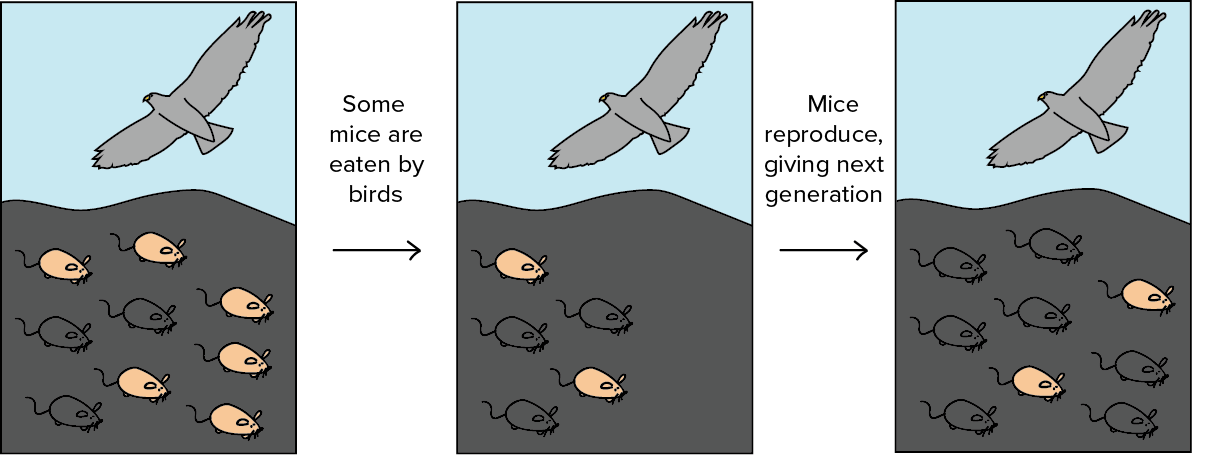


The primary difference natural and artificial selection is
In nature selection the “pressure” comes from the environment; In artificial selection the “pressure” comes from humans (or another species).
In artificial selection the “pressure” comes from the environment; In natural selection the “pressure” comes from humans (or another species).
Natural selections is when humans breed the animal; Artificial selection is when humans direct genes directly.
They are different terms for the same concept.
Artificial selection is also known as
natural selection
selective hearing
genetic manipulation
selective breeding

Define evolution in genetic terms.
any change in the frequency of alleles in populations of organisms from generation to generation.
any change in the frequency of alleles in an individual organism over it's lifespan.
any change in the frequency of alleles in communities of organisms from generation to generation.
any change in the frequency of alleles in an ecoystem of organisms from generation to generation.

The following is a similarity between artificial selection and natural selection
Takes hundreds of years
Humans determine traits
Nature determines traits
Offspring are produced
Artificial Selection decreases diversity which is bad because
organisms with same traits will refuse to reproduce with each other
organisms with all the same traits are susceptible to extinction.
organisms with the same traits will be very aggressive
organisms with same traits collectively get smarter and will some day rule the world


occur when a small sample of a population settles in a location separated from the rest of the population.
Genetic Drift
Founder Effect
Gene Flow
Bottleneck
any change in the allelic frequencies in a population due to change
Genetic Drift
Founder Effect
Gene Flow
Bottleneck
occurs when a population declines to a very low number and then rebounds
Genetic Drift
Founder Effect
Gene Flow
Bottleneck
cause a change in the allelic frequency by literally changing the genotype of the individual.
Mutation
Founder Effect
Nonrandom mating
Bottleneck
Which graph displays directional selection?


Which graph displays stabilizing selection?
is the inability of a species to mate with a related species.
reproductive isolation
prezygotic isolation
postzygotic isolation
isolation that operates before fertilization occur
reproductive isolation
prezygotic isolation
postzygotic isolation
isolation that operates after fertilization has occurred to ensure that the resulting hybrid remains infertile
reproductive isolation
prezygotic isolation
postzygotic isolation

Which of the following is an example of the bottleneck effect?
Cheetah populations reach their lowest levels with reduced diversity and as they rebound are so genetically similar they appear to be inbred.
Affected individuals with blue skin can trace their ancestry back to one of the first settlers in the region.
The environment of a fox population changes and over time foxes who are white survive and pass on their genes to their offspring.
Humans choose two dogs they like the characteristics of and breed them together.

A mutation is harmful to an organism if it
changes the phenotype of an organism
changes the DNA segment
reduces the organism's chance of survival
makes the organism better able to avoid predators
A mutation that is missing a nitrogen base is
deletion
substitution
addition
mixing
The mutated DNA segment is TTCGCAAG. This is an example of ___ mutation.
GAG-CTC-GAC-AGA
Mutant
GAG CTC-CAC-AGA
T-G-A-C-C-A
T-G-A-G-C-A

