

wayground logo

Free Printable Worksheets

Font size

S
M
L
XL
Worksheets

Cycling of Matter

Total questions: 23

Worksheet time: 12mins

Name
Class
Date
1.

The process in which water vapor is released into the air through the stoma on the leaves of plants is called __________.

a)

Evaporation

b)

Transpiration

c)

Precipitation

d)

Condensation

2.
The following are part of the carbon cycle EXCEPT _________.
a)
respiration
b)
precipitation
c)
decomposition
d)
photosynthesis
3.
Long-term process of the carbon cycle can form the following __________.
a)
limestone
b)
sandstone
c)
coquina
d)
basalt
4.
Bacteria in soil change __________ into ingredients plants can use.
a)
H2
b)
O2
c)
N2
d)
He2
5.
Plants rely heavily on ____ in the nitrogen cycle to incorporate nitrogen into organic compounds
a)
bacteria
b)
viruses
c)
fungi
d)
oxygen
6.

Green plants and algae make their own food through photosynthesis. What is photosynthesis?

a)

a cell process that uses energy from sunlight to convert water and oxygen into food

b)

a cell process that uses energy from sunlight to convert water and glucose into food

c)

a cell process that uses energy from sunlight to convert water and chlorophyll into food

d)

a cell process that uses energy from sunlight to convert water and carbon dioxide into food
7.

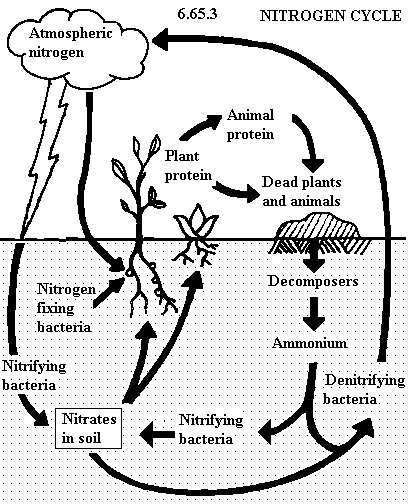
_______________________ converts nitrogen into a form that plants can absorb.

a)

Denitrifying bacteria

b)

Nitrogen fixing bacteria

c)

Decomposers

8.

How do animals obtain nitrogen stored in plants?

a)

Denitrifying bacteria

b)

Nitrogen fixing bacteria

c)

Directly from the atmosphere

d)

They eat the plants

9.

Which of the following cycles lacks a gas phase? This means that the element does not exist in a gas phase.

a)

carbon

b)

nitrogen

c)

phosphorous

d)

none of the above

10.

Where can you find carbon?

a)

Only in the Earth's atmosphere

b)

Inside all water molecules

c)

Inside the sun

d)

Inside every living thing on Earth

11.
Decomposition releases __________ into the soil
a)
hydrogen
b)
oxygen
c)
nitrogen
d)
helium
12.
When water moves downward through spaces in rock or soil it becomes __________.
a)
runoff
b)
a stream
c)
groundwater
d)
a lake
13.

What effect does the sun have on surface water?

a)

it causes it to boil

b)

it causes it to rain

c)

it causes it to sink

d)

it causes it to evaporate

14.

Which of the following most accurately describes the path of a nitrogen molecule through the environment?

a)

It moves through the environment once--going from gas, to solid, and back to gas

b)

It moves through the environment repeatedly, and always in the same order

c)

It moves through the environment repeatedly, but not necessarily in the same order

d)

It moves through the environment twice, then disappears

15.

How does carbon become locked inside the earth?

a)

Tree roots expel carbon into the soil as they grow

b)

Humans use machines to pump carbon dioxide into large underground tanks

c)

Rocks become richer in carbon as time goes on

d)

The carbon-rich bodies of plants and animals decay into the earth after they die

16.
Phosphorous is passed from plants to ____ who eat them
a)
plants
b)
animals
c)
scavengers
17.
Which of the following statements is true of the phosphorus cycle?
a)
Phosphorus enters the atmosphere as phosphates.
b)
The phosphorus cycle utilizes the processes of erosion, and weathering.
c)
Phosphates are used in carbohydrate and glucose storage.
d)
The phosphorus cycle utilizes bacteria to breakdown phosphates and make them available for plants.
18.
What role do decomposers play in the phosphorous cycle?
a)
absorb phosphorous 
b)
release phosphorous into atmosphere
c)
return phosphorous into the soil
d)
combustion
19.
When humans burn fossil fuels, most of the carbon quickly enters the                       as carbon dioxide.
a)
Water
b)
Atmosphere
c)
Sun
d)
Air
20.
How do living organisms return carbon to the atmosphere in the carbon cycle?
a)
respiration and photosynthesis
b)
 decomposition and respiration
21.
Organisms that play a role in the nitrogen cycle
a)
only plants
b)
only animals
c)
only bacteria
d)
plants, animals, & bacteria
22.
Plants and animals need nitrogen to make __________.
a)
Protein
b)
Carbohydrates
c)
Lipids
d)
Nucleic Acids
23.
When nitrogen gas is turned in to a form that plants and animals can use is called 
a)
Combustion
b)
Photosynthesis
c)
Decomposition
d)
Nitrogen Fixation