wayground logo

Free Printable Worksheets

Font size

S
M
L
XL
Worksheets

Unit One Review Game - The Nature of Science (Phys. Sci.)

Total questions: 74

Worksheet time: 5hrs 53mins

Name
Class
Date
1.

What is the outcome (DEPENDENT) variable?

a)

plant height

b)

time in days

c)

sunflower

d)

daisy

2.

Cindy placed three beehives with the same mass into separate (but identical) glass containers. Hive A was kept at 10 degrees Celsius (˚C), Hive B was kept at 29 ˚C, and Hive C was kept at 37 ˚C. For the next month she measured the amount of honey each hive produced. Hive B produced more than the other two hives.

What is the Manipulated (INDEPENDENT) variable in her experiment?

a)

The temperature of each hive

b)

The number of hives

c)

The mass of each hive

d)

The amount of honey produced

3.

What is the best definition of the term "theory", as it’s used in science?

a)

What is the best definition of the term "theory", as it’s used in science?

b)

It is well tested set of ideas that explains events that occur in nature.

c)

A theory is based on laws that can be proven true.

d)

It is a hypothesis that has been confirmed

4.

What is the difference between a scientific theory and a scientific law?

a)

A theory is a well-tested range of representations and a law is a concrete physical representation.

b)

A theory is a well-tested range of observations of why something works and a law is a well-tested concrete explanation how things work

c)

A theory is a well-tested range of observations of how something works and a law is a well-tested concrete explanation of why things work

d)

A theory is a hypothesis that is yet to be proven false and a law is a hypothesis that will always be true.

5.

A scientific idea that cannot be tested is called?

a)

Science

b)

Conspiracy Theory

c)

Data

d)

Pseudoscience

e)

An opinion

6.

What is an observation?

a)

Something you measure or detect with your senses.

b)

The way you feel about something

c)

An educated guess

d)

A theory that has been disproved

7.

An inference is based on:

a)

both scientific observations and known facts

b)

known facts

c)

scientific observations

d)

a rumor you started in the bathroom

8.

What is the scientific method?

a)

A systematic procedure for how to conduct a scientific experiment

b)

The process of solving a problem

c)

A way of making non-scientific observations

d)

A way to summarize findings from multiple investigations

9.

What is a hypothesis?

a)

An educated prediction or answer to a testable question

b)

A random guess

c)

An observation based on feelings or emotions

d)
10.

What is the best way to collect and record data?

a)

In a data table

b)

On post-it notes

c)

On scrap paper

d)

interpretive dance

11.

An observation that is measurable and made with tools (such as a ruler or scale) is what type

a)

quantitative

b)

qualitative

c)

koalatative

12.

After the data is analyzed the hypothesis is stated as correct or incorrect in the __________

a)

conclusion

b)

experiment

c)

hypothesis

d)

table of contents

13.

What step does every scientific experiment begin with?

a)

hypothesis

b)

question/problem

c)

procedures

d)

conclusion

14.
The summary at the end of an experiment that explains the results. 
a)
conclusion
b)
procedures
c)
materials
d)
responding variable
15.
The information you record in an experiment is called your ____________.
a)
data
b)
conclusions
c)
notebook
d)
inquiry
16.
After a scientific experiment is performed, data is recorded, and conclusions are drawn, what should be done next?
a)
Share your research with other scientists
b)
Keep your research a secret
c)
Destroy all evidence of your experiment
17.

List the Scientific Process steps in order.

a)

Observation, Question, Hypothesis, Experiment, Data, Conclusion

b)

Conclusion, Observation, Experiment, Data, Hypothesis

c)

Observation, Experiment, Hypothesis, Conclusion, Data, Question

d)

None of the above

18.
Which is NOT a step in the scientific method?
a)
Make observation
b)
Form a theory
c)
Collect data
d)
Form a hypothesis
19.
Should experiments be repeated over and over to see if the results are the same each time?
a)
yes
b)
no
20.
This part of the experiment serves as a basis of comparison; the one variable being tested has been omitted. 
a)
experimental group
b)
control group
c)
data
d)
variables
21.
This variable in an experiment is the one being deliberately changed by the scientist. 
a)
dependent variable
b)
independent variable
c)
data
d)
control group
22.
An experiment is performed on plants to see how different liquids affect plant growth. Each plant in the experiment is given a different liquid; water, apple juice, or milk. Each plant has the same amount of soil, sunlight, and listens to the same music. In this investigation, the independent variable is ...
a)
The type of plant
b)
The amount of sunlight
c)
The type of music
d)
The type of liquid
23.
A student wants to test the effects of type of exercise on heart rate.  What is the dependent variable?
a)
heart rate
b)
type of exercise
c)
amount of exercise
d)
time of day exercise occurs
24.
On what axis should the independent variable always be?
a)
X
b)
Y
25.
An experiment is performed on plants to see how different liquids affect plant growth. Each plant in the experiment is given a different liquid; water, apple juice, or milk. Each plant has the same amount of soil, sunlight, and listens to the same music. In this investigation, what are the controlled variables?
a)
Type of plant, amount of music, and sunlight
b)
Water, apple juice, milk
c)
Plant growth
26.
Squidward found new reeds to tryout for his clarinet.  He used an APPLAUSOMETER to measure applause after playing  Under the Sea with each reed.  The results were put in the table.
What was controlled?
a)
The Song
b)
The Reed
c)
The Applause
27.
Squidward found new reeds to tryout for his clarinet.  He used an APPLAUSOMETER to measure applause after playing  Under the Sea with each reed.  The results were put in the table.
What was the independent variable?
a)
The Song
b)
The Reed
c)
The Applause
28.
Squidward found new reeds to tryout for his clarinet.  He used an APPLAUSOMETER to measure applause after playing  Under the Sea with each reed.  The results were put in the table.
What was the dependent variable?
a)
The Song
b)
The Reed
c)
The Applause
29.
A factor that is a quantity that can have more than one value is a
a)
model.
b)
constant.
c)
variable.
d)
method.
30.
It occurs when a scientist's expectations change how the results are viewed
a)
Scientific law
b)
Scientific theory
c)
Bias
d)
Model
31.
What is the main purpose of a line graph?
a)
to compare two things
b)
to show trends over time
c)
to have an independent variable
d)
so you don't have to read words
32.
What is the name of this graph?
a)
line plot
b)
line graph
c)
bar graph
d)
frequency table
33.
How many more students voted for Visit with friends than School Clubs and Watch TV combined?
a)
59
b)
32
c)
40
d)
50
34.
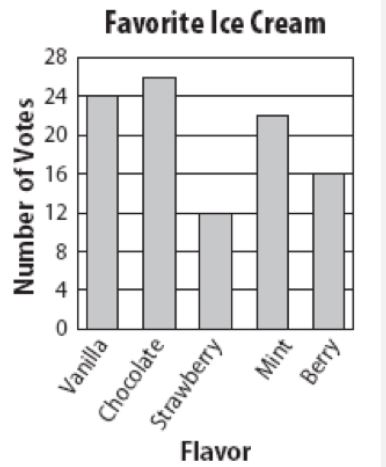
Which type of graph is this?
a)
Histogram
b)
Bar Graph
c)
Stem Plot
d)
Box Plot
35.
What type of graph is this?
a)
Bar graph
b)
Histogram
c)
Pie Chart
d)
Stem Chart
36.
How many kilograms of candy did Paige get?
a)
2
b)
8
c)
16
d)
32
37.
Which questions can be answered by this bar graph?
a)
Which sport did girls like to play?
b)
Where were the sports played?
c)
How many more students like basketball than softball?
d)
What are the other types of sports that students liked?
38.
How many pizzas were sold by Domiano’s Pizza and Little Secrets Pizza?
a)
160
b)
200
c)
20
d)
180
39.
How many total people took the survey?
a)
50
b)
150
c)
100
d)
200
40.
How many more students played soccer than football?
a)
3
b)
30
c)
6
d)
60
41.

Convert 6 m to cm

a)

60 cm

b)

600 cm

c)

6000 cm

d)

0.6 cm

42.

Convert 5.3 km to m

a)

53 m

b)

530 m

c)

5300 m

d)

53000 m

43.

Convert 0.84 m to cm

a)

0.084 cm

b)

0.0084 cm

c)

8.4 cm

d)

84 cm

44.

Convert 54,000 mm to km

a)

0.054 km

b)

0.54 km

c)

5.4 km

d)

54 km

45.

Convert 0.067 km to mm

a)

67 mm

b)

670 mm

c)

6700 mm

d)

67000 mm

46.

Convert 3000 g to kg

a)

0.3 kg

b)

3 kg

c)

30 kg

d)

300 kg

47.

Convert 3000 g to kg

a)

0.3 kg

b)

3 kg

c)

30 kg

d)

300 kg

48.

Convert 5 kg to g

a)

50 g

b)

500 g

c)

5000 g

d)

50000 g

49.

Convert 560 g to kg

a)

56 kg

b)

5.6 kg

c)

0.56 kg

d)

0.056 kg

50.

Convert 35,000 mg to kg

a)

0.035 kg

b)

0.35 kg

c)

3.5 kg

d)

35 kg

51.

Convert 9.48 kg to g

a)

94.8 g

b)

948 g

c)

9480 g

d)

94800 g

52.
When measuring the mass of an elephant it is best to use:
a)
g
b)
nL
c)
ng
d)
kg
53.
What are the three base units?
a)
mass,length,grams
b)
meters,length,grams
c)
measuring,liters,games
d)
meters,liters,grams
54.
Give the correct symbol:  meter
a)
m
b)
M
c)
mm
d)
MM
55.

What is the volume of liquid in the graduated cylinder?

a)

50 mL

b)

4.5 mL

c)

45 mL

d)

45 L

56.
Cam performs an experiment using the lab equipment shown.  What 2 properties is Cam MOST LIKELY measuring?
a)
mass and volume
b)
volume and temperature
c)
mass and temperature
d)
length and mass
57.
Which lists metric units, in order, from smallest to largest?
a)
milligram, centigram, gram
b)
kilogram, gram, centigram
c)
decagram, hectogram, milligram
d)
kilogram, hectogram, decagram
58.
What is the SI unit for temperature?
a)
Celsius
b)
Fahrenheit
c)
liter
d)
thermometer
59.
What does kilo mean?
a)
thousand
b)
hundred
c)
ten
d)
ten thousand
60.

What is volume?

a)

how heavy it is

b)

how much space it takes up

c)

how much matter is in the object

d)

the shape of the object

61.
What is this?
a)
Measuring tube
b)
Test tube
c)
Graduated Cylinder
d)
Pipette
62.

What units is volume measured in?

a)

grams

b)

degrees

c)

milliliters or cm3

d)

pounds

63.

What is the volume displacement of SpongeBob?

a)

1 mL

b)

2 mL

c)

3 mL

d)

4 mL

64.
What is the Volume Equation for this shape?
a)
V= (1/6)bhh
b)
V= lwh
c)
V= (1/2)bhh
d)
V= (1/3)lwh
65.
Frank has a paper clip. It has a mass of 9g and a volume of 3cm3. What is its density?
a)
3 g/cm3
b)
1/3 g/cm3
c)
27 g/cm3
d)
39 g/cm3
66.
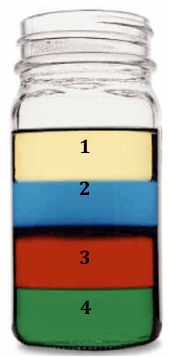
Put the liquids in order from most dense to least dense?
a)
4, 3, 2, 1
b)
1, 2, 3, 4
c)
3, 4, 2, 1, 
d)
4, 3, 1, 2
67.
An object with which of the following densities will float on water?
a)
0.7 g/cm3
b)
1.2 g/cm3
c)
3.5 g/cm3
d)
11.4 g/cm3
68.
A student knows the mass of an object. What other variable does the student need to know to calculate the object's density?
a)
Color
b)
Weight
c)
Volume
d)
Length
69.

What unit is volume measured in?

a)

grams

b)

degrees

c)

milliliters or cm3

d)

pounds

70.

Convert 35⁰F to Celsius (5/9 x (0F - 32))

a)

1.6⁰

b)

1.7⁰C

c)

2.0⁰

d)

16.6⁰C

71.

Convert 72⁰F to Celsius (5/9 x (0F - 32))

a)

2.2⁰C

b)

222⁰C

c)

22.2⁰C

d)

161.6⁰C

72.

Convert 30°C to Fahrenheit (1.8 x 0C) + 32

a)

860°F

b)

86°F

c)

63.8°F

d)

56°F

73.

Which of the follow represents a normal body temperature of 98.6°F in °Celsius? 5/9 x (0F - 32)

a)

37°C

b)

370°C

c)

72.5°C

d)

72.6°C

74.

100 Celsius is ? Kelvin (K = Celsius + 273)

a)

173 K

b)

373K

c)

273 K

d)

0 K