wayground logo

Free Printable Worksheets

Font size

S
M
L
XL
Worksheets

Let's Review: Unit 2

Total questions: 67

Worksheet time: 46mins

Name
Class
Date
1.

What methods can you use to measure the pH of a solution?

a)

Observing color or clarity

b)

Measuring mass or volume

c)

Using acid base-indicators or pH meters

d)

Measuring density or electrical conductivity

2.

A substance that is 3 on the pH scale would be a(n):

a)

acid

b)

base

c)

neutral

d)

solute

3.
What color does litmus paper turn in the presence of an acid?
a)
blue
b)
black
c)
green
d)
red
4.
Bases are located where on the pH scale?
a)
any number can be a base
b)
below 7
c)
above 7
d)
number 7 is a base
5.
Which of the following is NOT a characteristic of an acid?
a)
sour taste
b)
corrosive
c)
it feels slippery
d)
it can burn the skin
6.
A substance that is a 10 on the pH scale would be a(n) ____.
a)
acid
b)
neutral
c)
base
d)
indicator
7.
At what location on the pH scale can you find acids?
a)
number 7 on the pH scale is acidic
b)
below 7
c)
above 7
d)
you can find acids all throughout the scale
8.

A sour taste is a characteristic of:

a)

acids

b)

bases

c)

neutral

d)

pH scale

9.

pH is the measure of the concentration of ______.

a)

Acids

b)

H+ ion

c)

OH- ion

d)

Bases

10.

Stronger acids have a pH closer to...

a)

7

b)

0

c)

14

d)

9

11.

Weaker bases have a pH closer to...

a)

8

b)

0

c)

14

d)

4

12.

A pH level of 7 indicates

a)

acid

b)

base

c)

neutral

d)

none of the following

13.

The pH scale is a range from:

a)

1-7

b)

0-14

c)

1-5

d)

1-14

14.

Which of the following is an acid?

a)

soap

b)

baking soda

c)

orange juice

d)

pure water

15.

Which of the following is true about acids and bases?

a)

The lower the pH #, the stronger the acid

b)

the higher the pH #, the stronger the acid

c)

The lower the pH #, the more neutral the acid

d)

The higher the pH #, the weaker the base

16.

You test a solution with pH paper, and the paper turns blue. The solution is ______.

a)

neutral

b)

an acid

c)

a base

d)

an acid & a base

17.

If an acid is combined with a base of equal strength, the result will most likely be

a)

A neutral solution.

b)

Impossible to tell without testing the pH.

c)

A stronger acid.

d)

A stronger base.

18.
Enzymes are considered to be 
a)
Lipids
b)
Carbohydrate
c)
Protein
d)
Nucleic Acid
19.
What is the purpose  of an enzyme?
a)
give permission for the reaction
b)
raise activation energy
c)
speed up reactions
d)
control how many reactions occur
20.
Where do substrates bind on an enzyme?
a)
voltage-gated channels
b)
surface receptor
c)
calcium channels
d)
active site
21.
What is structure A?
a)
Substrate
b)
Active site
c)
Enzyme
d)
Products
22.
At 40 degrees Celsius, your biological enzymes will...
a)
Functional optimally
b)
Denature
c)
Wait until the temp. increases
d)
Wait until the temp. decreases
23.
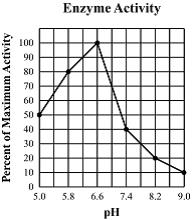
Which of the following conclusions can be drawn from this graph?
a)
The optimum pH of the enzyme is 6.6.
b)
The optimum pH of the enzyme is 5.8
c)
The enzyme’s activity increases as pH increases 5.0 to 9.0
d)
The enzyme’s activity is greater around pH of 8.0 .
24.
What makes an enzyme substrate specific?
a)
Size
b)
Shape
c)
Name
d)
Location it is found in
25.
The part of the enzyme that the substrate bonds to is called the _____.
a)
active site
b)
activation energy
c)
bond site
d)
peptide bond
26.
How do enzymes increase the speed of chemical reactions?
a)
reducing the number of products   
b)
reducing the activation energy
c)
increasing the temperature of the cell
d)
increasing the concentration of reactants 
27.
What is a substance called if it speeds up a chemical reaction?
a)
reusable
b)
catalyst
c)
specific
d)
fragile
28.
After the enzyme and substrate bind together and perform the reaction, what does the substrate become?
a)
a substrate
b)
an enzyme
c)
a product
d)
an active site
29.
can a change in pH alter the active site of an enzyme
a)
yes
b)
no
30.
Which of these is NOT true?
a)
Enzymes can denature (change shape) when the temperature gets too high.
b)
Enzymes can only be used once in a chemical reaction. 
c)
Extreme pH can denature enzymes.
d)
Enzymes speed up chemical reactions. 
31.
What happens when enzymes are heated to a high temperature?
a)
The enzymes die.
b)
The shapes of the enzyme are altered or denatured
c)
The enzymes' amino acid sequence changes.
d)
The enzymes remain the same
32.
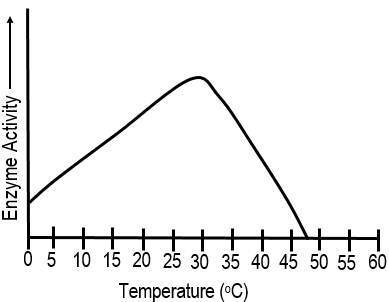
Based on the graph, what temperature does this enzyme work best? 
a)
15 C
b)
40 C
c)
30 C
d)
47 C
33.
What are the enzymes called when they are at low temperature? 
a)
denatured
b)
Killed
c)
inactive
d)
normal
34.
Letter D...
a)
active site
b)
enzyme
c)
substrate
d)
products
35.
Letter B...
a)
active site
b)
enzyme
c)
substrate
d)
products
36.
Letter C...
a)
active site
b)
enzymes
c)
substrate
d)
products
37.
Letter E...
a)
active site
b)
enzyme
c)
substrate
d)
products
38.

What is the function of an enzyme?

a)

Enzymes break themselves into small pieces

b)

They are catalysts that speed up chemical reactions

c)

They are catalysts that slow down chemical reactions

d)

Enzymes combine products to form reactants

39.

Which of the following factors affects enzyme activity?

a)

All of the above

b)

Concentration of the enzyme or substrate

c)

pH

d)

Temperature

40.

Lactase is an enzyme that breaks down lactose sugar. It normally operates in the human body in the stomach, which is acidic. A drug company wants to test a lactase enzyme medicine in the lab to make sure that it works and can be used to treat people with lactose intolerance. Which test conditions would produce the best lactase enzyme activity?

a)

In an ice bath with a pH of 7

b)

In warm water with a pH of 2

c)

In boiling water with a pH of 5

d)

In warm water with a pH of 9

41.

You stomach is a very acidic environment. At what pH would your stomach enzymes, that are built to work best in the stomach, have the highest activity?

a)

2

b)

10

c)

7

d)

14

42.

According to the Graph and the figure, if gastric enzymes in the stomach leak into the small intestine, will they still work to digest materials in the small intestine?

a)

Yes, because the pH increases when you move from the stomach to the intestine, which increases enzyme activity.

b)

Yes, because gastric enzymes work well at pH 8.

c)

No, because gastric enzymes denature in an acidic environment.

d)

No, because the pH increases when you move from the stomach to the intestine, which denatures the enzyme.

43.

Hyperthermia occurs when the body gets too hot. Which of the following explains why increasing temperature is dangerous for our bodies?

a)

Increasing temperature causes enzymes in our body to work too fast, so they break down things that they shouldn't.

b)

Increasing temperature causes enzymes in our body to unfold or denature, so they cannot speed up reactions that we need to survive.

44.
Proteins are made of monomers called ___________
a)
Nucleotides
b)
Monosaccharides
c)
Amino Acids
d)
Glycerol and fatty acids
45.
DNA and RNA are examples of 
a)
Carbohydrates
b)
Lipids
c)
Proteins
d)
Nucleic Acids
46.
Nucleotides are monomers of
a)
Carbohydrates
b)
Lipids
c)
Proteins
d)
Nucleic Acids
47.
Monosaccharides are monomers of
a)
Carbohydrates
b)
Lipids
c)
Proteins
d)
Nucleic Acids
48.
Waxes, oils and fats are examples of
a)
Carbohydrates
b)
Lipids
c)
Proteins
d)
Nucleic Acids
49.
What is the function of nucleic acids?
a)
store genetic information
b)
store energy (long-term)
c)
store energy (short-term)
d)
build skin, hair, nails, muscles
50.
Which macromolecule stores energy, insulates us, and makes up the cell membrane?
a)
lipids
b)
proteins
c)
carbohydrates
d)
nucleic acids
51.
Lipids can be digested into what smaller subunits?
a)
nucleic acids
b)
amino acids
c)
fatty acids
d)
glucose
52.
All polymers are made up of...
a)
monosaccharides
b)
monomers
c)
proteins
d)
None of these
53.

Enzymes belong to which class of macromolecules?

a)

lipids

b)

carbohydrates

c)

proteins

d)

nucleic acids

54.

All organic compounds contain the elements ______________ & _________________________.

a)

Carbon & Hydrogen

b)

Nitrogen & Carbon

c)

Phosphorus & Sulfur

d)

Sulfur & Sodium

55.
The three main parts of a nucleotide are the sugar, the phosphate group, and the _____________  base.
a)
carbon
b)
oxygen
c)
nitrogen
d)
hydrogen
56.
Glycerol and fatty acids combine to form...?
a)
Carbohydrates
b)
Lipids
c)
Proteins
d)
Nucleic Acids
57.
I am responsible for long term energy storage in mammals.
a)
Protein
b)
Lipid
c)
Carbohydrate
d)
Nucleic Acid
58.
The word saccharide means:
a)
sugar
b)
glucose
c)
sweetener
d)
carbohydrate
59.
The diagram shows the structure of an amino acid. Which type of molecule is formed from amino acids?
a)
lipids
b)
proteins
c)
carbohydrates
d)
nucleic acids
60.

True or False?

Macromolecules are tiny molecules that cells need.

a)

True

b)

False

61.

A lipid is a macromolecule that is used to...

a)

give cells/systems energy.

b)

build cell parts.

c)

give cells/systems long term energy storage.

d)

help cells with chemical processes.

62.

A carbohydrate is a macromolecule that is used to...

a)

give cells/systems energy.

b)

build cell parts.

c)

give cells/systems long term energy storage.

d)

help cells with chemical processes.

63.

Which Macromolecule is this?

a)

Protein

b)

Carbohydrate

c)

Lipid

d)

Nucleic Acid

64.

Which Macromolecule is this?

a)

Protein

b)

Lipids

c)

Carbohydrates

d)

Nucleic Acids

65.

Which Macromolecule is this?

a)

Proteins

b)

Lipids

c)

Carbohydrates

d)

Nucleic Acids

66.

Single units of macromolecules are referred to as:

a)

Monomers

b)

Polymerization

c)

Polymers

d)

Monosaccharides

67.

Many monomers strung together creates a _____________.

a)

Monochain

b)

Polymer

c)

Polysaccharride

d)

Product