
 Worksheets
VL7.8: HW 10.04
Total questions: 70
Worksheet time: 35mins
Name
Class
Date
1.

a)
Alkali
b)
Alkaline Earth
c)
Halogens
d)
Noble Gases
2.

a)
Alkali
b)
Alkaline Earth
c)
Halogen
d)
Noble Gases
3.

a)
Alkali
b)
Alkaline
c)
Halogen
d)
Noble Gases
4.

a)
Alkali
b)
Alkaline
c)
Halogen
d)
Noble Gases
5.

a)
Transition Metals
b)
Inner Transition Metals
c)
Metals
d)
Metalloids
6.

a)
Transition Metals
b)
Post Transition Metals
c)
Non Metals
d)
Metaloids
7.

a)
Transition Metals
b)
Post Transition Metals
c)
Non Metals
d)
Metaloids
8.
Who first created the periodic table?
a)
Henry Mosley
b)
Dmitri Mendeleev
c)
Alfred Wegener
9.
What is the Law of Conservation of Mass?
a)
It states that no matter can be created or destroyed.
b)
It states that no energy can be created or destroyed.
c)
It states that matter can be created or destroyed.
d)
It states that no sound can be created or destroyed.
10.
What is a coefficient?
a)
The small number on the right of the chemical symbol.
b)
The large number to the left of a formula.
11.

CARBON
a)
C
b)
Ca
c)
Cl
d)
Cu
12.

HELIUM
a)
H
b)
He
c)
Hl
d)
Hm
13.

HYDROGEN
a)
H
b)
He
c)
Hy
d)
Hd
14.

FLUORINE
a)
F
b)
Fl
c)
Fu
d)
Fe
15.

BORON
a)
B
b)
Be
c)
Bo
d)
Br
16.

NEON
a)
N
b)
Ne
c)
No
d)
Nn
17.

NITROGEN
a)
N
b)
Ne
c)
Ni
d)
Nt
18.

OXYGEN
a)
O
b)
Ox
c)
Oy
d)
Og
19.

BERYLLIUM
a)
B
b)
Bo
c)
Be
d)
Br
20.
LITHIUM
a)
L
b)
Li
c)
Lt
d)
Lh
21.
1 Proton
a)
H
b)
He
c)
Ho
d)
Hs
22.
2 Protons
a)
H
b)
He
c)
Ho
d)
Hs
23.
3 Protons
a)
Li
b)
He
c)
La
d)
Cs
24.
4 Protons
a)
Li
b)
He
c)
Be
d)
Ba
25.
5 Protons
a)
B
b)
He
c)
Be
d)
Ba
26.
6 Protons
a)
B
b)
C
c)
Ca
d)
Ba
27.
7 Protons
a)
N
b)
Ni
c)
Na
d)
Ba
28.
8 Protons
a)
N
b)
O
c)
S
d)
C
29.
9 Protons
a)
N
b)
O
c)
F
d)
C
30.
10 Protons
a)
Ne
b)
O
c)
F
d)
Ni
31.
compounds are chemically bounded together
a)
False
b)
true
c)
I don't know?
32.
Can an element be broken down into a simpler substance
a)
yes
b)
No
33.
Are there any compounds on the periodic table
a)
yes there are many
b)
no because only elements are on the periodic table
c)
I think they are?
34.
Which one has more than one type of atom in it
a)
Element
b)
Compound
35.
which one only has one type of atom In it.
a)
Element
b)
compound
36.
Is salt (NaCI) a compound or a element
a)
Compound
b)
element
37.
which one can be found on the periodic table
a)
Compound
b)
Element
38.
What cannot be broken down into other substances?
a)
Compound
b)
Mixture
c)
Solids
d)
Element
39.
Which of the following is not a compound?
a)
HCl
b)
Cl
c)
NaCl
d)
CO2
40.
A combination of substances that are not chemically combined is called a(n)____________.
a)
mixture
b)
compound
c)
physical
41.
Mixtures are separated through ___________changes.
a)
mixture
b)
compound
c)
physical
42.

This picture represents which of the following?
a)
element
b)
compound
c)
mixture
43.

This picture represents which of the following?
a)
element
b)
compound
c)
mixture
44.
Which of the following represents an element?
a)
H2O
b)
H2
c)
NaCl
d)
CaCO3
45.
Salt has a chemical formula of NaCl. Salt is a...
a)
Compound
b)
Element
c)
Mixture
d)
None of the Above
46.
An element is made up of only one kind of _____.
a)
isotope
b)
plastic
c)
atom
d)
metal
47.
_____ small particles that make up most types of matter on Earth.
a)
compounds
b)
atoms
c)
mixtures
d)
elements
48.
Jello is an example of a...
a)
Element
b)
Compound
c)
Mixture
49.
Glucose (C6H12O6) is an example of a...
a)
Element
b)
Compound
c)
Mixture
50.

How many atoms of Oxygen are in this compound?
a)
1
b)
2
c)
3
d)
4
51.
a)
Alkali
b)
Alkaline Earth
c)
Halogen
d)
Noble Gases
52.
a)
Alkali
b)
Alkaline Earth
c)
Halogens
d)
Noble Gases
53.
a)
Alkali
b)
Alkaline
c)
Halogen
d)
Noble Gases
54.
a)
Alkali
b)
Alkaline
c)
Halogen
d)
Noble Gases
55.
a)
Transition Metals
b)
Inner Transition Metals
c)
Metals
d)
Metalloids
56.
a)
Transition Metals
b)
Post Transition Metals
c)
Non Metals
d)
Metaloids
57.
a)
Transition Metals
b)
Post Transition Metals
c)
Non Metals
d)
Metalloids
58.
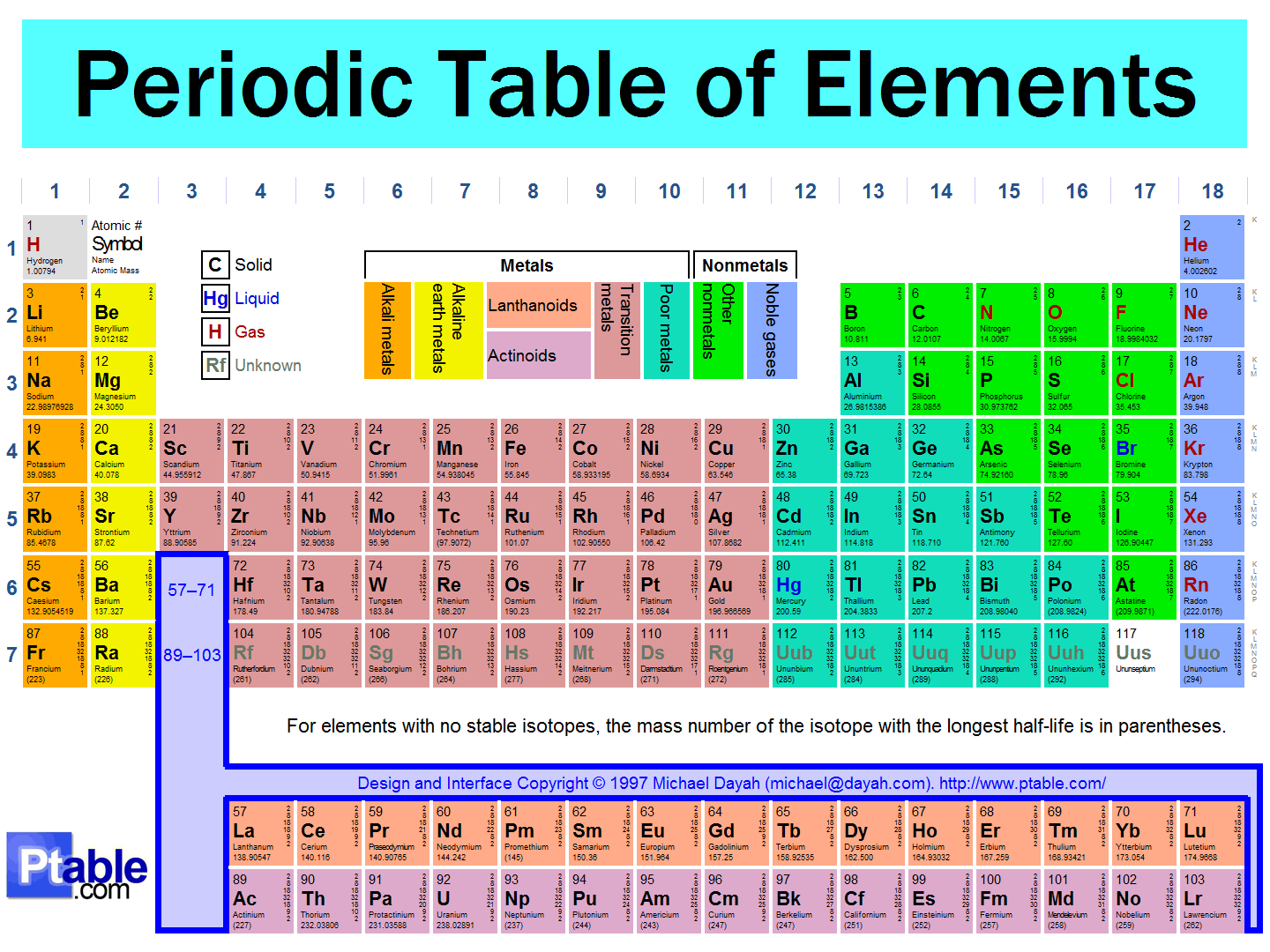
The horizontal row on the periodic table is called a
a)
group
b)
family
c)
period
d)
atomic number
59.

A vertical column is called...
a)
group
b)
tower
c)
period
d)
crew
60.

Most of the elements on the periodic table are classified as _____.
a)
Metals
b)
Nonmetals
c)
Metalloids
d)
Periods
61.
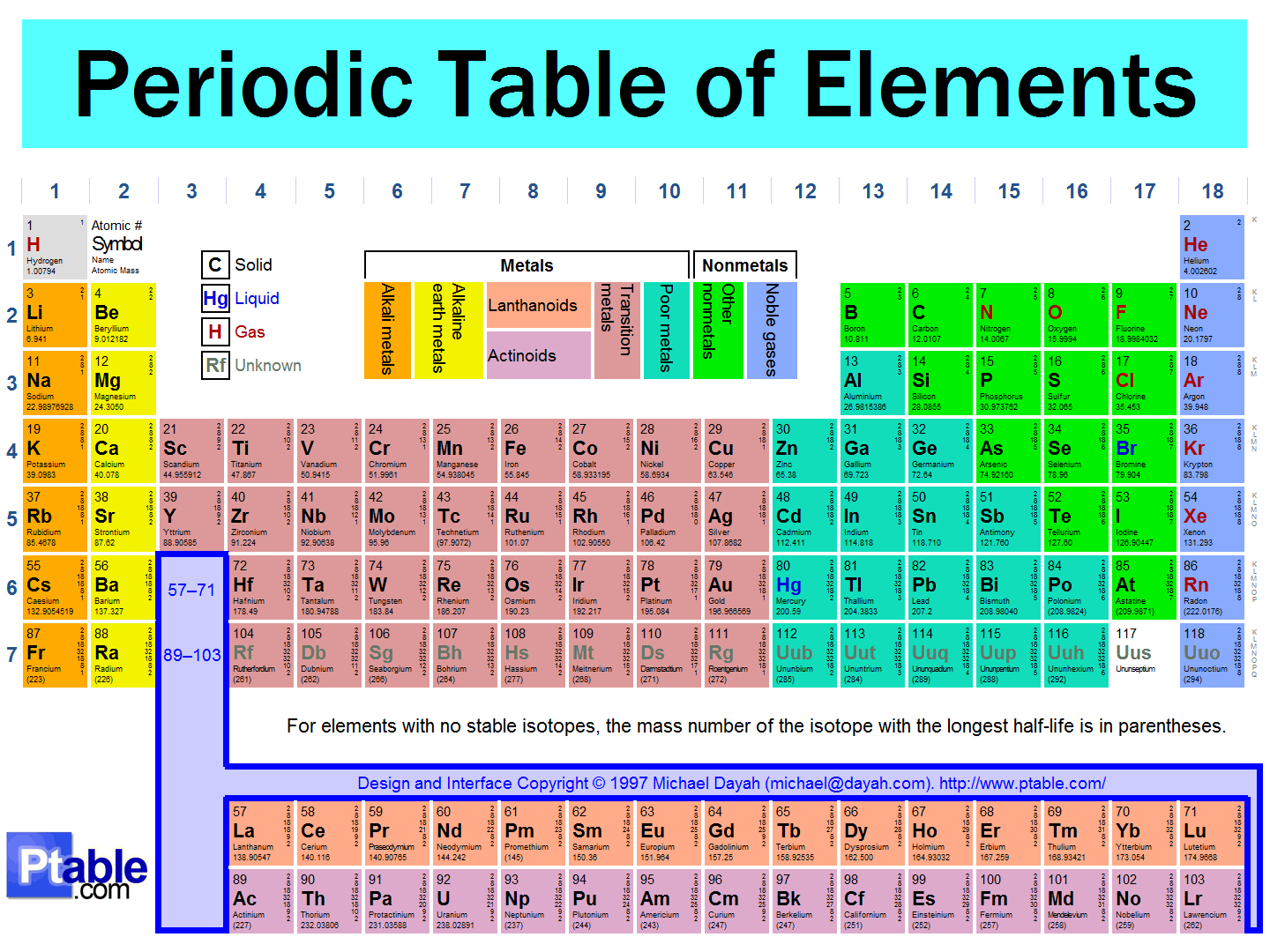
This class of elements are sometimes called "semiconductors."
a)
Metals
b)
Nonmetals
c)
Metalloids
d)
Groups
62.
The atomic number tells you what?
a)
number of electrons
b)
number of protons
c)
number of neutrons
d)
both electrons and protons in an atom.
63.
Elements which are shiny, conduct electricity and heat are called
a)
metal
b)
nonmetal
c)
metalloid
d)
nonexistent
64.

The atoms along the staircase are called
a)
metals
b)
nonmetals
c)
metalloids
d)
noble gases
65.
In the modern periodic table elements are arranged by:
a)
atomic mass
b)
atomic number
c)
valence electrons
d)
number of isotopes
66.

The yellow atoms are called
a)
metals
b)
nonmetals
c)
metalloids
d)
noble gases
67.
Metalloids can be described as...
a)
same as nonmetals
b)
bad conductors
c)
characteristics of metals and nonmetals
d)
same as metals
68.

Which section are the metals in?
a)
dark blue
b)
light blue
c)
purple
d)
pink
69.

In what section would Transition Metals be found?
a)
orange
b)
light blue
c)
blue
d)
white
70.
Elements on the left side of the periodic table are
a)
metals
b)
nonmetals
c)
metalloids
d)
noble gases
100 %

