wayground logo

Free Printable Worksheets

Font size

S
M
L
XL
Worksheets

Astronomy A Review

Total questions: 97

Worksheet time: 3hrs 14mins

Name
Class
Date
1.

As galaxies move away from our galaxy

a shift on the electromagnetic spectrum is noticed. This phenomena is

called _____________.

a)

redshift

b)

blueshift

2.

The Big Bang Theory explains the formation of the...

a)

Earth

b)

Sun

c)

Universe

d)

Solar System

3.
What does the Big Bang theory suggest?
a)
The universe was just there
b)
The Milky Way is the only solar system
c)
The universe is continually expanding
d)
The universe is collapsing in toward a single point
4.

Why is the light from distant galaxies red-shifted?

a)

They produce more red light than nearby galaxies

b)

They are moving away from us

c)

The longer wavelengths are filtered out more by dust

d)

They are moving toward us

5.

How is the "Big Bang" described?

a)

an explosion

b)

an expansion

c)

a contraction

6.

In relation to us, most galaxies are…

a)

Moving toward us

b)

Moving away from us

c)

Not moving

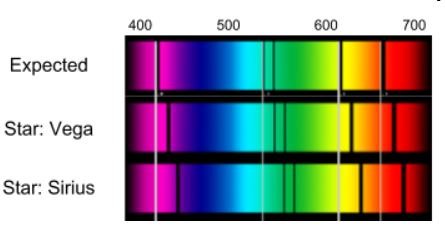
7.

What is true about these stars?

a)

Both of these stars are moving away from us.

b)

Both of these stars are moving towards us.
8.

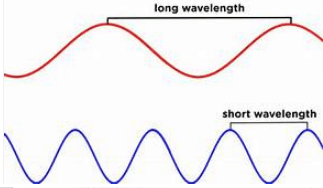
What happens to the wavelengths of energy if they are moving AWAY from a source?

a)

The waves stretch out and get longer.

b)

The waves compress and get shorter.

9.
Which of the following is evidence of the Big Bang Theory?
a)
Cavemen heard a loud bang at the beginning of time.
b)
The universe isn't moving
c)
The universe is expanding
d)
The universe is getting smaller
10.
Which of the following is NOT evidence of the Big Bang Theory?
a)
Abundance of Hydrogen and Helium
b)
CMBR everywhere
c)
Stars that are blue shifted
d)
the universe is getting bigger
11.
What can we conclude from the observation that nearly all galaxies are moving away from us?
a)
Massive black holes are drawing galaxies away from Earth.
b)
The Sun and Earth are located at the center of the universe.
c)
Everything in the universe is moving the same direction.
d)
The once-smaller universe is expanding in all directions.
12.
Which of the following is the best description of the Big Bang Theory?
a)
The Big Bang Theory is the prevailing model about the universe’s origin and is supported by observations of the universe’s expansion.
b)
The Big Bang Theory is just one of the ideas about the universe’s origin, many of which are equally respected by the scientific community.
c)
The Big Bang Theory states that pre-existing matter was compacted into a hot and dense form and suddenly exploded into infinite, empty space.
d)
The Big Bang Theory is the scientific explanation of how the Sun, Earth, and the rest of the Solar System were formed at the beginning of time.
13.

Most scientists believe the Big Bang Theory explains which of the following questions?

a)

How our planets and moons formed

b)

How our universe began

c)

How the sun turns hydrogen into helium

d)

How fast light travels through space

14.

What orbits around the center of a Geocentric system?

a)

Sun, Moons, Mercury, Venus, Earth, Mars, Jupiter, Saturn, Uranus, Neptune.

b)

sun, moons,


mercury, venus, mars, jupiter, saturn, uranus, neptune

c)

Earth, Sun, and all other planets.

d)

Sun, Moons,


Mercury, Venus, Mars, Jupiter, Saturn, Uranus, Neptune.

15.

Who proposed the Heliocentric system?

a)

Copernicus

b)

Ptolemy

c)

Aristotle

d)

Galileo

16.

What orbits around the center of a Heliocentric system?

a)

All objects in the Solar System but the Sun.

b)

The Milky-way.

c)

The universe.

d)

Sirius, Canopus, Arcturus, Alpha, Centauri, and Procyon.

17.

Who supported the Geocentric system?

a)

Ptolemy

b)

Aristotle

c)

Copernicus

d)

Galileo

18.

What is the biggest difference between the Geocentric Model and the Heliocentric Model?

a)

the shape of the planets' orbits

b)

the movement of the moon

c)

the center of the solar system

19.

Kepler's first law states that the orbits of the planets are in the shape of a/an...

a)

perfect circle

b)

ellipse

c)

spiral

20.
  What does "geo-" mean?
a)
Earth
b)
sun
c)
Center
21.
This image shows the:
a)
Geocentric Solar System
b)
Heliocentric Solar System
22.

Who came up with this model?

a)

Copernicus

b)

Kepler

c)

Galileo Galilee

d)

Ptolemy

23.

Which scientific instrument did Galileo use to change the world?

a)

telescope

b)

spyglass

c)

mirror

d)

magnifying glass

24.

Who supported Copernicus's Heliocentric Model

a)

Galileo

b)

Plato

c)

Ptolemy

d)

No one

25.

Who discovered the shape of a planet's orbit is actually an ellipse?

a)

Ptolemy

b)

Copernicus

c)

Kepler

d)

Galileo

26.

Heliocentrism states that:

a)

Saturn is at the center of the universe

b)

The sun is at the center of the universe

c)

Jupiter is at the center of the universe

d)

The Earth is at the center of the universe

27.

Geocentrism states that:

a)

The Earth is at the center of the universe

b)

Jupiter is at the center of the universe

c)

The Sun is at the center of the universe

d)

The Moon is at the center of the universe

28.
Who discovered the Geocentric Model?
a)
Copernicus
b)
Galileo
c)
Ptolemy
d)
Kepler
29.
What model does this represent?
a)
Geocentric 
b)
Heliocentric 
30.
What model does this represent?
a)
Geocentric 
b)
Heliocentric 
31.
Planets orbit the Sun in a shape called a(n)
a)
circle
b)
ellipse
c)
focus
d)
perihelion
32.
What is true about the area between points A, B and the Sun, and the area between points H, I and the Sun?
a)
The area between A, B and the Sun is the largest.
b)
The area between H, I and the Sun is the largest
c)
Both areas are equal in size
d)
There is not enough information to determine the areas
33.
Kepler's first law states that the orbits of the planets are oval in shape or 
a)
ellipses
b)
perfect circles
34.
The farther away a planet is from the sun, the _______ it takes it to orbit the sun once. 
a)
longer
b)
shorter
35.
The path a planet travels around the sun is called its 
a)
orbit
b)
ellipse
c)
barycenter
d)
precession
36.
Our galaxy is called the
a)
Earth Nebula
b)
The Hubble Galaxy
c)
The Milky Way
d)
The Snickers
37.
Galaxies are composed of (best answer)
a)
stars
b)
stars and gas
c)
stars, dust, and gas
d)
stars, dust, and gas held together by gravity
38.
The Milky Way Galaxy is a 
a)
spiral
b)
lenticular
c)
elliptical 
d)
irregular
39.
What type of galaxy is this?
a)
Spiral
b)
Elliptical
c)
Irregular
d)
Irrational
40.
What type of galaxy is this?
a)
Spiral
b)
Elliptical
c)
Irregular 
d)
Irrational
41.
What is not a galaxy?
a)
Optical Galaxy
b)
Spiral Galaxy
c)
Elliptical Galaxy
d)
Irregular Galaxy
42.
Place these objects in order from smallest to largest.
a)
Planets, solar system, universe, galaxy
b)
Solar system, planets, galaxy, universe
c)
Planets, solar system, galaxy, universe
d)
Galaxy, solar system, planets, universe
43.
Our sun is located on one of the Spiral Galaxy arms.  
a)
True
b)
False
44.
There are other galaxies besides ours.
a)
True
b)
False
45.
The Milky Way is shaped like a
a)
ellipse
b)
spiral
c)
double spiral
46.
The universe is
a)
1 light year across
b)
everything that exists
c)
only our galaxy
47.
No one knows how large the universe is.
a)
False
b)
True
48.
Mercury 
a)
1st 
b)
2nd 
c)
3rd 
d)
4th 
49.

Venus ( thick atmosphere that traps in heat) ((hottest planet))

a)

1st

b)

2nd

c)

3rd

d)

4th

50.

What are the four inner planets?

a)

Earth, Uranus, Mercury, Venus

b)

Mercury Venus Earth Saturn

c)

Mars, Earth , Mercury, Venus

d)

Mars, Earth, Neptune, Mercury

51.

Which planet is farthest from the sun?

a)

Neptune

b)

Jupiter

c)

Mercury

d)

Uranus

52.

What are the outer planets?

a)

Jupiter, Saturn, Earth, Neptune

b)

Saturn, Neptune, Mars, Uranus

c)

Uranus, Saturn, Neptune, Jupiter

d)

Mercury, Venus, Earth, Mars

53.

What is at the center of our solar system?

a)

asteroid belt

b)

Earth

c)

sun

d)

moon

54.

Which planets are made of solid surfaces and rocky cores?

a)

terrestrial

b)

gas giants

c)

outer planets

55.

Which planets are mostly made of gases?

a)

terrestrial

b)

gas giants

c)

inner planets

56.
The surface of this planet appears red due to rusting iron in the rocks.
a)
Mercury
b)
Mars
c)
Pluto
d)
Venus
57.
Almost Earth’s twin in size and mass, this planet has very thick atmosphere.
a)
Venus
b)
Mars
c)
Mercury
d)
Neptune
58.

This cold, blue planet was discovered by a mathematical prediction.

a)

Neptune

b)

Jupiter

c)

Mars

d)

Venus

59.
This is the largest planet in the solar system.
a)
Saturn
b)
Jupiter
c)
Uranus
d)
Venus
60.
Only planet known to have life
a)
Earth
b)
Mars
c)
Venus
d)
Mercury
61.
This is the only planet in the solar system with oceans of liquid water.
a)
Mercury
b)
Mars
c)
Venus
d)
Earth
62.
This gas giant has a large storm in its atmosphere known as The Red Spot
a)
Jupiter
b)
Saturn
c)
Uranus
d)
Neptune
63.
Which planet is not a terrestrial planet?
a)
Mars
b)
Neptune
c)
Earth
d)
Mercury
64.
Which planet is not a gas giant?
a)
Saturn
b)
Jupiter
c)
Neptune
d)
Venus
65.
Is this the correct order of the planets from the sun: Mercury, Venus, Earth, Mars, Jupiter, Uranus, Saturn, Neptune?
a)
Yes
b)
No
66.
Made of ice, dust and gas
a)
asteroid
b)
meteoroid
c)
comet
d)
meteor
67.
Appears as a streak in the sky.
a)
asteroid
b)
meteoroid
c)
comet
d)
meteor
68.
Found in the Oort Cloud
a)
asteroid
b)
meteoroid
c)
comet
d)
meteor
69.
Often called shooting stars.
a)
asteroid
b)
meteoroid
c)
comet
d)
meteor
70.
Sometimes called "dirty snowballs".
a)
asteoids
b)
meteoroids
c)
comets
d)
meteors
71.
Piece of rock that burns up as it passes through the earth's atmosphere.
a)
asteroid
b)
meteoroid
c)
comet
d)
metoer
72.
Piece of a meteoroid that strikes the earth's surface
a)
comet
b)
asteroid
c)
meteor
d)
meteorite
73.
I am a rock entering a planet's atmosphere.
a)
meteor
b)
meteorite
c)
asteroid
d)
comet
74.
One similarity between asteroids, comets and meteoroids is that they all:
a)
are made of rock
b)
come from the Asteroid Belt
c)
come from the Oort Cloud
d)
orbit the sun
75.
Huge chunks of rock and metal (some measuring miles wide) are believed to be left-over pieces of planets and moons called:
a)
Comets
b)
Meteors
c)
Asteroids
d)
Meteroids
76.
When a meteoroid STRIKES the surface of the earth scientists refer to them as:
a)
Asteroids
b)
Comets
c)
Meteors
d)
Meteorites 
77.

The ____ forms around the nucleus when the sun heats it up.

a)

dust tail

b)

coma

c)

nucleus

d)

gas tail

78.

The comet's tail always flies __________________.

a)

ahead of the comet

b)

toward the sun

c)

ahead of the sun

d)

away from the sun

79.

Comet tails are a result of __________.

a)

their orbit

b)

solar wind

c)

north winds

d)

the sun

80.
What is gravity?
a)
A force
b)
Energy
c)
A push
d)
All of them
81.
Without gravity we would________. 
a)
Float away
b)
Stay in the ground
c)
Nothing would happen.
d)
I don't know
82.
Why a ball falls to the ground?
a)
Earth's force of gravity is GREATER than the ball's, so the ball gets attracted to the ground. 
b)
Earth's force of gravity is LESS than the ball's, so the ball gets attracted to the ground. 
83.
Which has more mass, Earth or the Moon?
a)
Earth
b)
Moon
c)
The same
84.
As distance between two objects increase the pull of gravity 
a)
Increases
b)
Decreases
c)
Stays the same
85.

Inertia is Newton's _______ Law of Motion.

a)

First

b)

Second

c)

Third

86.

Objects with MORE mass have...

a)

MORE inertia

b)

LESS inertia

c)

the SAME amount of intertia

87.

Objects with more mass are..

a)

harder to speed up or slow down

b)

easier to speed up or slow down

88.

Objects with less mass are...

a)

easier to speed up or slow down.

b)

harder to speed up or slow down.

89.

Complete the excerpt of Newton's First Law of Motion


"An object in motion will ________ until it is acted on by an unbalanced force."

a)

...stay in motion...

b)

...stop its motion...

c)

...increase its motion...

d)

...decrease its motion...

90.

Complete the excerpt of Newton's First Law of Motion


"...and an object at rest will ________ until acted on by an unbalanced force."

a)

...stay at rest...

b)

...start an increasing motion...

c)

...start a decreasing motion...

91.

What force is there on Earth that makes inertia hard to understand because our objects do not stay in motion forever?

a)

friction

b)

air resistance/drag

c)

gravity

92.

Which of these are GREAT example of inertia?

a)

a person flying through the windshield during a car wreck because they weren't wearing their seat belt

b)

a person staying in the vehicle and hitting the air bag during a car wreck because they are wearing a seat belt

c)

earth constantly traveling at the same speed in it's orbit

d)

a meteor traveling through space at a constant speed until it hits something

93.

the tendency of an object to resist a change in its motion

a)

acceleration

b)

inertia

c)

mass

d)

frame of reference

94.
Because of inertia, a moving object will keep ________.
a)
at rest
b)
moving
c)
in one spot
d)
inertia 
95.
Which of the following is an example of inertia?
a)
Slamming on the breaks in your car and flying forward.
b)
An apple falling off of a tree. 
c)
Running at a cross country event. 
96.

Diagram shows a cat chasing a rat.

The inertia of the car is bigger than the rat because

a)

the size of the cat is bigger than the rat.

b)

the mass of the cat is bigger than the rat

c)

the length of the cat is more than a rat.

d)

the height of the cat is more than the rat.

97.

Diagram shows a man jerking a table cloth. The glass remain on the table because of inertia. Which action increase the inertia ?

a)

Use a rougher cloth

b)

Use a smoother cloth

c)

Pull the cloth with greater force

d)

Fill the glass with more water.