wayground logo

Free Printable Worksheets

Font size

S
M
L
XL
Worksheets

CBA 3

Total questions: 100

Worksheet time: 1hrs 23mins

Name
Class
Date
1.

Which is not a physical property of a metal?

a)

Malleability

b)

Ductility

c)

Conductivity

d)

Brittle

2.

Speed is equal to...

a)

Time/Speed

b)

Speed/Time

c)

Distance/Time

d)

Time x Distance

3.

This is an example of what type of Heat Transfer?

a)

Conduction

b)

Convection

c)

Radiation

d)

Apparation

4.

Heat moved from the...

a)

Room to the frying pan

b)

Room to the egg

c)

Egg to the frying pan

d)

Frying pan to the egg

5.
The faster an object moves, the ________ kinetic energy it has. 
a)
more
b)
less
c)
none of the above
d)
all of the above 
6.
__________ is stored energy. 
a)
Potential
b)
Kinetic
c)
None of the above 
d)
All of the above 
7.
When you stretch a rubber band, you are storing __________ energy. 
a)
kinetic 
b)
potential
c)
none of the above
d)
all of the above 
8.
What kind of energy is in a rock at the edge of a cliff?
a)
Potential
b)
Kinetic
9.
What kind of energy is in a battery?
a)
Potential
b)
Kinetic
10.
Think about the Law of Conservation of Energy.
Which of the following is not true?
a)
Energy cannot be destroyed.
b)
Energy cannot be created.
c)
Energy cannot be transformed.
d)
Energy can only be transformed.
11.
What type of energy is stored in a battery?
a)
electrical
b)
chemical
c)
thermal
d)
mechanical
12.
At what position would a cyclist have the most kinetic energy?
a)
A
b)
B
c)
D
d)
F
13.
Microwaves, x-rays, ultraviolet rays, infrared waves, light waves are all examples of 
a)
electrical energy
b)
electromagnetic energy
c)
chemical energy
d)
nuclear energy
14.

Kinetic Energy of wind is transferred to _____ Energy in a windmill.

a)

Solar

b)

Mechanical

c)

Electrical

d)

Potential

15.
A cell phone battery dies.  It gets plugged into an electrical outlet to recharge. Which of the following energy transformations occur during the charging?
a)
mechanical to chemical
b)
electrical to solar
c)
chemical to light
d)
electrical to chemical
16.

Electrical -> Kinetic -> Sound and Heat

a)

A triple beam balance measuring an object’s mass

b)

A pencil sharpener plugged into a wall outlet

c)

A projector displaying a diagram on the screen

d)

A working flashlight used to light up a dark corner

17.
Mr. Frohmberg thinks its too hot in the classroom. He plugs in a fan and turns it on, what energy transformation now occurs?
a)
mechanical to electrical
b)
electrical to mechanical
c)
chemical to mechanical
d)
electromagnetic to mechanical
18.
The diagram shows a circuit with a battery and a bulb. While the bulb is producing light, which type of energy is decreasing in the battery?
a)
gravitational potential energy.
b)
elastic potential energy
c)
chemical potential energy
d)
mechanical potential energy
19.
A student listens to music with a digital music player, similar to the one shown below. Which best describes the energy transformations that take place in the music player?
a)
Mechanical to chemical to electrical
b)
Chemical to sound to electrical
c)
Chemical to electrical to sound
d)
Electrical to heat to sound
20.
Inside a power plant, coal is burned to produce hot gases.  What type of energy conversion takes place as hot gases cause turbines to move?
a)
Thermal energy to chemical energy
b)
Thermal energy to kinetic energy
c)
electrical energy to kinetic energy
d)
Kinetic energy to thermal energy
21.
The tool used to measure the mass of a substance or object is a ______________.
a)
balance
b)
graduated cylinder
c)
ruler
d)
thermometer
22.
Jack has a rock. The rock has a mass of 14g and a volume of 2cm3. What is the density of the rock?
a)
7 mL
b)
7 g/cm3
c)
28 g/cm3
d)
1/7 g/cm3
23.
Which units of measurement are used for volume?
a)
grams
b)
centimeters
c)
grams/milliliter
d)
milliliter
24.
Which lab tool might you use to measure the volume of a liquid?
a)
electric scale
b)
bunsen burner
c)
test tube
d)
graduated cylinder
25.
What is the volume of Object X?
a)
10.0 cm3
b)
15.0 cm3
c)
20.0 cm3
d)
25.0 cm3
26.
I have two objects with the same volume but different masses.  Which object will be more dense?
a)
The object with less weight.
b)
The object with more weight.
c)
The object with more mass.
d)
The object with less mass.
27.
What is the formula for density?
a)
density = mass x volume
b)
density = mass / volume
c)
density = mass + volume
d)
density = mass - volume
28.
Frank has a paper clip. It has a mass of 9g and a volume of 3cm3. What is its density?
a)
3 g/cm3
b)
1/3 g/cm3
c)
27 g/cm3
d)
39 g/cm3
29.
What is the definition of CONDUCTION?
a)
When heat is transferred from objects like rays of light or electromagnetically.
b)
a  hot liquid or air that  expands, becomes less dense, and rises or becomes more dense, and sinks.
c)
When heat transfers from objects that are touching.
d)
When heat transfers through the heater or AC in your house.
30.
What is the definition of CONVECTION
a)
When heat transfers through waves.
b)
When heat transfers from objects that are touching.
c)
a  hot liquid or air that  expands, becomes less dense, and rises or becomes more dense, and sinks.
d)
Heat traveling from the sun
31.
Which of the following is an example of convection?
a)
A hair dryer is drying up your hair.
b)
When the AC or heater changes the temperature.
c)
When a car engine turns hot after being turned on.
d)
When you are making soup and the water is rising and lowering.
32.
The way the heat is moving from the hot coffee is called...
a)
convection
b)
radiation
c)
insulation
d)
conduction
33.
Warm air rises and the cool air sinks demonstrates this type of heat transfer. 
a)
conduction
b)
convection
c)
radiation
d)
Insolation 
34.
The baby chickens are kept warm from the heat lamps demonstrates this type of heat transfer. 
a)
conduction
b)
convection
c)
radiation
35.
The candle will slowly heat the metal and transfer the heat directly to the mans hand.
a)
conduction
b)
convection
c)
radiation
36.
One disadvantage to using coal to produce electricity is that coal -
a)
forms in a short amount of time.
b)
is abundant over a wide area.
c)
is not environmentally friendly.
d)
is relatively quite affordable.
37.
Look at the graph provided. What percent of the total energy used in the United States in 2009 came from fossil fuels?
a)
16%
b)
83%
c)
46%
d)
54%
38.
What is a major disadvantage of using nuclear power to generate electricity?
a)
A small amount of power is produced
b)
No greenhouse gases are produced
c)
The power plants are inexpensive to build
d)
The by-product of nuclear power is radiation
39.

A wind turbine can produce electrical energy because __________.

a)

it boils water

b)

it slows wind

c)

it turns a generator

d)

it collects light

40.

Which process can be used to power your home?

a)

solar electric energy

b)

solar thermal energy

c)

both solar thermal and solar electric energy

d)

neither

41.

Where does the heat come from for geothermal energy?

a)

water

b)

sun

c)

atoms

d)

earth

42.
Nonrenewable resources are natural resources, such as fossil fuels, that will eventually be used up and can never be replaced
a)
True
b)
False
43.
Hydroelectric power produces electricity using.....
a)
Wind
b)
Sunlight
c)
Moving water
d)
Dung
44.
Nuclear Power is a __________ energy resource.
a)
Renewable
b)
Nonrenewable
45.
__________ is an energy resource that WILL NOT run out in the next several hundred years.
a)
Renewable Energy Resource
b)
Nonrenewable Energy Resource
c)
Fossil Fuel
d)
Forever Fuel
46.
One disadvantage to using coal to produce electricity is that coal -
a)
forms in a short amount of time.
b)
is abundant over a wide area.
c)
is not environmentally friendly.
d)
is relatively quite affordable.
47.
Which of the following recommendations could a community make to its citizens that would do the most to conserve energy resources?
a)
Carpool, bicycle, or walk whenever possible
b)
Keep lighting turned on when they are not in use
c)
Drivers and all passengers should wear seatbelts
d)
Recycle papers and plastics whenever possible
48.
How many different elements are in this chemical formula: C2H2ClK3
a)
6
b)
8
c)
2
d)
4
49.
Which of the following atomic symbols is written correctly?
a)
ee
b)
hE
c)
C
d)
CL
50.
 Which of the following atomic symbols is written correctly? 
a)
OH
b)
oH
c)
fe
d)
H
51.
Which of the following is a pure substance?
a)
CO
b)
C02
c)
Co
d)
H2O
52.
Which of the following is a pure substance?
a)
O2
b)
Al2CO5
c)
C6H12O6
d)
SiO2
53.
Which of the following is a pure substance?
a)
O2
b)
Al2CO5
c)
C6H12O6
d)
SiO2
54.
Which of the following atomic symbols for bromine is written correctly?
a)
bR
b)
BR
c)
Br
d)
br
55.
Which of the following atomic symbols for bromine is written correctly?
a)
bR
b)
BR
c)
Br
d)
br
56.
Which of the following chemical formulas represents a compound? 
a)
C3
b)
O2
c)
CH3CHO
d)
H2
57.
What is krypton?
a)
element
b)
compound
c)
mixture
58.
Can be found on the periodic table
a)
Element
b)
Compound
c)
MIxture
59.
What is gold?
a)
element
b)
compound
c)
mixture
60.
What is sugar?
a)
element
b)
compound
c)
mixture
61.
What is water?
a)
element
b)
compound
c)
mixture
62.
When two or more elements chemically combine
a)
element
b)
compound
c)
mixture
d)
solution
63.
Which one can be found on the periodic table?
a)
Compound 
b)
Element
64.

Which item on this element square is the chemical symbol?

a)

Copper

b)

29

c)

Cu

d)

63.546

65.
What element is found in all four areas of the earth that we studied?
a)
Sodium (Na)
b)
Oxygen (O)
c)
Carbon (C)
d)
Nitrogen (N)
66.
What is the most abundant element found in the earth's atmosphere?
a)
Oxygen
b)
Sulfur
c)
Nitrogen
d)
Argon
67.
This element occurs in large amount in the atmosphere and small amount in living things.
a)
Nitrogen
b)
Oxygen
c)
Argon
d)
Carbon
68.
Which of the following elements appears in the smallest percentage in the oceans?
a)
Hydrogen (H)
b)
Oxygen (O)
c)
Chlorine (Cl)
d)
Sodium (Na)
69.
Which of the following elements appears in the smallest percentage in the oceans?
a)
Hydrogen (H)
b)
Oxygen (O)
c)
Chlorine (Cl)
d)
Sodium (Na)
70.
This table represents the elemental composition of the _____
a)
Atmosphere
b)
Ocean
c)
Life on Earth
d)
Crust
71.

What is the formula to calculate volume?

a)

V = length x width

b)

V = length x width x height

c)

V = width x height

d)

V = height x length

72.

Solids with an irregular shape can be measured with a ________.

a)

graduated cylinder

b)

ruler

73.

Solids with a regular shape can be measured with ________.

a)

a graduated cylinder

b)

a ruler

74.

1mL is equivalent to 1 cm3.

a)

True

b)

False

75.

What units are used to measure a regular or irregular shape?

a)

millimeters

b)

cubic inches

c)

milliliters

d)

cubic centimers

76.

A solid with a volume of 5cm3 is placed in a graduated cyclinder with 45mL of water. What will the graduated cylinder read once the solid is placed into the graduated cylinder?

a)

5cm3

b)

40mL

c)

50mL

d)

50cm3

77.
What is the mass on this triple beam?
a)
220g
b)
222g
c)
20g
78.
What is the mass on this triple beam?
a)
270g
b)
202g
c)
273g
79.
What is the mass on this triple beam?
a)
506g
b)
576g
c)
570g
80.
What is the mass on this triple beam?
a)
270g
b)
202g
c)
272g
d)
200g
81.
What is the mass on this triple beam?
a)
200g
b)
44g
c)
244g
d)
4g
82.
What is the mass on this triple beam?
a)
143g
b)
40g
c)
43g
d)
3g
83.
What is the mass on this triple beam?
a)
272g
b)
702g
c)
202g
84.
What tool is this?
a)
scale
b)
graduated cylinder
c)
triple beam balance
d)
massonater
85.
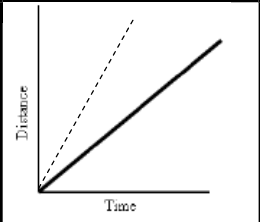
What does this graph represent?
a)
Constant Speed
b)
Acceleration
c)
Not moving
86.
What two measurements are necessary for calculating speed?
a)
Mass and time
b)
Temperature and mass
c)
Mass and distance
d)
Distance and time
87.
Calculate the average speed (in meter/sec) if a cheetah runs 180 meters in 10 seconds.
a)
198 m/sec
b)
170 m/sec
c)
12 m/sec
d)
18 m/sec
88.
What is the speed of an object that travels 60 meters in 4 seconds?
a)
240 m/s
b)
15 m/s
c)
0.067 m/s
d)
15 mph
89.
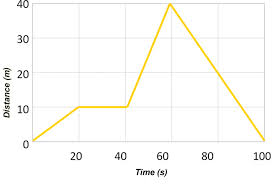
How long did it take this object to travel 10 m?
a)
0 s
b)
10 s
c)
15 s
d)
20 s
90.
How long did it take this object to travel back to its reference/starting point?
a)
20 s
b)
30 s
c)
60 s
d)
100 s
91.
At 60 seconds, how far had this object traveled? 
a)
0 m
b)
10 m
c)
20 m
d)
40 m
92.
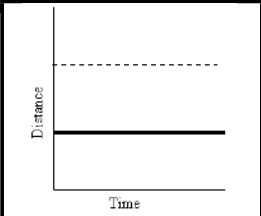
What does this graph represent?
a)
Constant speed
b)
Acceleration
c)
Not moving
93.
What is this graph showing?
a)
Constant Speed
b)
Acceleration (speeding up)
c)
Deceleration (slowing down)
d)
No motion
94.
A measurement of how fast an object is moving
a)
Velocity
b)
Speed
c)
Vector
d)
Acceleration
95.
What is happening at D?
a)
Stationary
b)
Accelerating
c)
Fast steady speed; moving away from the starting position
d)
Slower steady speed; moving away from the starting position
96.
What is happening at A?
a)
Stationary
b)
Accelerating
c)
Slower steady speed; moving away from the starting position
d)
Steady speed; returning to start position
97.
What is happening in this graph from point A to B?
a)
The object is accelerating.
b)
The object is not moving.
c)
The object is decelerating.
d)
The object is moving at a constant speed.
98.
What is happening in this graph from point B to C?
a)
The object is going down a hill.
b)
The object is returning to its starting location.
c)
The object is slowing down.
d)
The object is staying still.
99.
If you travel 10 miles in 5 minutes, what is your speed?
a)
10 mi/min
b)
15 mi/min
c)
50 mi/min
d)
2 mi/min
100.
Which of the following is NOT a correct unit for speed?
a)
miles per hour
b)
km/min
c)
seconds per hour
d)
cm/s