
 Worksheets
Magnets and F&M Review
Total questions: 99
Worksheet time: 1hrs 8mins
What happens to the energy in a system of magnets when the magnetic force causes two magnets to move?
The potential energy in the system increases.
The kinetic energy in the system decreases.
Some of the potential energy is converted to kinetic energy.
Some of the kinetic energy changes to potential energy.
What is kinetic energy?
The energy that is stored in an object or system
To push objects away from each other
The energy that an object has because it is moving
To move from one object to another
What is potential energy?
The energy that an object has because it is moving
The energy that is stored in an object or system
To provide evidence against a claim
One of the two opposite ends of a magnet

What happens to the potential energy?
The potential energy does not change because the magnets in the system do not change.
The potential energy increases because Magnet 2 moves against the magnetic force.
The potential energy decreases because Magnet 2 moves against the magnetic force.
The potential energy decreases because Magnet 2 moves in the same direction as the magnetic force.

Based on the magnetic field lines diagram, what will happen to these two sets of magnets?
Set 1 magnets will repel, set 2 magnets will attract
Set 1 magnets will attract, set 2 magnets will attract
Set 1 magnets will attract, set 2 magnets will repel
Both sets of magnets will repel

Based on the magnetic field lines diagram, what will happen next with these sets of magnets?
In both sets the magnets will attract.
In both sets the magnets will repel.
In Set 1 the magnets will repel and in Set 2 the magnets will attract.
In Set 1 the magnets will attract and in Set 2 the magnets will repel.

Will these magnets attract or repel?
Attract
Repel

Will these magnets attract or repel?
Attract
Repel

Will these magnets attract or repel?
Attract
Repel
Neither
Both

What will happen when these magnets are let go?
The magnets will not move because they are not touching.
The magnets will move closer to each other because the magnetic force will pull them together.
The magnets will move away from each other because the magnets are not touching.
The magnets will move away from each other because the magnet force will push them apart.
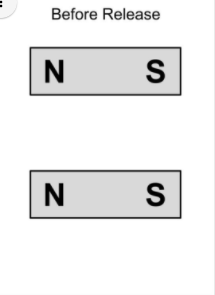

What will happen next?
The trains will move closer because the magnetic force will pull the trains together.
The trains will not move because the magnets are not touching.
The trains will move away from each other because the magnetic force will push the trains apart.
The trains will move away from each other because the magnets are not touching.

How does magnetic force affect the energy in a system of magnets when the magnets are released and begin to move?
The magnetic force increases the potential energy in the system.
The magnetic force decreases the potential energy in the system.
The magnetic force changes kinetic energy into potential energy.
The magnetic force changes potential energy into kinetic energy.

Which move will result in the greatest potential energy increase?
Moving the cart on Track 1 one space to the right.
Moving the cart on Track 2 one space to the left.
Moving the cart on Track 2 one space to the right.
All moves will result in the same increase in potential energy.


What happens to the potential energy in the system, when the magnetic train is moved away from the stationary magnet?
The potential energy increases because the magnet is moved against the magnet force.
The potential energy decreases because the magnet is moved against the magnet force.


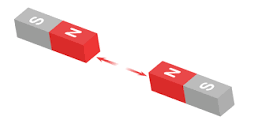
granite


A device that uses a free-moving magnetic needle to show direction is a:
lodestone
magnet
compass
magnetic field

Which toy boat(s) experienced the strongest force when it was bumped? How do you know?
The blue toy boat experienced the strongest force because it takes a stronger force to slow something down than it takes to speed something up.
The gray toy boat experienced the strongest force because it had the fastest ending speed.
The orange and gray toy boats experienced the strongest forces because they both gained the same force as they sped up. The blue boat lost force, so it slowed down.
All three toy boats experienced the same strength force because they changed speed by the same amount.

Which chair(s) experienced the strongest force when hit? How do you know?
The blue and red chairs experienced the strongest force because they are both more massive than the yellow chair and they changed speed by the same amount.
The red chair experienced the strongest force because it is as massive as the blue chair and has the highest ending speed.
All three chairs experienced the same force because they changed speed by the same amount.
The blue chair experienced the strongest force because it takes more force to slow an object than it takes to make it go faster.

In which crash did the skateboard experience a stronger force? Why?
The skateboard did not experience a force; only the shopping cart experienced a force in the crashes.
Crash 2; the force on the cart was stronger in this crash, so the force on the skateboard was also stronger.
The diagram doesn't tell you anything about the force on the skateboard. It only gives information about the force on the shopping cart.
The skateboard experienced the same force in both crashes. The shopping cart changed speed by the same amount in each crash, so the force on the skateboard was the same each time.
Sandra pushed a wooden block and it slid across the floor.
The wooden block gradually slowed down and stopped after moving 10 meters.
Why did the block stop moving?
The floor exerted a force that is opposite to the direction of the block's motion.
The block ran out of force.
The floor absorbs force from the block.
All objects stop moving because their natural state is to be still.

Which golf ball(s) experienced the strongest force when hit? How do you know?
The white and purple golf balls because they gained force, while the green golf ball lost force.
The green golf ball because it takes a stronger force to slow something down than to speed something up.
The green golf ball because it changed speed the most.
The white golf ball because it has the fastest ending speed.

Which puck(s) experienced the strongest force when hit? How do you know?
All three hockey pucks experienced the same force because they changed speed by the same amount.
The black hockey puck; it is more massive and it has the fastest ending speed.
The purple hockey puck; it takes a stronger force to slow down a more massive object than to speed it up.
The black and purple hockey pucks; they have more mass than the green puck, but changed speed by the same amount.

In which crash did the tennis ball experience a stronger force? How do you know?
Crash 1; the force on the soccer ball was stronger in this crash, so the force on the tennis ball was also stronger.
There was no force on the tennis ball. In each crash only the soccer ball experienced a force.
It was the same in both crashes. The soccer ball changed speed by the same amount in each crash, so the force on the tennis ball was the same both times.
The diagram doesn't tell you anything about the force on the tennis ball. It only gives information about the force on the soccer balls.

Which skier(s) experienced the strongest force when bumped? How do you know?
The skiers in the yellow and purple sweaters; they both gained the same force as they sped up, but the skier in the red sweater lost force and slowed down.
The skier in the yellow sweater experienced the strongest force because he has the fastest ending speed.
All three skiers experienced the same strength force because they changed speed by the same amount.
The skier in the red sweater because it takes a stronger force to slow something down than to speed it up.

Which soccer ball(s) experienced the strongest force? How do you know?
All three soccer balls experienced the same force because they changed speed by the same amount.
The orange soccer ball; it has more mass and the fastest ending speed.
The blue soccer ball; it takes a stronger force to slow down a more massive object than to speed it up.
The blue and orange soccer balls; they have more mass than the black soccer ball, but changed speed by the same amount.

In which crash did the asteroid experience a stronger force? How do you know?
Crash 2; the force on the planet was stronger in this crash, so the force on the asteroid was also stronger.
There was no force on the asteroid. Only the moon and planet experienced a force in each crash.
The diagram doesn't tell you anything about the force on the asteroid. It only gives information about the force on the planet and the moon.
The force was the same in both crashes. The planet and moon changed speed by the same amount so that means the force on the asteroid was the same in both crashes.
At dinner, Hans passed the salt shaker to his sister Jessica by sliding it across the wooden table.
The salt shaker gradually slowed down and stopped after moving 12 centimeters.
Why did the salt shaker stop moving?
The salt shaker ran out of force.
The table exerts a force that is opposite to the salt shaker's motion.
The table absorbs force from the salt shaker.
All objects stop moving because their natural state is to be still.

Which curling stone(s) experienced the strongest force when hit? How do you know?
The blue curling stone experienced the strongest force because it takes a stronger force to slow something down than it takes to speed something up.
The blue curling stone experienced the strongest force because it changed speed the most.
The orange curling stone experienced the strongest force because it has the fastest ending speed.
The yellow and orange curling stones experienced the same strength force because they both gained force, but the blue curling stone lost force.

Which skateboard(s) experienced the strongest force from Kristina's push? How do you know?
The pink skateboard experienced the strongest force for two reasons: it is a more massive object and it has the fastest ending speed.
The brown skateboard experienced the strongest force because it requires more force to slow an object down than to speed it up.
The brown and pink skateboards experienced the strongest force because they are both more massive than the green skateboard and they changed speed by the same amount.
All three skateboards experienced the same strength force because they changed speed by the same amount.

In which crash did the cone experience a stronger force? How do you know?
There was no force on the cone. In both crashes, only the hockey puck experienced a force.
The diagram doesn't tell you anything about the force on the cone. It only gives information about the force on the pucks.
It was the same force in both crashes; the hockey puck changed speed by the same amount in each crash, so the force on the cone was the same each time.
Crash 1; the force on the black hockey puck was stronger in this crash, so the force on the cone was also stronger.

A satellite was in two separate crashes. In both crashes, the satellite had the same mass. Engineers want to know about the speed and direction of the satellite after the crashes. Why would the crash affect the motion of the satellite, and which crash caused a greater change in motion for the satellite?

In a warehouse, the workers sometimes slide boxes along the floor to move them. Two boxes were sliding toward each other and crashed. The crash caused both boxes to change speed. Based on the information in the diagram, which statement is correct? In your answer, explain what the forces were like and why the boxes changed speed.
What is a collision?
The moment when two objects hit each other.
A push or pull that can change the motion of an object.
to reach a conclusion using your observations and your background knowledge
speed in a particular direction
What is a force?
The moment when two objects hit each other.
A push or pull that can change the motion of an object.
to reach a conclusion using your observations and your background knowledge
speed in a particular direction
What does it mean to infer?
The moment when two objects hit each other.
A push or pull that can change the motion of an object.
to reach a conclusion using your observations and your background knowledge
speed in a particular direction
What is velocity?
The moment when two objects hit each other.
A push or pull that can change the motion of an object.
to reach a conclusion using your observations and your background knowledge
speed in a particular direction
What is net force?
The sum of all the forces acting on an object.
A push or pull that can change the motion of an object.
to reach a conclusion using your observations and your background knowledge
speed in a particular direction
What is friction?
The sum of all the forces acting on an object.
A push or pull that can change the motion of an object.
a force between an object and the surface it is moving over
speed in a particular direction
What is a balanced force?
The sum of all the forces acting on an object.
A push or pull that can change the motion of an object.
a force between an object and the surface it is moving over
all the forces on an object equal out so that the object doesn't move
What is an unbalanced force?
Forces acting on an object are NOT equal - object moves
A push or pull that can change the motion of an object.
a force between an object and the surface it is moving over
all the forces on an object equal out so that the object doesn't move
What is inertia?
Forces acting on an object are NOT equal - object moves
An object's tendency to resist a change in its motion.
a force between an object and the surface it is moving over
all the forces on an object equal out so that the object doesn't move
What is Newton's first law of motion?
Things in motion tend to stay in motion, and things at rest tend to stay at rest, unless acted on by an external force
Force = mass X acceleration
For every action, there is an equal and opposite reaction
Don't eat Fig Newtons with orange juice
What is Newton's second law of motion?
Things in motion tend to stay in motion, and things at rest tend to stay at rest, unless acted on by an external force
Force = mass X acceleration
For every action, there is an equal and opposite reaction
Don't text under an apple tree
To push objects away from one another
repel
refute
force
attract
a line that connects opposite magnetic poles and represents the strength and direction of the magnetic field
magnetic pole
magnetic field
electromagnet
magnetic field line
a type of magnet in which the magnetic field is produced by an electric current
super magnet
electromagnet
static magnet
magnetic field
to move from one object to another or one place to another
convert
refute
transfer
kinetic energy
the space around a magnet in which magnetic forces can act on objects
magnetic field
magnetic field line
magnetic pole
magnetic pull
an object, diagram, or computer program that helps us understand something by making it simpler or easier to see
system
model
question
claim
to pull objects toward one another
repel
convert
attract
transfer
A system is a set of interacting parts forming a complex whole
true
false
a push or a pull that can change the motion of an object
attract
system
force
convert
the ability to make things move or change
model
system
force
energy
to separate or set apart
isolate
convert
transfer
refute
an object is converted when it changes from one type to another
false
true
an electromagnet does not have a magnetic field produced by an electric current
false
true
magnetic fields occur only inside a magnet
true
false
a magnetic pole is found at either end of a magnet and is often called, "north" or "south"
true
false
Fill in the blank: A current in a wire produces a _______________ _____________ around the wire.
big circle
electric square
magnetic field
green cube
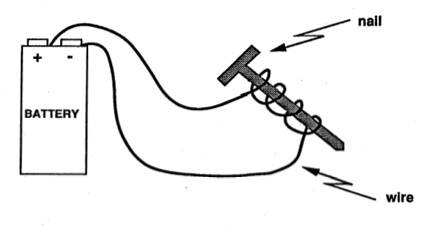
What is an electromagnet?
Wire wrapped around a core.
Wire next to a core.
A magnet near a current.
a magnet on top of a current.
How do the number of coils in an electromagnet affect its strength?
The coils affect an electromagnet's strength.
The coils affect an electromagnet's direction.
The coils affect an electromagnet's height.
The coils affect an electromagnet's color.

Which electromagnet will pick up LESS paper clips?
A
B

Because of inertia, a resting object ________.
will remain at rest
will move at a constant speed
will eventually move
is unbalanced
The first law of motion states that objects in motion will:
stop
accelerate
stay in motion
rest
Newton's second law of motion states that an unbalanced force is equal to mass times:
acceleration
force
motion
inertia
As more unbalanced force is applied to an object, its acceleration:
stays the same
decreases
increases
Newton's third law of motion states that for every action there is:
an opposite, but equal reaction.
an opposite and equal reaction.
a reaction.
A 20 kg bike accelerates at 10 m/s2. What was the force?
30 Newtons
2 Newtons
200 Newtons
10 Newtons
An object in motion stops when.....
It falls of an edge.
it is acted upon by an outside force.
It is eaten
It never stops

What was Newton's first name?
Isaac
Ivan
Michael
Iforgot

The reason a ball bounces up when it hits the ground:
The ball and ground repel each other.
The ball exerts a force on the ground, and the ground exerts a force on the ball.
What explains why objects resist changes in their state of motion?
gravity
inertia
force
friction
What explains a quantity that has BOTH speed and direction?
Inertia
Force
Speed
Velocity
The force that prevents a ball rolling on the ground from continuing on it's path forever is...
Friction
Gravity
Inertia


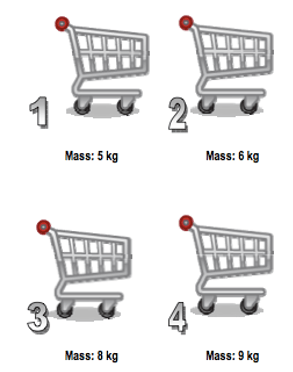

____ force is needed to move objects of larger mass.
less
equal
more
light

