
 Worksheets
Ultimate Quizizz
Total questions: 100
Worksheet time: 2hrs 40mins
Name
Class
Date
1.
What are the 3 things ALL PLANTS NEED.
a)
Soil, Water, and Oxygen
b)
Water, Love, and Sun light
c)
Sun light, Water, and Carbon Dioxide
d)
Water, Carbon Dioxide, and Glucose
2.
Chapter 1 Question
Why didn’t the plants and animals in the biodome have enough energy storage molecules?
a)
A change in the amount of carbon dioxide led to a decrease in the amount of energy storage molecules made by producers in the biodome.
b)
A change in the amount of sunlight led to a decrease in the amount of energy storage molecules made by producers in the biodome
c)
A change in the amount of water led to a decrease in the amount of energy storage molecules made by producers in the biodome
d)
There was no issue with the energy storage molecules in the biodome
3.
Chapter 2 Question
What caused carbon dioxide to decrease in the air (abiotic matter) of the biodome?
a)
The plants died due to no sun
b)
The humans killed to many animals
c)
The decomposers died
d)
The plants turned to much carbon dioxide into oxygen
4.
Chapter 3 Question
What happened to the carbon that used to be in the air (abiotic matter) of the biodome?
a)
It leaked out
b)
The carbon died
c)
It got trapped as dead matter
d)
It got trapped in producers
5.
Vocab question!!
What is cellular respiration?
a)
a type of atom (a tiny piece) that makes up molecules such as carbon dioxide and energy storage molecules
b)
the process by which plants and other producers use energy from sunlight to change carbon dioxide and water into oxygen and glucose (an energy storage molecule)
c)
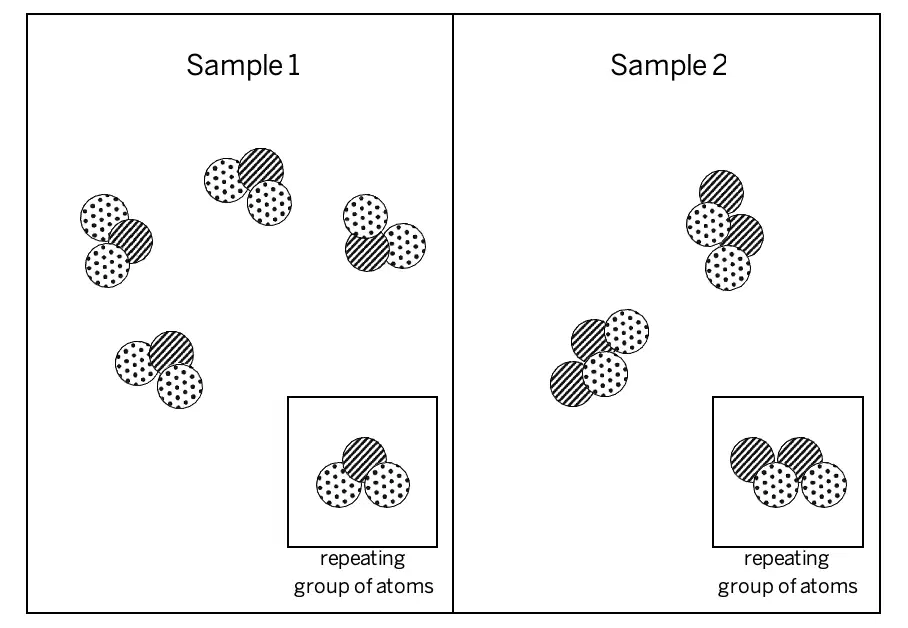
an organism that needs to eat in order to get energy storage molecules (such as starch and fat)
d)
the chemical reaction between oxygen and glucose that release energy into cells
6.
Why did the decomposers die?
a)
There wasn't enough energy storage molecules
b)
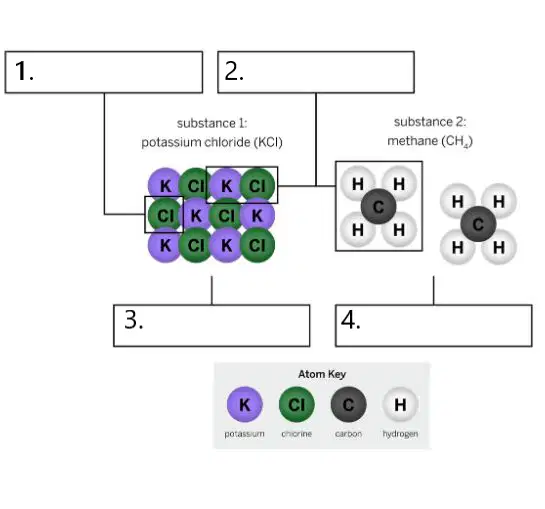
The Econauts forgot to feed them
c)
The Econauts buried them to deep and forgot to put earthworms in the biodome
d)
Carbon left the biodome because the producers made to much oxygen
7.
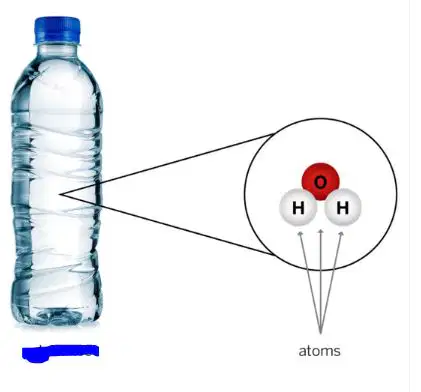
Key Concept
As organisms release energy during cellular respiration, carbon dioxide is produced from the carbon in energy storage molecules. This process moves carbon from biotic to abiotic matter.
a)
True
b)
False
8.
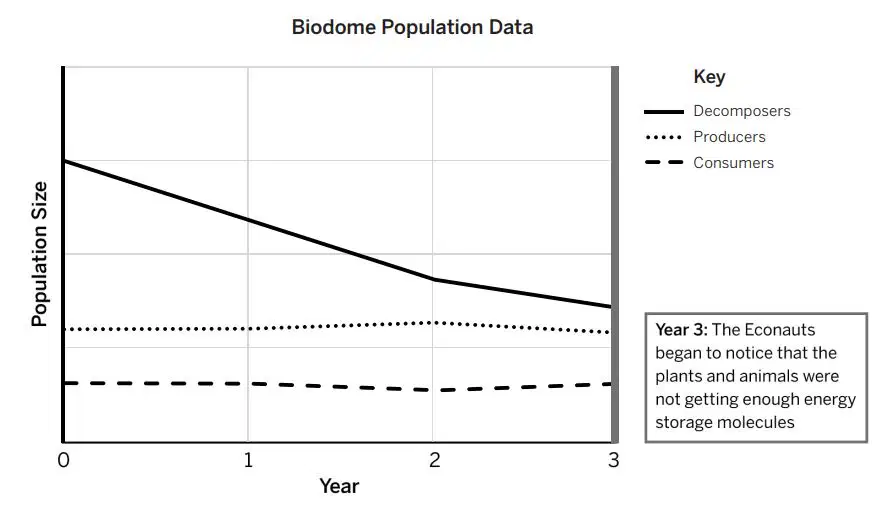
According to the graph which of these 3 things decreased significantly over 3 years?
a)
Producers
b)
Decomposers
c)
Consumers
d)
Nothing decreased
9.
Which one of these events increases the amount of carbon dioxide in the air?
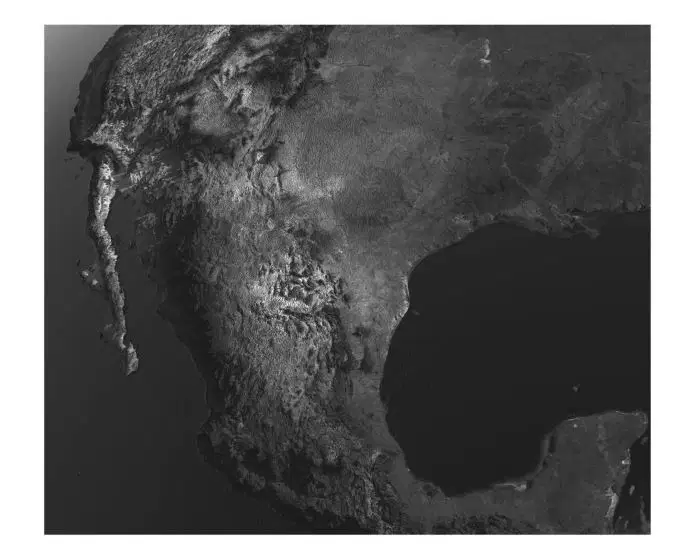
a)
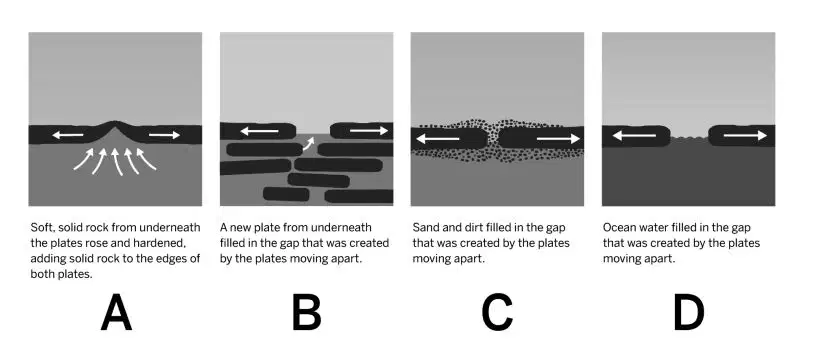
A producer going through photosynthesis
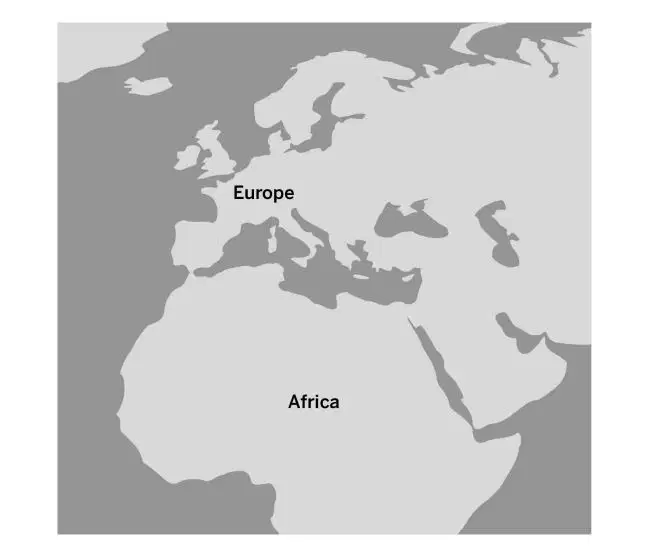
b)
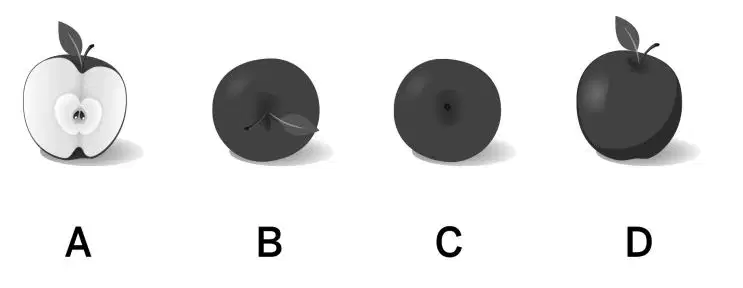
A rock rolling down a hill
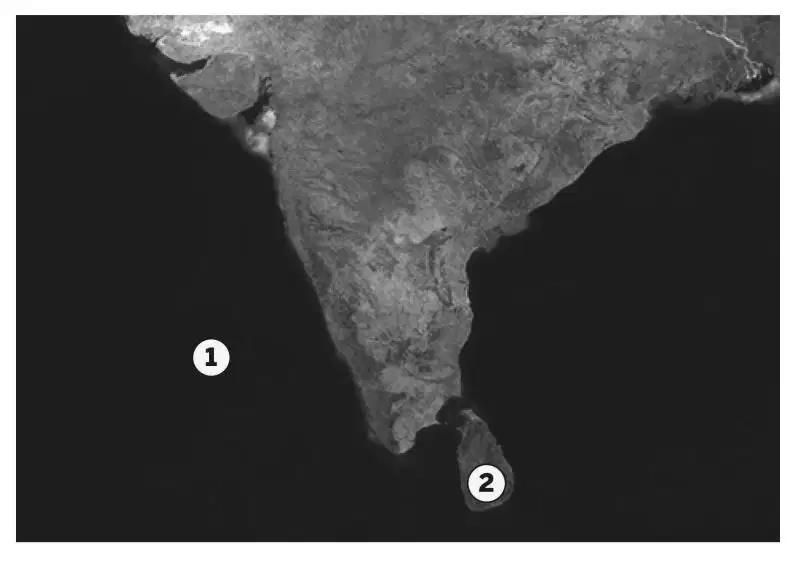
c)
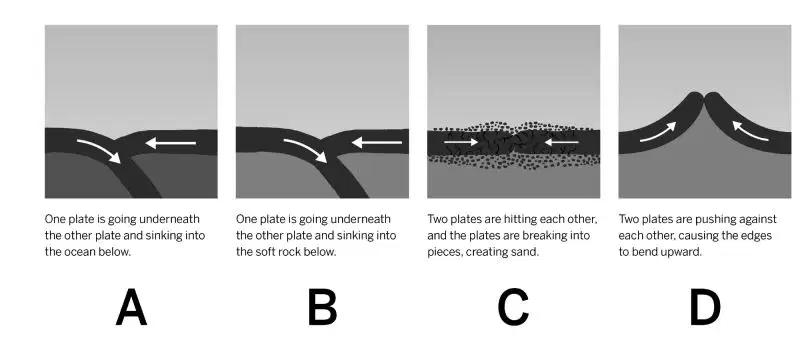
A tree that is on fire
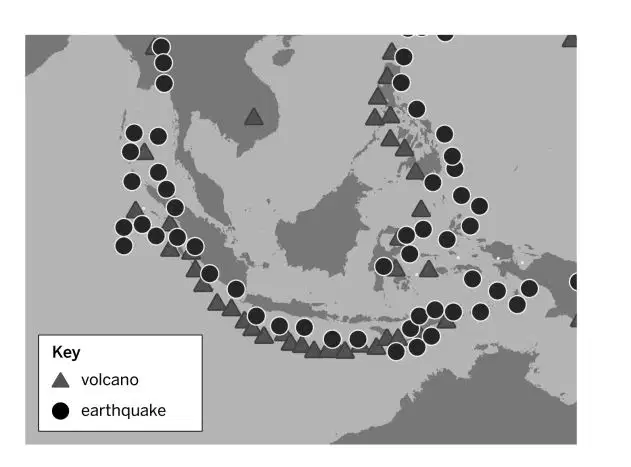
d)
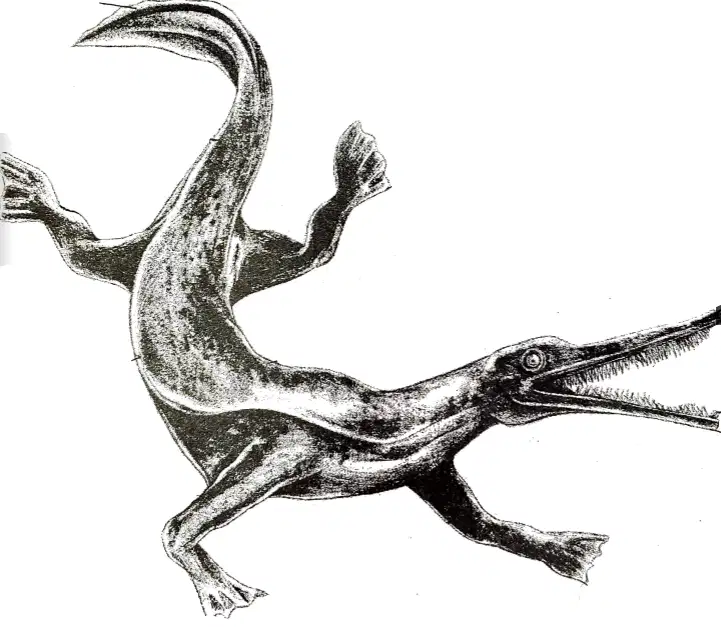
Dead leaf's sitting on the ground
10.
Key Concept
As organisms release energy during photosynthesis, carbon dioxide is produced from the carbon in energy storage molecules. This process moves carbon from biotic to abiotic matter.
a)
True
b)
False
11.
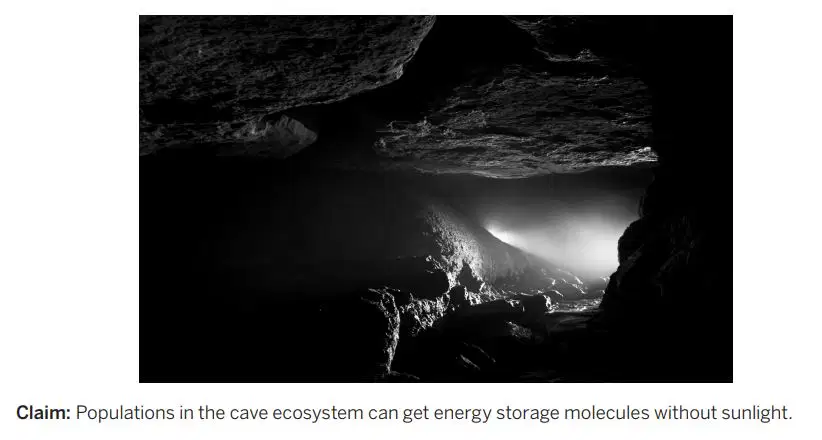
Is this claim correct?
a)
Yes
b)
No
c)
Maybe
12.
When we turned off the sunlight in the Sim what happened to the ecosystem?
a)
Nothing it was fine
b)
It did much better then when the sun was on
c)
It died
d)
It started to die but then recovered
13.
Which one of these is made during cellular respiration?
a)
Photosynthesis
b)
Carbon Dioxide
c)
Glucose
d)
Oxygen
14.
All living organisms do cellular respiration.
a)
True
b)
Flase
15.
Which organelle allows cellular respiration to take place?
a)
Cytoplasm
b)
Mitochondria
c)
Chloroplasts
d)
Lysosome
16.
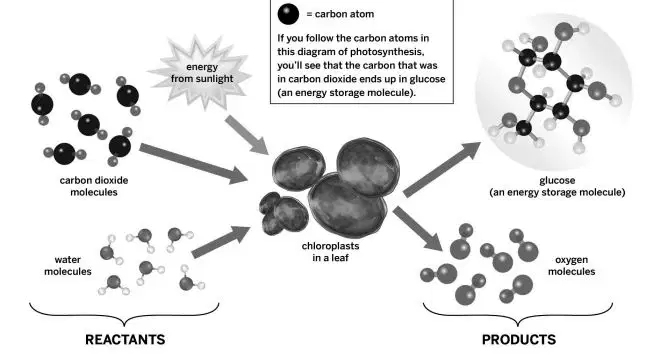
What's this called?
a)
Photo Respiration
b)
Photosynthesis
c)
Cellularsynthesis
d)
Cellular Respiration
17.
Which organelle allows photosynthesis to take place?
a)
Cytoplasm
b)
Mitochondria
c)
Chloroplasts
d)
Lysosome
18.
Check all that apply
What organisms do cellular respiration?
a)
Producers
b)
Consumers
c)
Decomposers
d)
Dead matter
19.
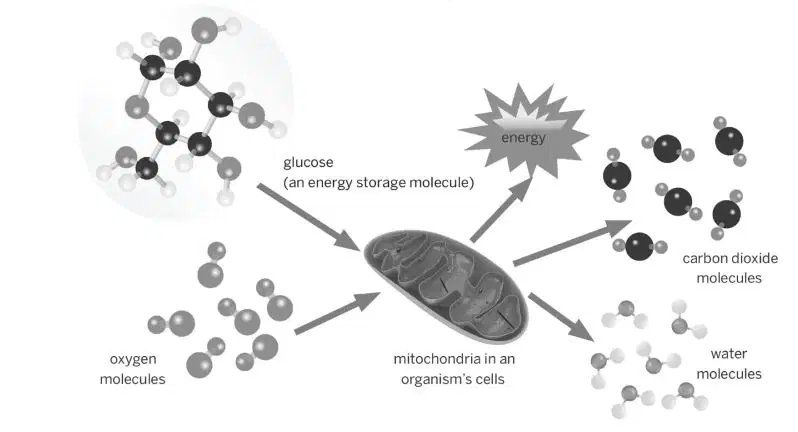
What's this called?
a)
Photo Respiration
b)
Photosynthesis
c)
Cellularsynthesis
d)
Cellular Respiration
20.
Check all that apply
What organisms here can do Photosynthesis?
a)
Tree
b)
Flower
c)
Cat
d)
Human
21.
Jaime is using the Sim and asks you for advice. He says, “I want an ecosystem that makes as many energy storage molecules as possible! What should I do to increase the number of energy storage molecules that producers can make?”
1. What should Jaime do to increase the number of energy storage molecules that producers can make? You may choose more than one answer.
There is more than 1 answer check all that apply
a)
Decrease the amount of carbon dioxide in the ecosystem.
b)
Increase the amount of carbon dioxide in the ecosystem.
c)
Decrease the amount of sunlight in the ecosystem.
d)
Increase the amount of sunlight in the ecosystem.
22.
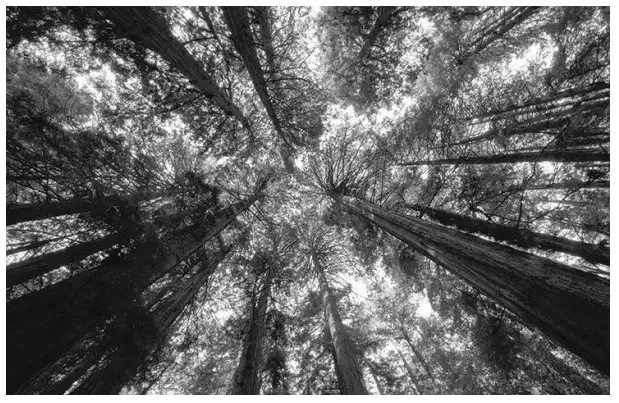
The sun has been up for several hours, and it has been shining on these trees. What can the trees do because they are in sunlight? What does this mean for the number of energy storage molecules in the trees?
The trees can . . .
a)
give off carbon to the air. Giving off carbon allows them to make energy storage molecules.
b)
give off carbon to the air. Giving off carbon uses up energy storage molecules.
c)
take in carbon from the air. The carbon is used to make energy storage molecules.
d)
take in carbon from the air. The carbon is used to break down energy storage molecules.
23.
Scientists are studying photosynthesis in a forest ecosystem that has plants, animals, and decomposers (which consume dead things). Which group or groups of organisms in the forest carry out photosynthesis?
a)
all organisms in the forest
b)
animals and decomposers
c)
plants and decomposers
d)
plants
24.
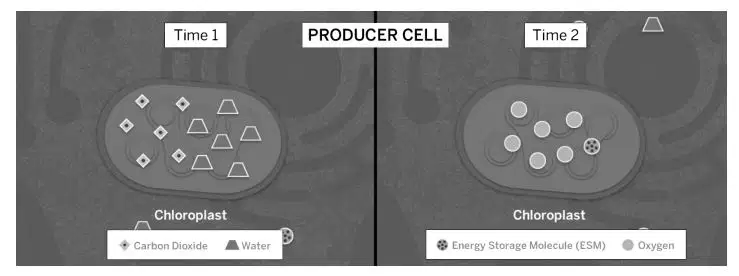
These images from the Sim show the same cell of a producer, but at two different times. What happened?
a)
It copied itself
b)
It became a chloroplast
c)
It went through photosynzthesis
d)
It went from biotic mater to abiotic matter
25.
Giant kelp are plantlike organisms that grow in clear ocean water. Over the last few hours some kelp has been taking in carbon from the water around it. Is the kelp in sunlight? What has happened to the number of energy storage molecules in the kelp?
The kelp . . .
a)
is in sunlight, and the number of energy storage molecules in the kelp has decreased.
b)
is in sunlight, and the number of energy storage molecules in the kelp has increased.
c)
is not in sunlight, and the number of energy storage molecules in the kelp has decreased.
d)
is not in sunlight, and the number of energy storage molecules in the kelp has increased.
26.
Scientists are studying photosynthesis in a desert ecosystem that has plants, animals, and decomposers (which consume dead things). Which group or groups of organisms in the desert carry out photosynthesis?
a)
plants
b)
plants and decomposers
c)
all organisms in the desert
d)
animals and decomposers
27.
An ivy plant has been taking in carbon from the air for several hours. Is the ivy in sunlight? What has happened to the number of energy storage molecules in the ivy? The ivy . . .
a)
is in sunlight. The number of energy storage molecules in the ivy has decreased.
b)
is in sunlight. The number of energy storage molecules in the ivy has increased.
c)
is not in sunlight. The number of energy storage molecules in the ivy has decreased.
d)
is not in sunlight. The number of energy storage molecules in the ivy has increased.
28.
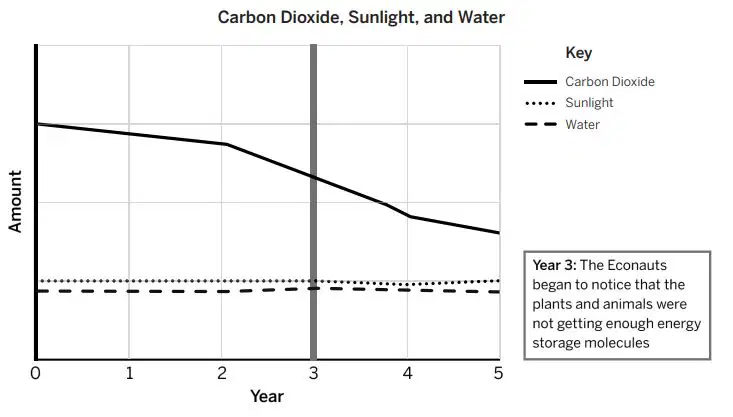
What change happened in the biodome according to this data?
a)
Sunlight increased
b)
Water increased
c)
Carbon Dioxide decreased
d)
Carbon Dioxide incressed
29.
Vocab question!!
What is a producer
a)
an organism that needs to eat in order to get energy storage molecules (such as starch and fat)
b)
an organism that can make its own energy storage molecules (such as glucose)
c)
a molecule that organisms can use to release the energy they need to survive
d)
matter that makes up the living and dead organisms in an ecosystem
30.
Vocab question!!
What is a consumer?
a)
the process by which plants and other producers use energy from sunlight to change carbon dioxide and water into oxygen and glucose (an energy storage molecule)
b)
an organism that can make its own energy storage molecules (such as glucose)
c)
all the living and nonliving things interacting in a particular area
d)
an organism that needs to eat in order to get energy storage molecules (such as starch and fat)
31.
Vocab question!!
What is carbon?
a)
a type of atom (a tiny piece) that makes up molecules such as carbon dioxide and energy storage molecules
b)
the process by which plants and other producers use energy from sunlight to change carbon dioxide and water into oxygen and glucose (an energy storage molecule)
c)
a molecule that organisms can use to release the energy they need to survive
d)
a molecule made of carbon and oxygen atoms
32.
Vocab question!!
What is carbon dioxide?
a)
a molecule that organisms can use to release the energy they need to survive
b)
all the living and nonliving things interacting in a particular area
c)
the process by which plants and other producers use energy from sunlight to change carbon dioxide and water into oxygen and glucose (an energy storage molecule)
d)
a molecule made of carbon and oxygen atoms
33.
Vocab question!!
What is photosynthesis?
a)
a type of atom (a tiny piece) that makes up molecules such as carbon dioxide and energy storage molecules
b)
the process by which plants and other producers use energy from sunlight to change carbon dioxide and water into oxygen and glucose (an energy storage molecule)
c)
an organism that needs to eat in order to get energy storage molecules (such as starch and fat)
d)
a molecule that organisms can use to release the energy they need to survive
34.
Vocab question!!
What is a energy storage molecule
a)
a molecule that organisms can use to release the energy they need to survive
b)
the process by which plants and other producers use energy from sunlight to change carbon dioxide and water into oxygen and glucose (an energy storage molecule)
c)
all the living and nonliving things interacting in a particular area
d)
a set of interacting parts forming a complex whole
35.
Vocab question!!
What is an ecosystem?
a)
the process by which plants and other producers use energy from sunlight to change carbon dioxide and water into oxygen and glucose (an energy storage molecule)
b)
a molecule that organisms can use to release the energy they need to survive
c)
matter that makes up the living and dead organisms in an ecosystem
d)
all the living and nonliving things interacting in a particular area
36.
Vocab question!!
What is a system?
a)
matter that makes up the living and dead organisms in an ecosystem
b)
a set of interacting parts forming a complex whole
c)
an organism that needs to eat in order to get energy storage molecules (such as starch and fat)
d)
a molecule made of carbon and oxygen atoms
37.
Jaime is using the Sim and asks you for advice. He says, “I want an ecosystem that makes as little energy storage molecules as possible! What should I do to decrease the number of energy storage molecules that producers can make?”
1. What should Jaime do to decrease the number of energy storage molecules that producers can make? You may choose more than one answer.
There is more than 1 answer check all that apply
a)
Decrease the amount of carbon dioxide in the ecosystem.
b)
Increase the amount of carbon dioxide in the ecosystem.
c)
Decrease the amount of sunlight in the ecosystem.
d)
Increase the amount of sunlight in the ecosystem.
38.
Vocab question!!
What is biotic matter?
a)
matter that makes up the nonliving parts of an ecosystem, such as air, water, and rocks
b)
matter that makes up the living and dead organisms in an ecosystem
c)
an organism that can make its own energy storage molecules (such as glucose)
d)
a set of interacting parts forming a complex whole
39.
Vocab question!!
What is abiotic matter?
a)
matter that makes up the living and dead organisms in an ecosystem
b)
a molecule that organisms can use to release the energy they need to survive
c)
an organism that can make its own energy storage molecules (such as glucose)
d)
matter that makes up the nonliving parts of an ecosystem, such as air, water, and rocks
40.
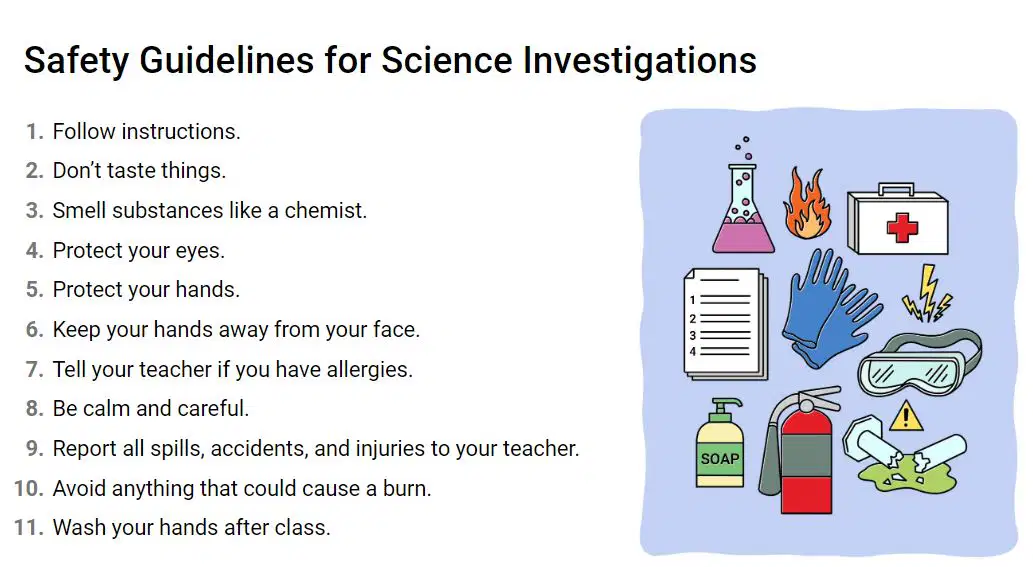
Oh no!!!
The person across from you spills a container of an unknown substance on the table!!
They see Mr. Dake did not notice and quickly clean it up. Its extremely obvious to you that they don't plan on telling Mr. Dake
Which safety Guideline should you follow?
a)
9
b)
1
c)
2
d)
3
e)
4
41.
Scale in science means?
a)
The object you weigh yourself on
b)
It's what fish have on there sides
c)
Something that is made of all the same atoms or groups of atoms
d)
The relative size of things
42.
During a chemical reaction, all of the atoms that make up the 1._____________ rearrange to form the 2.___________.
a)
1. chemicals 2. atoms
b)
1. reactants 2. products
c)
1. items 2. other items
d)
1. products 2. reactants
43.
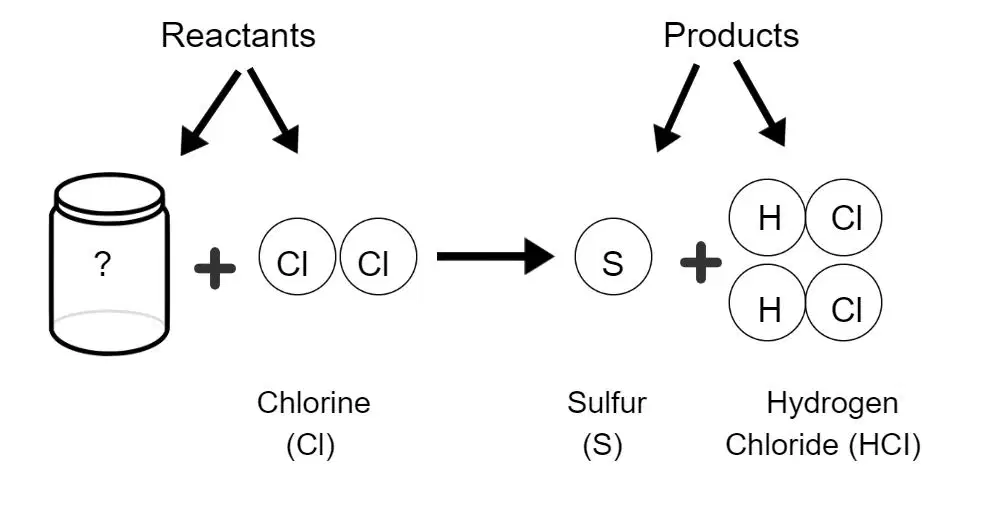
What was in the jar Jessie put the chlorine gas into?
a)
hydrogen sulfide (H2S)
b)
iron sulfide (FeS)
c)
sodium sulfide (Na2S)
d)
hydrogen (H2)
e)
sulfuric acid (H2SO4)
44.
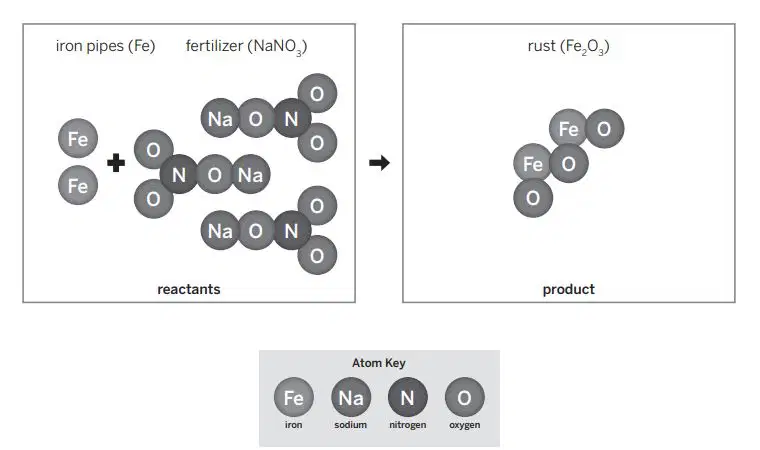
Which Claim was correct?
a)
Claim 1: During the chemical reaction, only the rust was produced.
b)
Claim 2: During the chemical reaction, the rust and another substance were produced.
45.
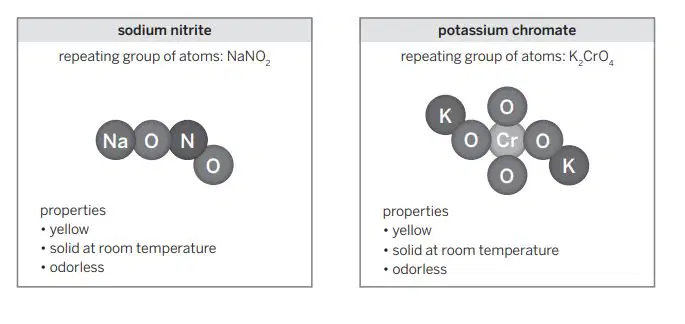
Based on these atomic-scale models, what other substance could be in the water besides rust?
a)
Sodium nitrite
b)
Potassium chromate
c)
Both
d)
Neither
46.
During a chemical reaction, atoms cannot be created or destroyed.
a)
True
b)
False
47.
What is the science definition of Product?
a)
An ending substance that is made during a chemical reaction
b)
A starting substance that is part of a chemical reaction
c)
Something a company makes to make money
d)
An object, diagram, or computer program that helps us understand something by making it simpler or easier to see
48.
During a chemical reaction, one or more starting 1._____________ change into one or more different 2._____________.
a)
1.rearrange 2. chemical reactions
b)
1. reactants 2. products
c)
1. products 2. reactants
d)
1. properties 2. models
49.
What is the science definition of Reactant?
a)
An ending substance that is made during a chemical reaction
b)
When two substances have different colors
c)
A starting substance that is part of a chemical reaction
d)
An object, diagram, or computer program that helps us understand something by making it simpler or easier to see
50.
In the city of Westfield what was the red substance in the water?
a)
Clothing dye from people washing there clothes wrong
b)
Iron oxide also known as rust
c)
Fertilizer
d)
Pipe substance
51.
Is burning a type of chemical reaction?
a)
Yes
b)
No
52.
Which claim is correct?
What happens to the atoms of a substance when it burns?
a)
Claim 1: All of the atoms are destroyed.
b)
Claim 2: All of the atoms rearrange to form a different substance or different substances.
c)
Claim 3: Some of the atoms are destroyed, and some of the atoms rearrange to form a different substance or different substances.
53.
Can atoms be destroyed?
a)
Yes
b)
No
c)
Sometimes
d)
Every time a chemical reaction happens
54.
What is an Endothermic reaction?
a)
it is a reaction where the energy in an object disappears form existence
b)
it is a reaction that takes in energy from its surroundings and stores the energy away
c)
it is a reaction that releases stored energy
d)
it is a reaction that can only happen on certain planets in our solar system
55.
What is an Exothermic reaction?
a)
it is a reaction where the energy in an object disappears form existence
b)
it is a reaction that takes in energy from its surroundings and stores the energy away
c)
it is a reaction that releases stored energy
d)
it is a reaction that can only happen on certain planets in our solar system
56.
Would you be able to get energy from your food if there weren't chemical reactions in your body?
a)
Yes
b)
No
c)
Maybe
57.
Which one of these models shows what happens when you burn ethanol?
a)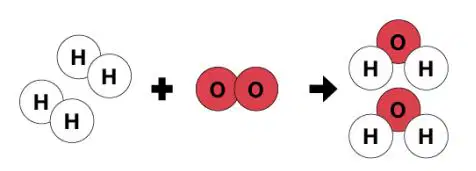
1
b)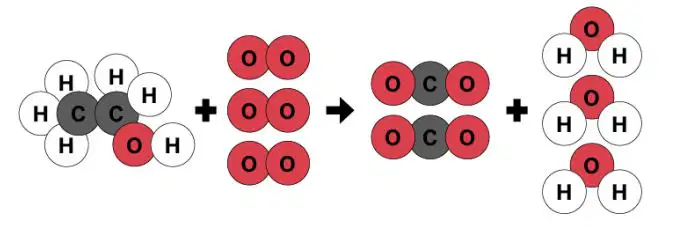
2
58.
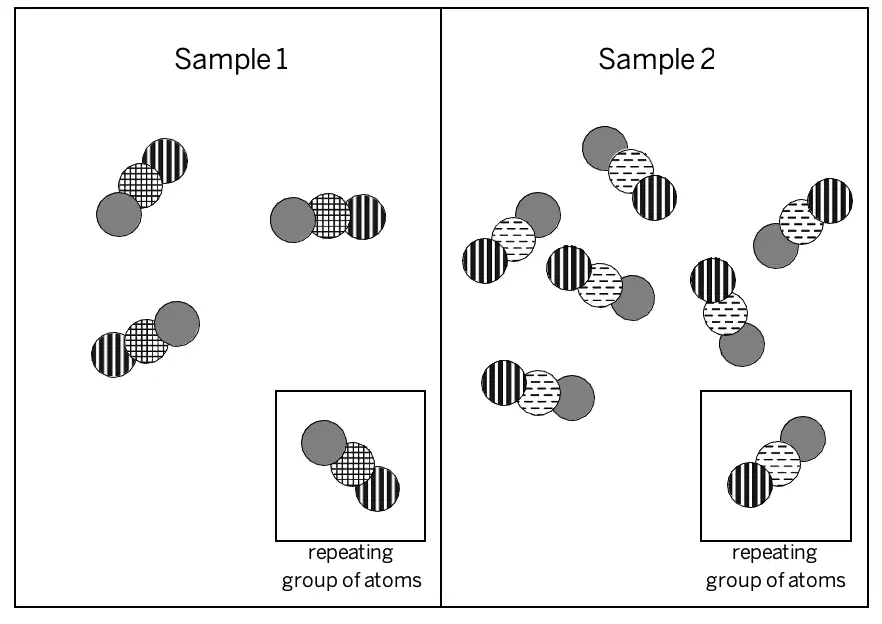
The diagram above shows the repeating groups of atoms that make up two samples. Will the properties of the two samples likely be the same or different? (Examples of properties are smell, color, and the temperature at which a substance melts.)
a)
The properties will likely be different because the repeating groups of atoms that make up each sample are different.
b)
The properties will likely be different because there are more repeating groups of atoms in Sample 2.
c)
The properties will likely be the same because the repeating groups of atoms that make up the two samples have the same number of atoms.
d)
The properties will likely be the same because the repeating groups of atoms that make up the two samples have two of the same types of atoms.
59.
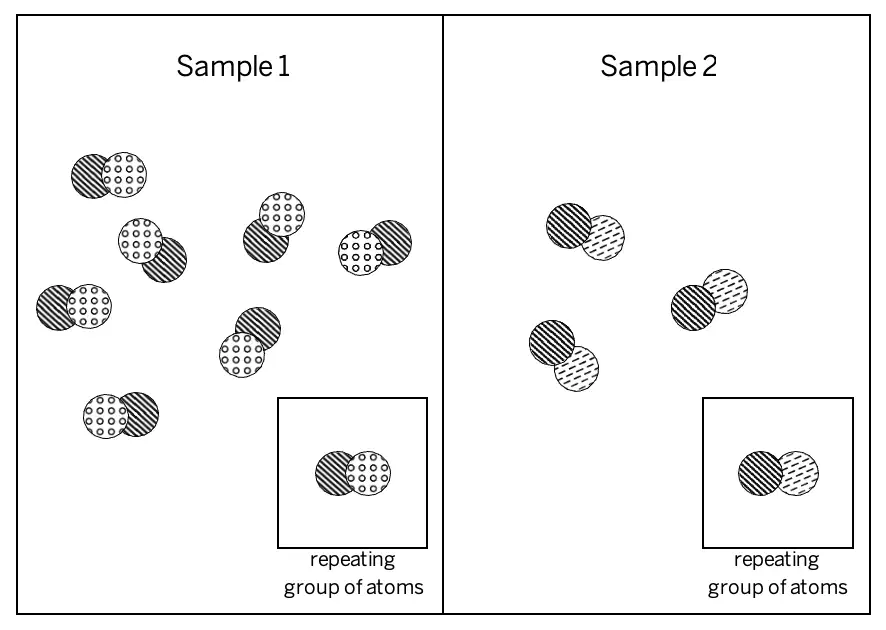
The diagram above shows the repeating groups of atoms that make up two samples. Will the properties of the two samples likely be the same or different? (Examples of properties are smell, color, and the temperature at which a substance melts.)
a)
The properties will likely be different because the repeating groups of atoms that make up each sample are different.
b)
The properties will likely be different because there are more repeating groups of atoms in Sample 1.
c)
The properties will likely be the same because the repeating groups of atoms that make up the two samples have one of the same types of atoms.
d)
The properties will likely be the same because the repeating groups of atoms that make up the two samples have the same number of atoms.
60.
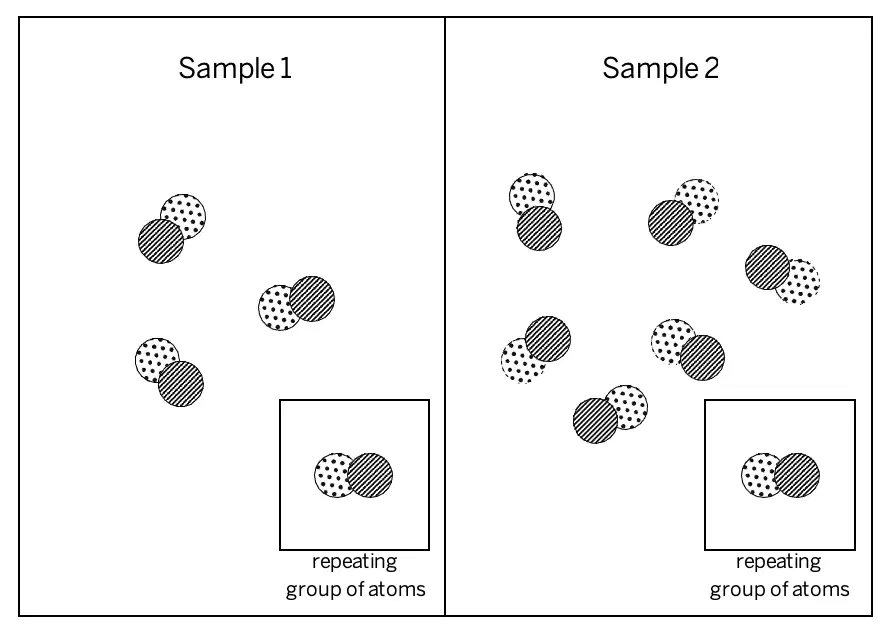
The diagram above shows the repeating groups of atoms that make up two samples. Both samples are green gases at room temperature. Will the other properties of the two samples be the same or different? (Examples of properties are smell, color, and the temperature at which a substance melts.)
a)
The other properties will be the same because the repeating groups of atoms that make up the two samples are the same.
b)
The other properties will be different because there are more repeating groups of atoms in Sample 2.
c)
The other properties will be the same because both samples are green at room temperature.
d)
The other properties will be the same because both samples are gases at room temperature.
61.
You mix two substances together the atoms move and rearrange what is this called?
a)
Model
b)
Substance
c)
Chemical reaction
d)
Property
62.
The diagram above shows the repeating groups of atoms that make up two samples. Both samples are liquid at room temperature. Will the properties of the two samples likely be the same or different? (Examples of properties are smell, color, and the temperature at which a substance melts.)
a)
The properties will likely be the same because the repeating groups of atoms that make up the two samples have the same types of atoms.
b)
The properties will likely be the same because both samples are liquids at room temperature.
c)
The properties will likely be different because the repeating groups of atoms that make up the two samples have different numbers of atoms.
d)
The graph shows too much fluctuation to be confident about a trend.
63.
Carbon atoms change into other types of atoms like hydrogen and oxygen when they need to for a chemical reactions.
a)
True
b)
False
64.
Which claim is correct?
a)
Claim 1: The iron pipes changed into rust
b)
Claim 2: The fertilizer changed into rust
c)
Claim 3: The iron pipes and the fertilizer changed into rust
d)
Claim 4: Someone called Rusty put the rust in the water
65.
What is the science definition of model?
a)
A person who wears clothes and walks down a runway
b)
An object, diagram, or computer program that helps us understand something by making it simpler or easier to see
c)
Someone you look up to
d)
A starting substance that is part of a chemical reaction
66.
Which of these is the correct order of labels?
a)
1. Atom 2. Extended structure 3. Repeating atom group 4. Molecules
b)
1. Atom 2. Repeating atom group 3. Extended structure 4. Molecules
c)
1. Repeating atom group 2. Atom 3. Extended structure 4. Molecules
d)
1. Molecules 2. Repeating atom group 3. Extended structure 4. Atom
67.
Substances have different properties because they are made of different groups of atoms. These groups vary in the type or number of atoms that make up the group
a)
True
b)
False
68.
Atom in science means?
a)
Something that is made of all the same atoms or groups of atoms
b)
The tiny pieces that all matter, all the stuff in the world, is made of
c)
Something that can be observed about a substance, such as its color, smell, or boiling point
d)
The relative size of things
69.
Property in science means?
a)
Land you can own
b)
The items that you own such as a cellphone or hat
c)
Something that can be observed about a substance, such as its color, smell, or boiling point
d)
Something that is made of all the same atoms or groups of atoms
70.
Different substances have different properties.
a)
True
b)
False
71.
Which of these is on the macroscale
a)
The individual atoms in a table
b)
A pen you can see
c)
The atoms in the air
d)
Microscopic bacteria you can not see without a microscope
72.
All the atoms in this water bottle are the same. As a scientist what would we call the water in this bottle?
a)
Macroscale
b)
Substance
c)
Scale
d)
Property
73.
Which of these is considered a property?
a)
Smell
b)
Color
c)
Boiling Point
d)
All of these are property's
74.
What is the human made material that looks like diamonds called?
a)
Cubic Zirconia
b)
Adamantium
c)
Dilithium
d)
Vibranium
75.
What chemical substance would make orange juice taste like sweaty gym socks?
a)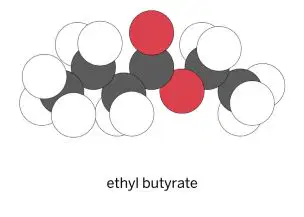
Ethyl Butrate
b)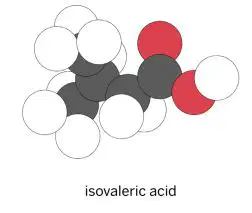
Isovaleric Acid
76.
Substance in science means?
a)
Something that can be observed about a substance, such as its color, smell, or boiling point
b)
Something that is made of all the same atoms or groups of atoms
c)
The temperature at which a substance changes from the liquid phase to the gas phase
d)
The relative size of things
77.
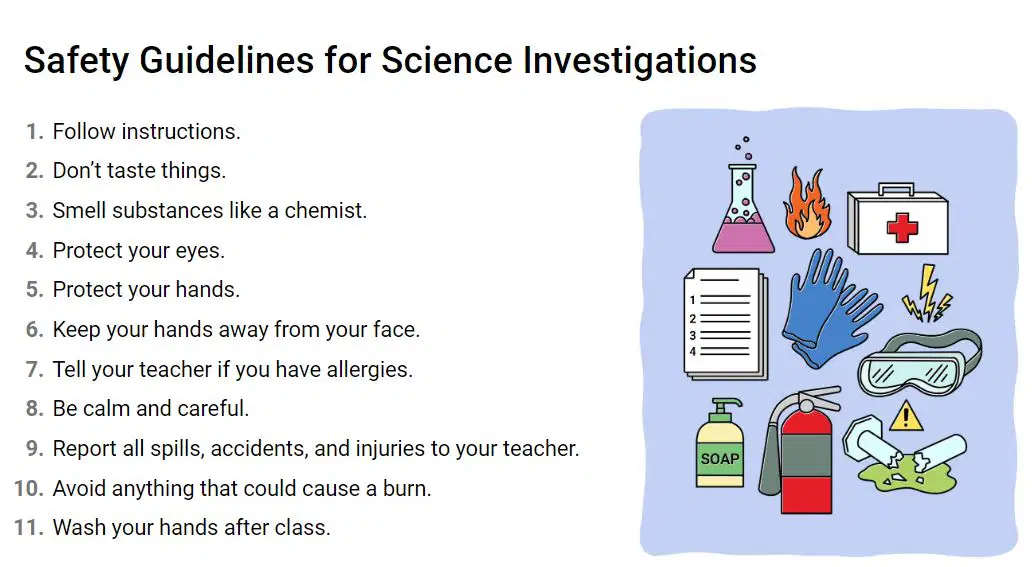
Oh no!!!
The person across from you opened one of the samples and is daring their partner to taste what's inside.
Which safety Guideline is not being followed?
a)
2
b)
1
c)
3
d)
4
e)
5
78.
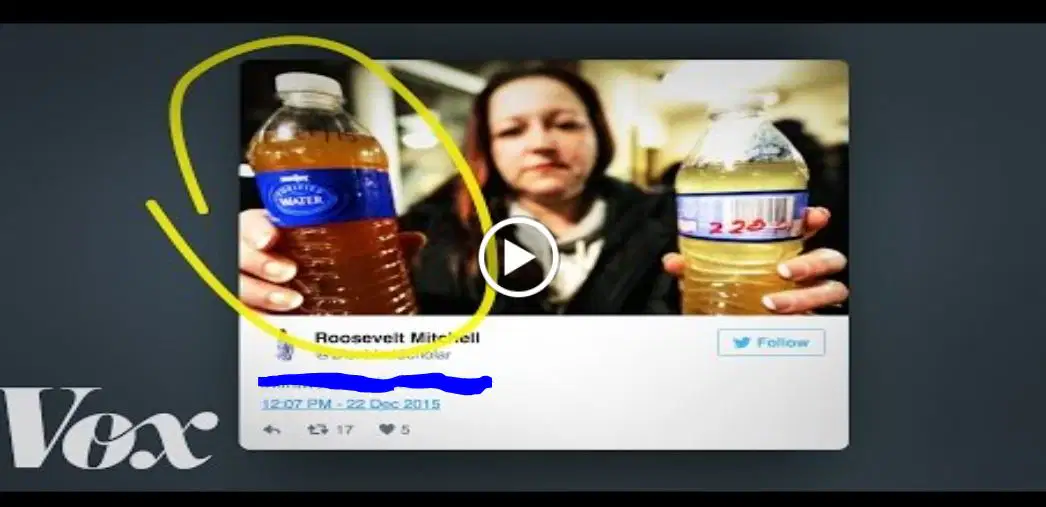
What real life location had lead in its water in 2016?
a)
Fresno Michigan
b)
Ferndale Michigan
c)
Flint Maryland
d)
Flint Michigan
79.
3 students are given a sample of a substance. Each is asked to write down an observation of its property's. Which student did the best job on there observation?
a)
Student 1: It is white and in small pieces
b)
Student 2: It is white, grainy, and looks like crystals
c)
Student 3: It is ugly in color and solid
80.
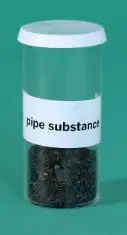
If you are asked to describe a property of this sample What would be the best example of an observation you could make?
a)
Its a solid
b)
Its dark in color
c)
It is black and its texter is grainy
d)
It's heavy
81.
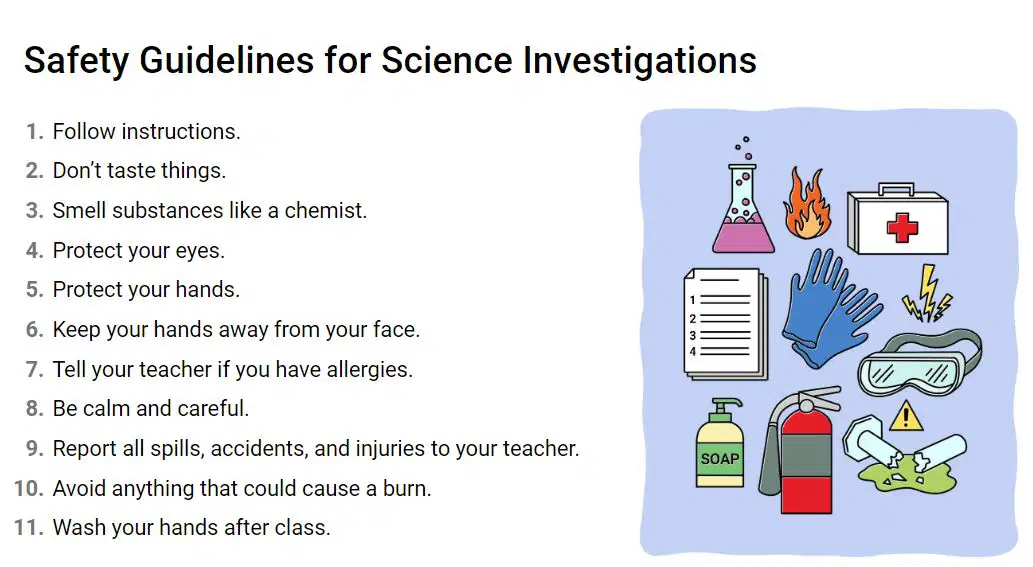
Oh no!!!
The person across from you told you that they are allergic to baking soda a few days ago. Today Mr. Dake said we are using baking soda in an experiment and the person across from you is choosing to not tell Mr. Dake
Which safety Guideline is not being followed?
a)
7
b)
1
c)
2
d)
3
e)
4
82.
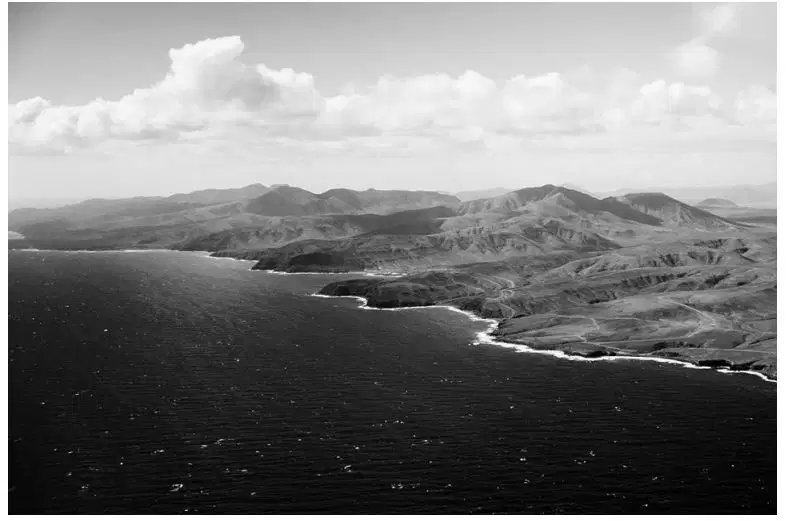
Which statement best describes what Earth’s outer layer is like underneath the surface in the image?
a)
Underneath both the soil and the ocean, Earth’s outer layer is made of sand and water.
b)
Underneath both the soil and the ocean, Earth’s outer layer is made of hard, solid rock.
c)
Underneath the soil, Earth’s outer layer is made of hard, solid rock. Underneath the ocean, Earth’s outer layer is made of sand.
d)
Underneath the soil, Earth’s outer layer is made of water.
83.
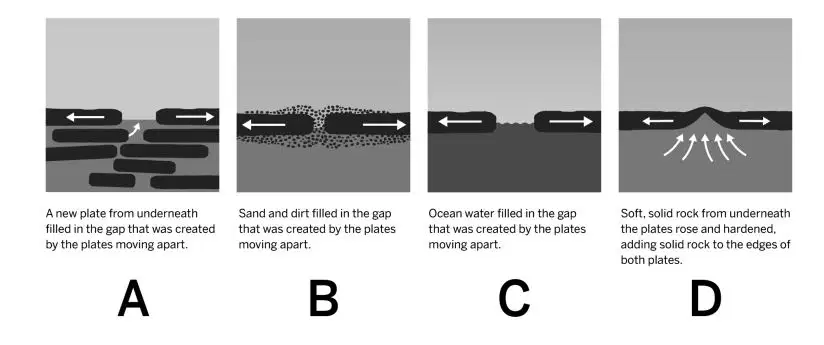
Dr. Raisa and her team of geologists have been studying GPS data that shows that two plates moved apart. Which diagram shows what happened between the two plates as they moved away from each other?
a)
Diagram A: A new plate from underneath filled in the gap that was created by the plates moving apart.
b)
Diagram B: Sand and dirt filled in the gap that was created by the plates moving apart.
c)
Diagram C: Ocean water filled in the gap that was created by the plates moving apart.
d)
Diagram D: Soft, solid rock from underneath the plates rose and hardened, adding solid rock to the edges of both plates.
84.
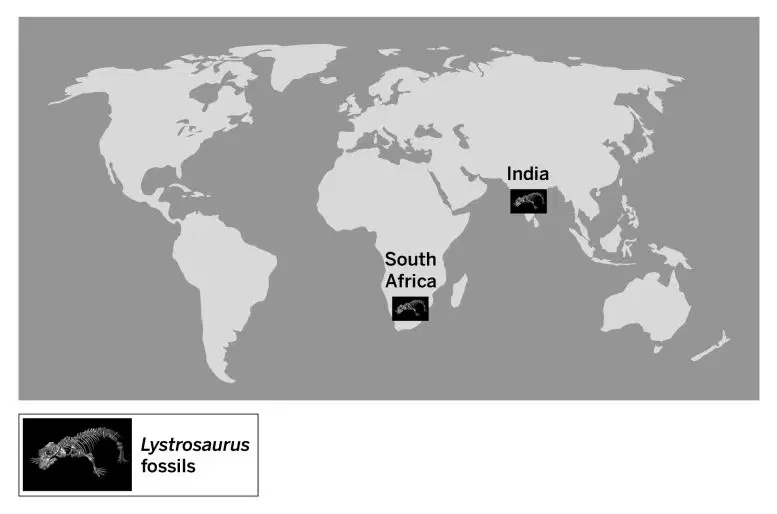
Fossil remains of Lystrosaurus (an extinct four-legged animal) have been discovered in India and South Africa. When they were living, all the Lystrosaurus lived together on land, and they could not swim. However, now there is an ocean between the Lystrosaurus fossils. What could explain how these fossils got so far apart?
a)
India and South Africa are parts of different plates. The plates slowly moved far apart as soft, solid rock from underneath got added to the edges of the plates over millions of years.
b)
India and South Africa are parts of different plates. The plates floated away from each other across the ocean.
c)
India and South Africa are parts of different plates. The plates slowly moved apart as new plates from underneath got added between them over millions of years
d)
India and South Africa are parts of different plates. The plates were sometimes pushed far apart by earthquakes, and soft, solid rock from underneath got added to the edges of the plates
85.
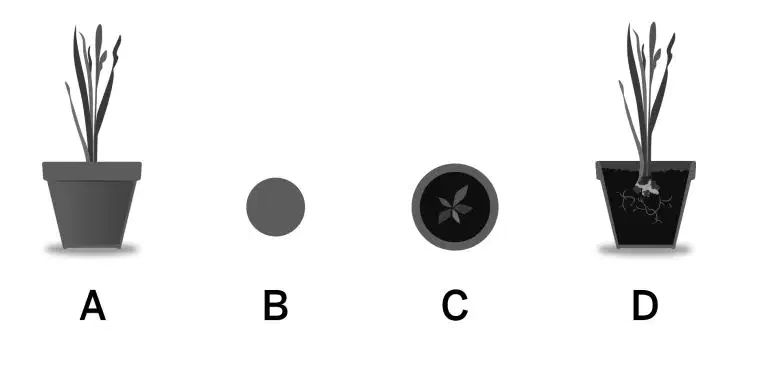
Scientists often study cross sections to better understand what the inside of something looks like. If we took a cross section of a potted plant by cutting it vertically, what would the cross section look like?
a)
A
b)
B
c)
C
d)
D
86.
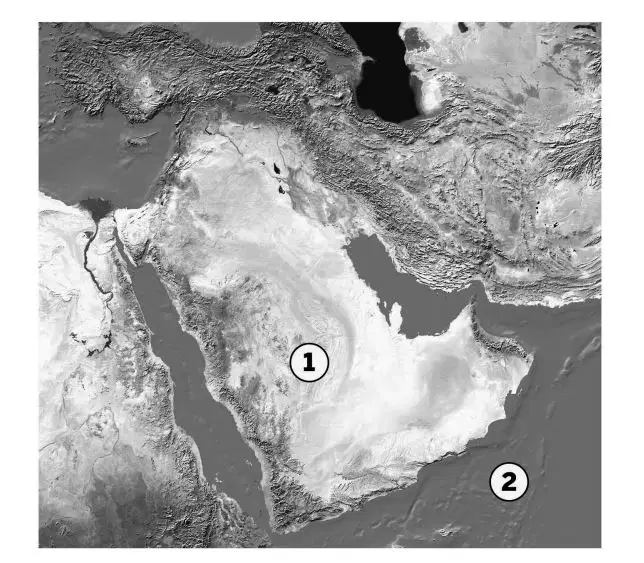
A team of geologists wants to study hard, solid rock under the surface of Earth. The team is considering drilling down in Saudi Arabia (1) or in the Arabian Sea (2). Where will the geologists find hard, solid rock?
a)
neither under 1 nor 2, because there is sand and gravel under both places
b)
neither under 1 nor 2, because there is water under both places
c)
under 1 and 2, because Earth’s entire outer layer is made of hard, solid rock
d)
only under 1, because Earth’s outer layer is made of hard, solid rock under continents but not under the ocean
87.
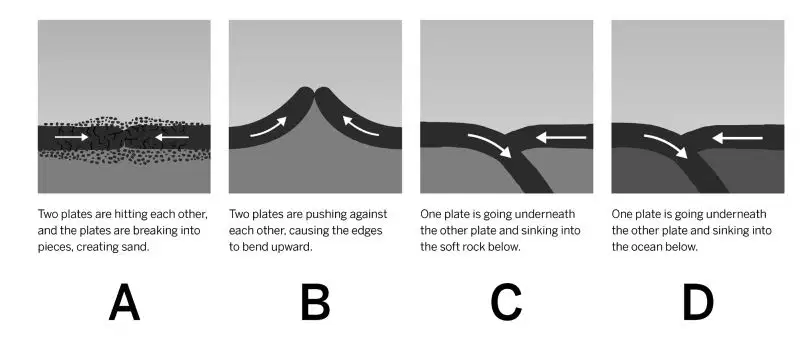
Dr. Patel and her team have been using GPS to track two plates that are moving toward each other. Which diagram shows what is happening at the place where the plates are moving toward each other?
a)
Diagram A: Two plates are hitting each other, and the plates are breaking into pieces, creating sand.
b)
Diagram B: Two plates are pushing against each other, causing the edges to bend upward.
c)
Diagram C: One plate is going underneath the other plate and sinking into the soft rock below.
d)
Diagram D: One plate is going underneath the other plate and sinking into the ocean below.
88.

Similar rock formations have been discovered in Brazil and South Africa. These rock formations were formed at the same time and are made of the same types of rocks. What could explain how these rocks got so far apart?
a)
Brazil and South Africa are parts of different plates. The plates were sometimes pushed far apart by earthquakes, and soft, solid rock from underneath got added to the edges of the plates.
b)
Brazil and South Africa are parts of different plates. The plates floated away from each other across the ocean.
c)
Brazil and South Africa are parts of different plates. The plates slowly moved apart as new plates from underneath got added between them over millions of years.
d)
Brazil and South Africa are parts of different plates. The plates slowly moved far apart as soft, solid rock from underneath got added to the edges of the plates over millions of years.
89.
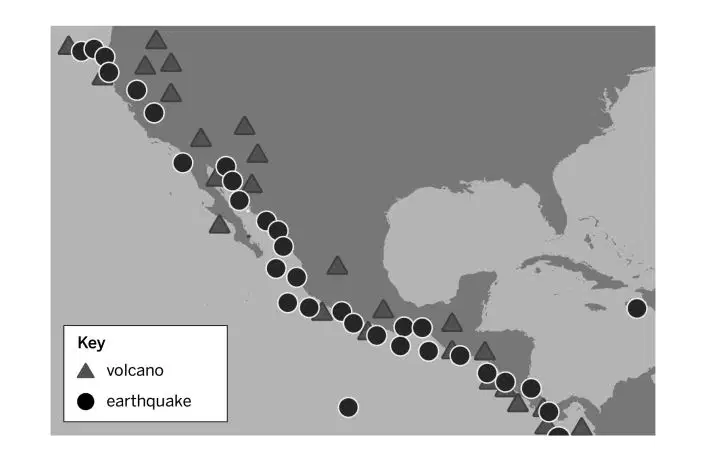
Patterns on this map tell us that . . .
a)
volcanic activity and earthquakes can cause damage to buildings and hurt people.
b)
volcanic activity and earthquakes happened in similar areas.
c)
volcanic activity and earthquakes happened in random locations all over the map.
d)
volcanic activity and earthquakes happened in the following order: volcanic activity, earthquake, volcanic activity, earthquake, and so on.
90.
Which statement best describes what Earth’s outer layer is like underneath the surface in the image?
a)
Underneath the soil, Earth’s outer layer is made of water.
b)
Underneath the soil, Earth’s outer layer is made of hard, solid rock. Underneath the ocean, Earth’s outer layer is made of sand.
c)
Underneath both the soil and the ocean, Earth’s outer layer is made of hard, solid rock.
d)
Underneath both the soil and the ocean, Earth’s outer layer is made of sand and water.
91.
Dr. Bailey and his team are studying two plates that are far apart from each other. However, these two plates used to be next to each other. Which diagram shows what Dr. Bailey and his team would find between these plates?
a)
Diagram A: Soft, solid rock from underneath the plates rose and hardened, adding solid rock to the edges of both plates.
b)
Diagram B: A new plate from underneath filled in the gap that was created by the plates moving apart.
c)
Diagram C: Sand and dirt filled in the gap that was created by the plates moving apart
d)
Diagram D: Ocean water filled in the gap that was created by the plates moving apart.
92.
In the past, Africa used to be farther away from Europe than it is now (shown above). What could explain why Africa is closer to Europe now than it was before?
a)
Africa and Europe are parts of different plates. The plates floated toward each other across the ocean.
b)
Africa and Europe are parts of different plates. The plates were sometimes pushed toward each other by earthquakes, and one plate went under the other plate into soft, solid rock.
c)
Africa and Europe are parts of different plates. The plates slowly moved toward each other over millions of years. When the plates hit each other, they broke into smaller pieces.
d)
Africa and Europe are parts of different plates. The plates slowly moved toward each other as one plate went under the other plate into soft, solid rock over millions of years.
93.
Scientists often study cross sections to better understand what the inside of something looks like. If we took a cross section of an apple by cutting it vertically, what would the cross section look like?
a)
A
b)
B
c)
C
d)
D
94.
A team of engineers wants to study hard, solid rock under the surface of Earth. The team is considering drilling down in the Indian Ocean (1) and in Sri Lanka (2). Where will the team find hard, solid rock?
a)
under 1 and 2, because Earth’s entire outer layer is made of hard, solid rock
b)
only under 2, because Earth’s outer layer is made of hard, solid rock underneath continents but not under the ocean
c)
neither under 1 nor 2, because there is water underneath both places
d)
neither under 1 nor 2, because there is sand and gravel underneath both places
95.
A team of researchers has been using GPS data to track two plates that are moving toward each other. Which diagram shows what is happening at the place where the plates are moving toward each other?
a)
Diagram A: One plate is going underneath the other plate and sinking into the ocean below.
b)
Diagram B: One plate is going underneath the other plate and sinking into the soft rock below.
c)
Diagram C: Two plates are hitting each other, and the plates are breaking into pieces, creating sand.
d)
Diagram D: Two plates are pushing against each other, causing the edges to bend upward.
96.
Patterns on this map tell us that . . .
a)
volcanic activity and earthquakes happened in the following order: volcanic activity, earthquake, volcanic activity, earthquake, and so on.
b)
volcanic activity and earthquakes happened in random locations all over the map.
c)
volcanic activity and earthquakes can cause damage to buildings and hurt people.
d)
volcanic activity and earthquakes happened in similar areas.
97.
What is the name of this creature?
a)
Stegosaurus
b)
Megalosaurus
c)
Mesosaurus
d)
Spinosaurus
98.
Which claim is correct?
a)
Claim 1: Plates move, which can cause earthquakes.
b)
Claim 2: Earthquakes cause the plates to move.
99.
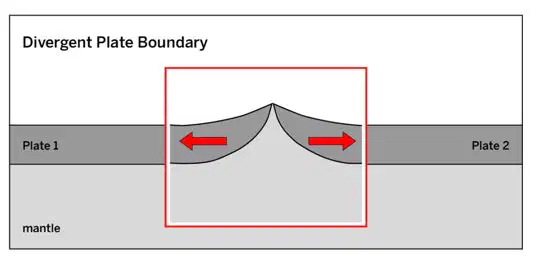
When plates move away from each other, what landform forms?
a)
Mid-ocean ridge
b)
Plate Boundary
c)
Mantle
d)
Trench
100.
If the mantle is cold will plates move?
a)
Yes they will move.
b)
No they will not move.
c)
The mantle has nothing to do with plates moving.
d)
Water makes the plates move not the mantle.
100 %

