Wayground logo

Free Printable Worksheets

Font size

S
M
L
XL
Worksheets

Unit 2 (Characteristics of Matter) Midterm Review

Total questions: 40

Worksheet time: 53mins

Name
Class
Date
1.
What phase change(s) may occur at pressures below 4.58 mmHg?
a)
sublimation/deposition
b)
melting/freezing
c)
all phase changes are possible at these pressures
d)
vaporization/condensation
2.
Water exists as a _____________ at 700 mmHg and 50 °C.
a)
solid
b)
liquid
c)
gas
d)
supercritical fluid
3.
Water exists as a _____________ at 3 mmHg and 50 °C.
a)
solid
b)
liquid
c)
gas
d)
supercritical fluid
4.
The pressure is increased on a sample of water at 0 °C from 0 mmHg to 800 mmHg.  In order, what changes occur?
a)
deposition, melting
b)
sublimation, melting
c)
condensation, freezing
d)
deposition, freezing
5.

Length

a)

Intensive Property

b)

Extensive Property

6.

Density

a)

Intensive Property

b)

Extensive Property

7.

Melting point

a)

Intensive Property

b)

Extensive Property

8.

Color

a)

Intensive Property

b)

Extensive Property

9.

Heat changes H2O to steam

a)

Physical Change

b)

Chemical Change

10.

NaCl (salt) dissolves in water

a)

Physical Change

b)

Chemical Change

11.

Boiling point

a)

Physical Property

b)

Chemical Property

12.

Reacts with water

a)

Physical Property

b)

Chemical Property

13.

Solubility

a)

Physical Property

b)

Chemical Property

14.

Flammability

a)

Physical Property

b)

Chemical Property

15.
What is a homogeneous mixture?
a)
a mixture that is the same throughout.
b)
a mixture that is made up of one type of atom.
c)
a mixture that is made up of one type of compound
d)
a mixture that cannot be separated through physical changes
16.
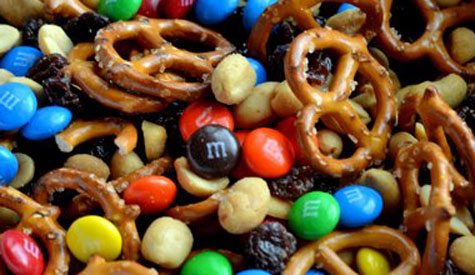
What type of mixture is this?
a)
homogenous mixture
b)
chemical
c)
heterogeneous mixture 
d)
solid mix
17.
Aluminum
a)
Element
b)
Compound
c)
Homogeneous Mixture
d)
Heterogeneous Mixture
18.
Sweet Tea
a)
Element
b)
Compound
c)
Homogeneous Mixture
d)
Heterogeneous Mixture
19.

What is CO2 and example of?

a)

element

b)

molecule

c)

compound

20.
Which of the following is a sign that a chemical reaction has occurred?
a)
change in shape
b)
melting
c)
formation of a gas
d)
dissolving
21.
Which of the following is NOT an example of a physical change?
a)
crumpled paper
b)
pencil sharpening
c)
shrunken clothing
d)
rust
22.
A solid piece of chocolate is melted and changed to liquid form. Which property of the piece of chocolate will remain the same?
a)
Texture
b)
Temperature
c)
Shape
d)
 Mass
23.
A material was cooled from 100ºC to 40ºC.  What is the temperature change?
a)
60ºC
b)
40ºC
c)
-60ºC
d)
-40ºC
24.
A sample of iron receives 50.J of heat energy that raises the temperature of the iron 25.0°C. If iron has a specific heat of  0.10 J/g°C, what is the mass of the iron sample?
a)
25 g
b)
30 g
c)
20 g
d)
50 g
25.
You have 20 g of water with specific heat of 4.18 J/gŸ°C.  The temperature changes from 25° C to 20° C.  How much heat energy (Q) moves from the water to the surroundings?
a)
418 Joules
b)
209 J
c)
83 J
d)
4.18 J
26.

If 96.5 grams of gold has a volume of 5 cm3 , what is the density of gold?

Hint: density = mass/volume

a)

482.5 g/cm3

b)

19.3 g/cm3

c)

0.05 g/cm3

d)

101.5 g/cm3

27.

If the density of a diamond is 3.5 g/cm3 , what would be the mass of a diamond whose volume is .5 cm3?

Hint: density = mass/volume

a)

1.75 g

b)

7 g

c)

0.14 g

d)

4 g

28.

If a 96.5g piece of aluminum has a density of 2.7 g/cm3, what is its volume?

Hint: density = mass/volume

a)

35.7 cm3

b)

260.55 cm3

c)

0.03 cm3

d)

99.2 cm3

29.

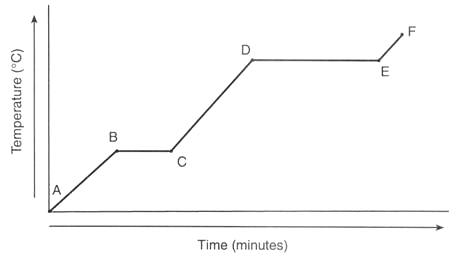
What is happening to the particles in the substance between points D and E?

a)

Melting

b)

Freezing

c)

Vaporizing

d)

Sublimating

30.
What is deposition?
a)
Phase change from gas to solid
b)
phase change from liquid to solid
c)
Phase change from solid to gas
d)
Phase change from liquid to gas
31.
What is sublimation?
a)
phase change between solid and liquid
b)
pahse change from gas to solid
c)
phase change from solid to gas
d)
phase change from solid to solid
32.
Melting is ...
a)
liquid to solid
b)
solid to liquid
c)
solid to gas
d)
gas to liquid
33.
Freezing is...
a)
Solid to gas
b)
Liquid to solid
c)
Gas to solid
d)
Liquid to gas
34.
Boiling is ...
a)
liquid to gas
b)
gas to solid
c)
gas to liquid
d)
solid to liquid
35.

Between which points is water changing its temperature?

a)

A <----> B

b)

B <----> C

c)

C <----> D

d)

D <----> E

e)

E <----> F

36.

Between which points is water changing states of matter?

a)

A <----> B

b)

B <----> C

c)

C <----> D

d)

D <----> E

e)

E <----> F

37.
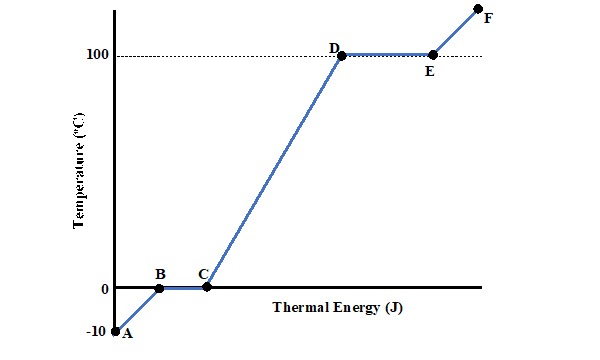
A substance's heating curve is shown in the graph.  What is its boiling point?
a)
100 C
b)
60 C
c)
80 C
d)
20 C
38.
True or false: melting and freezing occur at the same temperature!
a)
True
b)
False
c)
I don't know
39.
What state(s) of matter are present at D-E?
a)
Solid-liquid
b)
Liquid
c)
Liquid-gas
d)
Gas-Solid
40.
What line segment represents only the solid state?
a)
A-B
b)
B-C
c)
C-D
d)
D-E