wayground logo

Free Printable Worksheets

Font size

S
M
L
XL
Worksheets

Unit 2 Review: Formulas & Chemical Reactions

Total questions: 70

Worksheet time: 53mins

Name
Class
Date
1.
A compound is ___
a)
a pure element
b)
composed only of metals
c)
is a combination of two or more elements
d)
has the same properties as its parts
2.
How many aluminum atoms are in Al2O3 ?
a)
1
b)
2
c)
3
d)
5
3.

What word below is used in counts the number of molecules you have of a substance

a)

coefficient

b)

subscript

c)

exponent

d)

chemical formula

4.

What determines the number of atoms of an element in a chemical formula?

a)

coefficient

b)

subscript

c)

chemical symbol

d)

atomic number

5.

What is the coefficient for this formula? 9NaCl2

a)

9

b)

2

c)

1

d)

11

6.

How many total atoms are in this formula? 3Zn2O3H

a)

6

b)

9

c)

18

7.

Which of the following best explains the relationship between molecules and atoms?

a)

Atoms are molecules that have a charge.

b)

Atoms have smaller parts, called molecules.

c)

Molecules are made up of two or more atoms.

d)

Molecules are atoms that have no mass.

8.

Rust forming on a piece of iron is an example of which of the following:

a)

A physical change because the process can be reversed

b)

The natural process of decay as metallic ions age

c)

A chemical change because oxygen atoms from the atmosphere bonded with the iron atoms

9.

During a chemical reaction, substances (called reactants) are combined to form new substances (called products). Which of the following accurately describes the reactants and the products of a chemical reaction?

a)

The products contain a different number of atoms than the reactants but have the same properties.

b)

The number of atoms and the properties are the same in the reactants and the products.

c)

The products contain the same number of atoms as the reactants but have different properties.

d)

The number of atoms and the properties are different in the reactants and the products.

10.

Which of the following is NOT an indicator of a chemical reaction?

a)

A phase change

b)

A temperature change

c)

A color change

d)

A gas being created

11.

Which of the following is true regarding the atoms involved in a chemical reaction?

a)

The same number of each type of atom will always be present before and after a chemical reaction takes place.

b)

Some of the atoms present before the reaction will always be lost during a chemical reaction.

c)

Some of the atoms will always be changed into a different type of atom by a chemical reaction.

d)

Some of the atoms will always be changed into a different type of atom by a chemical reaction.

12.

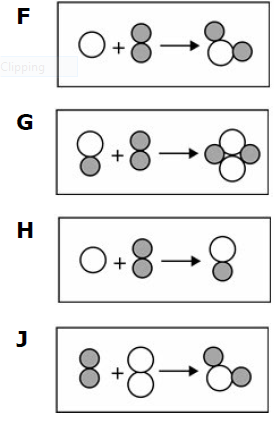
Which of the following atomic models of chemical reactions correctly demonstrates the Law of Conservation of Matter?

a)
b)
c)
d)
13.

What type of change is rusting or burning?

a)

A physical change

b)

A chemical change

14.
Which of the following lists all the elements that are present in a molecule of potassium carbonate, K2CO3 ?
a)

Arbon and Oxygen

b)
phosphate and calcium
c)
potassium, carbon, and oxygen
d)
phosphorus, oxygen, and calcium
15.
The formula for glucose is C6H12O6. How many elements does glucose contain?
a)
1
b)
3
c)
24
d)
432
16.

Acetic acid is a compound found in vinegar. The chemical formula for acetic acid is CH3COOH.

How many different elements are in acetic acid?

a)
3
b)
5
c)
6
d)
8
17.
A student mixes two solutions, planning to produce carbon dioxide. Which of the following is the BEST evidence that a chemical reaction is producing carbon dioxide?
a)
color change
b)
formation of a solid
c)
temperature change
d)
formation of bubbles
18.
Students collect rock samples on a field trip and test them for different properties. Which of the following is a chemical property of rocks?
a)
having a white color
b)
reacting when tested with a drop of acid
c)
having a rough surface
d)
being easy to scratch with a piece of metal
19.
The chemical formula for sodium sulfate is Na2SO4. How many sulfur atoms are in the formula for sodium sulfate?
a)
1
b)
2
c)
6
d)
7
20.
How many atoms are in one molecule of baking soda, NaHCO3?
a)
5
b)
4
c)
12
d)
6
21.

Cu + 2AgNO3 2Ag + Cu(NO3)2

How many copper (Cu) atoms are there in 

Cu(NO3)2 ?

a)
1
b)
2
c)
5
d)
6
22.

Serotonin is a chemical substance that acts as a neurotransmitter. It helps relay messages in the human brain. The formula for one molecule of serotonin is shown below.

C10H12N2O

How many atoms in all are in a molecule of serotonin?

a)
1
b)
4
c)
24
d)
25
23.

2AgNO3 + CaCl2 --> 2AgCl + Ca(NO3)2

Identify the products in the chemical equation above.

a)
2AgNO3 and CaCl2
b)
2AgCl and Ca(NO3)2
c)
CaCl2 and Ca
d)
Ag, Cl, N, and Ca
24.
NaOH + HCl --> NaCl + H2O Identify the reactants in the chemical equation above.
a)
NaOH and HCl
b)
NaCl and H2O
c)
HCl and H2O
d)
HCl and NaCl
25.
Which of the following is a compound?
a)
Co
b)
O2
c)
C
d)
CO2
26.
Which of the following is NOT an element?
a)
H2O
b)
H2
c)
O2
d)
Au
27.
How many atoms are there TOTAL in:
H2SO4
a)
6
b)
5
c)
7
d)
3
28.
How many Hydrogen are in 4H2O?
a)
6
b)
8
c)
2
d)
4
29.
How many molecules are in 10MgCl2?
a)
10
b)
2
c)
30
d)
13
30.
All of the following are chemical changes except
a)
iron rusting
b)
water evaporating
c)
wood burning
d)
food rotting
31.
How many atoms of carbon (C) are in C6H12O6?
a)
3
b)
6
c)
12
d)
24
32.
Which of the following is an example of a chemical change?
a)
Water evaporating
b)
Tearing paper into smaller pieces
c)
Combining baking soda and vinegar
d)
Mixing sugar and water
33.
All of the following are indicators of a chemical change except --
a)
change in the state of matter
b)
formation of a gas
c)
change in temperature
d)
formation of a precipitate
34.
How many elements are in C6H12O6?
a)
1
b)
2
c)
3
d)
4
35.
A change in the shape of an object is an example of _________________.
a)
a chemical change
b)
energy
c)
an endothermic change
d)
a physical change
36.
What type of change occurs when a new substance is formed that has different properties from the original substances?
a)
chemical change
b)
nuclear change
c)
physical change
d)
mutation
37.
Which of the following represents a chemical change?
a)
cutting a piece of paper with scissors
b)
cooling a mixture of air and kerosene vapor to obtain liquid kerosene
c)
burning a piece of notebook paper in the presence of oxygen
d)
heating water over a flame to its boiling point
38.
Which of the following is an example of a physical change?
a)
souring milk
b)
mixing baking soda and vinegar
c)
rusting metal
d)
mixing oil and vinegar
39.
Which of the following is a chemical change?
a)
the rusting of iron
b)
dissolving salt in water
c)
melting an ice cube
d)
bending a copper wire
40.
Which of the following is an example of a chemical change?
a)
rusting of a bicycle
b)
painting a house
c)
washing a dog
d)
tearing up a newspaper
41.
Which is an example of a physical change?
a)
sodium and chlorine form salt
b)
a copper ring turns white and green
c)
a log burns in a fire
d)
using sand and water to build a sand castle on a beach
42.
Which of the following is an example of a physical change?
a)
wood burning
b)
ice melting
c)
food digesting
d)
iron rusting
43.
In any chemical reaction, the mass of the products is always:
a)
slightly less than the mass of the reactants
b)
much less than the mass of the reactants
c)
the same as the mass of the reactants
d)
greater than the mass of the reactants
44.
Your mother used pancake mix, eggs, and milk to make pancakes.  Which of these is the product?
a)
the pancake mix
b)
the eggs
c)
the milk
d)
the pancakes
45.
How do chemical reactions turn substances into new substances?
a)
with burning acid
b)
the molecules mix together and create new substances
c)
the atoms break apart and combine back together in new ways
d)
the ionic compounds mix in water to form solutions
46.
A candle wick burning is an example of a _________________________
a)
physical reaction
b)
condensation
c)
neutrons
d)
chemical reaction
47.
In a ___________change, a substance changes into a different substance.
a)
Physical
b)
Chemical
48.
When a candle melts, it is a ___________________  change.
a)
chemical
b)
physical
c)
transparent
d)
undefined
49.
What indicates a chemical reaction occurred?
a)
Heat or Light is released
heat or light is produced
b)
gas (bubbles) produced
c)
color change
d)
all of the above
50.

A(an) ______ is the number that appears before a formula in a chemical equation.

a)

subscript

b)

coefficient

c)

ratio

d)

denominator

51.

In chemical reactions, what does the Law of Conservation of Matter mean?

a)

Matter is not created or destroyed.

b)

The total mass of the reactants is greater than the total mass of the products.

c)

The total mass of the reactants is less than the total mass of the products.

d)

Matter is not changed.

52.
The substances listed on the right side of a chemical equation are the
a)
Yields
b)
Reactants
c)
Products
d)
Precipitates
53.
The blue numbers in the image below represent ________
a)
I don't know, and don't want to try
b)
coefficients
c)
subscripts
d)
none of the answers are correct
54.

A substance that takes part in and undergoes change during a reaction

a)

Product

b)

Molecule

c)

Reactant

55.

A new substance with unique chemical and physical properties that is formed when two or more elements are chemically bonded during a chemical reaction

a)

Product

b)

Compound

c)

Molecule

d)

Atom

56.
What is the arrow in a chemical equation...
H2 + O --> H2O
a)
Reactants
b)
Products 
c)
Yields 
d)
Chemical Equation 
57.
In the equation,          2Mg + O2 ---> 2MgO, which are the reactants?
a)
Mg and O
b)
MgO
c)
Mg and MgO
d)
O and MgO
58.
Which of the following models best demonstrates a balanced chemical equation?
a)
F
b)
G
c)
H
d)
J
59.
A teacher is demonstrating physical and chemical changes to her class. Which action should she use to demonstrate a chemical change?
a)
cutting a piece of paper
b)
folding a piece of paper
c)
tearing a piece of paper
d)
burning a piece of paper
60.
Which of the following describes a precipitate?
a)
a liquid forms when a block of metal is heated
b)
a solid forms when one liquid is poured into another
c)
a gas forms when a solid is placed in a liquid
d)
bubbles form when an acid is poured on a rock
61.
Digesting your food is an example of 
a)
chemical change
b)
physical change
62.

How many atoms of sulfur are in each molecule of H2SO4?

a)

1

b)

4

c)

2

d)

7

63.

Alanine is an amino acid with formula C3H7NO2. How many atoms in all are in each molecule of alanine?

a)

3

b)

7

c)

12

d)

13

64.

How many atoms of carbon are in a molecule of vinyl chloride (C2H3Cl)?

a)

1

b)

3

c)

6

d)

2

65.

Which of the following accurately describes the chemical formula of the molecule shown above?

a)

3CH8O

b)

C3H7O

c)

C4H8O2

d)

C3H8O

66.

Which of the following molecules has the formula CH2O?

a)
b)
c)
d)
67.

Which elements are in the formula shown above?

a)

Tin and Chlorine

b)

Tin, Carbon and Lithium

c)

Sulfur, Nitrogen and Chlorine

d)

Sulfur, Nitrogen, Carbon and Lithium

68.

Which elements are in the formula shown above?

a)

Cobalt only

b)

Carbon and Oxygen

c)

Copper only

d)

Carbon and Osmium

69.

How many atoms of hydrogen are in the formula CH3CH2Br?

a)

5

b)

3

c)

2

d)

7

70.

How many different elements are in the formula CH3CH2Br?

a)

3

b)

5

c)

6

d)

2