wayground logo

Free Printable Worksheets

NEW

Font size

S
M
L
XL
Worksheets

Food Chains, Food Webs and Trophic Levels

Total questions: 50

Worksheet time: 50mins

Name
Class
Date
1.

In the food web shown, who is the secondary consumer?

a)

grass

b)

mouse

c)

rabbit

d)

fox

2.

For an energy pyramid, the 10% rule states that

a)

10% of the energy is transferred from one organism to the next.

b)

10% of the energy is gained.

c)

10% of the animals will starve.

d)

10% of the producers are eaten.

3.

What does a primary consumer eat?

a)

tertiary consumers

b)

secondary consumers

c)

producers

d)

decomposers

4.
An organism that lives by breaking apart dead organic matter into simpler parts is...
a)
scavenger
b)
consumer
c)
decomposer
d)
carnivore
5.
What does a food web represent?
a)
All connections of energy flow throughout all organisms in a ecosystem.
b)
The specific ways that mutualism is carried out.
c)
A single pathway or energy flow between organisms. 
d)
How carnivores get their food. 
6.
What is missing from this food chain?
Grass > Grasshopper > Bird > Snake
a)
Producer
b)
Primary Consumer
c)
Secondary Consumer
d)
Decomposer
7.

In an ecological pyramid top carnivores are represented at the

a)

the base

b)

the tip

c)

in the middle

d)

all over the pyramid

8.

First trophic level of a ecological pyramid includes

a)

producers

b)

primary consumers

c)

secondary consumers

d)

tertiary consumers

9.

what does an energy pyramid show?

a)

Energy flow in a community

b)

Longest lifespans

c)

The stronger animal higher it is on the pyramid

10.

A consumer gets energy by doing what?

a)

Making it themselves

b)

Breaking down biotic wastes and dead organisms and returning raw materials to the ecosystem

c)

Soaking it up from the ground

d)

Feeding on other organisms

11.

Tropic levels are represented by

a)

squares

b)

circles

c)

pyramids

d)

lines

12.

In the energy pyramid , how many of the energy in each level gets lost as heat ?

a)

80%

b)

90%

c)

10%

d)

20%

13.

How is a food web different from a food chain?

a)

Foods webs contain only producers, not consumers.

b)

Food webs do not include decomposers.

c)

Food webs contain many different,linked food chains.

d)

Food webs exist in aquatic environment;food chain exist in terrestrial environment

14.

what role do you play in the food web?

a)

producers

b)

consumer

c)

Decomposer

d)

Human

15.

How might a lack of sunlight disrupt the food web

a)

It would cause consumers to consume less

b)

It would prevent decomposers from decomposing matter

c)

It would prevent producers from producing nutrients.

d)

It would not disrupt the food web at all.

16.

The arrows in a food web display

a)

Symbiotic relationships

b)

That nutrients move from predator, to prey

c)

The direction energy is moving

d)

Trophic levels

17.

On average, this much energy transfers from prey to predator:

a)

15%

b)

5%

c)

10%

d)

100%

18.
In feeding relationships, not all energy is passed along since:
a)
It's used by the prey during its life to perform life functions
b)
The prey has not consumed all the food it possibly could
c)
The predator uses so much energy to catch the prey
d)
The prey was very tried, and likely sick, when it was eaten
19.

The 3rd trophic level of this energy pyramid is:

a)

E

b)

D

c)

C

d)

A

20.

The primary consumer of this energy pyramid is

a)

B

b)

A

c)

D

d)

C

21.
Which animal is the apex predator?
a)
hawk
b)
lizard
c)
snake
d)
grass
22.
Which of the following is a herbivore?
a)
cricket
b)
frog
c)
hawk
d)
shrew
23.
Organisms that create their own energy from sunlight or chemicals
a)
Herbivore
b)
Omnivore
c)
Autotroph
d)
Heterotroph 
24.
All of the living and nonliving things in an area that interact with each other are called a/an ______.
a)
community
b)
habitat
c)
population
d)
ecosystem
25.
Organisms that break down dead or decaying organisms.
a)
Decomposers
b)
Producers
c)
Consumers
26.
How many herbivores are in this web?
a)
1
b)
2
c)
3
d)
4
27.
Use the diagram to answer the question.
The trout is a source of food for the human and the eagle. When there are more than one organism vying for the same source we call this____?
a)
Population
b)
Resources
c)
Community
d)
Competition
28.

Overlapping food chains

a)

food cycle

b)

food network

c)

food system

d)

food web

29.
If a frog is the prey, what could be the predator?
a)
Grass
b)
Insect
c)
Snake
d)
Snail
30.
What does a Primary Consumer eat?
a)
Tertiary Consumers
b)
Secondary Consumers
c)
Producers
31.
A third-level consumer has to be which type?
a)
Carnivore.
b)
Decomposer.
c)
Producer.
d)
Herbivore.
32.
In a food web, arrows point at:
a)
who gets energy.
b)
who gets eaten.
33.
Bacteria, fungi, and earthworms are examples of: 
a)
scavengers
b)
predators
c)
prey
d)
decomposers
34.
Which organism recieves the least amount of energy from the producer?
a)
Owl
b)
Grasshopper
c)
Lilypad
d)
Mouse
35.
All energy on Earth ultimately comes from what source?
a)
Water
b)
Sun
c)
Consumers
d)
Oxygen
36.
An energy pyramid represents what?
a)
How much sunlight is available for the ecosystem to use. 
b)
How much energy a particular organism needs. 
c)
How much energy is needed to build a pyramid. 
d)
The amount of energy available to the next 'feeder' in a food web.
37.
How much energy is available to be passed on to the next trophic level in an ecosystem?
a)
100%
b)
10%
c)
50%
d)
75%
38.
Why is there a limited amount of energy that can be passed on to the next feeding level?
a)
There is never enough sunlight available. 
b)
Some ecosystems have limited resources. 
c)
Organisms use some of the energy they get from eating.
d)
All the energy is available to be passed on. 
39.
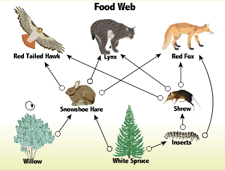
What may happen if the snowshoe hare was removed from the food web pictured?
a)
The insects in the habitat would increase.
b)
The shrew population would decrease due to being only hawk food source.
c)
The willow tree population would decrease.
d)
Foxes would dies due to no food source. 
40.
The rabbit in this food web would be considered a:
a)
Decomposer
b)
Producer
c)
Secondary Consumer
d)
Primary Consumer
41.
The mouse in this food web would be considered a:
a)
Primary Consumer
b)
Producer
c)
Tertiary Consumer
d)
Secondary Consumer
42.
As a predator this lion is also an example of a ______________.
a)
Producer
b)
Autotroph
c)
Carnivore
d)
Herbivore
43.
Which of the animals in this food web is a secondary consumer?
a)
Hawk
b)
Lizard
c)
Mouse
d)
Snake
44.
Which level will contain plants?
a)
A
b)
B
c)
C
d)
D
45.
In the energy pyramid here, which organisms have the most energy available?
a)
Producers
b)
Carnivores
c)
Herbivores
d)
Top Predator
46.
Which of the following illustrates the correct ordering of trophic levels?
a)
decomposers-carnivores-autotrophs-herbivores
b)
herbivores-autotrophs-carnivores-decomposers
c)
autotrophs-herbivores-carnivores-decomposers
d)
carnivores-producers-omnivores
47.
In an ecological pyramid, which type of organism always has the least amount of energy available?
a)
Producers
b)
Herbivores
c)
Carnivores
d)
Top Predator
48.
If there are 100 Kcal of energy available in the producers, how much energy would be available in the herbivores?
a)
10 Kcal
b)
1 Kcal
c)
100 Kcal
d)
1000 Kcal
49.
In this ecological pyramid which type of consumer gets only 10% of the energy stored in plants?
a)
Herbivore
b)
Carnivore
c)
Omnivore
d)
Secondary Consumer
50.
This diagram shows the amount of energy that moves from one feeding level to another.
a)
Energy Pyramid
b)
Food Web
c)
Ecosystem
d)
Food Chain