
Font size
 Worksheets
Standard 2: Atoms, Isotopes, & Absolute Age
Total questions: 36
Worksheet time: 1hrs 14mins

H, He, Li, Be, etc. are different ________________.
elements
protons
neutrons
electrons

The proton _____
has no mass and is neutral
has an atomic mass of 1 and is negatively charged
has an atomic mass of 1 and is positively charged
has no mass and is negatively charged

The neutron has:
an atomic mass of 1 and neutral charge
an atomic mass of 0 and negative charge
an atomic mass of 1 and positive charge
an atomic mass of 0 and neutral charge

The electron has _____
an atomic mass of 1 and positive charge
low mass and positive charge
low mass and neutral (no charge)
low mass and negative charge
Each of the elements (such as H, He, Li, Be, etc.) is a different substance than the other elements because they all have different numbers of __________________.
elements
protons
neutrons
electrons

Which particles hang out in the nucleus of an atom?
wontons
bosons
neutrons
electrons
protons

Which subatomic particles determine the identity of an element?
electrons
protons
neutrons
photons

Neutrons...
serve as a source of charge in an atom
serve as a shock absorber for collisions
serve as a shield for radiation
help to hold the nucleus together

Atoms of the same element have the same number of _____
electrons in their nuclei
orbiting protons
neutrons in their nuclei
protons in their nuclei

Variants of an element, with different masses, different numbers of neutrons, but the same chemical properties, are called _____
isotropics
isotherms
isomers
isotopes

What do these three images represent?
different isotopes of the same element
different elements
they are all radioactive elements
electrons within an atom
What is the neutron's role in the nucleus?
To help hold the atom together.
To attract the electrons to the protons.
To increase the mass of the atom, allowing it to react properly with other elements.
To determine the type of element the atom is.


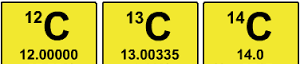
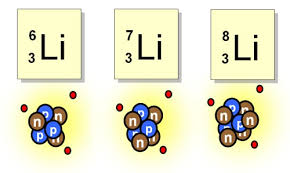
Two isotopes of Oxygen are oxygen-16 and oxygen-18. These isotopes differ from one another by two neutrons.
true
false
Isotopes that will decay are called __________ isotopes.
weak
unsteady
unstable
variable
Radioactivity is the release of __________ from unstable atoms
strength
protons
electrons
energy (and / or particles)
A process in which atoms of an unstable element decay into atoms of a stable element
radiometrics
half-life
decay rate
radioactive decay
When an unstable radioactive atom decays, it eventually turns into:
a more stable atom
a less stable atom
the exact same atom but with less pure energy
empty space
The time necessary for half of the parent isotope to decay into daughter isotopes.
half-time
parental-decay
half-life
half-decay
the element that undergoes radioactive decay is called the _____________ isotope.
daughter
parent
foster
sibling
Radioactive Decay converts
Half lives into daughter isotopes.
Parent Isotopes into Daughter Isotopes.
Daughter Isotopes into Parent Isotopes.
Parent Isotopes into Half lives.

Americium-241 is radioactive. Neptunium -237 is not radioactive. Which isotope is the PARENT isotope?
Neptunium
Americium
Americium-241 is radioactive. Neptunium -237 is not radioactive. Which isotope is the DAUGHTER isotope?
Neptunium
Americium
Americium-241 is radioactive. Neptunium -237 is not radioactive. Which bar graph represents the YOUNGEST sample (a rock sample that was most recently formed from magma)?
A
B
C
D
E
Americium-241 is radioactive. Neptunium -237 is not radioactive. Which bar graph represents the OLDEST sample (a rock sample that formed from magma long ago)?
A
B
C
D
E
Americium-241 is radioactive. Neptunium -237 is not radioactive. Which bar graph represents a rock sample for which one half life has passed?
A
B
C
D
E
Americium-241 is radioactive. Neptunium -237 is not radioactive. Which bar graph represents a rock sample for which TWO half lifes have passed?
A
B
C
D
E
If a radioactive substance has a half life of 200 years, how much time has passed if ¼ (25%) of the original isotope is left? (Hint: Figure out how many half lifes have passed to get to 25%, then multiply that by the time for each half life - 200 years.)
25 years
600 years
50 years
400 years

