
NEW
Font size
 Worksheets
Atoms, Periodic Squares, and Drawing Elements
Total questions: 32
Worksheet time: 16mins
All matter is composed of...
Cells
Atoms
Tacos
Stars
The building blocks of matter are called...
Atoms
Legos
Quarks
Protons
Middle of the atom is called:
Nucleus
Outer cloud
Quantum corner
Particle zone
Outer portion of an atom where we find electrons is called:
Nucleus
Outer Cloud
The Electron Hangout
Taco Bell
Chemists use this unit of measurement when representing the mass of the atom and its subatomic particles:
Atomic Mass Units (AMUs)
Grams (g)
Nanograms (ng)
Particlismals (pcm)
What takes up most of the MASS of an atom:
Nucleus
Outer cloud
What takes up most of the VOLUME of an atom?
Nucleus
Outer cloud
We call the protons, neutrons, and electrons of an atom the...
Subatomic particles
Microatoms
Tiny atomic friends
Nanomolecules
This subatomic particle has the symbol p+
This subatomic particle has the symbol n0
nonitron
This subatomic particle has the symbol e-
electrolysis
This subatomic particle has ALMOST 0 mass (in AMUs):
Proton
Neutron
Electron
The proton and neutron have about the same mass. What is it in AMUs?
About 1 AMU
About 2 AMUs
Close to Zero AMUs
Charge of a proton:
Positive
Negative
Neutral
Charge of a neutron:
Positive
Negative
Neutral
Charge of an electron:
Positive
Negative
Neutral
Location of a proton in an atom:
Nucleus
Outer cloud
Location of a neutron in an atom:
Nucleus
Outer cloud
Location of an electron in an atom:
Nucleus
Outer cloud
A pure substance that is made up of only ONE type of atom is called:
An element
An atom
A compound
A mixture
True or false: You cannot separate an element into other substances.
True
False
This scientist created the periodic table:
Dmitri Mendeleev
Albert Einstein
Niels Bohr
Marie Curie
This on a periodic table square tells us the number of protons:
Atomic Number
Atomic Mass
True or false: When calculating the number of electrons, there is always an equal number of electrons and protons.
True
False
Atomic Mass - Atomic Number is how you calculate the number of...
Protons
Neutrons
Electrons
The first shell holds how many electrons?
2
8
18
32
The second shell holds how many electrons?
2
8
8 or 18
32
The third shell holds how many electrons?
2
8
8 or 18
32
The fourth shell holds how many electrons?
2
8
8 or 18
32
True or false: Each element has its own square on the periodic table.
True
False

This is an atom of which element?
Hydrogen
Helium
Lithium
Calcium
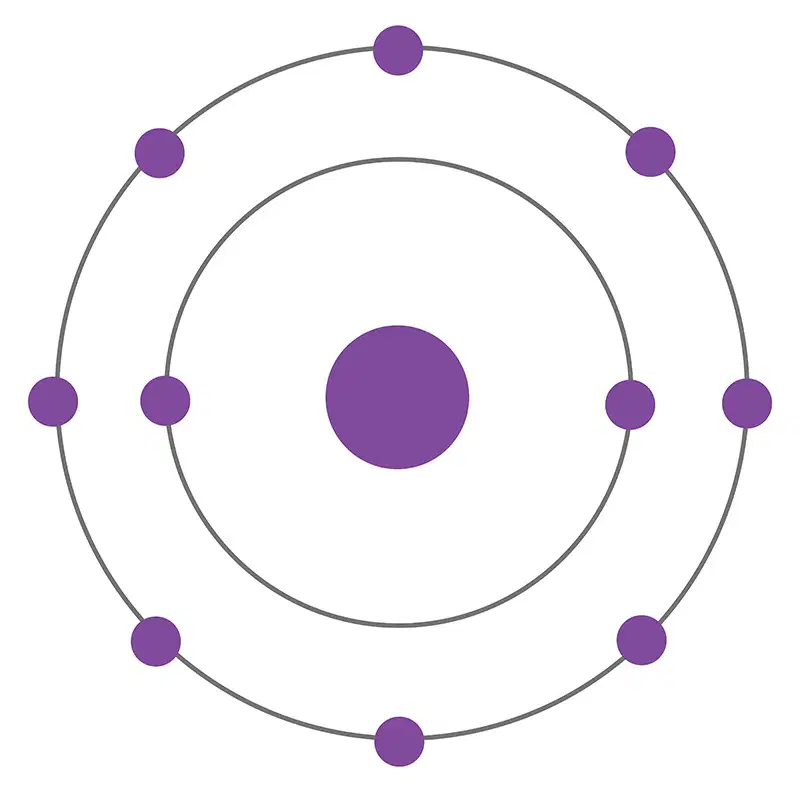
This is an atom of which element?
Neon
Calcium
Hydrogen
Potassium

